
A compulsory Division of inherited property in Saudi Arabia is a court claim filed by an heir when the heirs cannot agree on dividing or selling inherited real estate, or when an heir is unable to obtain or benefit from their share. It commonly arises when one heir refuses to sell, refuses to sign the required documents, takes exclusive possession of the property, or when the property cannot be divided in kind among the heirs.
In Saudi Arabia, dividing inherited real estate does not normally begin with an immediate sale. The process starts by identifying the heirs, determining the estate assets, reviewing the title deeds, and then choosing the appropriate legal route. For a broader overview before proceeding with a division claim, see Inheritance and Estates in Saudi Arabia.
Terms sometimes used in Arabic such as “forced estate division” or “statement of claim for compulsory estate division” generally refer to a judicial request to terminate joint ownership of inherited real estate. In practical legal English, the more appropriate expressions are division of inherited real estate or compulsory division of inherited property.
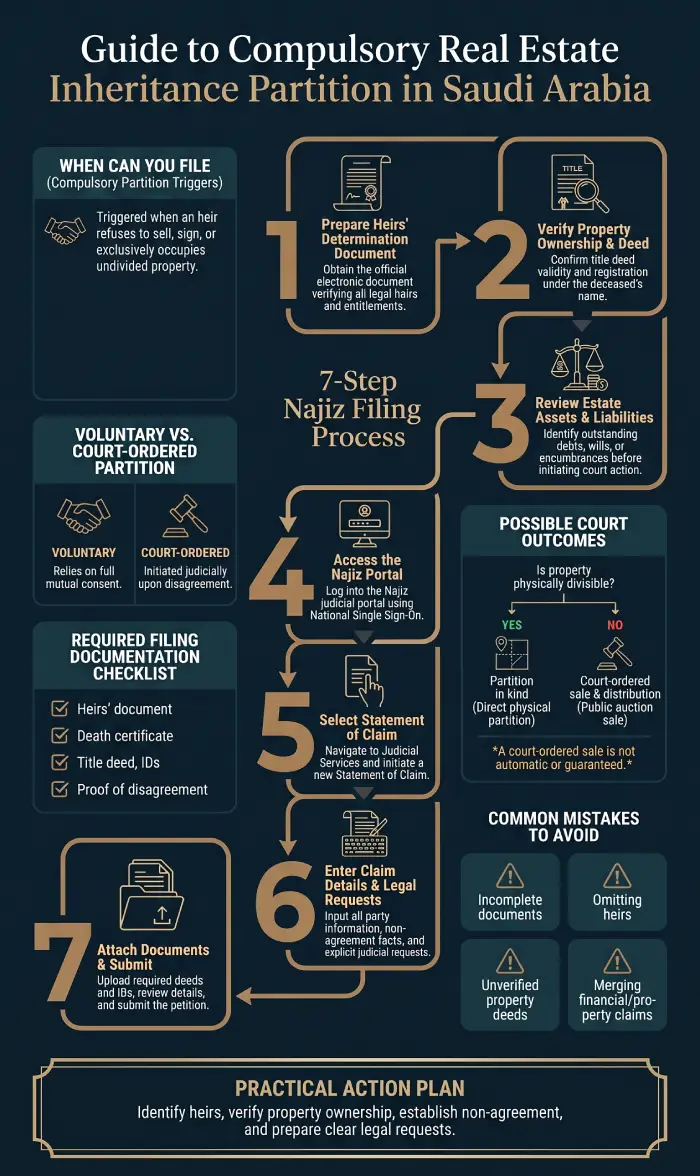
Quick Answer: When Can You File for Compulsory Division of Inherited Property?
A compulsory division of inherited property in Saudi Arabia may be filed when the heirs cannot agree on dividing or selling inherited real estate, or on using it fairly.
For example, court proceedings may become necessary where one heir refuses to sell, refuses to sign the required documents, occupies the property alone, or where the property cannot practically be divided in kind.
The claim should not simply state: “I want my share of the inheritance.”
The property should be clearly identified, the heirs and their legal capacities should be stated, the reason why division has failed should be explained, and the requested relief should be clearly drafted in the statement of claim.
What Is a Compulsory Division of Inherited Property Claim?
A claim for division of inherited real estate is a judicial request to terminate co-ownership of property forming part of an estate.
Co-ownership means that several heirs own shares in the same property without a separate physical portion being allocated to each heir. This may make sale, disposal, or use of the property dependent on the rights of the other co-owners.
This situation may continue for years where one heir refuses to sell, disputes the valuation, or uses the property alone.
A compulsory division claim is therefore concerned not only with inheritance rights themselves, but with how the joint ownership can practically be brought to an end.
The proceedings may result in physical division if the property can legally and practically be subdivided.
Alternatively, the property may be sold and the proceeds distributed if physical division is impossible or would cause a material reduction in value.
The result is therefore not the same in every case. It depends on the title deeds, the nature of the property, and the relief requested by the parties.
Amicable Division vs Compulsory Division
The key difference between amicable and compulsory division is whether the heirs are in agreement.
If the heirs agree on dividing or selling the property, they may proceed through the appropriate consensual estate procedures.
If one heir refuses or the process becomes blocked, court proceedings may become necessary.
| Comparison | Amicable Division | Compulsory Division |
|---|---|---|
| Nature of the process | Agreement between the heirs | Dispute or refusal |
| Starting point | Documentation or Estate Platform | Statement of Claim through Najiz |
| Main requirement | Consent of the heirs | Application by an interested heir |
| Possible result | Division or sale by agreement | Judgment ordering division or sale |
| Duration | Usually shorter | Depends on the dispute |
| Expert involvement | Usually less common | May be required for valuation |
The Saudi Ministry of Justice’s estate-division route is particularly relevant where the estate is clear and the heirs are in agreement.
Where an heir refuses to sell or prevents the others from benefiting from inherited property, however, amicable division may no longer be sufficient, and a compulsory division claim may need to be considered.
If the dispute is still at the general estate-distribution stage rather than a specific property-division claim, see How to Divide an Inheritance in Saudi Arabia to understand the possible routes involving inherited homes, land, rental property, and refusal by an heir to divide the estate.
When Can a Compulsory Division Claim Be Filed?
A compulsory division of inherited property in Saudi Arabia may be appropriate when continued joint ownership prevents heirs from exercising their rights.
The dispute does not necessarily need to be highly complex. A practical refusal that prevents sale or division may be enough to require judicial intervention.
Common situations include:
- One heir refuses to sell the inherited property without offering a reasonable alternative.
- An heir refuses to sign division or transfer documents.
- One heir occupies the inherited family home and prevents the others from benefiting from it.
- The property is rented out and one heir receives the rental income without distributing it among the other heirs.
- The property cannot be physically divided because of its nature or size.
- A minor or absent heir is involved and their share requires judicial protection.
- The heirs disagree over the property’s valuation or the appropriate method of disposal.
Where one heir benefits from the property exclusively, the issue may involve more than division alone.
A separate claim relating to rental proceeds or compensation for exclusive use may also arise, but this generally requires documents or evidence establishing that one heir alone benefited from the property.
Can Heirs Be Forced to Sell Inherited Property?
A compulsory division claim may ultimately result in the sale of inherited property where physical division is impossible or where dividing the property would cause material harm or a significant reduction in value.
However, sale should not be treated as an automatic or guaranteed outcome.
The court may consider the nature of the property, the heirs’ requests, the documents submitted, and an expert report or valuation where required.
Sale of an inherited family home may therefore become relevant where:
- The property cannot be physically divided without causing harm.
- The land is too small for a practical subdivision.
- The heirs cannot agree for one heir to purchase the shares of the others.
- Continued joint ownership prevents some heirs from exercising their rights.
- A valuation or expert report supports sale instead of physical division.
The more accurate question is therefore not merely:
“Can the heirs be forced to sell?”
The relevant questions are whether the property can be divided in kind, whether continued co-ownership causes prejudice, and whether the requested relief has been clearly drafted.
How to File an Inherited Property Division Claim Through Najiz
Filing a claim for division of inherited real estate begins with preparing the case file before accessing Najiz.
Proceedings may be delayed where information is incomplete, the requested relief is unclear, or not all persons with legal standing have been included.
Before filing the claim, confirm that an heirship document or other recognised inheritance document has been issued.
If this step has not yet been completed, see How to Obtain an Electronic Heirship Document through Najiz.
Practical Steps
- Prepare the heirship document or recognised inheritance document.
- Identify the property subject to division, including the title deed number and relevant details.
- Review the estate inventory if the assets or debts are unclear.
- Log in to Najiz through National Unified Access.
- Select the Statement of Claim service from the judicial-services section.
- Enter the claimant’s and defendants’ details.
- State the facts and requested relief clearly.
- Attach the supporting documents and review the application before submission.
When preparing a statement of claim for estate division, avoid vague or general wording.
The property should be identified, the reason why division has failed should be explained, and the final relief should be clearly stated—for example, physical division where possible, or sale and distribution of the proceeds if physical division is not feasible.
When Should You Choose Amicable Division and When Should You File a Claim?
The following table may help identify the initial route:
| Situation | Likely Route |
|---|---|
| All heirs agree on sale or division | Amicable division |
| One heir refuses to sell | Compulsory division claim |
| The property can be subdivided | Request physical division |
| The property cannot be divided | Request sale and distribution of proceeds |
| One heir uses the property alone | Consider division and any proven income/use claim |
| A minor or absent heir is involved | Review the procedure before filing |
| The estate includes debts or a will | Identify liabilities before distribution |
It is generally not advisable to file a compulsory division claim without first identifying the actual reason why the estate process has become blocked.
The problem may concern the division itself, proof of ownership, incomplete heir information, or uncertainty regarding the assets forming part of the estate.
If the disagreement concerns the heirs’ shares before sale or division, see How to Calculate Inheritance Shares in Saudi Arabia before proceeding with a property-division claim.
Checklist Before Filing the Claim
Before filing a compulsory division of inherited property in Saudi Arabia, prepare a concise file establishing your legal standing, identifying the property, and explaining the reason for the dispute.
This helps make the claim more precise and may reduce the need for additional submissions later.
Prepare the following:
- Heirship document.
- Death certificate or other proof of death.
- Property title deed or ownership records.
- Details of all heirs.
- Powers of attorney where a representative is acting.
- Evidence of refusal to sell or divide, where available.
- Lease agreements or rental-income records if the property is rented.
- Information concerning any minor heir and their guardian.
- A clear description of the relief requested: division, sale, or a claim concerning rental proceeds.
If the ownership status of the property is unclear or the title deed is subject to correction procedures, the legal status of the deed should first be reviewed.
The court requires sufficiently clear ownership documentation before determining whether the property should be divided or sold.
Estate Division Claim Template: What Should the Statement of Claim Include?
A statement of claim for division of inherited property should be specific and connected to the actual facts.
The court does not require unnecessarily lengthy wording. It requires accurate information, clearly stated relief, and documents establishing legal standing and the subject matter of the dispute.
Key Information
- Name of the deceased and date of death.
- Number and date of the heirship document.
- Names and legal capacities of the heirs.
- Property details and title deed number.
- Reason why division or sale could not be agreed.
- Final relief requested.
- Request for an expert assessment or valuation where required.
Short Illustrative Template
Our deceased relative passed away and was survived by the heirs identified in Heirship Document No. (…). The estate includes the property described in Title Deed No. (…). As the heirs have been unable to agree on dividing or selling the property, I request that the court order physical division where possible, or alternatively order the sale of the property and distribution of the proceeds among the heirs according to their lawful inheritance shares if physical division is not feasible.
This wording is illustrative only and is not suitable for every case.
Documents Required for an Inherited Property Division Claim
The strength of the case often depends on the documents available before the claim is drafted.
If the title deed is unclear, not all heirs have been included, or the reason for the dispute has not been properly identified, proceedings may be delayed or require additional submissions.
Commonly relevant documents include:
- Heirship document.
- Death certificate.
- Property title deed or ownership records.
- Identification documents of the heirs.
- Powers of attorney.
- Guardianship document where a minor is involved.
- Documents relating to debts or a will, where applicable.
- Lease agreements or evidence of rental income.
- Correspondence or other evidence indicating refusal to sell or divide.
It is therefore not sufficient to rely on a generic template found online.
Each property has its own facts, each estate has its own circumstances, and each claim requires wording suited to the documents and relief involved.
Where the estate includes a minor or guardianship issues, the matter may not be purely a real-estate dispute and may also involve personal status procedures.
In such circumstances, consulting a Personal Status Lawyer in Jeddah may be appropriate where guardianship, minors’ rights, or relevant family documents affect the estate.
Competent Court and Duration of an Inherited Property Division Case
The competent judicial route may vary depending on the classification of the claim and the nature of the dispute.
Many estate-division matters begin through estate or personal status procedures in Najiz, while some cases may overlap with an independent real-estate dispute.
There is no single fixed duration for an inherited-property division case.
The timeframe may depend on the number of heirs, completeness of the documents, involvement of a minor, objections raised by the parties, and whether valuation or expert evidence is required.
Factors that may prolong proceedings include:
- Missing heirship documentation.
- Unclear property information.
- Death of an heir before division is completed.
- An heir residing outside Saudi Arabia.
- A rented property or undistributed rental proceeds.
- The need for an expert or valuation.
- Combining the division claim with other requests that have not been clearly drafted.
Once an enforceable judgment has been issued, the matter may move to enforcement proceedings depending on the terms of the judgment.
This may include sale, distribution, or other enforcement measures according to what the court has ordered.
When Do You Need an Inherited Property Division Lawyer?
Not every estate division requires complex court representation.
If the heirs are in agreement and the documents are clear, an amicable route may be suitable.
A property dispute between heirs, however, is different from merely completing a standard form, particularly where an heir refuses to sell, rental income has not been distributed, or a minor is involved.
In such cases, consulting an Inheritance & Estates Lawyer in Jeddah may assist with reviewing the title deeds, identifying the appropriate relief, and preparing the case before filing.
Legal review may be particularly important where:
- There is an express refusal to sell or divide.
- One heir has taken exclusive control of the property.
- Rental income has not been distributed.
- A minor or absent heir is involved.
- The estate contains several properties.
- The estate includes debts or a will.
- A compulsory division statement of claim needs to be drafted.
- There is confusion between estate inventory and estate division.
A lawyer’s role is not limited to drafting the claim.
It may also include reviewing title deeds, identifying the appropriate relief, organising supporting documents, and avoiding procedural errors that may delay the case.
Common Mistakes When Dividing Inherited Property
Some mistakes recur because they appear minor, but they may affect the progress of the proceedings.
A compulsory division of inherited property in Saudi Arabia should therefore be treated as a case involving documents, legal standing, and clearly drafted requests rather than merely as an online form.
Common mistakes include:
- Filing the claim before completing the heirship document.
- Failing to identify the disputed property.
- Requesting sale without explaining why physical division is not feasible.
- Using a generic estate-division statement of claim.
- Ignoring rental proceeds or exclusive use of the property.
- Failing to include all heirs.
- Overlooking the presence of a minor or absent heir.
- Relying on a general template without adapting it to the case.
- Combining several requests without organising them properly.
The requested relief should always be clear.
If division is requested, identify the property, the heirs, and the reason why agreement has failed.
If rental proceeds are sought, identify the relevant facts and supporting evidence.
Court Costs in Estate Division Cases
Claims relating to estate division have a particular treatment under Saudi judicial-cost rules, as explained by the competent judicial authorities.
However, this does not necessarily mean that the entire matter will involve no expenses.
Additional costs may arise in connection with expert evidence, property valuation, or subsequent procedures depending on the nature of the property and what the court requires.
It is therefore more accurate not to state that every estate-division case is completely free of cost. Certain expenses may arise depending on the procedure.
Legal Content You Can Trust
BMS LEGAL LAW FIRM
This guide is prepared to help readers understand
Saudi legal procedures through clear, practical
information based on the relevant legal framework.
Important:
This content is for general information only
and does not replace advice based on the specific
facts and documents of an individual case.
Frequently Asked Questions About Compulsory Division of Inherited Property
What Does a Compulsory Division of Inherited Property Claim Mean?
It is a claim in which an heir asks the court to terminate joint ownership of inherited real estate when the heirs cannot agree on division or sale.
When Should I File an Inherited Property Division Claim?
A claim may be considered where one heir refuses division or sale, takes exclusive control of the property, or where physical division between the heirs is not possible.
Can Heirs Be Forced to Sell Inherited Property?
The court may order a sale where physical division is not feasible or where continued co-ownership prevents heirs from exercising their rights. Sale is not automatic and depends on the property and the circumstances of the case.
What Should I Do if One Heir Refuses to Sell the Inherited Family Home?
Start by preparing the heirship document and the property title deed. Then determine whether the matter can still be resolved through amicable division or whether a judicial division claim may be required.
Compulsory Division of Inherited Property: 7 Steps is a legal route available where heirs cannot agree on dividing or selling inherited real estate or on benefiting from it fairly.
The process does not begin with the claim template alone. It begins with the heirship document, clear property information, identification of estate liabilities, and determining why division has become blocked.
If the heirs agree, amicable division will generally be the more appropriate route.
If there is refusal, exclusive control of the property, or a property that cannot practically be divided, judicial proceedings may become the more appropriate option.
The clearer the statement of claim and the more complete the supporting documents, the more organised the case can be presented before the competent court.
If you already have the property documents and an heirship document and want to determine the appropriate legal route, you may contact our law firm in Jeddah to review the available documents and identify the next procedural step.
Official Sources: