
If you are asking how to claim inheritance in Saudi Arabia when one of the heirs refuses to sell or divide the estate, start by establishing your status as an heir, identifying the estate assets, and then determining exactly what is causing the delay. Depending on the circumstances, the appropriate route may be an agreed division, a claim for estate income, or an estate division claim if the dispute continues.
The problem often goes beyond simply knowing your inheritance share. In practice, the real difficulty may begin after the death when the estate cannot be distributed. The heirs may own a house that one of them refuses to sell, a rented property whose income is collected by only one heir, or assets that have not yet been fully identified.
In Saudi Arabia, electronic judicial services are available for heirship documentation, estate inventory and estate division. Najiz provides services for issuing heirship documentation containing information about the deceased and the heirs, while the Saudi Ministry of Justice also provides estate inventory services through the Estates Platform after the relevant heirship documentation has been issued.
If you need a broader understanding before dealing with refusal or division disputes, see our Inheritance and Estates in Saudi Arabia guide for the general process of identifying heirs, inventorying estate assets and dealing with estate division when a dispute arises.
How to Claim Inheritance in Saudi Arabia When Estate Division Is Delayed
If one heir refuses to divide the estate, this does not mean that your inheritance right comes to an end. The appropriate process begins by organising the documents, attempting an agreed division, and then considering the judicial route if another heir continues to delay the process or the heirs cannot reach an agreement.
Start with these practical steps:
- Obtain the heirship document.
- Identify the estate assets, including real estate and financial accounts.
- Determine whether the dispute concerns a sale, division, rental income or concealed assets.
- Document an heir’s objection to the sale or refusal to attend.
- Attempt an amicable settlement or agreed estate division where appropriate.
- Consider filing a claim against an heir if the obstruction continues without a clear basis.
A court does not consider a general sense of unfairness alone. The claim should identify a specific request and clear facts. Instead of merely stating that you want your inheritance, identify the asset in dispute, explain the reason for the delay and provide the documents supporting your position.
| Your Current Situation | Most Relevant Next Step |
|---|---|
| No heirship document has been issued | Obtain the heirship document |
| The heirs are known but the assets are unclear | Request an estate inventory |
| All heirs agree | Proceed with an agreed estate division |
| One heir refuses to sell | Consider a division or sale claim |
| One heir collects rental income | Consider a claim for estate income |
| One heir refuses to grant a power of attorney | Pursue your right without waiting for their POA |
| An heir is absent | Take the appropriate procedure to protect the absent heir’s share |
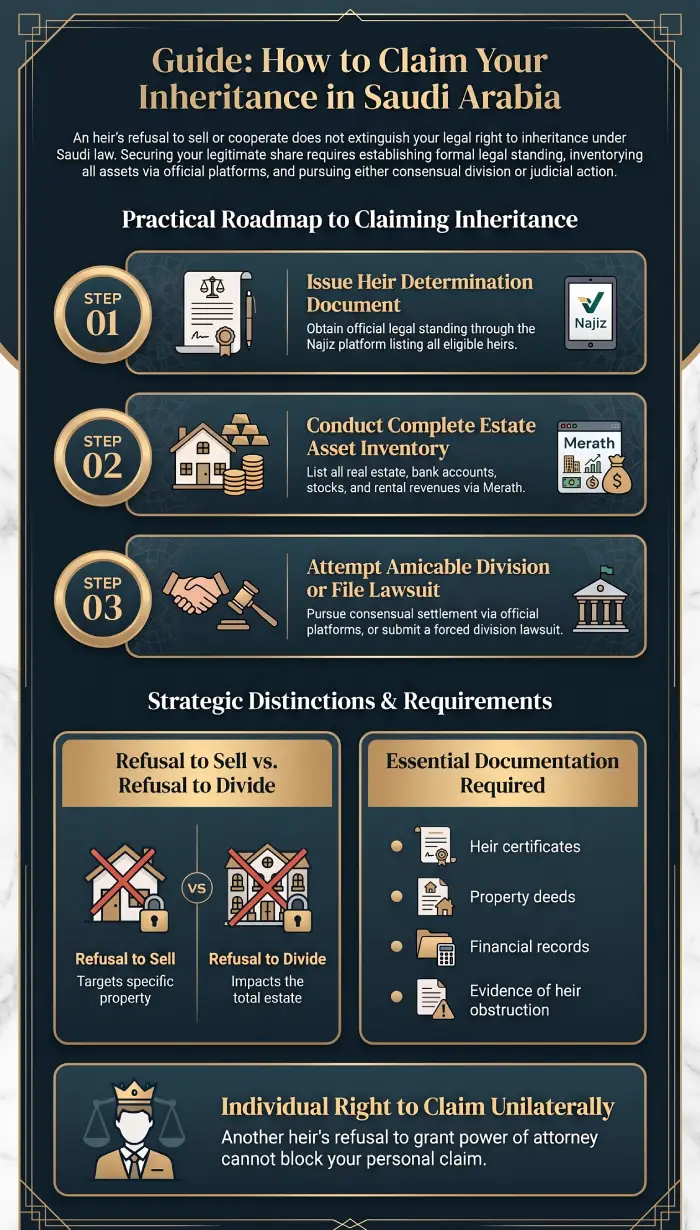
The Difference Between Refusing to Sell and Delaying Estate Distribution
Refusing to sell an inherited asset is different from refusing to distribute the estate, even though the practical result may appear similar.
In both situations, an heir may feel that their inheritance is being withheld, but the appropriate legal request depends on the asset in dispute and the nature of the objection.
If one heir refuses to sell, the dispute may concern a specific property, such as the family home or inherited land. The property should not simply be sold without taking the rights of all heirs into account. However, the refusal does not prevent the heirs from considering a judicial division or sale if an agreement cannot be reached.
If one heir refuses to divide the estate as a whole, the disagreement may involve all estate assets rather than one property alone. These may include:
- bank accounts;
- shares;
- rental income;
- movable assets;
- amounts owed to the deceased by third parties.
When asking what happens if one heir refuses to sell inherited property in Saudi Arabia, identify the type of asset first.
Do you want to sell a house? Are you claiming rental income? Do you need an estate inventory? Or is the problem that another heir refuses to grant a power of attorney or attend the relevant procedures?
Defining the issue accurately helps the court understand your request and helps you choose the appropriate procedure rather than filing a broad claim that may later need amendment or additional documentation.
Obtain the Heirship Document Before Claiming the Estate
The heirship document is the practical starting point for many inheritance claims. It establishes information about the deceased and the heirs and provides the legal basis required to continue procedures before the relevant authorities.
Because this document is an important first step, it is useful to understand how to obtain a Najiz Electronic Inheritance Deed in Saudi Arabia and the relevant requirements before proceeding with estate division or litigation.
Najiz provides heirship-related services within its electronic judicial services, while the Ministry of Justice also provides access to estate-related procedures through the relevant electronic platforms.
Being the deceased’s son, daughter or spouse does not, by itself, replace the official documentation required for formal procedures. The legal process generally requires the heir’s status to be established before moving on to identifying and distributing the estate assets.
The heirship document may be important when:
- dealing with official authorities;
- dealing with inherited real estate or accounts;
- requesting an estate inventory;
- filing an estate division claim;
- establishing each heir’s share before the court.
However, an heirship document does not mean that the estate has already been distributed.
It establishes the heirs and their recognised shares, but it does not necessarily identify every asset, transfer real estate or distribute estate income. The next stage may therefore involve an estate inventory, estate division or litigation depending on the nature of the dispute.
Estate Inventory and Identifying the Deceased’s Assets
An estate inventory means identifying the assets, rights and obligations left by the deceased before distribution.
This may include:
- real estate;
- bank accounts;
- shares and investments;
- debts;
- rental income;
- business interests.
The Saudi Ministry of Justice provides an estate inventory service through the Estates Platform. The process involves signing in through National Single Sign-On and selecting the deceased from the relevant records.
The Estates Platform also provides services for heirs who wish to divide an estate either by agreement or, where applicable, through compulsory procedures.
| Asset Type | Practical Examples | Useful Evidence |
|---|---|---|
| Real estate | House, land, building | Title deed or property records |
| Accounts | Bank balances | Account details or official inventory |
| Investments | Shares or portfolios | Statements or investment documents |
| Debts | Amounts owed to or by the deceased | Instruments, transfers or acknowledgements |
| Estate income | Rent or other returns | Contracts, transfers or receipts |
An estate inventory becomes particularly important when the heirs do not know all the deceased’s assets or where there is concern that assets may have been concealed.
It may also be important when one heir has control of an inherited property or receives its rental income alone.
Once the deceased’s assets have been identified, the next question is how they should be distributed in practice. Our guide on How to Divide Inheritance in Saudi Arabia explains how inherited houses, land, rental income and disputes over estate distribution may be handled.
The clearer the estate inventory, the more specific a later division or accounting claim can become. Therefore, when determining how to claim inheritance in Saudi Arabia, do not start with litigation alone. Start by identifying exactly which asset or right forms the subject of your claim.
Amicable Estate Division Through Najiz and the Estates Platform
An agreed estate division is generally the most appropriate route when all heirs agree on how the estate should be distributed.
It may be suitable where:
- the estate assets are clear;
- the inheritance shares are known;
- the heirs agree on valuation or sale;
- no heir refuses to sign or attend;
- there is no dispute concerning estate income or concealed assets;
- sufficient documentation is available to record the division.
The Saudi Ministry of Justice provides an agreed estate division service through the Estates Platform. The process begins by signing in through National Single Sign-On, selecting the relevant service and starting the application.
Accordingly, an amicable estate division between heirs through Najiz can be understood in practice as an electronic route connected with the Estates Platform and Ministry of Justice services.
However, if one heir refuses to sign, objects to the sale or fails to cooperate, an agreed division may no longer be sufficient.
At that stage, the issue is no longer simply about the electronic platform. A substantive dispute exists and may require a different legal route.
Keep copies of messages, correspondence, settlement attempts and any evidence showing the refusal.
This does not guarantee a particular judicial outcome, but it may help demonstrate the nature of an heir’s obstruction if the matter proceeds to court.
When Can You File an Estate Division Claim?
An estate division claim may become appropriate when the heirs cannot reach an agreement, an heir continues to refuse a sale, or jointly owned property cannot practically be dealt with without division.
It is a judicial procedure intended to end joint ownership and determine the respective rights in the jointly owned asset.
The Saudi Rules for the Division of Jointly Owned Property define jointly owned property as property owned by two or more persons in undivided shares, whether that ownership arises through a contract, inheritance or another basis.
They also define a division claim as a claim brought by one of the co-owners seeking their share of the jointly owned property.
An estate division claim may be appropriate in circumstances such as:
- one heir refusing to divide the estate despite clear inheritance shares and documents;
- an heir refusing to sell or obstructing dealings with inherited property;
- continued objection to liquidation without reaching a practical agreement;
- an inherited property that cannot practically be divided among the heirs without material difficulty;
- estate income or rent that has not been distributed according to the heirs’ shares;
- failure of an agreed division because of a substantial dispute.
Where the dispute concerns inherited real estate or a house that cannot easily be divided, it may be necessary to review the procedure for filing a compulsory estate division claim in Saudi Arabia before the competent court.
When preparing the statement of claim, do not rely only on a general statement such as “I want my inheritance.”
Identify:
- the asset in dispute;
- the reason the distribution has been delayed;
- the specific relief you are asking the court to grant.
Depending on the circumstances, the request may involve estate division, sale of a property where division is impracticable, accounting for estate income, or disclosure of estate assets.
The important distinction is that a general inheritance claim expresses the wish to receive an inheritance share, while an estate division claim is more specific because it relates to an identified asset and a defined request before the court.
Disputes Over an Inherited House or Other Real Estate
Inherited real estate is one of the most common sources of disagreement between heirs because it often cannot easily be divided.
The dispute may also involve one heir living in the property, existing rental income, or disagreement over the sale price or property valuation.
If one heir refuses to sell inherited real estate, that refusal should not automatically be treated as grounds for an immediate forced sale.
The nature of the property should first be examined, including whether it can be divided and whether continued joint ownership adversely affects the other heirs.
If one heir is living in the inherited family home, it is important to determine whether that occupation was agreed to by the other heirs.
If the occupation is exclusive and adversely affects the others, a claim relating to rent, estate income or division may need to be considered depending on the circumstances.
To prepare a claim relating to an inherited house, organise your documents as follows:
- heirship document;
- title deed or property information;
- evidence showing occupation or use;
- evidence showing refusal to sell or divide;
- any previous offer to purchase or buy out a share;
- rental details where the property is leased.
In these circumstances, it is not enough simply to say, “I want my share of the house.”
Identify your actual request:
Do you want the property sold?
Do you want another heir to purchase your share?
Are you claiming rent?
Or are you requesting physical division of the property where that is possible?
If the disagreement concerns a house, land or rented property, understanding how inheritance shares are calculated in Saudi Arabia can help determine whether division, sale or a claim for estate income is the more appropriate route.
Rental Income and Concealed Estate Assets
The dispute may concern not only the original estate assets but also the income generated by those assets.
This problem often arises when one heir collects rent from inherited property or manages an estate asset without distributing the resulting income.
Estate income means income generated from estate assets, such as rent from a house, commercial premises or land.
That income does not automatically belong solely to the heir who receives it. It relates to the estate and should be dealt with according to the heirs’ respective shares after the facts have been established.
If one heir is receiving rental payments, begin by collecting documents.
These may include:
- the tenancy agreement;
- bank transfers;
- messages from the tenant;
- receipts;
- any other evidence proving receipt of the rent.
To claim rental income from an inherited house, identify the property, the rental period, the amounts received and the person who received them.
The matter may first be pursued amicably. If no resolution is reached, an accounting claim may need to be considered.
Proving that estate assets have been concealed requires evidence and supporting circumstances, not suspicion alone.
Relevant evidence may include:
- messages;
- transfers;
- contracts;
- witnesses;
- title deeds;
- financial transactions linked to the estate.
If forgery or another potentially unlawful act is suspected, the facts should be reviewed by a legal professional before characterising the matter as a criminal offence.
Refusal to Grant a Power of Attorney and the Absence of an Heir
Refusal to grant a power of attorney is one of the issues that may delay estate procedures between heirs.
However, it does not mean that estate division has become impossible, nor does it mean that another heir is unable to take independent action to pursue their own rights.
If one heir refuses to grant a power of attorney, this does not eliminate your own right to pursue your inheritance.
A power of attorney is a means of facilitating legal procedures; it is not necessarily a condition for every heir to pursue their individual rights.
What happens if one heir refuses to grant a power of attorney under Saudi law?
Each heir may pursue their own rights personally or through their own authorised representative, depending on the procedure relevant to the case.
Where an estate is being divided while one heir is absent, the absent heir’s rights cannot simply be ignored.
The circumstances may require:
- proper notification;
- a valid power of attorney;
- or another legal procedure protecting the absent heir’s share.
The matter requires additional care where one of the heirs is a minor or resides outside Saudi Arabia.
Does Delaying an Inheritance Claim Affect Your Rights?
The underlying right to inheritance is not automatically lost merely because an heir delayed asking about or pursuing their share.
However, delay may make evidence more difficult to obtain, particularly if assets change, some heirs later die, or estate funds become mixed with other money.
Silence alone should not automatically be treated as a waiver unless there is a clear act indicating a relinquishment, settlement or transfer of the inheritance share.
Nevertheless, unnecessary delay should be avoided.
Documents may be lost, rental income may become more difficult to trace and property values may change over time.
If you are now asking how to claim inheritance in Saudi Arabia after several years, begin with what can still be proven.
Gather the documents, identify the heirs, inventory the real estate and financial accounts, and then select the appropriate route after reviewing the available file.
When Do You Need an Inheritance Lawyer?
Not every inheritance matter requires full court representation.
However, the need for an inheritance lawyer becomes more significant when a straightforward family division develops into a dispute involving a sale, estate assets, rental income or a power of attorney.
Legal review becomes particularly important where:
- one heir refuses to sell or divide the estate;
- an heir refuses to grant a power of attorney;
- inherited property cannot easily be divided;
- rental income or other estate income remains undistributed;
- an heir is absent or a minor;
- there is concern that estate assets have been concealed;
- you intend to file a claim against another heir.
When the disagreement develops into a clear obstruction of estate distribution, reviewing the documents before filing a claim becomes important.
For cases connected with Jeddah, consulting an Inheritance & Estates Lawyer in Jeddah can help determine whether the most appropriate route involves estate division, sale of inherited property or a claim for estate income.
Before seeking legal advice, prepare the heirship document, the estate inventory if available, real estate title deeds, tenancy agreements and evidence of any refusal or delay.
You can then contact BMS Legal Law Firm and Legal Consultations with a summary of the circumstances to identify the legal procedure most relevant to the case.
Role: [Legal Content Writer / Legal Editor]
Published by: BMS Legal Law Firm and Legal Consultations
Professional title: [Lawyer / Legal Consultant]
Last reviewed: [Day Month Year]
• Najiz Platform
• Estates Platform
• Relevant Saudi legal and procedural rules
- The first steps to take when estate distribution is delayed.
- The difference between refusing to sell and refusing to divide the estate.
- The documents commonly needed before amicable division or court action.
- When estate inventory, estate income claims or judicial division may need to be considered.
This content is provided for general legal information only and is based on the official sources available at the time of review. The appropriate legal procedure may differ depending on the estate documents, the assets involved and the circumstances of the dispute. A qualified legal professional should review the specific facts of an actual inheritance dispute.
Frequently Asked Questions About How to Claim Inheritance
1. How do I claim my inheritance in Saudi Arabia?
Start by obtaining the heirship document, then identify the estate assets and attempt an agreed division where possible. If one heir refuses to sell or divide the estate, the circumstances can then be reviewed to determine whether judicial proceedings are appropriate.
2. What should I do if one heir refuses to sell?
Document the refusal and identify the property in dispute. Then determine whether the property can be divided. If the heirs cannot reach an agreement, a judicial division or sale may need to be considered depending on the circumstances.
3. Can I file a claim if one heir refuses to divide the estate?
Yes. Where an amicable division cannot be completed and the refusal continues, an estate division claim may be considered. The heirship documentation and details of the asset to be divided should first be prepared.
4. Is the heirship document enough to claim my inheritance?
No. The document identifies the heirs and their recognised shares, but it does not by itself identify every estate asset or complete the actual distribution of the estate.
How to claim inheritance in Saudi Arabia when an heir refuses to sell or divide the estate begins with understanding that your right does not depend entirely on another heir’s willingness to cooperate. However, the claim still requires the correct documents and an appropriate legal procedure.
Start by establishing the heirs and identifying the estate assets. Then attempt an agreed division where possible.
If the dispute concerns inherited property, rental income, an absent heir or refusal to grant a power of attorney, do not reduce the matter to a general demand for your inheritance.
Identify the asset in dispute, gather evidence of the refusal and determine the specific request that should be pursued.
Before seeking legal advice, prepare the heirship document, the estate inventory if available, property title deeds, tenancy agreements and evidence showing any refusal or delay.
Official Sources: