
A power of attorney for heirs in Saudi Arabia is an authorisation granted by all or some of the heirs to a specified person so that the authorised representative can act on their behalf in a matter connected with the estate. The purpose may include dealing with Najiz, a bank, a notary office, selling inherited property, or following up on the division of an estate.
A general form is not sufficient in every case. Some transactions require express powers, such as authority to sell, transfer title, receive the purchase price, or represent a minor. The wording should therefore begin with the actual purpose of the authorisation rather than with a generic template that may not fit the case.
Before choosing the wording, it is useful to understand the broader inheritance and estate procedures in Saudi Arabia, because a power of attorney is only one step within a wider process that may begin with identifying the heirs and end with division or disposal of estate assets. The English destination is already published on the BMS Legal website.
Before Issuing a Power of Attorney for Heirs: What Should You Know?
Careful drafting is required when a power of attorney relates to selling real estate, dealing with a bank, receiving funds, dividing an estate, or representing a minor.
Do not begin with a general template. Start by defining exactly what the authorised representative needs to do, because authority to make enquiries or follow up a file is different from authority to sell property, transfer title, or receive sale proceeds.
7 Conditions to Review Before Issuing a Power of Attorney for Heirs
Before approving a power of attorney for heirs in Saudi Arabia through Najiz or using it before a bank or notary office, review the following practical points:
- Accurately identify the heirs and the authorised representative.
- State the deceased person’s name and the number of the Heirs Determination Document where the power of attorney relates to the estate.
- Define the purpose of the authorisation: administrative follow-up, sale, banking, estate division, or litigation.
- State the representative’s powers clearly without unnecessarily broad wording.
- Expressly include authority to sell, transfer title, or receive the purchase price where required.
- Consider whether any heir is a minor or resides outside Saudi Arabia before the document is issued.
- Check the duration and validity of the power of attorney before using or renewing it.
These points do not replace a complete review of the document, but they provide an initial test of whether the wording is suitable or needs amendment before approval.
Purpose of the Power of Attorney and the Most Suitable Form
Identifying the purpose of the authorisation helps determine the correct wording. A power of attorney for dealing with Najiz is not the same as one for selling inherited real estate, and a bank power of attorney differs from one used for estate division or appointing a lawyer for the heirs.
If the power of attorney is intended to prepare for distribution rather than merely administrative follow-up, it is useful to understand the steps for dividing an inheritance under Saudi law before deciding what authority should be granted for sale, division, or receipt of estate income. BMS Legal
| Purpose of the Power of Attorney | Most Suitable Form |
|---|---|
| Dealing with Najiz and government authorities | Administrative and procedural power of attorney |
| Selling inherited real estate | Power of attorney to sell inherited property |
| Dealing with the deceased’s bank | Bank power of attorney for heirs |
| Several heirs appointing one representative | Multi-party power of attorney |
| Minor heir or dispute between heirs | Legal review before issuing the power of attorney |
When Do Heirs Need a Power of Attorney?
Heirs may need a power of attorney when an estate procedure cannot be handled personally by all heirs at the same time. This often arises when dealing with banks, updating title documents, selling real estate, or submitting applications through Najiz.
A power of attorney may also be useful where the heirs want one person to follow up on documents, deal with the competent authorities, and reduce the need for repeated attendance by all heirs. Some users search for a “power of attorney form appointing one heir”; in practice, the important issue is whether the document clearly defines the representative’s powers and the limits of those powers.
The need for formal authorisation becomes more important where the estate includes real estate, money, bank accounts, or financial claims. In such cases, a verbal agreement alone may not be sufficient; the authorisation should clearly identify who represents the heirs and the extent of that representation.
Common situations include:
- More than one heir and difficulty arranging attendance by everyone.
- Inherited real estate that needs to be sold or have its title information updated.
- The need to deal with the deceased’s bank or obtain account information.
- The heirs wish to appoint one of them to manage estate procedures.
- An heir lives outside Saudi Arabia.
- A lawyer needs to be appointed to handle litigation or estate division.
- The estate requires dealings with government or judicial authorities.
What Is the Difference Between a Power of Attorney for Heirs and an Heirs Determination Document?
An Heirs Determination Document establishes who the heirs are and their inheritance entitlements, whereas a power of attorney authorises a person to conduct procedures or transactions on behalf of the principals.
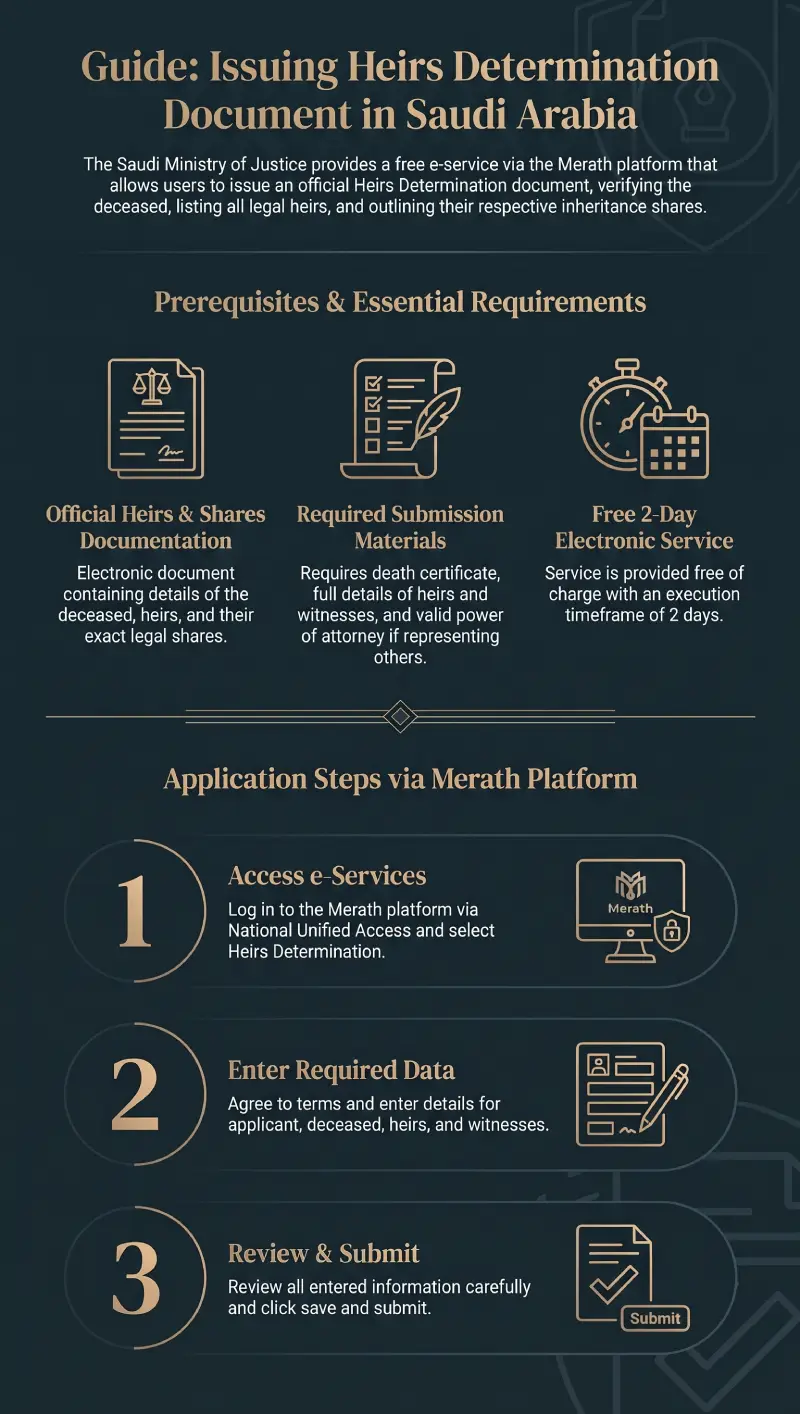
A power of attorney does not replace the heirs determination. It is therefore important to begin with the steps for obtaining an electronic Heirs Determination Document through Najiz where that document is required.
Najiz services indicate that the inheritance document includes information relating to the deceased and the heirs and their respective entitlements. The heirs determination therefore forms part of the basis of estate procedures, whereas the power of attorney acts as an instrument for carrying out authorised steps.
| Point of Comparison | Heirs Determination Document | Power of Attorney for Heirs |
|---|---|---|
| Function | Establishes the heirs and their entitlements | Authorises a person to act or conduct procedures |
| Effect | Establishes legal status as an heir | Defines the representative’s authority and limits |
| Use | Before division, sale, and certain banking procedures | During procedures or authorised transactions |
| Relationship to the estate | Identifies who is entitled to inherit | Identifies who may act on behalf of the heirs |
| Does one replace the other? | Does not replace a POA where representation is required | Does not replace the heirs determination |
General Power of Attorney for Heirs: Sample Wording
A general form may begin with the details of the heirs, the authorised representative, the deceased person, and the number of the Heirs Determination Document. It should then state its purpose, the authorities the representative may deal with, and the transactions the representative is permitted to perform.
A general form may often be suitable for administrative follow-up, requesting documents, signing administrative applications, and handling certain procedures.
However, selling property, receiving money, waiving rights, or representing a minor generally requires more precise wording.
Short Sample Power of Attorney for Heirs
We, the undersigned principals, in our capacity as heirs of the deceased and pursuant to Heirs Determination Document No. [●], hereby appoint Mr./Ms. [●], ID No. [●], to represent us before the competent authorities in matters concerning the estate of our deceased, request documents, receive and submit documents, sign the necessary applications, and follow up on estate-related procedures within the limits of this power of attorney.
This wording does not give the representative authority to sell property, transfer title, or receive funds unless those powers are expressly added.
It should therefore not be relied upon without further wording where inherited property is to be sold or where the representative needs to receive money from a bank.
When Is General Wording Not Sufficient?
General wording is not sufficient where the intended transaction directly affects ownership or estate assets.
Examples include:
- Selling an inherited house or land.
- Receiving money from a bank on behalf of the heirs.
- Representing a minor in an estate-related transaction.
- Signing an estate division agreement or settlement.
- Delegating powers to another person or appointing a lawyer with litigation authority.
- Waiving a right, making an acknowledgement, or entering into a financial settlement.
In these situations, the document should specify the type of transaction, the relevant authority, and the powers required.
It may also be appropriate to include practical restrictions, such as defining how the purchase price must be received or deposited into the heirs’ accounts.
Applying the Power of Attorney Requirements to the Estate File
After understanding the general requirements, the more important issue is applying them to the actual circumstances.
A document may appear correct in general terms but still fail to serve its intended purpose if it does not identify the relevant authority, transaction, or limits of the representative’s powers.
If the purpose is to deal with a bank, do not rely only on wording such as “deal with the relevant authorities.”
If the purpose is to sell property, authority merely to deal with the notary office may not be sufficient without express authority to sell and transfer title.
If the purpose is to appoint a lawyer, the lawyer’s powers should correspond to the estate file, litigation, or the competent authority involved.
Information That Should Not Be Omitted
Before approving the document, confirm that the following information is clear:
- Name of each heir granting the power of attorney.
- National ID or residency number.
- Name and identification details of the authorised representative.
- Name of the deceased.
- Number of the Heirs Determination Document.
- Specific purpose of the power of attorney.
These details help reduce ambiguity when dealing with a bank, a notary office, or government authorities and help connect the authorisation to the relevant estate.
How Should the Subject Matter Be Defined?
The purpose should be stated clearly because an estate power of attorney is not always issued for a single type of transaction.
It may be issued for dealing with:
- Najiz.
- A bank.
- A municipality.
- A notary office.
- A court.
It is generally preferable to draft the document according to the actual requirement, for example:
- Dealing with government authorities concerning the deceased’s estate.
- Dealing with banks to enquire about accounts.
- Selling a specified inherited property.
- Following up the division of the estate among the heirs.
- Appointing a lawyer to handle a claim or procedure.
A common question is: How do I appoint a lawyer for the heirs?
In practice, the document should expressly authorise the lawyer to handle the estate file, conduct litigation where required, submit applications, and deal with the competent authorities.
How Can the Powers Be Defined Without Making Them Too Broad?
The representative’s powers are the core of the document because the representative may act only within the authority granted by the principals.
If the authority is limited to administrative follow-up or enquiries, it should not be interpreted as authority to sell property or receive funds.
When preparing a power of attorney for heirs, distinguish between powers such as:
- Making enquiries and following up procedures.
- Receiving and submitting documents.
- Signing applications.
- Selling property and transferring title.
- Receiving the purchase price or other funds.
- Delegating authority to another person.
- Pleading and representing the principals before a court.
There is usually no reason to combine all these powers in one document unless the estate actually requires them.
The purpose is to grant enough authority to complete the intended transaction without unnecessarily opening powers that are unrelated to the file.
How to Issue a Power of Attorney for Heirs Through Najiz
A power of attorney for heirs in Saudi Arabia may be issued through Najiz where the parties’ details are complete and the purpose is clearly defined.
Najiz provides power-of-attorney services within its electronic notarial services, and the process is generally accessed through National Unified Access.
Users searching for a “Najiz power of attorney for heirs” are usually looking for the electronic issuance process. The platform facilitates issuance, but careful selection and drafting of the authorised powers remains important before approval.
Steps for Issuing an Electronic Power of Attorney
The general steps are:
- Log in to the Najiz portal through National Unified Access.
- Select powers of attorney and declarations services.
- Choose issuance of a power of attorney or a multi-party power of attorney.
- Enter the details of the principals and the representative.
- Select the relevant clauses and powers.
- Review the wording before approving it.
- Keep the power-of-attorney number and verify its status.
Do not select standard clauses hastily, particularly where the power of attorney relates to selling real estate or dealing with a bank.
The final wording determines what the authorised representative may be able to do.
When Should a Multi-Party Power of Attorney Be Used?
A multi-party power of attorney may be used when more than one heir wishes to appoint a single person in one document.
This can help unify the powers granted rather than requiring several separate powers of attorney with different wording.
The arrangement is sometimes described as a collective power of attorney for heirs and can be useful where several heirs appoint one heir or a lawyer to handle a defined estate file.
The powers granted should nevertheless be aligned carefully so that the scope of authority does not unintentionally differ from one heir to another.
Verifying and Renewing the Power of Attorney
After issuance, verify the power-of-attorney number and status and review the final wording before using it.
Errors in the scope of authority do not always become apparent at the issuance stage. They may instead arise later when the representative deals with a bank or notary office.
Keep a copy of the power of attorney, check its validity period, and determine whether a new authorisation may be required.
What is commonly described as renewing a power of attorney for heirs may in practice mean issuing a new power of attorney or updating the authorisation when the previous document expires or when its purpose changes.
Power of Attorney to Sell Inherited Property
A power of attorney to sell inherited property requires greater care than a general administrative authorisation.
A sale affects ownership and may involve transfer of title, receipt of the purchase price, and distribution of the proceeds.
The property should therefore be identified as precisely as reasonably possible, and the document should clearly state authority to sell, transfer title, and sign the necessary documents.
Particular attention should also be given to the method for receiving the purchase price because disputes often arise after the sale rather than before it.
Important Clauses in a Power of Attorney to Sell Inherited Real Estate
Important powers may include:
- Dealing with the notary office or competent real estate authorities.
- Updating title deed information where required.
- Signing sale and title-transfer applications.
- Identifying or describing the relevant property as precisely as possible.
- Receiving the purchase price or specifying the method of deposit.
- Receiving cheques or arranging transfer of funds.
- Signing the documents required within the defined scope of the sale.
A more controlled approach is to define the method of receipt, such as transferring the amount to the heirs’ accounts or receiving it by cheque in accordance with the agreed arrangement.
Clear wording reduces ambiguity over the representative’s control of sale proceeds.
Is a Power of Attorney for Heirs Enough to Sell Property?
It may be sufficient where the document expressly includes authority to sell, transfer title, and sign the required documentation, provided the relevant property and inheritance documents are also available.
A general administrative power of attorney may not be sufficient for a real estate transaction.
Particular care is required where there is a minor, an absent heir, or a dispute between the heirs. In such cases, a power of attorney alone may not be enough, and an additional judicial procedure or approval may be required depending on the nature and effect of the transaction.
Where the property is connected with an estate partition claim or compulsory sale, the procedure differs from a consensual sale. The broader process is explained in the BMS Legal guide to estate division in Saudi Arabia. BMS Legal
Bank Power of Attorney and Receiving an Inheritance Share
A bank power of attorney for heirs differs from one used for selling property because it concerns accounts, funds, and financial entitlements.
The heirs may require a representative to make enquiries, receive documents, or request information relating to account balances.
Authority to receive money should not be granted broadly without understanding its effect.
Once money is received, it still needs to be dealt with and distributed appropriately, and disputes may arise if the document does not define how money is to be received or deposited.
What Should Be Included in a Bank Power of Attorney?
When preparing a bank power of attorney for heirs, distinguish between authority to make enquiries and authority to receive funds.
A person authorised to deal with the bank does not necessarily need authority to receive the money.
Depending on the purpose, powers may include:
- Enquiring about accounts.
- Requesting statements or bank confirmations.
- Receiving documents.
- Receiving funds where required.
- Depositing funds into the heirs’ accounts.
- Signing the necessary bank forms.
Avoid broad wording giving the representative unrestricted authority to “receive all funds” unless that is genuinely required.
More precise drafting should state whether the representative may receive documents only, may also receive money, and how distribution is to be evidenced.
How Can You Protect Your Inheritance Share When Granting Authority?
You can reduce risk by defining financial powers carefully, requesting written records, and restricting the method of receiving funds.
A power of attorney does not, by itself, amount to a waiver of an inheritance share. However, it may give the representative practical authority to receive money where the document expressly permits it.
Where the power of attorney relates to receiving an inheritance share or distributing money among the heirs, it is important to understand the inheritance calculation process in Saudi Arabia before granting authority to receive or deposit funds, so that the limits of the power of attorney are not confused with the separate issue of determining each heir’s entitlement.
It is also preferable for the document to define a clear method of dealing with funds, such as depositing each heir’s share directly into that heir’s account.
The representative may also be required to provide a record of money received and estate-related expenses.
Where the estate involves substantial funds or several heirs, it may be appropriate to consult an inheritance lawyer before issuing a broadly drafted power of attorney.
The purpose of legal review is not necessarily to deal with an existing dispute; it may simply help define the authorisation more precisely.
General and Special Powers of Attorney for Heirs
A special or limited power of attorney is often more suitable for estate matters because it identifies the intended transaction and reduces overlap between unrelated powers.
A general power of attorney may be acceptable for certain administrative matters, but it is generally less suitable where the representative will be selling property or receiving money.
| Point of Comparison | Special Power of Attorney | General Power of Attorney |
|---|---|---|
| Scope | Specific transaction | Broad powers |
| Risk | Lower when carefully drafted | Potentially higher in a dispute |
| Use | Sale of property, bank matter, estate division | General administrative dealings |
| Practical approach | Often preferable for sensitive estate files | Use with caution |
When Is a Special Power of Attorney Appropriate?
A special power of attorney is suitable where the purpose is clear, such as:
- Selling a particular inherited property.
- Dealing with a specific bank.
- Following up a particular claim.
- Handling a consensual estate division.
In these situations, precise wording is generally more useful than broad language.
Risks of a General Power of Attorney
The main risk of a general power of attorney is that it may grant the representative powers that are not needed for the intended transaction.
A later dispute may arise over whether the principal intended to authorise a sale, receipt of money, waiver, or another transaction.
To reduce that risk, link the authorisation to the estate of a specified deceased person, define the relevant transaction, and use an appropriate validity period.
Authority to delegate powers to another person should also generally be included only where there is a genuine practical need.
Special Cases Before Issuing a Power of Attorney for Heirs
Some estate files are not suitable for a generic form because the issue is not merely one of wording. The status, location, or position of one of the heirs may change the appropriate procedure.
The main situations include:
Minor Heir
A minor does not personally sign the power of attorney.
The minor is represented by the person who has the legal capacity to act on the minor’s behalf, within the limits permitted by the applicable rules.
A minor’s share should not be included in a sale or estate division without first confirming the required authority, because certain transactions may require additional approval or judicial review depending on the nature of the asset and the effect of the transaction.
Heir Residing Outside Saudi Arabia
An heir residing outside the Kingdom may need to issue a power of attorney through the competent authority in the country of residence or through the relevant Saudi embassy or consulate.
The wording should correspond to the transaction to be carried out in Saudi Arabia.
A power of attorney for selling property is different from one limited to dealing with a bank or government authority.
An Heir Refuses to Grant a Power of Attorney
A power of attorney is a voluntary authorisation. An heir is therefore generally not compelled simply to appoint a person they do not wish to authorise.
The heirs who agree may grant authority within the limits of their own interests, while the refusing heir’s position remains separate.
Where consensual division or sale becomes impossible, a judicial or formal estate-division procedure may be more appropriate than attempting to expand the authority granted under the power of attorney.
The currently published Arabic article links this phrase to the same inheritance-calculation resource, so I have preserved the existing destination rather than inventing a new unpublished URL.
Common Mistakes When Preparing a Power of Attorney for Heirs
Most problems arise because a generic form is copied without adapting it to the intended transaction.
The document may look correct in general terms but still be insufficient when presented to a bank, notary office, or other competent authority.
Common mistakes include:
- Using a generic form when selling inherited property.
- Failing to state authority to sell and transfer title clearly.
- Granting unrestricted authority to receive funds.
- Ignoring the validity period of the electronic power of attorney.
- Failing to identify the deceased or the relevant Heirs Determination Document.
- Confusing a power of attorney with a waiver of an inheritance share.
- Failing to consider a minor or absent heir.
- Omitting how funds are to be distributed after receipt.
- Allowing delegation to another person without a clear reason.
- Failing to review the wording before approving it through Najiz.
When Do You Need an Inheritance Lawyer?
Legal review may be appropriate where the power of attorney involves real estate, a minor, substantial sums, a disagreement between heirs, or broad powers.
You may also review the BMS Legal service for an inheritance and estate lawyer in Jeddah to determine the appropriate wording before issuing the document or using it before the relevant authority.
Another common question is: How do I appoint a lawyer for the heirs?
The practical approach is to issue a clearly defined power of attorney authorising the lawyer to follow up the estate file, deal with the competent authorities, submit applications, and represent the principal before the court where required.
A consultation does not necessarily mean that a dispute already exists. It may simply be used to confirm that the authorisation granted to an heir or lawyer is neither too broad nor too narrow for the intended procedure.
Review the Powers Before Approving the Power of Attorney
The problem is not always the issuance of the document itself. Difficulties may arise because the powers are either broader or narrower than the intended transaction requires.
Where the document concerns real estate, a bank, estate division, or a minor heir, reviewing the wording before approval can help determine whether the powers granted correspond to the required procedure.
BMS Legal Law Firm
is a Saudi-licensed law firm based in Jeddah, providing legal services in inheritance and estate matters, including powers of attorney for heirs, estate administration, and inheritance disputes.
This guide explains how to define a representative’s authority, review the required powers, and avoid unnecessarily broad authorisation before issuing a power of attorney through Najiz.
Frequently Asked Questions About a Power of Attorney for Heirs
What Is a Power of Attorney for Heirs in Saudi Arabia?
A power of attorney for heirs in Saudi Arabia is an authorisation issued by all or some of the heirs to a specified person so that the representative can act for them in an estate-related matter, such as dealing with Najiz, a bank, inherited property, or another competent authority.
Is There One Standard Power of Attorney Form for All Heirs?
No. There is no single form suitable for every situation because authority to sell property differs from authority to deal with a bank, complete administrative procedures, or appoint a lawyer.
How Do I Issue a Power of Attorney for Heirs Through Najiz?
Log in to Najiz through National Unified Access, select the powers-of-attorney services, enter the details of the representative and principals, select the relevant powers, and review the wording before approval.
What Are the Main Requirements for a Power of Attorney for Heirs?
The main requirements include accurate identification of the principals and representative, clear identification of the estate where relevant, and precise wording of the required powers without granting unnecessary authority.
A power of attorney for heirs in Saudi Arabia is more than a ready-made form. It is a document that defines what the authorised representative may and may not do before dealing with Najiz, banks, real estate transactions, or judicial authorities.
Before approving any power of attorney, define its purpose, verify the details of the heirs and representative, control the powers relating to sale, receipt of funds, or administrative procedures, and pay particular attention to circumstances involving a minor or an heir residing outside Saudi Arabia.
Where an estate includes real estate, substantial funds, or disagreement between heirs, legal review of the wording before issuance may help protect the parties’ rights and reduce avoidable disputes.
Where you need the documents and proposed wording reviewed, you may contact BMS Legal directly to identify the procedure most appropriate to the estate circumstances. This is the translated version of the final internal CTA appearing in the published Arabic article.
Official References: