
The applicable penalty depends on the nature of the assault and the circumstances surrounding it. More severe penalties may apply when a weapon is used or multiple acts of abuse occur during the same incident. Cases involving a sister under the age of 18 also require consideration of the special protections provided under Saudi child protection legislation.
If you have experienced an assault or are following up on an existing report, this guide explains the applicable penalties, reporting procedures, evidence requirements and the possible effects of settlement and compensation claims.
Penalty for Beating a Sister Under Saudi Law: Quick Answer
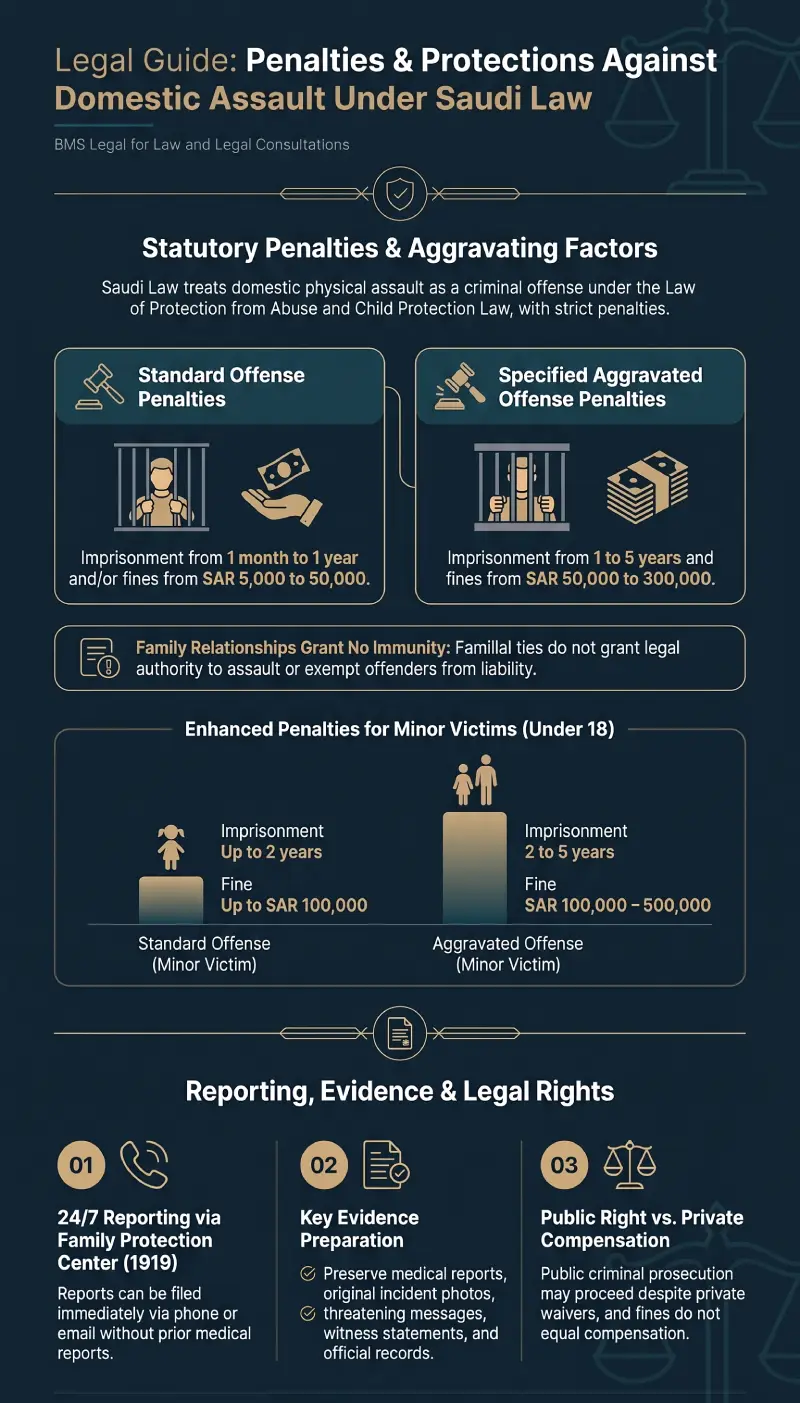
If a brother’s assault on his sister constitutes an offence under the Saudi Law of Protection from Abuse, the standard penalty is imprisonment for one month to one year, a fine of SAR 5,000 to SAR 50,000, or either penalty. In legally specified aggravated cases, imprisonment may reach five years and the fine may reach SAR 300,000. The outcome depends on the legal classification of the incident, the evidence and the circumstances established before the competent court.
Legal reference: Article 13 of the Saudi Law of Protection from Abuse.
What Is the Penalty for Beating a Sister in Saudi Arabia?
The penalty for beating a sister in Saudi Arabia depends on the nature of the assault, its circumstances and the available evidence. The general legal framework for the penalties for physical assault under Saudi law also applies, while an assault between siblings requires consideration of the protections specifically governing family abuse.
The Law of Protection from Abuse is a key legal reference for conduct involving physical or psychological mistreatment, threats and other forms of abuse within relationships covered by the legislation.
Is Hitting a Sister a Crime Even If the Offender Is Her Brother?
Hitting a sister may constitute a criminal offence when the conduct meets the legal requirements for abuse under the applicable Saudi legislation. Being siblings does not grant the brother immunity from legal liability or a general right to use physical force.
The Law of Protection from Abuse covers specified forms of physical and psychological mistreatment and threats within legally defined relationships. The official definition of abuse published by the Saudi Ministry of Human Resources and Social Development helps explain the scope of these protections.
For example, if a brother assaults his sister because he disagrees with a personal decision, describing the incident as a family dispute does not remove the need to examine the alleged assault itself. The competent authorities assess the conduct, any resulting harm and the evidence connecting the alleged offender to the incident.
The basic right to protection does not disappear when a sister marries or reaches adulthood. An adult or married sister can seek protection if her brother assaults her. Likewise, a dispute over inheritance, housing or family responsibilities does not authorise the use of violence.
Threatening to beat a sister may also fall within the statutory concept of abuse if the relevant legal conditions are met, even where no physical assault follows. Documenting the circumstances can therefore help distinguish an ordinary disagreement from conduct that may create criminal liability.
When Can a Brother Face Imprisonment or a Fine?
Article 13 of the Saudi Law of Protection from Abuse sets out a standard penalty for abuse offences and increased penalties in specified circumstances. It also addresses repeat offending through provisions concerning the doubling of the imposed penalty.
The penalties are summarised below.
| Legal classification | Imprisonment | Fine |
|---|---|---|
| Standard abuse offence | One month to one year | SAR 5,000–50,000, or either penalty |
| Legally specified aggravated cases | One to five years | SAR 50,000–300,000 |
| Repeat offending under the statutory provision | Doubling of the imposed penalty as provided by law | Subject to the statutory provision on doubling the imposed penalty |
Aggravating circumstances include using a weapon or committing multiple acts of abuse during the same incident, alongside other situations specified by law. However, repeated abusive conduct should not automatically be classified as statutory repeat offending without establishing the relevant facts and legal requirements.
Likewise, proving that an assault occurred does not automatically require the court to impose the maximum available sentence. The final legal classification depends on the evidence, the circumstances and the applicable provisions.
The amended Article 13 of the Law of Protection from Abuse, published in the Saudi Official Gazette, explains the standard penalty, aggravating circumstances and repeat-offending rules. It also permits the competent court to impose an alternative to a custodial sentence where the relevant statutory conditions allow.
How Do Injuries and Circumstances Affect the Penalty?
The penalty for beating a sister under Saudi law is not determined solely by whether bruises or visible wounds appear. The nature of the assault, surrounding circumstances and available evidence must also be considered.
Abuse may occur without an obvious physical injury, while serious injuries can raise additional questions about criminal liability and private claims. Medical findings help establish the nature of an injury but do not replace the legal assessment of the conduct.
Assault Without Visible Injury or With Physical Harm
An assault involving slapping, pushing or hitting may occur without leaving visible marks at the time of a medical examination. The absence of those marks does not automatically make the conduct lawful, although proving what happened may require other supporting evidence.
Where an assault causes a cut, fracture or another injury requiring treatment, a medical report may help document the resulting harm. Identifying the person responsible remains a separate evidentiary issue that must be assessed using the available information.
The following distinctions are important:
- Assault without visible injuries: The authorities examine the alleged conduct and supporting evidence without assuming that the absence of visible harm excludes abuse.
- Assault resulting in injury: Medical records and other evidence help establish the nature of the harm and its connection to the reported incident.
- Assault involving a stick: The nature of the object and the manner of its use must be examined before deciding whether a statutory aggravating circumstance applies.
- Assault causing permanent impairment or serious harm: Additional criminal-law considerations and private rights may arise, depending on the injury and the applicable legal provisions.
A medical report stating a particular recovery period does not automatically mean that the alleged offender must be detained. Pre-trial detention is a separate procedural matter governed by applicable legal requirements.
It is therefore important to distinguish between documenting an injury, determining whether an offence occurred, imposing procedural detention and issuing a final criminal judgment.
Repeated Assault and Abuse of a Sister Under 18
Where an assault has occurred repeatedly, the dates and number of incidents should be established. This helps distinguish multiple abusive acts within one incident from separate incidents that may require consideration under the legal rules on repeat offending.
If the sister is under 18, the Saudi Child Protection Law must also be considered because it provides specific safeguards for children.
Article 23 bis addresses the following penalties for offences falling within its scope.
| Offence under the Child Protection Law | Applicable penalty |
|---|---|
| Standard offence | Imprisonment for up to two years and a fine of up to SAR 100,000, or either penalty |
| Legally specified aggravated offence | Imprisonment for two to five years and a fine of SAR 100,000–500,000 |
The fact that the victim is a minor does not automatically mean that the aggravated penalty applies. The circumstances specifically identified by the legislation must be established.
These circumstances include the use of a weapon, multiple acts of abuse during the same incident and other situations identified in the relevant provisions.
The Saudi Child Protection Law, including Article 23 bis, provides the legal framework for examining the relevant penalties and their conditions.
How Can a Sister Report an Assault in Saudi Arabia?
A sister who has experienced an assault can report the incident or seek protection without waiting for another injury or gathering every possible document. Where an immediate threat exists, personal safety and contacting the appropriate authorities should take priority.
Saudi authorities provide official channels for reporting domestic abuse. Reports may concern abuse experienced by the person making the report or abuse affecting someone else.
Reporting Channels and Requests for Protection
The Saudi Ministry of Human Resources and Social Development receives domestic violence reports through its Family Protection Reporting Centre on the toll-free number 1919.
The centre operates 24 hours a day. The ministry also provides an official email channel for submitting reports.
Available reporting options include:
- Family Protection Reporting Centre: Call 1919 to report domestic abuse or request assistance.
- Email: Send information concerning the incident to 1919@hrsd.gov.sa.
- Competent security authorities: Contact the relevant authorities when an assault is taking place or there is an immediate threat requiring urgent intervention.
The ministry’s reporting service does not require supporting documents to be submitted before an initial report can be made. A victim should therefore not delay requesting help simply because a medical report is unavailable.
The official Saudi domestic violence reporting service explains the reporting channels, document requirements and general process.
When making a report, it is helpful to provide the date and location of the incident, the type of assault and whether the threat remains ongoing.
What Happens After an Assault Is Reported?
The authorities initially receive the report and assess the seriousness of the circumstances before determining the appropriate response. Depending on the case, this may involve coordination with family protection units, security authorities or healthcare providers.
The ministry explains that handling abuse cases may involve social, psychological and medical support, as well as referrals to the competent authorities when necessary.
A report does not automatically result in a criminal conviction. Criminal investigations and determinations of liability are subject to separate legal procedures and the jurisdiction of the relevant authorities.
If you have already reported an assault, retain the report number, submission date and any related official correspondence. You should also document new threats or incidents that may affect the assessment of risk.
For additional context on the criminal justice process, the guide to types of criminal cases in Saudi Arabia explains the wider framework within which criminal matters may be handled.
How Can a Sister Prove an Assault?
Proving an assault involves presenting information and evidence that may help establish what happened, who was allegedly responsible and what harm resulted. Evidence may include medical reports, messages, witness accounts and official documents.
Different items of evidence serve different purposes. A document may help establish that an injury occurred without independently proving who caused it.
For this reason, the evidence should be considered collectively rather than assuming that any single document will establish every element of the allegation.
Medical Reports and Photographs of Injuries
A medical report can document injuries observed during an examination and may describe their nature and possible medical consequences. Its usefulness may increase when its dates and findings are consistent with other information concerning the incident.
However, a medical report does not necessarily identify the offender by itself. Connecting an injury to a particular person may require additional evidence.
To preserve potentially relevant medical records and photographs:
- Keep a copy of the medical report issued by the healthcare provider.
- Preserve original photographs without making changes that could affect their evidentiary value.
- Record the dates of the assault, medical examination and any related official report.
- Retain treatment-related expense records if a compensation claim may arise.
Where urgent treatment is required, obtaining medical assistance should take priority over collecting additional evidence.
Proving an Assault Without Witnesses or Visible Marks
An assault may take place inside a family home without direct witnesses, or its visible effects may disappear before a medical examination. Nevertheless, other relevant evidence may be considered, subject to its legality and probative value.
Examples include messages containing threats or admissions, records of earlier reports and accounts from people who witnessed part of the incident.
Recordings may also be relevant, provided that the applicable legal requirements are respected and the material has not been obtained or shared unlawfully.
Six Items to Organise Before Reviewing an Assault Case
Before submitting documents or discussing a case with a lawyer, you can organise the available information and identify what may require further clarification.
| Item | What should you check? |
|---|---|
| Incident details | Date, location and sequence of events |
| Injuries | Medical reports and photographs, where available |
| Messages | Original communications concerning the assault or threats |
| Witnesses | Anyone who witnessed the incident or observed its effects |
| Official procedures | Report numbers, police records and related documents |
| Personal safety | Whether threats or assaults are continuing |
Legal note: Organising these materials can help present the incident clearly, but it does not guarantee that an allegation will be proved or that a particular judgment will be issued. Where danger continues, seeking protection remains the immediate priority.
Does Waiving a Complaint End an Assault Case?
It is important to distinguish between the public right and the private right when considering a waiver or settlement in an assault case.
In Saudi criminal-law terminology, the public right concerns the public interest in prosecuting offences under the applicable legislation. The private right concerns claims held by the injured person as a result of the incident.
Waiving a personal claim does not necessarily end all criminal proceedings. The legal effect depends on the offence, the applicable provisions and the circumstances of the case.
How Does Settlement Affect Public and Private Rights?
A settlement may address financial compensation or the waiver of a particular personal claim, but it does not necessarily terminate every related legal proceeding.
It is important to identify whether an agreement concerns specific individual rights or includes broader obligations.
Withdrawing a report, waiving a private claim and the termination of public criminal proceedings should not be treated as identical procedures. Each may have different legal consequences depending on the case and the stage reached.
Before signing a settlement or waiver, consider the following:
- Which rights and claims are expressly covered by the agreement?
- Does the agreement include financial payments or other obligations?
- Are criminal proceedings or compensation claims still pending?
- Is further protection required because threats or abuse are continuing?
These questions become particularly important where the assault was repeated, caused an injury or resulted in a potential compensation claim.
A family settlement is not a substitute for requesting protection when a new or continuing threat exists.
Can a Sister Claim Compensation for an Assault?
A sister may be entitled to seek compensation where the legal requirements for liability are met and the harm is established as being connected to the assault.
There is no fixed compensation amount that applies to every case of a brother assaulting his sister. The nature and extent of the harm may differ substantially between incidents.
Potential claims may involve medical expenses, bodily harm or other losses that can be established under the applicable legal rules. Compensation for non-material harm may also require consideration of the relevant legal requirements and supporting evidence.
A criminal fine must be distinguished from compensation. A fine is a penalty imposed under criminal legislation, whereas compensation concerns redressing loss or harm suffered by the injured person.
It would therefore be incorrect to assume that the maximum statutory fine is an amount the sister can personally recover.
Medical reports, treatment invoices and other records documenting losses may help support a claim, without establishing entitlement to any particular amount in advance.
Where a serious injury or a dispute over compensation exists, legal advice may assist in identifying the nature of the claim, the relevant documents and the competent authority.
A Sister’s Legal Rights and the Role of a Lawyer
Protecting a sister’s rights begins with identifying the current stage of the situation. There may be an immediate safety risk, an existing official report or a dispute concerning compensation.
This distinction matters because responding to urgent danger requires different steps from managing an ongoing legal claim.
A lawyer may be helpful where significant injuries are involved, evidence is disputed, multiple incidents have occurred or a settlement proposal is being considered. Legal assistance may include reviewing documents, explaining possible procedures and handling matters within the agreed scope of representation.
Before a consultation, it is useful to prepare a clear account of the incident and identify any available reports, medical records or communications.
The scope of legal services and the expected fees should also be explained before representation begins, without guaranteeing a particular result.
An initial criminal-law consultation with BMS Legal can help clarify the type of legal assistance available in criminal matters, including the review of relevant facts, documents and potential procedures.
About the Publisher and Official Legal Sources
Published by:
BMS Legal for Law and Legal Consultations.
Legal references:
The Saudi Law of Protection from Abuse,
the Saudi Child Protection Law,
and official information published by the
Ministry of Human Resources and Social Development.
Firm information:
View
BMS Legal’s licensing and registration details
.
Legal Disclaimer:
This article provides general legal information
about Saudi laws and regulations. It does not
replace an individual legal assessment of the
circumstances and documents relevant to each
case before taking legal action.
Frequently Asked Questions About Penalty for Beating a Sister
Can I Report an Assault Without a Medical Report?
Yes. The Saudi domestic violence reporting service does not require documents to be provided before an initial report is accepted. A medical report may later help establish an injury, but it is not a general prerequisite for making the report.
Can a Married Sister Report Her Brother for Assault?
Yes. Marriage does not prevent a sister from seeking protection if her brother assaults her. The incident is assessed according to the conduct, available evidence and applicable Saudi legislation, regardless of her marital status or residence.
Can a Family Member Report Abuse on Her Behalf?
Yes. The Ministry of Human Resources and Social Development allows reports concerning abuse experienced by the person reporting it or by another individual. The competent authorities then assess the information, seriousness of the circumstances and appropriate response.
Does a Sister's Waiver Automatically End the Public Criminal Case?
No. Waiving a personal claim does not automatically extinguish the public right. The effect depends on the legal classification of the offence, the applicable procedural rules, the terms of the settlement and the stage of the case.
What Should a Sister Do if Her Brother Continues Threatening Her?
New threats should be reported to the competent authorities, especially when they create an immediate risk. The Family Protection Reporting Centre can be contacted on 1919, while urgent situations may require intervention by the relevant security authorities
When Should a Sister Consult a Lawyer About an Assault?
Legal advice may be useful when significant injuries, an ongoing report, disputed evidence or a proposed settlement are involved. A lawyer can review the facts, explain possible rights and procedures and clarify the scope of available services.
Three priorities deserve attention after an assault: seeking protection, preserving evidence and understanding your legal rights. Where an immediate threat exists, requesting appropriate assistance comes first. Relevant documents and communications should then be preserved without alteration or unnecessary disclosure.
The penalty for beating a sister under Saudi law depends on the type of abuse, the available evidence and any legally established aggravating circumstances. The standard penalty or a more severe penalty may apply, while incidents involving a child also require consideration under the Child Protection Law.
Settlement and compensation should be assessed separately so that the legal consequences and relevant supporting documents are understood before important decisions are made.
If you have experienced domestic abuse, have an existing report or need guidance concerning settlement or compensation, you may seek legal advice from BMS Legal for Law and Legal Consultations.
You can contact BMS Legal to arrange a legal consultation and discuss the possible next steps while respecting the confidentiality of the information you provide.