
A waqf entitlement claim in Saudi Arabia is used when a person asserts a right to the revenue or usufruct of a waqf but is not recognised among the beneficiaries, or when the nazir refuses to pay that person’s share. A ready-made form is not enough on its own, because the strength of the claim depends on the waqf deed, the founder’s condition, the claimant’s capacity, and the clarity of the facts and requests.
A waqf entitlement claim differs from a claim to hold the nazir to account. The first asks whether the claimant is among the beneficiaries; the second concerns the limits of the nazir’s administration of the waqf and its revenue, and the duties and responsibilities attached to it.
Excluded from waqf revenue or refused your share?
A lawyer can review the waqf deed and the founder’s condition, and help you choose the right claim before you file through Najiz.
Enquiries are handled confidentially · No specific court outcome can be guaranteed
When Do You Use a Waqf Entitlement Claim?
An entitlement claim is filed where a waqf exists, a founder’s condition can be consulted, and a person says they belong among the beneficiaries without receiving their right. The need usually arises when a beneficiary is excluded from the revenue, the nazir refuses to pay the revenue, the beneficiaries disagree about how the founder’s condition is read, or the name is missing from the distribution lists.
Before preparing the statement, the waqf deed and the founder’s condition must be clear, because the conditions and spending purposes of a waqf in Saudi law are what decide who counts as a beneficiary. Our guide to waqf law in Saudi Arabia explains the general framework.
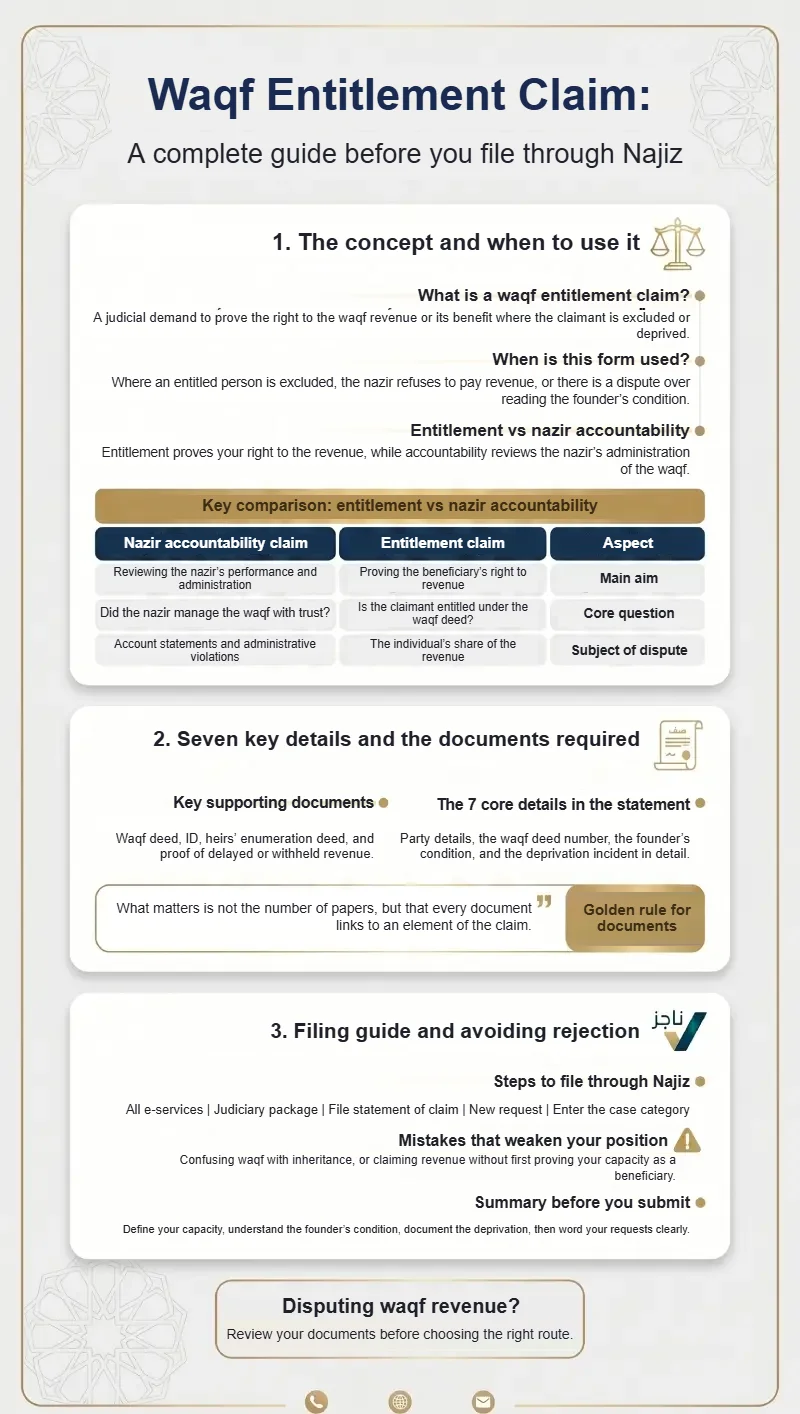
What Entitlement Means in a Waqf, and How It Differs From Accountability
Entitlement in a waqf means that a person or body has a proved right to benefit from the revenue or usufruct of the waqf under the founder’s condition. It may be a financial revenue, residence or a defined benefit, depending on the waqf deed. The right is not proved by assertion alone: there must be a clear link between the claimant and the founder’s condition, with documents supporting the capacity and the request.
The waqf asset and the beneficiary’s right are different things. The waqf asset is the property, real estate or capital that is held, while the beneficiary’s right is the benefit or revenue that comes from it. An entitlement statement therefore does not ask to divide the waqf as if it were an estate. It asks to prove that the claimant is among the beneficiaries, to be included in the distribution lists, or to be paid a share once entitlement and revenue are proved.
A claim to hold the nazir to account differs in its subject. It does not usually ask whether the claimant is a beneficiary, but whether the nazir has administered the waqf and its revenue properly. Where the nazir admits the claimant’s entitlement but does not explain the accounts, accountability may be closer. Where the nazir denies the claimant’s capacity altogether, the starting point is usually proving the entitlement.
Cases That Justify an Entitlement Claim
A claim is filed when a specific event stops the benefit reaching the person who says they are entitled. A family disagreement or a sense of unfairness is not enough: there must be a clear cause that can be put to the court and tied to the waqf deed, the founder’s condition and the supporting documents.
The most common cases are:
- A person is excluded from the waqf revenue although they believe the founder’s condition includes them.
- The nazir refuses to pay without a clear reason or acceptable document.
- The revenue is distributed to some beneficiaries and not to others.
- There is a disagreement about how the founder’s wording should be read.
- The beneficiary is not in the distribution lists or the records of beneficiaries.
- There is a claim for past revenue once the entitlement itself is established.
- A beneficiary or the nazir denies that the claimant is within the waqf.
The statement should set out the event precisely. Do not simply write “I was deprived of my right”: say how the deprivation happened, who did it, when it began, and which document shows the claimant is among the beneficiaries.
Situations That Need a Different Route
Not every waqf problem is solved by an entitlement claim. Sometimes the problem is the nazir’s administration, missing documentation, ownership of the asset, or the financial accounts. The dispute must be characterised before the title and form are chosen.
| Situation | Closest route |
|---|---|
| The claimant is not listed among the beneficiaries | Waqf entitlement claim |
| The nazir admits entitlement but does not explain the accounts | Accountability of the nazir |
| The waqf is not documented at all | Documenting or proving the waqf |
| Dispute over ownership of the property itself | A different claim depending on the facts |
| Claim for past revenue after capacity is proved | Revenue claim or a dependent request |
| Serious mismanagement affecting the waqf | Accountability or removal of the nazir |
If the entitlement itself is denied, the request should begin by proving the capacity. If the entitlement is accepted and the dispute is about accounts or expenses, a type of waqf review and an accountability claim may be closer than a separate entitlement claim. Documenting a waqf through Najiz is also a different service: it issues an official waqf deed and does not settle a dispute between a beneficiary and a nazir or among beneficiaries.
Details the Statement of Claim Must Not Omit
The strength of the statement depends on accurate details, not on long wording. It must explain who the claimant is and why the claimant is asking, who the defendant is, how each party relates to the waqf, and which text the claimant relies on. These elements should be clear before the requests are set out.
The basic details are:
- The claimant’s details and capacity in relation to the waqf.
- The defendant’s details and relation to the waqf.
- The waqf deed number and date.
- The text or exact summary of the founder’s condition.
- The reason the claimant falls among the beneficiaries.
- The event of deprivation or refusal to pay.
- The documents supporting each event.
- The specific judicial requests.
State whether the defendant is the waqf nazir, the administering body, or another beneficiary who disputes the capacity. If the problem is proof of the capacity of the person managing the waqf before entitlement is discussed, a nazir confirmation claim may come first or run alongside, depending on the documents. Neglecting these details makes the statement general and may weaken the link between facts and requests.
The Najiz statement of claim service shows that the user starts with a new request, then enters the classification, details and parties of the claim and attaches the necessary documents. The details and requests should therefore be prepared before entering the service, not only while completing the fields.
A separate route exists for beneficiaries of a family waqf that is under the General Authority for Awqaf’s trusteeship: the Authority’s beneficiary registration service, which records the beneficiary so entitlements can be disbursed. It is a registration service, not a lawsuit, and it does not replace a claim where the entitlement itself is disputed.
A Short Practical Form for a Waqf Entitlement Claim
The following form is illustrative only and does not suit every case without amendment. The wording changes with the waqf deed, the founder’s condition, the claimant’s capacity, the reason for the refusal and the requests needed. Treat it as a starting structure, not a final text for every dispute.
Subject: statement of claim to prove entitlement in a waqf and claim revenue where appropriate
To the Honourable President and Members of the competent circuit,
I submit this claim as claimant, asking to prove my entitlement in the waqf (…), under waqf deed number (…) dated (…), and on the basis of the founder’s condition in the document. The founder provided that the revenue or usufruct of the waqf is for (…), and the claimant falls within that condition because (…).
However, the defendant, in the capacity of (…), did not include the claimant among the beneficiaries, refused to pay the revenue, or distributed the revenue without counting the claimant’s right. As a result the claimant has been deprived of the benefit of the waqf although the cause of entitlement exists and documents support the claimant’s capacity and request.
The claimant therefore asks for judgment as follows:
- Proof of the claimant’s entitlement in the waqf of (…) under the founder’s condition.
- Including the claimant among the beneficiaries in the waqf records or distribution lists.
- Requiring the defendant to pay the revenue due, if its amount is proved.
- Requiring the defendant to carry out the formal consequences of the judgment.
- Reserving the claimant’s right to any dependent claims that appear from the documents.
Do not use this form as it stands where the founder’s condition has special descriptions, such as need, residence, an order of generations, or spending limited to a particular branch. In those cases the requests and facts must be adjusted to the text of the waqf, so the statement does not drift from the real dispute.
Documents Needed to Prove Entitlement
Documents for an entitlement claim begin with the waqf deed and the founder’s condition, then extend to whatever proves the claimant’s capacity and the event of deprivation. The strength of the file is not in the number of attachments but in each document being tied to a specific element of the claim.
| Document | Purpose |
|---|---|
| Waqf deed or document | Proves the waqf, its conditions and spending purposes |
| The founder’s condition | Identifies who is among the beneficiaries |
| National ID | Proves the claimant’s details |
| Deed of inheritors, where needed | Shows the link to the founder or the original beneficiary |
| Family record or kinship documents | Supports capacity where it is disputed |
| Revenue distribution lists | Shows the exclusion or a different distribution |
| Correspondence with the nazir | Proves the request or the refusal |
| Proof of delayed revenue | Supports a financial claim where one exists |
These documents serve three points: the existence of the waqf, the claimant’s capacity, and the event of deprivation. If the claim includes revenue, support it with whatever shows the period of refusal or the amount of revenue as far as possible. If the dispute concerns only capacity, priority goes to the waqf deed and whatever shows that the claimant falls within the founder’s condition.
Note that a waqf registration certificate does not replace the deed issued through the Ministry of Justice, as the General Authority for Awqaf’s frequently asked questions explain. It helps in administering the waqf, opening accounts and dealing with the bodies, but it is not a substitute for the deed when reading the conditions and the requests.
Trust and Legal Basis
Legal basis
This guide is based on the General Authority for Awqaf information and the Najiz statement-of-claim service listed below, and is written for general legal awareness rather than as advice on a specific case.
Published by: BMS Legal Law and Legal Consultancy Company.
Address: Jeddah, Al-Mishrifah District, Palestine Street, Al-Safeer Tower
Steps to File Through Najiz
Filing a waqf entitlement claim through Najiz begins with preparing the statement and documents before entering the service. Do not start from the platform; start from defining the request, the capacity, the defendant and the documents that prove each event.
- Prepare a summary of the facts, including the waqf deed, the founder’s condition and the claimant’s capacity.
- Identify the defendant: the nazir, the administering body, or another beneficiary.
- Choose the classification closest to the nature of the claim within the statement of claim service.
- Write the subject clearly, for example: a request to prove entitlement in a waqf.
- Enter the judicial requests without general or rhetorical wording.
- Attach the documents supporting each event.
- Review the statement before sending to check that the request and the opposing party are clear.
Before sending, check three things: is the request clear, is the defendant right, and do the documents prove the capacity and the deprivation? If the answers are unclear, the statement may need redrafting before it is filed.
Entitlement Versus Accountability of the Nazir
The main difference is that an entitlement claim examines the claimant’s right in the waqf, while an accountability claim examines the nazir’s administration and acts. Mixing them weakens the requests, because each route needs different facts and documents.
| Point of comparison | Entitlement claim | Accountability of the nazir |
|---|---|---|
| Subject of the dispute | The claimant’s capacity and right to revenue | Administration of the waqf and its revenue |
| Main question | Is the claimant entitled? | Did the nazir administer as required? |
| Key document | Waqf deed and founder’s condition | Revenue and expense statements |
| Common request | Proof of entitlement or payment of revenue | An account statement or holding the nazir to account |
| Common mistake | Claiming revenue without proving capacity | Asking for accountability while denying entitlement |
Once capacity is established, the claim can move to the financial effect. If it is not established, a claim for revenue may be premature. On the other hand, if the nazir does not deny the claimant’s capacity but refuses to disclose or says there is no revenue, accountability may be closer than an entitlement claim. Where mismanagement harms the waqf, see our guide to the types of waqf in Saudi Arabia and consider whether the nazir should be removed.
Mistakes That Weaken the Statement of Claim
The facts may be strong, yet weak drafting can harm the claim. Mistakes appear most when a general form is used, the founder’s condition is ignored, a waqf is confused with an estate, or revenue is claimed before entitlement is established.
- Using a general form not tied to the founder’s condition.
- Not proving the claimant’s capacity as a beneficiary.
- Confusing a waqf with an inheritance in the requests.
- Suing a party who is not the right defendant.
- Claiming revenue without proving entitlement.
- Attaching many documents that do not serve the facts.
- Omitting proof of the refusal or the exclusion.
A waqf is not always distributed like an estate. A founder may set a special condition that differs from the method of dividing inheritance, so long as the condition is valid in the waqf deed. The statement should therefore not just say “I claim my legal share”; it should link the request to the founder’s condition and the reason the claimant falls among the beneficiaries.
When Do You Need a Waqf Lawyer?
Legal review is needed where the founder’s condition is unclear, the documents are incomplete, or the dispute overlaps between entitlement and accountability. It also matters where past revenue is claimed, several beneficiaries object, or it is unclear who should be sued.
- A long founder’s condition open to more than one reading.
- A dispute between several beneficiaries or family branches.
- A claim for revenue due for earlier years.
- Overlap with accountability of the nazir or a request for statements.
- Missing or conflicting documents.
- Uncertainty about the proper defendant.
- A need to draft precise requests before filing.
Where the founder’s condition overlaps with the capacity of a beneficiary or family documents, advice from a personal status lawyer in Jeddah helps define the route before the statement is filed. Where heirs are involved, an inheritance and estates lawyer in Jeddah can help separate waqf entitlement from ordinary estate rights.
Frequently Asked Questions About a Waqf Entitlement Claim
What is a waqf entitlement claim?
It is a claim in which the claimant asks to prove a right to the revenue or usufruct of a waqf under the founder's condition and the documents.
When is a waqf entitlement claim filed?
It is filed when a beneficiary is excluded, the nazir refuses to pay the revenue, or there is a dispute about how the founder's condition is read.
What are the most important details of a waqf entitlement claim?
They include the parties' details, the waqf deed, the founder's condition, the reason for entitlement, the event of deprivation, and the judicial requests.
What documents are needed for a waqf entitlement claim?
The most important are the waqf deed, the founder's condition, proof of the claimant's capacity, and the correspondence or distribution lists showing the refusal or exclusion.
Can a waqf entitlement claim be filed through Najiz?
Yes. It can be filed through the statement of claim service on Najiz once the details and attachments are ready.
What is the difference between an entitlement claim and holding a nazir to account?
An entitlement claim proves the claimant's right in the waqf, while accountability reviews the nazir's administration of the revenue and expenses.
Conclusion
A waqf entitlement claim in Saudi Arabia is not just a form to copy. It starts with identifying the right capacity and request. Before filing, review the waqf deed, the founder’s condition, the reason for entitlement, the event of refusal, and the documents that support each request.
If the dispute concerns waqf revenue or exclusion from the list of beneficiaries, begin by identifying the route precisely: proving entitlement in the waqf, claiming the revenue, or holding the nazir to account. That reduces confusion in the statement and helps draft clear requests that the court can consider.
If the documents are unclear or the dispute over revenue is under way, you can contact us through our contact page for an initial review that identifies the type of claim before filing.
Need help with a waqf entitlement claim? Send us the deed and your documents for an initial review of the route that fits your case.
Need help with a waqf entitlement claim?
Speak with a BMS Legal lawyer in Jeddah for an initial review of the waqf deed, your documents and the route that protects your rights.
Enquiries are handled confidentially · No specific court outcome can be guaranteed
Official Legal and Government Sources
- Najiz: statement of claim service (Arabic-language official service page).
- General Authority for Awqaf (official website).
Disclaimer: This article is for general legal awareness and is not advice on an individual case, and reading it does not create a lawyer–client relationship. The legal assessment varies with the facts, the documents and the rules that apply to each case.