
The need for a waqf nazir accountability claim in Saudi Arabia arises when there are signs of a defect in the administration of the waqf or its revenue. The defect may be a failure to distribute revenue, a refusal to provide an account statement, a breach of the founder’s condition, or dealing with the waqf asset without a clear justification.
A claim does not rest on personal objection alone. It rests on facts and documents that show the effect of the nazir’s conduct on the waqf or its beneficiaries. It is therefore important to know the cases that justify holding a nazir to account, the documents required, the ways to prove the violation, and the steps for filing the claim.
Before going into the detail, understand the limits of a nazir’s authority and duties in our guide to waqf law in Saudi Arabia, because a claim can only be built on a violation connected to the nazir’s administration of the waqf.
Suspect mismanagement of a waqf or its revenue?
A lawyer can review the waqf deed, the account statements and your capacity, and help identify the right route before you file.
Enquiries are handled confidentially · No specific court outcome can be guaranteed
Accountability Claim Against a Waqf Nazir: When Is It the Right Step?
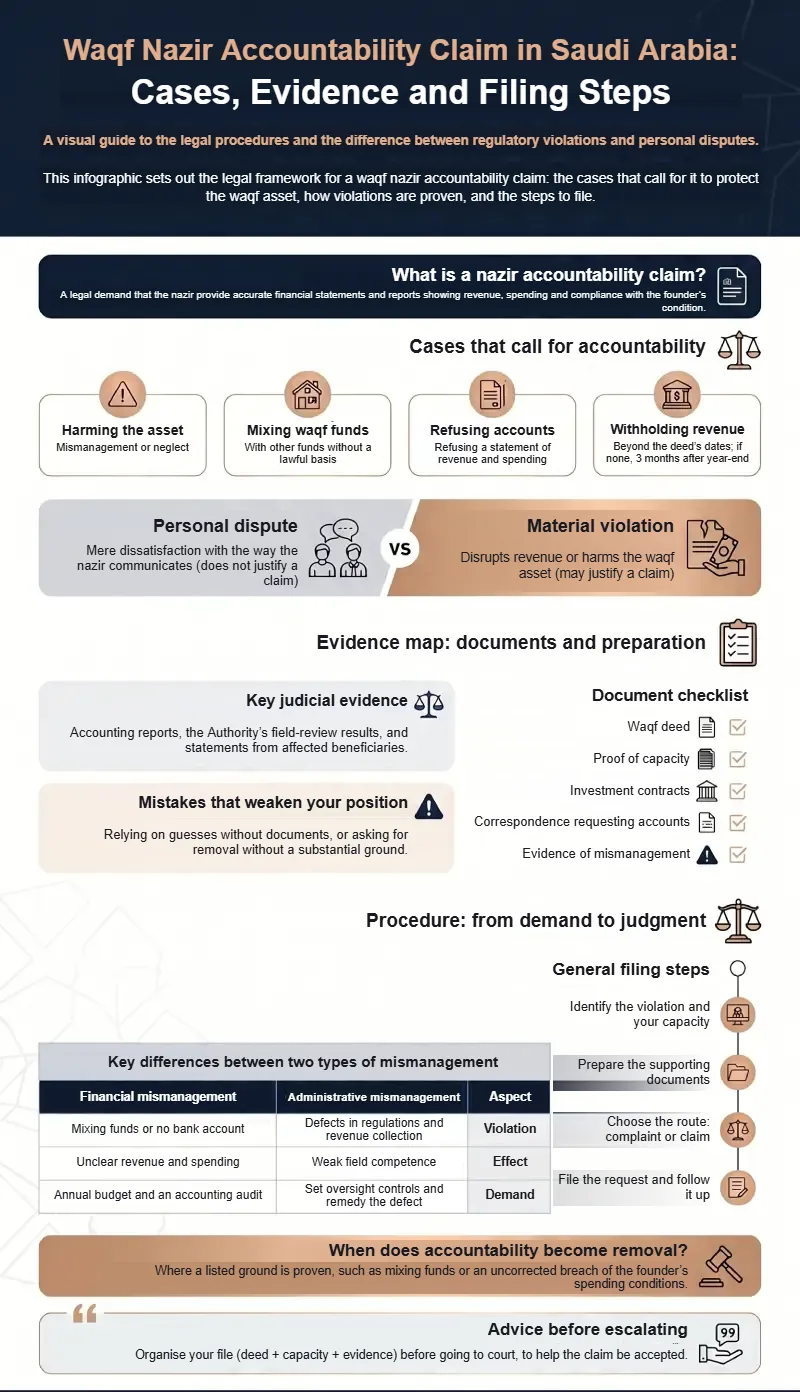
An accountability claim suits cases where there is a significant violation in the administration of the waqf, such as non-distribution of revenue, refusal to provide an account statement, mixing of funds, or breach of the founder’s condition. A family disagreement or dissatisfaction with the nazir is not enough: capacity, interest and documents are needed to support the request.
Before filing, arrange the waqf deed, the founder’s condition, whatever proves your capacity, and your earlier correspondence with the nazir. You can then decide the closest route: a request for the accounts, a complaint to the competent body, or an accountability claim before the appropriate court.
What Does Holding a Waqf Nazir to Account Mean?
Holding a waqf nazir to account means requiring the nazir to give a clear statement about the administration of the waqf, its income and its expenses. The aim is to examine the accounts and the nazir’s compliance with the founder’s condition and the interest of the waqf.
A nazir does not manage personal money. A nazir manages endowed property that has defined conditions and spending purposes. The nazir’s acts are therefore tied to the waqf deed, the founder’s condition, the rights of the beneficiaries, and whatever serves the interest and lasting benefit of the waqf.
A nazir’s responsibility also depends on the nature of the waqf and its conditions, so accountability cannot be separated from the general rules that govern the conditions of a waqf in Saudi law.
A claim matters more where the nazir refuses to show the accounts or to explain how revenue is spent. The General Authority for Awqaf has published the regulation organising trusteeship work, to regulate that work in a way that serves the founder’s purpose and protects the waqf.
When Can a Nazir Be Held to Account?
A claim may be filed where capacity, an interest and a provable violation are all present. The claimant must show a link to the waqf, for example as a beneficiary, a person named in the waqf, or an interested person harmed by the nazir’s administration.
General phrases such as “the nazir is negligent” or “we do not trust the administration” are not enough. It is better to identify the violation precisely: is the problem the revenue? Does the nazir refuse an account statement? Are properties leased without a clear statement? Was revenue spent against the founder’s condition?
| Point of comparison | A personal dispute with the nazir | A significant violation open to accountability |
|---|---|---|
| Basis | Dissatisfaction or a family dispute | An event connected to the administration of the waqf |
| Proof | Often weak | Clear documents or indications |
| Effect | Usually does not touch the waqf | Often affects the revenue or the asset |
| Example | Disagreement about how to communicate | Non-distribution of revenue or mixing of funds |
Before filing, ask yourself: what is the harm? What is the document? How does the act relate to the founder’s condition? Clear answers make the file more coherent.
Main Cases for Holding a Waqf Nazir to Account in Saudi Arabia
The most common case is a nazir who refuses to distribute waqf revenue despite clear beneficiaries. A request is stronger where there is regular income from a property or an investment, and no statement showing the income and expenses.
Another important case is a refusal to provide an account statement or to let beneficiaries see the financial statements. It may point to a lack of transparency, especially if beneficiaries have already asked for the statement and received no clear answer.
A breach of the founder’s condition is also a significant case, particularly where revenue is spent on people who are not entitled. That includes spending against the waqf deed, refusing to spend, or changing the beneficiary without a clear basis.
Accountability is also needed where waqf funds are mixed with other money, or where there are no clear separate accounts. It becomes prominent where the waqf asset is sold or leased in a way that harms the beneficiaries or conflicts with the interest of the waqf.
| Case | Practical effect | What to examine |
|---|---|---|
| Non-distribution of revenue | Beneficiaries’ rights are suspended | The founder’s condition and spending records |
| Refusing an account statement | Financial administration is unclear | Earlier requests and the nazir’s replies |
| Breach of the founder’s condition | Spending contrary to the purpose | The waqf deed and the spending purposes |
| Mixing funds | Revenue is hard to trace | Accounts and transfers |
| Dealing with the asset | Possible harm to the waqf | Deeds, contracts and the justifications |
The way a violation is assessed depends on the type of waqf. The revenue of a family waqf is not read like that of a charitable or joint waqf, as becomes clear when looking at the types of waqf in Saudi Arabia.
Who Can Ask for a Waqf Nazir to Be Held to Account?
A request can be made by a person with capacity and an interest connected to the waqf, such as a beneficiary, a person named in the waqf, or an interested person harmed by the way the waqf is run.
Heirs do not always have capacity merely as heirs. They need a recognised link to the waqf, to the founder’s condition or to the beneficiaries. Capacity must therefore be proved before the details of the violation are discussed.
A competent regulatory body may also step in where there is a violation touching the administration, data or documents of the waqf. A private family dispute must therefore be distinguished from a violation that touches the interest of the waqf or its beneficiaries.
Accountability Claim or Removal Claim?
Accountability focuses on requiring the nazir to explain the accounts, state revenue and expenses, and correct a defect where it is proved. Removal is tied to a graver violation, loss of a recognised condition, or significant harm that makes the nazir’s continuation unsuitable.
A case may start with accountability alone where the problem is missing information or unclear expenses. It may move on to removal if mixing of waqf funds, abuse of position or a significant breach of the founder’s condition is proved.
| Case | Request usually most suitable |
|---|---|
| Incomplete account statement | Accountability and an order to provide the accounts |
| Non-distribution of revenue | Accountability and correction of spending |
| Mixing funds | Accountability, and removal may be needed |
| Breach of the founder’s condition | Accountability or removal, depending on gravity |
| Nazir unable to manage | A replacement or assistant where needed |
Removal should not be requested automatically in every claim. It is better to order the requests according to the facts, so the file does not look wider than its support. If accountability reveals a grave violation or repeated harm, the request may move from account statements to the conditions for removing a waqf nazir in Saudi Arabia.
Documents Needed Before Filing
Documents are the foundation of an accountability claim, because they move the request from an accusation to a file that can be examined. The most important is the waqf deed, since it shows the founder’s condition and the limits of spending and administration.
Prepare proof of the claimant’s capacity, such as whatever shows beneficiary status. Lease contracts or investment data also help to show that revenue existed and should have been stated or distributed.
It is best to gather the following before any step:
- The waqf deed.
- The founder’s condition or the text that governs spending.
- Proof of the claimant’s capacity and interest.
- Lease contracts or investment data.
- Account statements, income and expenses.
- Payment receipts, or proof of refusal to pay.
- Correspondence asking the nazir for the account statement.
- Proof of dealing with the asset or of mismanagement.
Where the waqf is a family waqf or tied to an inheritance, arranging capacity and documents with an inheritance and estates lawyer in Jeddah helps separate the waqf dispute from ordinary inheritance disagreements.
Trust and Legal Basis
Legal basis
This guide is based on the General Authority for Awqaf trusteeship regulation and the violations schedule, together with Najiz services listed below, and is written for general legal awareness rather than as advice on a specific case.
Published by: BMS Legal Law and Legal Consultancy Company.
Address: Jeddah, Al-Mishrifah District, Palestine Street, Al-Safeer Tower
How to Prove a Waqf Nazir’s Violation
Proving a violation starts by linking the event to a document. If the allegation is that the nazir does not distribute revenue, state the source of the revenue, who the beneficiaries are, and for how long no payment has been made.
If the violation is a refusal to give an account statement, it is better to record the request by letter or another provable means. Lease contracts, bank transfers and account statements can also be used where available.
Where the dispute is about hidden revenue or mixed funds, an accounting report may be needed. A report helps where there are several properties, overlapping accounts, or expenses that are hard to understand from the primary documents.
| Type of violation | Suitable evidence |
|---|---|
| Non-distribution of revenue | The waqf deed, spending records, beneficiary data |
| Refusing an account statement | Recorded letters, earlier requests, the nazir’s replies |
| Mixing funds | Bank statements, transfers, an accounting report |
| Breach of the founder’s condition | The condition, the act in breach, the payment document |
| Dealing with the asset | Deeds, contracts, sale or lease documents |
Steps for Filing the Claim in Saudi Arabia
The first step is to identify the violation precisely. It is not enough to write that the nazir mismanaged. State the act, the period, the effect and the document that supports each point.
Next, gather the documents and link them to each request. If you ask for a statement of revenue, attach what shows that revenue exists. If you ask for correction of the distribution of revenue, attach what proves your capacity and the founder’s condition.
Where possible, record a request to the nazir for the accounts before escalating. This is not a condition in every case, but it helps show that the dispute did not begin with a claim.
The nazir’s duties give the claim its basis. Under the trusteeship regulation, revenue must be paid according to the purposes and dates in the waqf deed, through the waqf’s own bank account, and where the deed sets no date it must be paid within three months of the end of the waqf’s financial year. The nazir must also document distributions, keep the waqf’s accounts, and make information that concerns them available to beneficiaries on request. A breach of these duties is a violation first; whether it also supports removal depends on the grounds the regulation lists.
Judicial requests are filed through the route that fits the type of request and jurisdiction. It is not advisable to assert one route before examining the case, because some cases begin with a regulatory complaint while others need a court claim.
What Goes in the Statement of Claim?
The statement of claim must be ordered and specific. Begin with the claimant’s details and capacity, then the nazir’s details and capacity, then the waqf and its deed.
Then state the facts in a clear sequence: when the nazir began to administer, what the violation is, and how it affected the revenue, the beneficiaries or the waqf asset.
Then write the requests that fit, without unnecessary expansion. They may include requiring the nazir to provide the accounts, statements of revenue and expenses, correction of the distribution of revenue, or stopping an act that harms the waqf.
Finish with a clear list of documents. Each document should support a specific request, so the claim is not a general narrative with no evidential structure.
Illustrative Form of the Claim
The following outline is illustrative only. It does not replace drafting suited to the waqf deed and the facts, and it must be adjusted to the documents available and the requests that fit.
To the Honourable Judges of the competent court
Claimant: [name], capacity: [beneficiary / person named in the waqf / interested person].
Defendant: [name of nazir], capacity: nazir of the waqf of [name of waqf].
Subject of the claim: a request to hold a waqf nazir to account and require the nazir to provide the accounts of the waqf.
Facts: The defendant holds the trusteeship of the waqf under [the waqf deed] and is bound to administer it according to the founder’s condition. The claimant has been harmed by [non-distribution of revenue / refusal to provide an account statement / breach of the founder’s condition / mismanagement], despite asking for the accounts to be explained.
Documents: the waqf deed, proof of the claimant’s capacity, correspondence with the nazir, and any available contracts or financial statements.
Requests: to require the nazir to provide a detailed statement of income and expenses, to state the spending of the revenue, and to correct whatever is proved to be a violation, with whatever steps are needed to protect the interest of the waqf.
Do not use this outline as it stands before reviewing the waqf deed and the founder’s condition, because every waqf has its own conditions, spending purposes and beneficiaries.
Possible Requests in an Accountability Claim
The requests vary with the nature of the violation, so a ready-made list should not be copied without tying it to the facts. An unsuitable request can weaken the statement of claim.
The requests may include:
- Requiring the nazir to provide the accounts of the waqf.
- A statement of income and expenses over a defined period.
- Handing over documents or data connected to the waqf.
- Correcting the spending of revenue where a violation is proved.
- Returning sums if they are shown to have been paid out wrongly.
- Stopping an act that harms the waqf asset or its revenue.
- Removal, if there is a significant and proved violation.
- Appointing a replacement nazir where the interest of the waqf requires it.
Not every request is used in every case. It is better to choose the request that answers the real problem, not the one that merely increases the number of requests.
A Complaint to the General Authority for Awqaf or a Claim?
A complaint usually suits regulatory or administrative violations, such as refusing to allow inspection, failing to keep documents, or failing to update data. A claim is closer where a judicial order, accountability or the return of sums is sought.
The two routes can be combined where a violation has both a regulatory and a judicial side, for example mixing of funds or a continuing refusal to give the account statement, together with a request to require the nazir to provide the accounts or correct the spending.
| Route | When it suits | Expected outcome |
|---|---|---|
| Complaint to the Authority | A regulatory or administrative violation | An inspection or a regulatory step |
| Court claim | An order, accountability or return of sums | A judgment or a judicial decision |
| Both together | A violation with several sides | Regulatory action alongside a judicial request |
If the violation goes beyond the accounts, it can help to see when a request moves from accountability to removal, with the support of a personal status lawyer in Jeddah.
Mistakes That Weaken an Accountability Claim
The first mistake is filing a claim over a personal dispute alone. The problem must be turned into specific facts, such as non-distribution of revenue, refusal of an account statement, or an act against the founder’s condition.
The second is ignoring the waqf deed or the founder’s condition. That document is the reference for accountability and shows whether the nazir’s act agrees with or departs from what the founder wanted.
A common mistake is using general phrases without documents, such as saying the nazir hid money without attaching contracts, statements or recorded requests.
The file is also weakened when accountability, removal and compensation are mixed without order. It is better to start with the request closest to the facts, then add other requests if they have clear support.
When Do You Need a Lawyer?
You need a lawyer where the waqf deed is unclear, where there are several properties and sources of revenue, where the nazir refuses to provide the accounts, or where accountability is combined with a removal request. In these cases it is not enough to describe the violation: the documents must be organised and the requests drafted clearly.
Where the waqf overlaps with the rights of beneficiaries or a long family dispute, a personal status lawyer in Jeddah can help read capacity and requests before escalating.
Before getting in touch, prepare what you have of the waqf deed, proof of beneficiary status, lease contracts, account statements and correspondence with the nazir.
Frequently Asked Questions About Holding a Waqf Nazir to Account
What is a waqf nazir accountability claim?
It is a claim that seeks to require the nazir to explain the administration, income and expenses of the waqf where there is a violation or a significant refusal.
When can I file a waqf nazir accountability claim in Saudi Arabia?
It can be filed where there is capacity, an interest and a provable violation, such as non-distribution of revenue or refusal to provide an account statement.
Who is entitled to hold a waqf nazir to account?
A person with capacity and an interest, such as a beneficiary, a person named in the waqf, or someone harmed by the nazir's administration.
Can a beneficiary ask a waqf nazir for an account statement?
Yes, where the request is tied to the beneficiary's rights, to the waqf revenue or to the way the nazir manages the endowed property.
What should I do if the nazir does not distribute the revenue?
Start with a recorded request, then gather the waqf deed and whatever proves the revenue, and then assess the route of a complaint or a claim.
What is the difference between holding a nazir to account and removing one?
Accountability examines the administration and the accounts, while removal asks to end the nazir's authority where there is a significant reason.
Conclusion
A waqf nazir accountability claim in Saudi Arabia is not just a search title. It is a practical route that should start with identifying the violation, then gathering the documents, then choosing the right request. Accountability does not rest on bare objection or a family dispute, but on capacity, an interest and events that can be proved.
After arranging the waqf deed, the correspondence and the revenue statements, you can send a short description of your case through our contact page to identify the most suitable legal step.
Need help holding a waqf nazir to account? Send us the deed and your documents for an initial review of the route that fits your case.
Need help holding a waqf nazir to account?
Speak with a BMS Legal lawyer in Jeddah for an initial review of the waqf deed, your documents and the route that protects your rights.
Enquiries are handled confidentially · No specific court outcome can be guaranteed
Official Legal and Government Sources
- Regulation Organising Trusteeship Work, General Authority for Awqaf (Arabic-language official document).
- Schedule of Violations and Penalties under the Trusteeship Regulation (Arabic-language official document).
- Najiz: waqf documentation and judicial services (Arabic-language official service page).
Disclaimer: This article is for general legal awareness and is not advice on an individual case, and reading it does not create a lawyer–client relationship. The legal assessment varies with the facts, the documents and the rules that apply to each case.