Verifying property ownership in Saudi Arabia means making sure the seller has the right to dispose of the property, that the title deed or ownership document is valid and up to date, and that no significant restriction appears on the property, such as a mortgage, a seizure, a dispute or an inadequate power of attorney.
It is not enough to rely on a photo of the deed or on the seller’s word before paying a deposit or signing a sale contract. The buyer needs to check the ownership data, the seller’s capacity, the property boundaries, and any restriction that may later affect the transfer of ownership.
Buying property? Verify the deed before you pay.
A real estate lawyer can review the deed, the seller’s capacity and any restrictions before you pay a deposit or sign.
Enquiries are handled confidentially · No specific court outcome can be guaranteed
Summary: What to Verify Before Signing Anything
Verifying property ownership starts with examining the title deed or ownership document, then matching the owner’s and property’s data, confirming the seller’s capacity, and reviewing restrictions that may prevent the sale or delay the transfer.
| Check | What you review | Why it matters |
|---|---|---|
| The deed or document | Deed number, owner, area | Confirms the ownership data |
| Matching the seller | ID, power of attorney, heirs’ capacity | Prevents a sale by someone without capacity |
| Restrictions | Mortgage, seizure, notes | Reduces the risk of a blocked transfer |
| Matching the property | Plot number, plan, boundaries | Avoids a mismatch between reality and the document |
| Legal review | Power of attorney, heirs, dispute, old deed | Before paying the price or deposit |
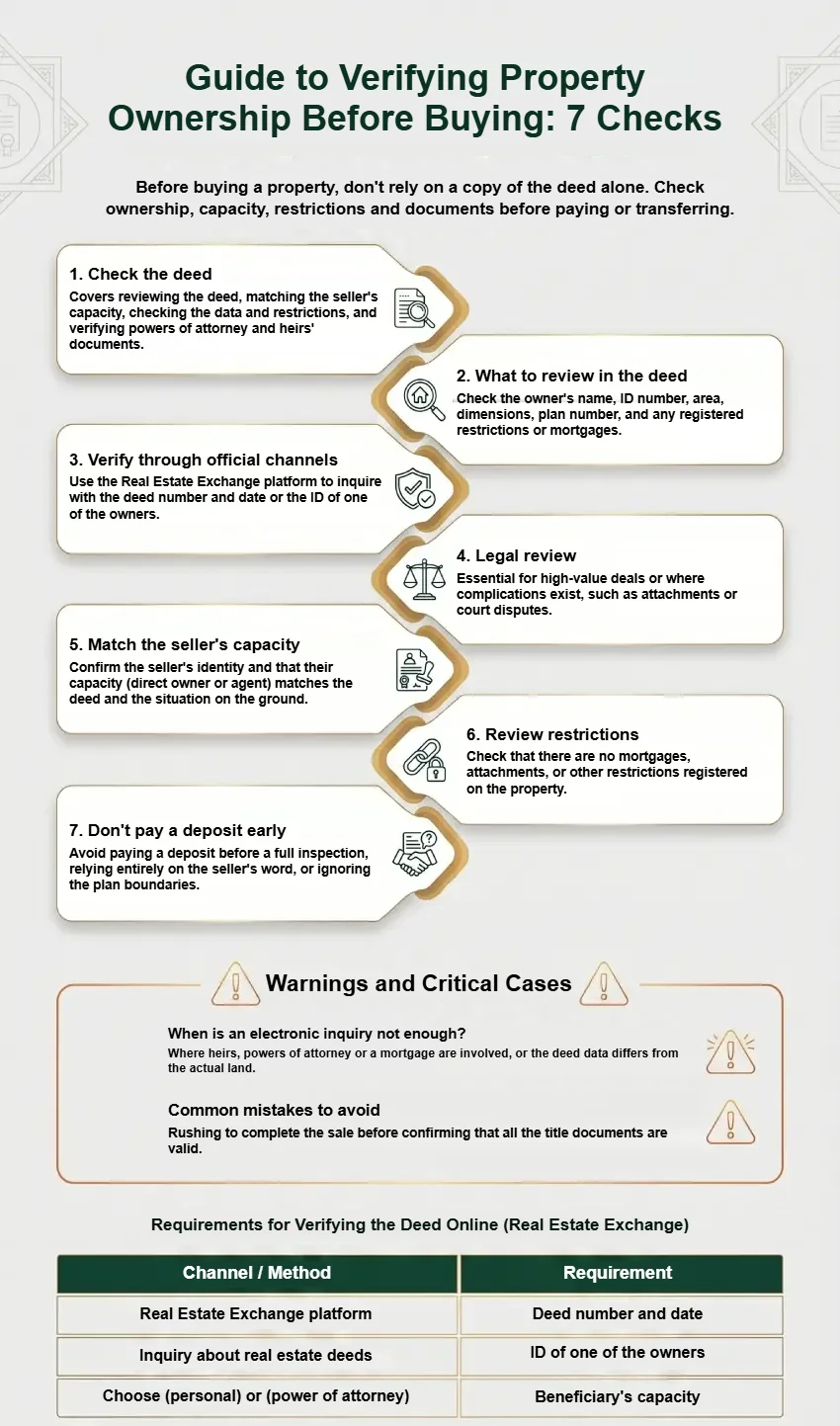
7 Core Checks Before Buying Property
Before buying any property, seeing a photo of the deed or hearing the seller’s assurance is not enough. It is better to go through seven short checks that reduce the risk of a dispute or a blocked transfer.
- Check the deed or ownership document: confirm the deed or document number and the owner’s and property’s data from an official source.
- Match the seller’s capacity: check whether the seller is the direct owner, an agent, an heir or a company representative.
- Review the property data: check the area, boundaries, plot number, plan number and city.
- Verify restrictions: watch for a mortgage, seizure, notes or any restriction that may affect disposal.
- Check the power of attorney: if the sale is by proxy, confirm the powers to sell, transfer, sign and receive the price.
- Review heirs’ documents: when buying inherited property, ask for the heirs’ deed and the necessary powers of attorney or approvals.
- Stop at any ambiguity: if a difference or missing document appears, do not pay a deposit before a legal review.
Ownership checks start before the deposit
In property deals, a photo of the deed alone is not enough. What matters is matching the seller’s capacity, checking the power of attorney or the heirs, and reviewing the restrictions that may affect the transfer.
- The deed and the document: review the deed number, the owner’s data, the area and the plot number before relying on any agreement.
- The seller’s capacity: check whether the seller is a direct owner, an agent, an heir or a company representative.
- Restrictions and risks: watch for a mortgage, a seizure, or any difference that may delay or block the sale or transfer.
When Is Legal Review Important?
With a power of attorney, heirs, a mortgage, a seizure, mismatched data or a high-value deal, legal review helps you understand the risks before signing or transferring. A real estate lawyer in Jeddah can review the property documents using a clear method: the deed, the capacity, the power of attorney, the heirs and the restrictions that affect the property.
What Does Verifying Property Ownership in Saudi Arabia Mean?
Verification means reviewing the official documents and platforms to confirm that the property belongs to the person offering it for sale. It includes examining the deed, the ownership document, the real estate register data and the seller’s legal capacity.
The difference between knowing the owner’s name and legal verification is important. You may know the name of a person linked to the property, but that is not enough for a safe deal. You must be sure that the person has the right to sell, or is an agent with clear powers, a legal representative of a company, or an heir holding valid documents.
So the question “how do I find out who owns a property?” is not answered by a name alone. The practical answer starts with the ownership document and ends with checking the capacity, the restrictions and the documents that affect the property.
When Do You Need to Verify Ownership?
You need to verify ownership before any financial or legal commitment, especially before paying a deposit or signing the sale contract. A deposit may open a dispute if it later appears that the deed is not up to date or that the seller lacks sufficient authority.
A deed check should also be done before the final transfer, because restrictions may appear or change before the transfer of ownership is complete. The need grows when the property is owned by heirs, sold by proxy, or when the deed data differ from reality.
Verification is also needed if the deed is old, if the area and boundaries are unclear, or if the property is tied to a mortgage or a seizure. In these cases an electronic inquiry alone is not always enough.
Official Ways to Verify Property Ownership
There are several official routes to inquire about ownership or verify a title deed. One of the most prominent is the service for inquiring about a property ownership document. The Ministry of Justice explains that it runs through the Real Estate Exchange platform with a National Single Sign-On account: you choose the beneficiary capacity and enter the document number and date, or the document number and the ID number of one of the owners, to view the details of the document and the property.
Property ownership checks are rarely complete without reviewing the deed data itself, so an inquiry about a property deed is a basic step for understanding the state of the document and the property data before moving on to the power of attorney, the heirs or the restrictions. Our guide to a Saudi property deed inquiry explains how to do it.
The Real Estate Registry is linked to services such as the ownership registration deed, the real estate register extract, the transfer of ownership, and the management of rights, restrictions and obligations. Verifying the ownership registration deed is therefore important for properties registered in kind or those that have real estate register data.
What Data Should You Check in the Title Deed?
Confirming that a title deed is valid does not mean reading the deed number only. You must review the owner’s data and capacity, and the ID or commercial register number, then match it with the person selling the property or signing the contract.
You must also check the property data itself, such as the plot number, plan number, area, boundaries, lengths, district, city and type of use. Any difference between the deed and reality may later affect the price, the transfer or a dispute.
| Property data | What it shows |
|---|---|
| Owner’s name and ID number | The capacity of the person selling the property |
| Deed or document number | Helps with the official inquiry |
| Area and lengths | Reveals any material difference |
| Plot and plan number | Links the property to its legal location |
| Restrictions and mortgages | Shows a possible impediment |
| Description and use | Helps in understanding the nature of the property |
Verifying the Seller’s Capacity Before Buying
If the seller is the direct owner, check that the name and ID match the deed or ownership document. Do not rely on a preliminary contract or a written conversation if the capacity is not clear from the official documents.
Sale by proxy
When the sale is by power of attorney, review the agent’s powers carefully. The power of attorney should include what permits sale, transfer and signing, and what relates to receiving or handing over the price, depending on the nature of the deal. Not every general power of attorney is suitable for sale or transfer.
Company-owned property
If the owner is a company, check the commercial register and the authority of the manager or the authorised person. Some cases may need a partners’ resolution or a clear authorisation to sell the real estate asset.
Inherited property
If the property is owned by heirs, ask for the heirs’ deed and verify the heirs’ approval or valid powers of attorney. Watch for cases involving a minor, an absent heir or a dispute among the heirs. Our guide to the Najiz electronic inheritance deed explains the document used to establish the heirs.
In deals involving an agent, heirs or an owning company, advice from a real estate lawyer in Jeddah helps clarify the seller’s legal capacity before signing the contract or paying the deposit.
Documents Needed to Verify Ownership of a Property
The documents differ by case, but there are core documents to request before moving to signing or payment. They include the deed or ownership document, the owner’s data, the property data, and the draft sale contract, if any.
In special cases you need additional documents, such as a power of attorney for sale, the heirs’ deed, the heirs’ approvals, mortgage or mortgage-release documents, or the owning company’s documents.
- A copy of the deed or property ownership document.
- The owner’s ID or commercial register.
- The deed or document number.
- The plot number, the plan and the area.
- A power of attorney for sale, if there is an agent.
- The heirs’ deed when buying inherited property.
- Mortgage or seizure documents, if any.
- The draft sale contract or the deposit agreement.
Common Mistakes When Verifying Property Ownership
The most prominent mistake is relying on the seller’s word without clear documents. Personal trust is not enough in property transactions, especially where large sums or more than one party are involved.
Other mistakes include:
- Paying the deposit before examining the deed and the restrictions. A problem may appear later in the deed, a difference in area, insufficient powers for the agent, or an objection from one of the heirs.
- Neglecting to check the power of attorney, even though selling by proxy needs a careful review. Not every general power of attorney is valid for sale, transfer or receiving the price.
- Ignoring the boundaries and the plan. The deed may be sound in origin, but the property data need matching with reality before the final price is set.
Trust and Legal Basis
Legal basis
This guide is based on the Ministry of Justice property ownership inquiry and deed update services and the Real Estate Registry services listed below, and is written for general legal awareness rather than as advice on a specific case.
Published by: BMS Legal Law and Legal Consultancy Company.
Address: Jeddah, Al-Mishrifah District, Palestine Street, Al-Safeer Tower
When Is an Electronic Inquiry Not Enough?
An electronic inquiry alone is not enough where there are signs of an ownership dispute or a difference between the deed data and reality. In that case you need to examine the documents, the contract, the correspondence and the legal capacity of each party.
Nor is it enough on its own when buying inherited property, verifying a power of attorney for the sale of property, or where there is a mortgage or a seizure. You may need additional documents or a legal review before any financial commitment.
The need for review also appears in high-value deals, commercial property, or property tied to a company, heirs or financing. The aim here is to reduce risk before the transfer, not to treat a dispute after it occurs.
Sometimes the disagreement is not about proving ownership but about denying that a property is attributable to someone, or denying a liability tied to it. Understanding how to prove that you do not own a property helps before choosing the right procedure.
What Should You Do If a Problem Appears in the Ownership?
If a problem appears, pause payment or signing until the picture is clear. Do not sign a new declaration, and do not send an extra amount before understanding the effect of the problem on the transfer or the contract.
Gather the deed, the contract, the messages, the powers of attorney, the heirs’ documents and any payment receipts. Then identify the type of defect: a deed that is not up to date, an incomplete power of attorney, a mortgage, a seizure, a dispute, or a sale by someone without capacity.
The problem may be procedural and need an update or amendment of a title deed. The Ministry of Justice explains that the service for updating or amending a title deed runs through the Real Estate Exchange platform: choosing the type of request, entering the data, attaching the required documents, then submitting the request.
If the problem moves from missing data to a dispute over the right itself, the path of proving ownership of the property becomes more tied to the case, especially where documents need legal arranging before a claim is made.
When Do You Need Real Estate Legal Advice?
You need real estate legal advice before signing a binding sale contract, when paying a large deposit, or if the property is being sold by proxy or is owned by heirs.
You also need it when a difference appears in the deed, when you suspect a mortgage or a seizure, or when a party’s capacity is unclear. In these cases a real estate lawyer reviews the documents before escalation or signing.
At BMS Legal, a property review starts by understanding the case, then examining the deed, the capacity, the power of attorney and the restrictions.
Where the deal involves a power of attorney, heirs, a mortgage or mismatched data, you can reach our legal team to review the documents and identify the right step before the transfer.
Quick Answer: When Is Property Ownership Verification Necessary?
Property ownership verification is necessary before paying a deposit, before signing the sale contract, when buying from an agent or heirs, or if a mortgage, a seizure or a difference in the deed data appears.
In those cases the deed, the seller’s capacity, the restrictions and the documents that affect the deal must be reviewed before the transfer. If the deal is high in value or tied to a company or heirs, it is better to review the file before any bank transfer.
Frequently Asked Questions About Verifying Property Ownership
How do I verify property ownership in Saudi Arabia?
Start by examining the deed or ownership document, then match the owner's and property's data, the restrictions and the seller's capacity.
How do I know that the seller really owns the property?
Match the seller's name and ID with the deed, or review the power of attorney or the heirs' documents where needed.
How can I check that a title deed is valid?
Review the deed number, the owner's data, the area, the plot number, the plan and any visible restrictions.
Is the deed alone enough to prove ownership of a property?
The deed is important, but it is not always enough where there is a power of attorney, heirs, a mortgage or a dispute.
How can I tell whether a property is mortgaged or seized?
Review the registered restrictions and rights, and ask for a mortgage-release document or the approval of the related party if there is one.
When do I need a real estate lawyer before buying property?
You need one when there is a power of attorney, heirs, a mortgage, a seizure, mismatched data or a high-value deal.
Conclusion
Verifying property ownership in Saudi Arabia before buying is not just a heading in a guide but a practical path. It starts with examining the deed or document, then matching the seller’s capacity, reviewing the power of attorney or the heirs, checking the restrictions, matching the property data, and stopping at any unclear point before paying or transferring.
Do not rely on a photo of the deed alone, and do not pay a deposit before reviewing ownership, capacity and restrictions. Start with an inquiry about a property ownership document or about a title deed, then examine the seller’s legal capacity.
If any point is unclear, early legal review is often cheaper than a long dispute after the purchase. You can ask for real estate legal advice when the deal involves a power of attorney, heirs, a mortgage or mismatched data.
For an initial review, contact a law firm in Jeddah and send the deed and the available documents, so the file can be examined and directed to the right step before the transfer, without promising any result in advance.
Planning to buy a property? Send us the deed and the seller’s documents for an initial review before you pay a deposit.
Planning to buy a property?
Speak with a BMS Legal lawyer in Jeddah for an initial review of the deed and documents before you pay a deposit.
Enquiries are handled confidentially · No specific court outcome can be guaranteed
Official Legal and Government Sources
- Ministry of Justice: inquiry about a property ownership document (Arabic-language official service page).
- Ministry of Justice: request to update or amend a title deed (Arabic-language official service page).
- Saudi Real Estate Registry (Arabic-language official website).
Disclaimer: This article is for general legal awareness and is not advice on an individual case, and reading it does not create a lawyer–client relationship. The legal assessment varies with the facts, the documents and the rules that apply to each case.