
Transferring property ownership in Saudi Arabia is the formal procedure by which ownership passes from the current owner to the new owner, after checking the deed, the capacity of the parties, and settling the obligations tied to the property transaction where they apply. A sale contract alone is often not enough unless the conveyance or registration is completed through the competent body.
The topic matters when buying land, an apartment or a villa, when transferring property between relatives, or when dealing with inherited or mortgaged property. The procedure may be simple if the deed is sound and the parties are ready, but it becomes complicated where there is a mortgage, heirs, a power of attorney, a minor, or a refusal by one of the parties.
Najiz offers a service for listing a real estate deal to create a deal between a seller and a buyer and complete the dealings through the platform. The Real Estate Registry also allows a request to transfer ownership of property registered in whole or in part, and to register the transaction in the real estate register.
This guide explains how property ownership is transferred, the conditions, steps, documents, tax, and the problems that may block the conveyance. It also shows when legal review becomes important before paying the price or filing a claim.
Buying, selling or transferring a property?
A real estate lawyer can review your deed, contract, tax position and any mortgage or power of attorney before the conveyance.
Enquiries are handled confidentially · No specific court outcome can be guaranteed
Practical Answer Before the Conveyance Starts
If you want to transfer ownership of a property, start by examining the deed, then verify the identity of the parties, the capacity of the agent if any, and that the property is free of mortgage, seizure or restrictions. Then the transfer procedures are completed through the competent platform, with payment of the real estate transaction tax where it applies.
| Item | Practical summary |
|---|---|
| The procedure | Transfer of ownership, or real estate conveyance |
| The route | Najiz, the Real Estate Exchange, or the Real Estate Registry, depending on the property’s status |
| Key condition | A sound deed, parties with capacity, and a property free of impediments |
| Tax | Real estate transaction tax where it applies |
| Sensitive cases | Power of attorney, heirs, a minor, a mortgage, jointly owned property |
| Common risk | Paying the price before the conveyance is complete or while an impediment sits on the deed |
Before paying the full price, make sure the property data match reality, that the deed can be disposed of, and that the method of payment is documented. This early check reduces the chance of delay, especially for old, mortgaged or multi-owner properties.
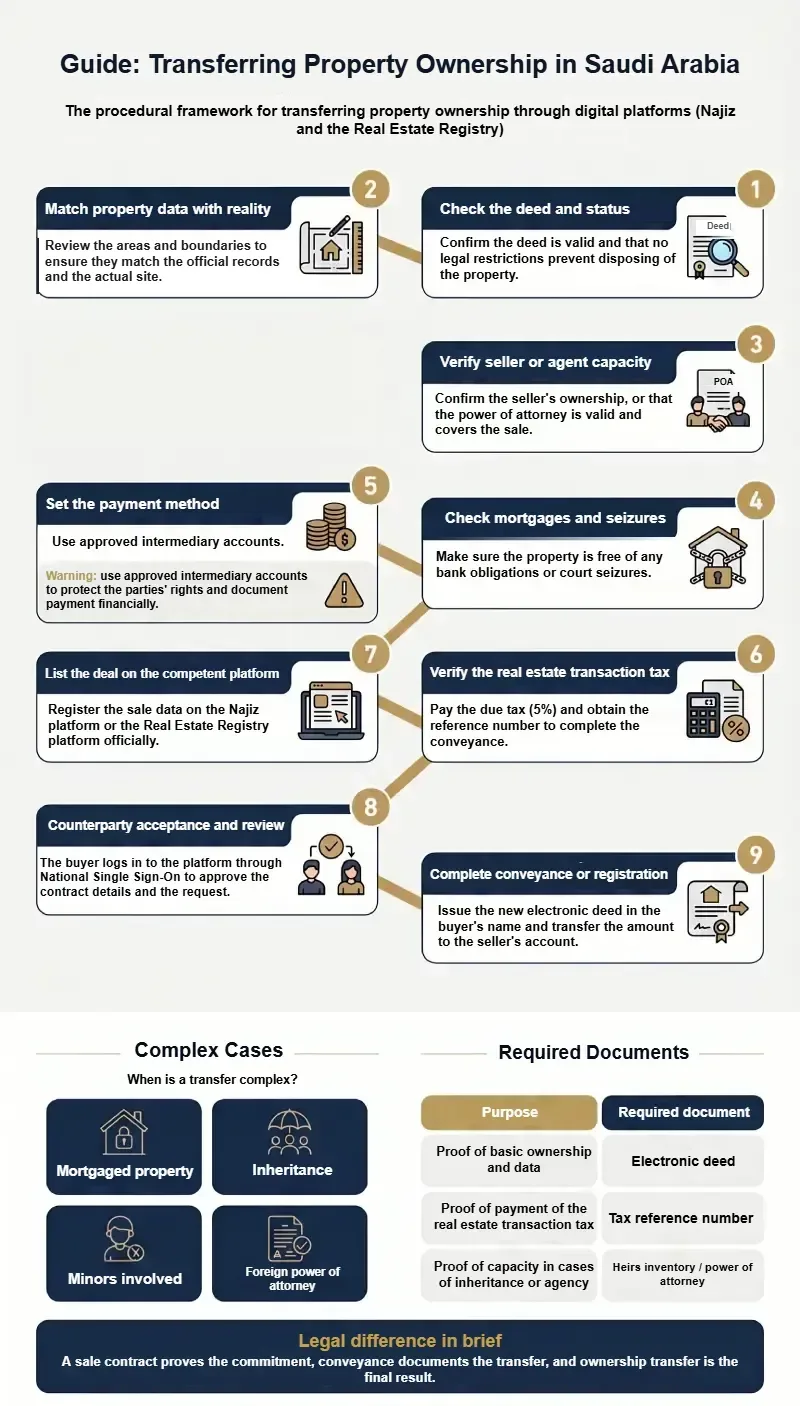
9 Steps Before Transferring Property Ownership in Saudi Arabia
Before starting the transfer, do not make payment, or accepting the deal electronically, your first step. The right order begins with examining the documents, capacity and obligations, then moving to the conveyance or registration once the risks are clear.
The steps for transferring property ownership electronically in Saudi Arabia are:
- Verify the deed data and the property’s status: review the deed number, owner’s name, type of property, area and registered restrictions before any procedure.
- Match the property data with reality: confirm that the location, boundaries, use and area match what appears in the deed or the register.
- Confirm the seller’s or agent’s capacity: check whether the seller is a direct owner, an agent, a representative of heirs, a guardian, a trustee, or an authorised company representative.
- Check for a mortgage, seizure or other restriction: do not start the deal before knowing whether there is a mortgage, seizure, waqf, dispute or impediment affecting the conveyance.
- Set the method of payment and document the instalments: agree clearly on how the price is paid, when, and what happens to the amount if the conveyance fails.
- Register the real estate transaction tax where it applies: check whether the transaction is subject to tax, who bears it, and whether any exemption or exception needs proof.
- List the deal through the competent platform: the electronic transfer begins through Najiz, the Real Estate Exchange, or the Real Estate Registry, depending on the property’s status.
- The other party accepts after reviewing the data: the request is accepted only after reviewing the property data, the value of the deal, the parties and the obligations tied to it.
- Complete the conveyance or register the transfer: once the requirements are met, the conveyance is documented or the transfer is registered, and the deed and transaction documents are kept.
Before the conveyance starts, a photo of the deed is not enough; it is better to examine its data and status through an inquiry about a property deed to confirm the deed number, the owner’s name and the property data before moving to payment or listing the deal. Our guide to a Saudi property deed inquiry explains how.
These steps do not replace examining the particular case if the property is inherited, mortgaged, jointly owned or tied to a power of attorney. In those cases the route may change from a direct electronic procedure to a legal review before the conveyance.
Choose Your Situation Before Starting
Not all property deals follow the same path. Identify your situation first, then prepare the right documents before starting the transfer procedures.
| Your situation | What you need now |
|---|---|
| A clear deed and no mortgage | Follow the electronic conveyance steps after reviewing the data |
| A mortgaged property or one with a loan | Review the mortgagee’s approval and how the mortgage is released |
| Inherited property | The heirs’ deed and their approvals or powers of attorney |
| A seller who refuses to convey | Prepare the contract, proof of payment and correspondence |
| Transfer by power of attorney | Check the scope and validity of the power of attorney |
| A minor is involved | Check the capacity of the guardian or trustee and any approvals needed |
| A company-owned property | Review the commercial register, authorisation and the representative’s powers |
If your situation is unclear, start by examining the deed, the contract and the capacity before any new payment, since some cases need advice from a real estate lawyer in Jeddah before reaching the conveyance stage.
What Does Transferring Real Estate Ownership Mean in Saudi Arabia?
Transferring property ownership means ownership passes officially from one person to another, after the transaction is documented and the owner’s data updated with the competent body. It includes the passing of the right tied to the property from the seller, the donor or the heirs to the new owner.
The important difference here is that a sale contract is not always equal to transfer of ownership. The parties may sign a contract that is valid as an obligation, but ownership is not formally complete until the conveyance or registration. A buyer may therefore hold a legal claim without appearing as the official owner until the procedure is finished.
In the modern real estate system, the transfer of ownership may be tied to the electronic deed, or to the Real Estate Registry if the property falls within the in-kind registration scope. The executive regulation of the In-Kind Real Estate Registration Law explains that an ownership registration deed includes the property number, the in-rem rights, their owners and details, and their ownership shares.
In practice, the problem appears when the buyer pays the price or the deposit before the conveyance is complete. The contract, proof of payment, correspondence and the deed’s status then determine the right course.
The difference between transfer of ownership and conveyance
Transfer of ownership is the legal result, while the real estate conveyance is the procedure that leads to it. People use the terms interchangeably, but the distinction helps where there is a dispute or delay.
The conveyance means documenting the passing of the property from the current owner to the new owner. It usually appears in sales, where the seller conveys the property to the buyer once the data and requirements are complete. Transfer of ownership may also be used for gifts, partition, inheritance or other dispositions.
The term “listing a real estate deal” appears when a deal is created between a seller and a buyer through the competent platform. For properties registered in kind, the route may be through the Real Estate Registry, because the property itself becomes the focus of registration, not only the owner’s name.
To simplify the difference:
- The sale contract proves an obligation between the parties.
- The conveyance documents the passing of the property.
- Transfer of ownership is the final effect once the procedure is complete.
- The Real Estate Registry records the property’s data, rights and owners when in-kind registration applies.
If you hold a sale contract without a conveyance, do not treat the matter as complete ownership. It is better to examine the documents and identify the closest procedure before entering a long dispute.
Conditions for Transferring Property Ownership Before the Conveyance
The conditions for transferring property ownership in Saudi Arabia are not limited to holding a deed. They include the capacity of the seller and buyer, a sound deed, a property free of mortgage or seizure, clear deal data, and payment of the real estate transaction tax where it applies. Where there is a power of attorney, heirs, a minor or a financing body, the approvals and documents become an essential part of completing the conveyance.
| Condition | Why it matters |
|---|---|
| Capacity of the parties | To confirm that seller and buyer have the capacity to dispose |
| A sound deed | Any error or restriction may stop the conveyance |
| A property free of impediments | Such as a mortgage, a seizure or a dispute |
| Matching deal data | To avoid refusal or delay of the request |
| Payment of tax where it applies | The conveyance may stall without it |
| A valid power of attorney | If one of the parties acts through an agent |
| Approval of heirs or guardian | Where heirs or a minor are among the owners |
If the property falls within the Real Estate Registry, the requirements of the service for in-kind registered property must be observed. The Registry’s ownership transfer service requires signing in through National Single Sign-On, choosing the property, completing the service form, attaching the requirements, paying the fee, then submitting the request.
In ordinary cases the procedure may look direct. But with a mortgage, heirs or an incomplete power of attorney, reviewing the documents before the conveyance matters more than finishing the request quickly.
Required Documents by Case
Documents vary by the type of disposition, the capacity of the parties and the property’s status. Still, there is a core group to prepare before starting, so the request does not stall over a small omission.
| Case | Documents or data needed | Practical note |
|---|---|---|
| Ordinary sale | IDs of the parties, deed, deal data, payment details | Match the deed data with reality |
| Power of attorney | A valid power of attorney with suitable powers | Check the powers to sell, convey and sign |
| Heirs | Heirs’ deed, deed, approvals or powers of attorney of the heirs | A dispute among heirs may stop the procedure |
| Minor | Guardianship or trusteeship document and needed approvals | The disposition must protect the minor’s interest |
| Company | Commercial register, articles, resolution or authorisation of the representative | Check the manager’s or delegate’s authority |
| Mortgage or loan | The mortgagee’s approval or proof the mortgage is released | Do not rely on a verbal promise to release it |
Do not settle for preparing only the visible documents. Sometimes the problem lies in the content of the document itself, such as a power of attorney that lacks the power to convey, a sale contract that sets no transfer date, or a deed that needs updating before disposition.
If the deal involves a company or an investment property, it is better to review the manager’s powers and the partners’ resolutions. This reduces the risk of objection to the disposition after the sale is completed.
Fees and Tax on Transferring Property Ownership
Many people confuse service fees, the real estate transaction tax, and the amounts agreed between seller and buyer. These items should therefore be separated before signing the contract or paying a deposit.
The real estate transaction tax is usually the most important in sales. The Zakat, Tax and Customs Authority explains that it is a tax at 5% of the value of the property being sold or whose possession is transferred, whatever its condition or form, and it is paid before or during the conveyance or documentation of contracts.
Fees or financial consideration for services may differ by service, platform and type of request. So no single figure should be given for all cases, especially when dealing with the Real Estate Registry or in-kind registration services.
Before agreeing, the contract should state:
- Who bears the real estate transaction tax.
- Who bears any financial consideration for the platform or registration.
- Whether the price includes the tax or not.
- When payment is made, and before which exact step.
- What happens if an unforeseen tax or obligation appears.
There are exceptions or special treatments for some dispositions, such as certain gifts or the transfer of ownership within an estate. The nature of the disposition should therefore be checked before assuming an exemption or payment.
Trust and Legal Basis
Legal basis
This guide is based on the Najiz real estate deal service and the Real Estate Registry ownership transfer service listed below, and is written for general legal awareness rather than as advice on a specific case. Tax figures should be confirmed with the Zakat, Tax and Customs Authority before any transaction.
Published by: BMS Legal Law and Legal Consultancy Company.
Address: Jeddah, Al-Mishrifah District, Palestine Street, Al-Safeer Tower
Expected Time to Complete the Procedure
The time to transfer property ownership varies with the readiness of the deed, the completeness of the parties’ data, the tax position, and the presence of a mortgage, heirs or a power of attorney. It is better to treat the time as an estimate tied to the case, not a fixed number for every deal.
Quick cases are usually those where the deed is electronic and clear, the parties act for themselves, and there is no mortgage, seizure or dispute. Complete payment and tax details also help reduce delay.
Cases that take longer usually include:
- Transfer of ownership of property to heirs.
- Transfer of a mortgaged property or one with a loan.
- A minor among the owners.
- A power of attorney whose powers need verification.
- An error in the deed data or the property boundaries.
- A difference between the value of the deal and the tax data.
- A party refusing to accept or to convey.
If the procedure is delayed, do not begin by accusing the other party. First examine whether the delay is technical, tax-related, due to a missing document, or due to a legal impediment on the property.
Transferring Ownership by Power of Attorney
Property ownership can be transferred by power of attorney if the power of attorney is valid and current and gives clear powers for the disposition required. The problem is often not the existence of a power of attorney but whether it is sufficient for the type of disposition.
When a power of attorney is used, check these points before accepting the deal:
- Is the power of attorney valid at the time of the disposition?
- Does it cover sale, purchase or conveyance?
- Does it include the power to sign documents?
- Does it allow receiving or handing over the price when needed?
- Does the agent represent one party only?
- Is there a conflict of interest between agent and principal?
- Was it issued by a person who is still alive and has capacity?
The gravest mistake is to pay a large sum relying on a general or unclear power of attorney. A power of attorney may allow an administrative act but not suffice for the conveyance, receiving the price or completing the property disposition.
If you are a buyer, do not accept a power of attorney just by seeing a copy. Verify its validity and content through official channels, and have it reviewed legally if the deal is high in value or tied to heirs or a company.
Heirs and Minors in Property Transfers
Transferring property to heirs needs more care than an ordinary sale, because the property may be owned by several people in different shares. The capacity of each heir and his approval, or a person lawfully representing him, must be confirmed.
For inherited property, check:
- That a valid heirs’ deed exists.
- The names of the heirs and their shares.
- The heirs’ approval of the sale or transfer.
- Valid powers of attorney for those who do not attend. See our guide to a power of attorney for heirs.
- Resolution of any dispute over shares or management.
- That there is no will, waqf or restriction that affects the property.
If one of the owners is a minor, deal with the disposition carefully. The signature of a relative is not enough if he has no clear legal capacity, because dispositions of a minor’s property are subject to rules that protect the minor’s interest.
Some cases may need permission or approval from the competent authority, depending on the capacity of the guardian or trustee and the nature of the disposition. Avoid selling the property or receiving the price before confirming that the capacity of whoever represents the minor is complete.
Gifts Between Relatives and Their Effect on Transfer
Transfer of property ownership between relatives may be a sale for a price, a gift without consideration, a partition, or a disposition tied to a family arrangement. The description changes the documents, the tax effects and how a dispute is handled if it arises later.
A gift means transferring ownership without financial consideration. It may be subject to certain tax exceptions if the statutory conditions are met. The Zakat, Tax and Customs Authority explains that the real estate transaction tax applies to all property transactions made by sale and what is deemed equivalent, including transfer of ownership without consideration unless exempted under the executive regulation.
Do not assume an exemption just because of kinship. The family relationship must be proven, it must be established that the disposition is a genuine gift and not a disguised sale, and there must be no undocumented consideration.
When transferring property from father to son or to a wife, the reason must be clearly documented. If the disposition is a sale, the price and the payment method should be specified. If it is a gift, the specific requirements of that description should be completed.
Transferring a Mortgaged Property or One With a Loan
Transferring a mortgaged property is not as simple as for a property free of restrictions. A mortgage means another body holds a right over the property, and the conveyance is often not completed until that right is dealt with.
Handling may be through releasing the mortgage, the mortgagee’s approval, or arranging simultaneous payment, depending on the property’s status and the financing. What matters is that the buyer does not rely on verbal promises that the mortgage will be released later. See our guides on selling a mortgaged property and the real estate mortgage transfer conditions.
Before buying a property with a loan or mortgage, review:
- The amount of the outstanding debt.
- The mortgagee or financing body.
- Whether there is initial approval of the disposition.
- Who bears repayment of the debt.
- Whether payment is made before the conveyance or through a documented mechanism.
- What happens if the mortgagee does not approve.
The greatest danger is that the buyer pays a large part of the price outside a documented mechanism, then the mortgage cannot be released or the seller refuses to convey. The file then becomes a financial and property dispute that needs careful arrangement of evidence and steps.
Why a Property Transfer May Be Refused or Blocked
A transfer may be blocked for reasons tied to the deed, the parties, the tax, or restrictions on the property. The cause of the obstacle should therefore be identified before choosing the legal step.
| Cause of obstacle | Common example | Suitable step |
|---|---|---|
| A problem in the deed | Data not updated or not matching | Fix the deed before the sale |
| A shortfall in capacity | An insufficient or expired power of attorney | Review the power of attorney or issue a valid one |
| A mortgage or seizure | A restriction preventing free disposition | Release the restriction or obtain the needed approval |
| Heirs | Some heirs do not agree | Settlement or a judicial route, depending on the case |
| A minor | No guardian capacity or required permission | Complete the approvals before disposition |
| Tax | Not registered, or data differ | Correct the data and pay what is due |
| Seller refuses | Price received without conveyance | A formal notice or a claim to compel conveyance |
If the problem is only technical, reviewing the platform or updating the data may be enough. If the obstacle is refusal or dispute, keep the evidence and do not rely on verbal conversations.
What If the Seller Refuses to Transfer Ownership?
If the seller refuses to transfer ownership after agreement, do not start with a direct claim before arranging your file. The first step is to collect the documents that prove the sale, the payment, the agreement on conveyance, and any correspondence confirming the seller’s commitment.
Start with this list:
- The sale contract or purchase agreement.
- Payment receipts or bank transfers.
- Relevant WhatsApp messages or emails.
- The deed and property data.
- Any set date for the conveyance.
- What shows the seller’s refusal or delay.
- Details of witnesses, if any.
Then the suitable route is identified. Settlement may be enough if the disagreement is over a date or a missing document. A formal notice may be needed if the seller is stalling without clear reason.
If refusal continues, a claim to compel the seller to convey may be suitable, depending on the strength of the contract, proof of payment and the property’s status. Claims for rescission or compensation may also arise if independent harm is proven from the delay or breach. Our guide to real estate lawsuits in Saudi Arabia explains the types of claims.
Where the refusal relates to a sale contract, payments, or a dispute among several parties, instructing a real estate lawyer may be needed to determine the closest route: settlement, notice or claim.
When Do You Need a Property Transfer Lawyer?
Not every transfer needs a lawyer. But some cases carry practical risk, because a mistake may lead to a long dispute or a financial loss. The lawyer’s role then is to examine the file before escalation or payment.
You usually need real estate legal advice in these cases:
- A sale contract without a conveyance.
- The seller refuses to transfer ownership after receiving the price.
- A mortgage, seizure or restriction on the property.
- Transfer of inherited property where there is a dispute.
- Selling property owned by a minor or a person of limited capacity.
- An unclear power of attorney, or one issued long ago.
- Property jointly owned among several owners.
- A deal in a company’s name or among a business’s assets.
- A difference between the deed’s area and reality.
- A wish to file a claim to compel conveyance.
Where a mortgage, a seizure or refusal to convey appears, reviewing the file with a law firm in Jeddah is an important step to understand the risks before escalation. Before paying the price or a deposit, drafting and reviewing the sale contract helps fix the obligations, conveyance dates, and how to handle default. See also our real estate sale agreement template and real estate transfer agreement template for the structure of these documents.
Common Mistakes Before Transferring Property Ownership
Most transfer problems arise from haste, excess trust, or relying on a short agreement that does not address the risks. The property deal should therefore be treated as a documents file, not a verbal understanding.
The most frequent mistakes:
- Paying the full price before making sure the deed can be conveyed.
- Relying on a short contract that sets no date for transfer of ownership.
- Failing to state how the money is recovered if conveyance fails.
- Ignoring a check for mortgage, seizure or existing restrictions.
- Accepting a power of attorney that lacks the power to sell or convey.
- Not checking the real estate transaction tax before agreeing.
- Neglecting to inspect the property on the ground and relying on the deed only.
- Not documenting the deposit or instalments in a provable way.
- A company signing without verifying its representative’s authority.
- Dealing with heirs without the clear approval of all of them.
A common mistake is to rely on the seller’s word or a photo of the deed without reviewing the data. Verifying the property ownership documents reduces the risk of dealing with a person who has no clear capacity or with a property carrying hidden restrictions.
Prepare These Documents Before Contacting Us
If your case needs review, prepare the core documents first. Having this data helps understand the problem quickly and reduces repeated preliminary questions.
- A copy of the deed or its data.
- The sale or purchase contract.
- Proof of payment or transfers.
- The power of attorney, if any.
- The heirs’ deed, if any.
- Details of the mortgage or loan, if any.
- Any correspondence proving the agreement or the refusal.
- The other party’s details and the agreed conveyance date.
Frequently Asked Questions About Transferring Property Ownership
When is property ownership considered actually transferred?
After the disposition is documented and the ownership data is updated with the competent body.
Is a sale contract enough to transfer ownership of a property?
Often not alone, because official ownership needs a conveyance or registration depending on the property's status and the competent platform.
What is the difference between transfer of ownership and conveyance?
Conveyance is the procedure that documents the disposition, while transfer of ownership is the final legal result.
How is property ownership transferred through Najiz?
By listing the deal, entering the parties' and property data, the other party accepting, and completing the related requirements.
What can stop a conveyance even if the deed exists?
An unsound deed, lack of capacity or data of the parties, a mortgage or seizure, or unpaid tax where it applies.
Does transferring property between relatives carry tax?
It depends on how the disposition is described, the degree of kinship and the conditions of exception, so check before the conveyance.
Conclusion
Transferring property ownership in Saudi Arabia: 9 steps before the conveyance start from one question before any signature or payment: are the deed, capacity, tax, method of payment and the property’s status clear enough to complete the procedure without delay? The conveyance is not a formality at the end of a sale; it is the point that exposes any earlier defect in the contract, power of attorney, mortgage or heirs’ approvals.
The more organised the property file is before starting, the clearer the transfer and the less exposed to delay. With a power of attorney, inherited property, a mortgage, a minor, or a seller stalling over the conveyance, treating the case as an ordinary electronic procedure may open an avoidable dispute.
So before any new step, collect the deed, the sale contract, proof of payment, the power of attorney if any, and any document showing the cause of the delay. These documents decide whether the closest route is a direct conveyance, settlement, notice, or a claim to compel conveyance where needed.
At BMS Legal, a transfer file starts with examining the documents, then explaining the suitable legal options for each case, without advance promises or unmeasured steps.
Need help transferring property ownership? Send us your deed, contract and proof of payment for an initial review of the route that fits your case.
Need help transferring property ownership?
Speak with a BMS Legal lawyer in Jeddah for an initial review of your documents and the route that protects your rights.
Enquiries are handled confidentially · No specific court outcome can be guaranteed
Official Legal and Government Sources
- Najiz: listing a real estate deal and transferring property ownership (Arabic-language official service page).
- Saudi Real Estate Registry: ownership transfer for in-kind registered property (Arabic-language official website).
Disclaimer: This article is for general legal awareness and is not advice on an individual case, and reading it does not create a lawyer–client relationship. The legal assessment varies with the facts, the documents and the rules that apply to each case.