
Many buyers look for the difference between a loan and real estate finance before signing a contract to buy a home. The two terms look close, but their effect differs when you read the contract, identify the financier, calculate the cost, and understand the mortgage and long-term obligations.
In Saudi Arabia, people may use the phrase “real estate loan” to mean support, a fund loan, or any product that helps them own a home. “Real estate finance” is more often tied to a structured contract with a bank or finance company, covering the finance amount, the cost of deferral, the repayment schedule, security, and the terms for early repayment or default.
The difference between a loan and finance is not the only question before signing, however. Some people start from entitlement, income limits and acceptance of the property, which are covered by the conditions for a real estate loan in Saudi Arabia, and then move on to what this guide explains about the contract and its effects.
Do you know what your finance contract really commits you to?
The product name will not decide your position. The contract, the mortgage, the cost of deferral and the early repayment terms will. A BMS Legal lawyer in Jeddah can give your documents an initial review.
Enquiries are handled confidentially · No specific court outcome can be guaranteed
The Difference Between a Loan and Real Estate Finance in a Minute
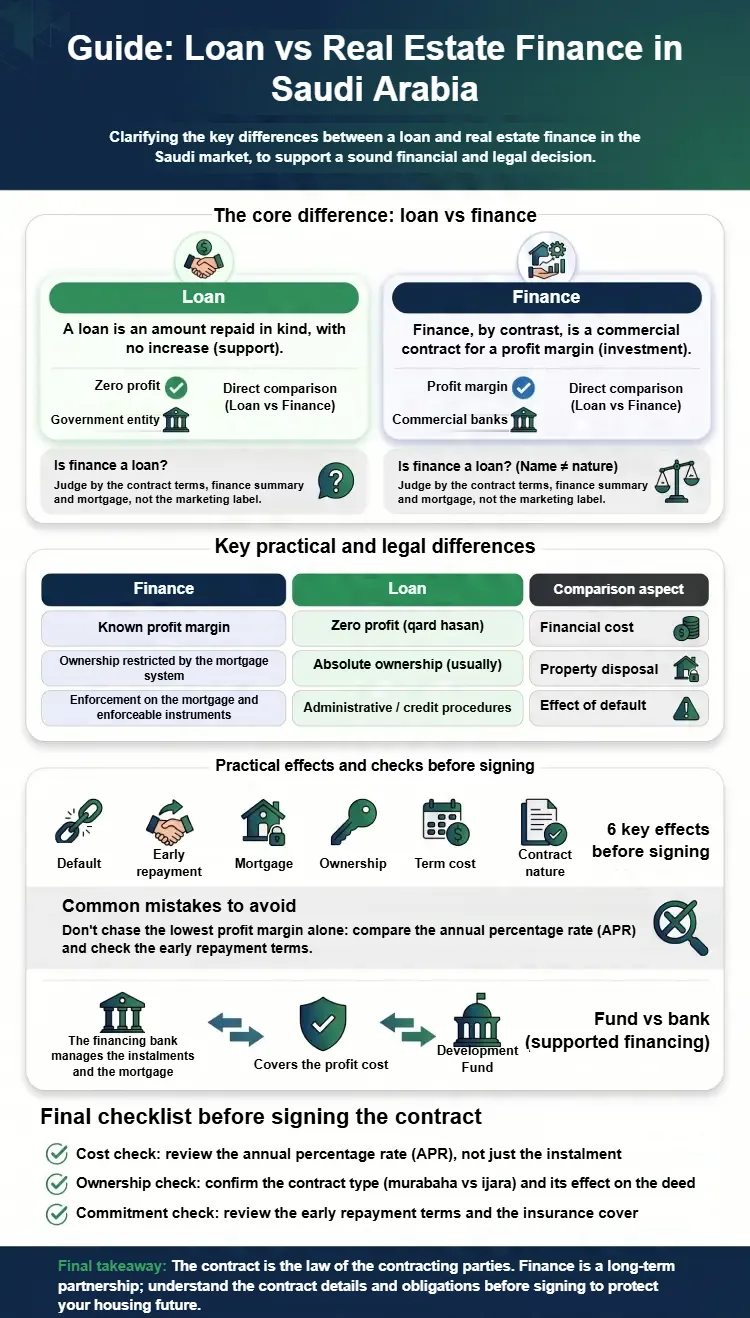
The difference is that “loan” is often used as a general term or for real estate support, while real estate finance is a structured contract with a financier to buy or build a property. The difference shows in practice in the cost of deferral, the annual percentage rate, the mortgage, ownership, early repayment and default.
A loan, in its simple sense, is an amount repaid on certain terms, and in common usage it may be tied to government support or social products. Real estate finance is a detailed contractual relationship that sets the rights and obligations of both parties.
Do not rely on the commercial name of the product alone. Examine the contract, the finance summary, the title deed and the mortgage, because verifying the property’s ownership documents before signing may reveal a restriction or note that changes your decision entirely.
What Are a Real Estate Loan and Real Estate Finance?
To understand the difference, start with definitions rather than bank advertising. Many offers use similar words, but the contract is the real reference when there is a dispute, default or early repayment.
In everyday use, “real estate loan” means any amount or support that helps buy a home or build a property. It may include programmes linked to the Real Estate Development Fund, housing support, or even bank finance that the customer calls a loan.
That usage does not mean every real estate product is a loan in the strict legal sense. The product may be finance structured as murabaha or ijara, a profit subsidy, or a contract tied to a mortgage and security.
Real estate finance, by contrast, is usually a financial product designed for buying or building property and offered by a licensed financier. It appears in a contract that includes the finance amount, repayment period, instalment, cost of deferral, annual percentage rate and security.
Finance from a bank may be structured as murabaha, ijara or another form, depending on the product and the financier. It may also be linked to a support programme such as the Real Estate Development Fund’s support.
Table: Loan Versus Real Estate Finance
Before deciding, compare the two terms from a practical angle. The table below shows the differences that usually appear when reading a contract and understanding the customer’s relationship with the financier.
| Point of comparison | Real estate loan | Real estate finance |
|---|---|---|
| Nature of the term | General or common usage | A structured finance contract |
| Related body | Sometimes a fund or support body | A bank or finance company |
| Object of the obligation | An amount or support for a property purpose | Finance tied to a specific property |
| Cost | Varies by programme | Cost of deferral, fees and profit |
| Security | Varies by product | May be tied to a mortgage or guarantee |
| Effect of default | Depends on the type of obligation | Appears in the contract and the mortgage |
| Disposal of the property | Not always affected | May need the financier’s consent |
This table is no substitute for reviewing the contract. Some products are called a real estate loan among people but are in fact real estate finance carrying long-term obligations.
If your question is about choosing the most suitable product, such as buying a home, self-build or land finance, compare the types of finance available before you decide.
Is Real Estate Finance Considered a Loan?
Real estate finance may be called a loan in common usage, but in a bank contract it is a finance product with a structure, a cost and security. So a product is judged not by its name but by the contract, the finance summary and the written obligations.
In some murabaha contracts, the financier buys the property and then sells it to the customer at a known profit with set instalments. In some ijara contracts, the manner of use and the final transfer of ownership differ according to the contract terms.
Before signing, ask yourself:
- What is the contract structure: murabaha, ijara or something else?
- What are the actual finance amount and the cost of deferral?
- Is there a mortgage on the deed, or a restriction on disposal?
- What happens on early repayment or default?
- Is the housing support inside the contract or outside it?
The practical question then is not only whether real estate finance is considered a loan, but what obligations this contract places on you throughout the finance period.
The Real Estate Development Fund and the Bank in Finance
The biggest confusion appears when comparing a Real Estate Development Fund loan with real estate finance from a bank. The fund is tied to support and housing enablement, while the bank or finance company is usually the party that concludes the finance contract and manages repayment and security.
You may hear the phrases “subsidised real estate loan” or “subsidised real estate finance”. In many cases the beneficiary receives finance from a financier, with government support under the programme’s terms and eligibility.
Describing a product as subsidised does not always mean the fund is the direct financier. The support may relate to the cost of finance, its profit, or part of the obligation, according to the approved programme and the contract signed.
If your objection concerns the fund or the support, the practical route starts with how to file a complaint against the real estate fund. Where a written objection is needed, the position should be drafted properly, and you should keep your complaint separate from the finance contract with the bank.
Subsidised Real Estate Finance Does Not Remove the Obligation
Subsidised real estate finance is not just an ordinary loan under another name. It is usually finance from a bank or finance company with support linked to a housing programme or the Real Estate Development Fund, so the source of the finance should be separated from the source of the support.
“Subsidised real estate loan” is an expression people use for a product that helps them own a home with government support. In reality it may appear inside a real estate finance contract and not as a separate loan from the fund.
Support may lighten part of the burden, but it does not remove the need to read the bank’s or finance company’s contract. Always keep two questions apart: are you entitled to support, and what does the finance contract impose on you?
7 Practical Effects You See Before Signing Real Estate Finance
The difference between a loan and real estate finance does not appear only in the definition but in seven practical effects. These effects decide what you will pay, what you own, and what you can do with the property.
- The nature of the contract: are you dealing with support or a detailed finance contract?
- The responsible party: is the obligation owed to a fund, a bank or a finance company?
- Cost of deferral: what is the total you will pay for the finance period?
- Mortgage or security: does it restrict the deed or the disposal of the property?
- Ownership and disposal: can you sell or transfer without consent?
- Early repayment: what is the effect of ending the finance before its due date?
- Default: what procedures may begin if you do not repay?
These seven effects are why reviewing the contract before signing matters. Do not let the commercial name of the product shorten your reading of the obligations.
Cost, Contract and Mortgage: What to Check Most Closely
The most frequent mistake a customer makes is comparing offers by the monthly instalment alone. The instalment may look suitable, yet it does not reveal the full cost, nor the effect of the finance period, the fees or the cost of deferral.
The annual percentage rate (APR) helps you compare the cost of finance between offers. It is more telling than the monthly instalment, because it shows the annual cost according to the elements of the contract.
The cost of deferral is the financial burden tied to the finance period. The longer the repayment period, the higher the total cost may be, even if the monthly instalment looks lighter, so do not let a lower instalment be your only measure.
Before comparing offers, do not stop at asking “how much is the instalment?”. Use the table below to identify the elements that reveal the true cost of the contract.
| What to check | Why it matters |
|---|---|
| Finance amount | Sets the principal obligation |
| Annual percentage rate | Helps compare offers |
| Cost of deferral | Shows the overall burden |
| Contract period | Affects the final cost |
| Early repayment | Matters on a sale or early termination |
| The mortgage | Restricts disposal of the property |
If a finance offer is clear on the instalment but not on the cost of deferral or the mortgage, you may need a contract review before signing to understand the obligations precisely.
A product name will not protect you in a dispute. What fixes your legal position is the finance contract, the contract summary, the repayment schedule, the security, and the terms on early repayment and default.
Finance, the Mortgage and Disposal of the Property
Real estate finance may be tied to a mortgage or security that restricts disposal of the property. You should therefore understand the relationship between finance and the mortgage before a sale, a transfer of ownership or a transfer of the debt.
Finance is the financial and contractual relationship between the customer and the financier. The mortgage is a legal security that restricts the property in the financier’s favour until the obligation is met or the necessary approval is given.
You may obtain finance to buy a home, yet the mortgage may prevent sale, gift or certain dispositions except with the financier’s consent and procedures. So do not treat a financed property as though it were free of restrictions.
A property with finance on it can be sold in some cases, but the matter does not proceed like an ordinary sale. Selling a mortgaged property usually involves the financier’s approval, settling the debt, or transferring the obligation, depending on the case; our guide to selling a mortgaged property explains the main steps, and real estate mortgage transfer conditions cover the transfer side.
Where the property is financed or mortgaged and you are thinking of selling it, the matter is not about the bank alone. You may need to examine the title deed and the conditions for disposal as part of a review of real estate disputes and contracts. Where the aim is to transfer the obligation and not only to sell, you should understand the effect of any assignment of the finance before agreeing to it.
Common Mistakes in Understanding the Loan and Real Estate Finance
Before signing, it is not enough to understand the theoretical difference between the terms. What matters is avoiding the mistakes that change the effect of the obligation on you later.
| Mistake | The better course |
|---|---|
| Comparing the instalment only | Compare the APR, the cost of deferral and the contract period |
| Ignoring the contract summary | Review the summary before signing |
| Not checking the mortgage | Verify the deed and any restrictions |
| Confusing support with finance | Separate the supporting body from the financier |
| Postponing the question of default | Understand the procedures before a problem arises |
The real mistake begins when finance is read as a financial commitment only and its effect on the property itself is ignored: the mortgage, disposal, sale and transfer of ownership. These are details whose practical weight shows when the contract is discussed with a real estate lawyer in Jeddah before signing.
When Do You Need a Legal Review Before Signing?
You need a legal review when the finance contract is long-term, contains an unclear clause, or relates to a mortgaged property, subsidised finance or a transfer of debt. Prepare the finance offer, the contract summary, the repayment schedule, the property details or title deed, the mortgage document and any correspondence with the financier. These documents help you understand the real obligation before signing, instead of relying on a short advertisement or a monthly instalment.
Trust and Legal Basis
Trust and Legal Basis
Legal basis
This guide is based on the Saudi Central Bank’s Real Estate Finance Law page listed below and general market practice, and is written for general legal awareness rather than as advice on a specific case. It does not recommend a product, and the contract you sign is what governs your rights and obligations.
Published by: BMS Legal Law and Legal Consultancy Company.
Address: Jeddah, Al-Mishrifah District, Palestine Street, Al-Safeer Tower
Frequently Asked Questions About the Difference Between a Loan and Real Estate Finance
What is the difference between a loan and real estate finance?
A loan is often used as a general term or for real estate support, while real estate finance is a structured contract with a financing body.
Is a real estate loan the same as real estate finance?
Not always. The contract decides the nature of the relationship, not the name used in an advertisement or in daily speech.
Is real estate finance considered a loan?
It may be called a loan in common usage, but contractually it is a finance product with a structure, a cost and security.
What is the difference between subsidised finance and a subsidised loan?
Subsidised finance is usually a finance contract with a financier, with support linked to a programme or a government body.
What is the difference between real estate finance and a real estate mortgage?
Finance is the financial contract, while the mortgage is a security that restricts disposal of the property until the obligation is met.
When do I need a lawyer before signing a finance contract?
When the contract is long-term, the property is mortgaged, the finance is subsidised, or a clause on repayment or default is unclear.
Conclusion
The difference between a loan and real estate finance, and its seven effects before signing, is a summary of a decision with long-lasting consequences. These effects start with the nature of the contract and run through the financier, the cost, the mortgage, ownership and early repayment, and end with default and what may follow from it.
Do not let the monthly instalment alone drive your decision. Read the cost of deferral, the annual percentage rate, the security, the mortgage, the early repayment clause, and the position on sale or transfer of the debt, because these terms reveal the real obligation and not the name written on the offer.
If the contract is unclear, the property is mortgaged, or you are comparing more than one finance offer, start by checking the documents before you sign.
To have your finance contract reviewed before you sign, contact BMS Legal in Jeddah for a preliminary review of your documents.
Unclear contract or a mortgaged property?
Send us your finance offer, contract summary or deed and a BMS Legal lawyer in Jeddah will highlight what needs attention before you sign.
Enquiries are handled confidentially · No specific court outcome can be guaranteed
Official Legal and Government Sources
- Saudi Central Bank: Real Estate Finance Law (Arabic-language official rulebook)
Disclaimer: This article is for general legal awareness and is not advice on an individual case, and reading it does not create a lawyer–client relationship. The legal assessment varies with the facts, the documents and the rules that apply to each case.