
Duration of investigation in drug cases becomes an immediate concern after an arrest, particularly when the family does not know where the case file is or what procedure comes next. The case may still be with the arresting authority, may have moved to the Public Prosecution, or may be awaiting an important chemical or technical report.
There is no single period within which every drug case investigation must be completed. Each file involves different facts, evidence, reports, and procedural requirements. It is therefore important to distinguish between the investigation period, detention pending investigation, and the trial period that begins after referral to court.
This guide explains the process from arrest and questioning through detention, extension, release, or referral to the competent court. It also outlines the factors that may affect how long the case remains before the Public Prosecution and the information needed to identify its current stage accurately.
Duration of Investigation in Drug Cases: Key Time Limits
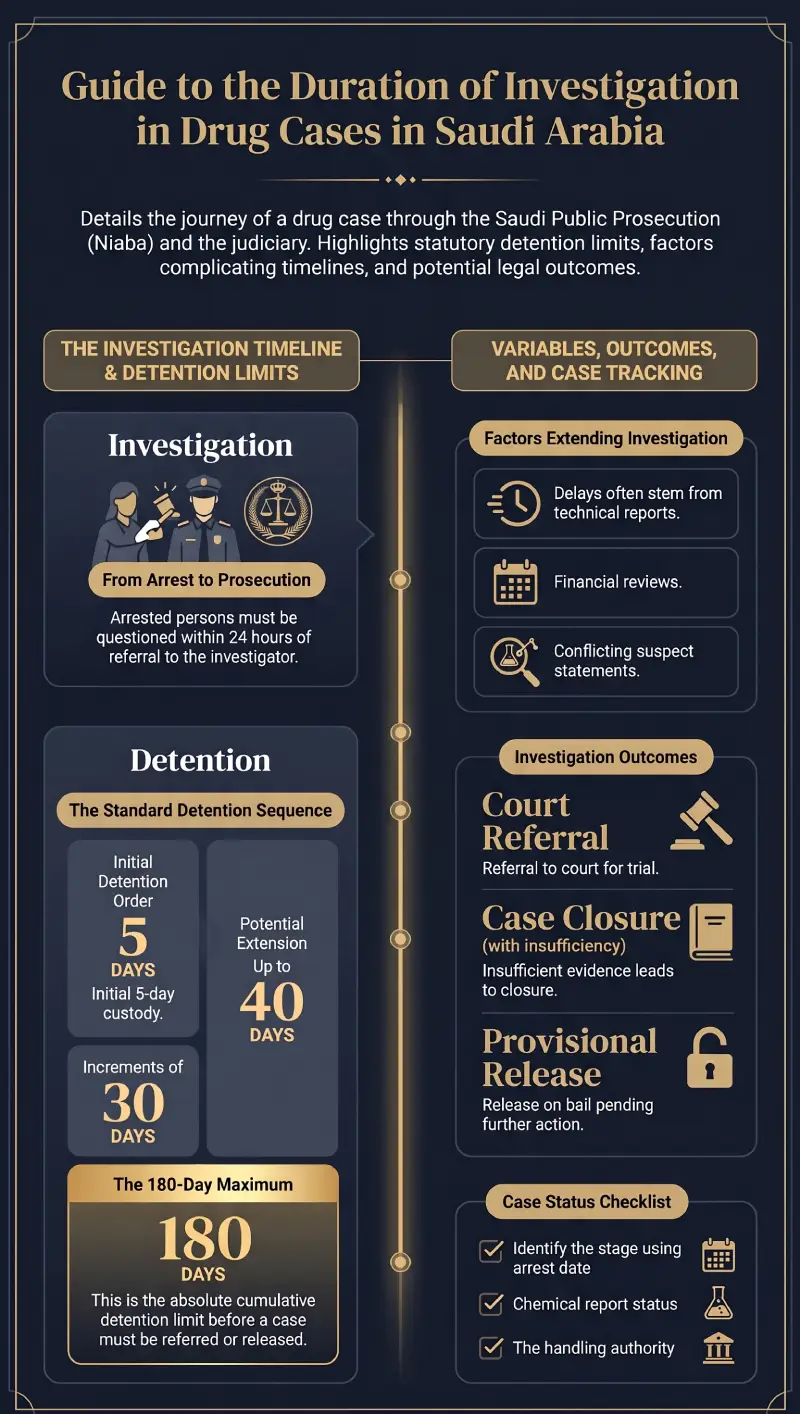
There is no fixed statutory period for completing every drug case investigation in Saudi Arabia. Detention during the investigation may initially be ordered for no more than five days from the date of arrest, provided that the applicable legal grounds are present.
Detention may be extended before the initial period expires. The first extensions may bring the total period to no more than 40 days from the arrest date. If the investigation requires additional time, further consecutive extensions may be issued, with each extension not exceeding 30 days.
The total detention period at this stage may not exceed 180 days from the date of arrest. Once this limit is reached, the accused must be referred to the competent court or released.
Investigation, Detention, and Trial: What Is the Difference?
The investigation period is the time required by the Public Prosecution to question the accused, hear witnesses, review official records, examine reports, and decide how the case should proceed.
An investigation may end while the accused remains detained. It may also continue after the accused has been provisionally released. The detention period, by contrast, is the period during which the accused remains in custody under a valid legal order.
Detention is not a punishment or a finding of guilt. It is a temporary procedural measure linked to the circumstances of the investigation and the legal grounds supporting continued custody.
The trial stage begins after the prosecution prepares the criminal case and refers it to the competent court. Upon referral, authority over continued detention or release transfers to the court. The proceedings then continue through the stages of a criminal case in Saudi Arabia until the court considers the evidence and issues its decision.
| Stage | Meaning | Main Authority | Possible Outcome |
|---|---|---|---|
| Investigation | Collecting evidence, questioning, and reviewing reports | Public Prosecution | Referral, closure, or release |
| Detention | Temporary restriction of the accused’s liberty | Public Prosecution, then the court | Extension or release |
| Trial | Judicial consideration of the case after referral | Competent court | Judicial decision |
How Long Can Detention Last in a Drug Case?
The detention period is calculated from the date of arrest, not from the date the laboratory result appears or the file reaches the Public Prosecution.
The investigator must question the accused within 24 hours of the accused being presented for investigation. The rights of the accused during investigation in Saudi Arabia remain applicable from the beginning of questioning until the relevant procedural decision is issued.
After questioning, the investigator decides whether the accused should be detained or released. The initial detention period ends after five days unless a valid extension order is issued before that period expires.
The first detention periods may be extended to a cumulative total of 40 days. Later extensions may be issued for periods not exceeding 30 days each, subject to the overall limit applicable before referral or release.
When a family asks how long an accused person may remain with the drug enforcement authority or before the Public Prosecution, there is no single answer. The arrest date, latest extension order, current authority holding the file, and status of the technical report must first be identified.
| Stage | Period | Possible Decision |
|---|---|---|
| Referral to the investigator | Within 24 hours | Questioning of the accused |
| After presentation | Within 24 hours | Detention or release |
| Initial detention | Up to 5 days | Release or extension |
| First extensions | Up to a total of 40 days | Continued detention or release |
| Later extensions | Up to 30 days each | Up to a total of 180 days |
| Reaching 180 days | From the arrest date | Referral or release |
| Exceptional circumstances | By court order | Reasoned judicial extension |
Detention Extensions and the Right to Challenge Them
Detention in a drug case is not extended automatically. Continued detention must remain connected to a valid legal basis and to investigative steps that still need to be completed.
Possible reasons for an extension may include waiting for the chemical report, completing a mobile phone examination, or comparing the statements of several accused persons.
The file may also require the review of financial transfers, additional examination of seized items, or further witness statements. The existence of one of these factors does not by itself make an extension valid without compliance with the required procedure.
The law does not provide one fixed answer to how many times detention may be extended. Instead, it regulates the cumulative period, the authority empowered to issue each order, and the maximum length of each later extension.
A person held in pretrial detention may challenge the detention order or an extension order before the competent authority, depending on who issued the decision. The challenge must be decided within five days from the date it is submitted.
Challenging continued detention is different from defending the underlying accusation. The challenge concerns the continued restriction of liberty, while the substantive defence addresses the evidence, the legal characterization of the conduct, and its connection to the accused.
Investigation Stages and Factors Affecting the Timeline
A drug case usually passes through five connected stages: arrest and preliminary inquiries, preparation of official records and preservation of seized items, referral to the Public Prosecution and questioning, examination of substances and samples, and the final decision on the file.
These steps form part of the broader process of criminal investigation in Saudi Arabia, from collecting initial information and documenting the incident to deciding whether the case should proceed.
The investigation may take longer when several accused persons are involved, their statements conflict, or phones and financial transfers require examination. A decision may also be delayed when the incident is connected to another case or to persons whose procedures remain incomplete.
The chemical report may affect the timing when the nature of the seized substance or the accused’s sample is necessary to determine the correct legal characterization. There is no single published period for receiving drug analysis results in every case.
The timeline may vary according to the type of examination, the number of samples, and the procedures required by the competent laboratory. It is therefore not possible to estimate how long a drug case investigation will take from the substance name or accusation alone.
Factors that may extend the investigation include:
- Multiple accused persons or related incidents.
- Delays in the chemical or technical report.
- Examination of messages, phones, and financial transfers.
- Re-examination of samples or seized items.
- Arrest in a different region from the investigating authority.
- The need to hear witnesses or conduct confrontations.
Referral, Case Closure, or Release
The investigation stage ends when the Public Prosecution considers the file ready for a procedural decision. If the available evidence is considered sufficient, the case is referred to the competent court under an indictment explaining the facts, legal characterization, and supporting evidence.
Before referral, the alleged conduct must be reviewed carefully. This may require distinguishing simple possession from drug possession for personal use, based on the circumstances of the arrest, the accused’s statements, and evidence relating to intent.
If the evidence is insufficient, or there is no basis for bringing the criminal case, the investigation may be closed in accordance with the applicable procedure. Closing the case is not the same as releasing the accused.
Case closure concerns the decision made about the investigation itself. Release concerns the accused’s liberty while the investigation or proceedings remain ongoing.
The investigator may issue a provisional release order when there is no longer a sufficient reason for continued detention. Release must not prejudice the investigation, and there should be no substantial concern that the accused will flee or disappear.
A released person must attend whenever requested and provide an approved address for receiving official notices. Release does not prevent the investigation from continuing or the case from being referred later.
Once the case reaches the court, the court becomes responsible for decisions concerning the accused’s continued detention or release.
Does the Timeline Differ by Type of Drug Case?
Saudi law does not assign a separate investigation period to personal use, possession, promotion, or trafficking cases. The practical duration instead depends on the scope of evidence, number of parties, reports, and procedures required.
A personal-use case may focus on the sample result and the circumstances of the arrest. A possession case may require closer examination of the accused’s connection to the seized material, including knowledge of its presence and the purpose behind possession.
The duration does not change solely because the allegation has a particular label. The scope of the investigation is primarily connected to the elements of a drug case under Saudi law and the evidence needed to establish each element.
A promotion case may require examination of conversations, communications, transfers, and relationships involving several people. A trafficking case may involve border points, multiple authorities, and several individuals.
There is also no separate investigation period merely because the incident is the accused’s first drug offence. A first offence does not, by itself, determine how long the investigation will take.
Each file must be assessed through its facts, arrest records, technical reports, and evidence connecting the accused to the alleged conduct. The name given to the case is not enough to predict either its duration or outcome.
What Does a Lawyer Review During the Investigation?
A legal review begins with the arrest date and then matches each procedure to the document authorizing or recording it. This includes the time the accused was referred to the investigator, the initial detention order, and every extension order.
The review also covers the authority that issued each decision, its date, and the records of arrest, search, and preservation of seized items. The accused’s statements, questioning records, confrontation records, chemical report, and sample result may also be relevant.
Depending on the file, the review may include digital and financial evidence, the legal characterization assigned to the incident, and the sufficiency of the existing evidence. The lawyer may also consider whether provisional release or a challenge to continued detention is procedurally available.
This review is not intended to promise an acquittal or release. Its purpose is to assess the procedural course, examine the available evidence, and identify the next appropriate legal step.
When a person is detained or a new extension has been issued, prepare the arrest date, extension orders, and any notice concerning referral or hearings. Sensitive documents should not be sent before verifying the official communication channel.
When specialist review is needed, a drug lawyer in Jeddah begins by examining the arrest date, extension orders, and available reports to identify the current stage and the next procedural step.
Frequently Asked Questions
How long does an investigation in a drug case take in Saudi Arabia?
There is no single duration for every investigation. Detention begins with an initial five-day period and may extend within the statutory limits applicable to the case.
Are the investigation period and the detention period the same?
No. An investigation includes collecting evidence, questioning, and reviewing reports, while detention means temporarily holding the accused under a valid legal order.
From which date is the detention period calculated?
The cumulative detention period is calculated from the date on which the accused was arrested.
How long is the initial detention period in a drug case?
The initial detention order may last for no more than five days from the date of arrest.
Can detention be extended more than once?
Yes. Detention may be extended within the prescribed periods and powers, with each later extension not exceeding 30 days.
What is the maximum detention period during the investigation?
The cumulative detention period may reach 180 days from the date of arrest before the accused must be referred to court or released.
What happens after 180 days of detention?
The accused must be referred to the competent court or released. After referral, the court becomes responsible for decisions concerning continued detention or release.
Do all drug case investigations take 180 days?
No. The 180-day period is the maximum cumulative detention limit before referral, not a mandatory investigation period for every case.
Can an extension of detention be challenged?
Yes. A person held in pretrial detention may challenge the detention order or its extension before the competent authority.
Can the chemical report delay referral to court?
It may delay the decision when identifying the substance or reviewing the sample result is necessary to determine the legal characterization of the incident.
Duration of Investigation in Drug Cases: Up to 180 Days—but that figure represents the maximum cumulative detention period before referral or release, not a fixed timeline for every investigation.
A drug case may move from arrest and questioning to detention, extensions, technical reports, and evidence review before reaching referral, case closure, or provisional release. The investigation may end before the maximum period is reached, and it may continue after the accused has been released.
To identify the current stage accurately, review the arrest date, latest extension order, authority handling the file, and status of the chemical report. When the timeline remains unclear, a law firm in Jeddah can begin by organizing the facts and available documents before assessing the next procedural step.
Legal Sources: