
Article 75 of Saudi Labor Law is a key provision when either an employee or an employer seeks to terminate an indefinite-term employment contract in Saudi Arabia. Termination is not based on the wishes of one party alone. The process must be supported by a legitimate reason, given in writing, and subject to a statutory notice period that varies depending on who initiates the termination and how the employee is paid.
Confusing Saudi Labor Law Article 75 with resignation, Article 77, or Article 80 may lead to applying the wrong legal rule to the employment relationship. Before taking any action, the parties should therefore review the type of employment contract, the stated reason for termination, the date of notice, the final working day, and any financial entitlements arising from termination.
The provision determines when termination of an indefinite-term employment contract may fall within Article 75 and what may follow if the required notice period is not observed or the legitimacy of the reason is disputed.
Article 75 of Saudi Labor Law in 3 Key Rules
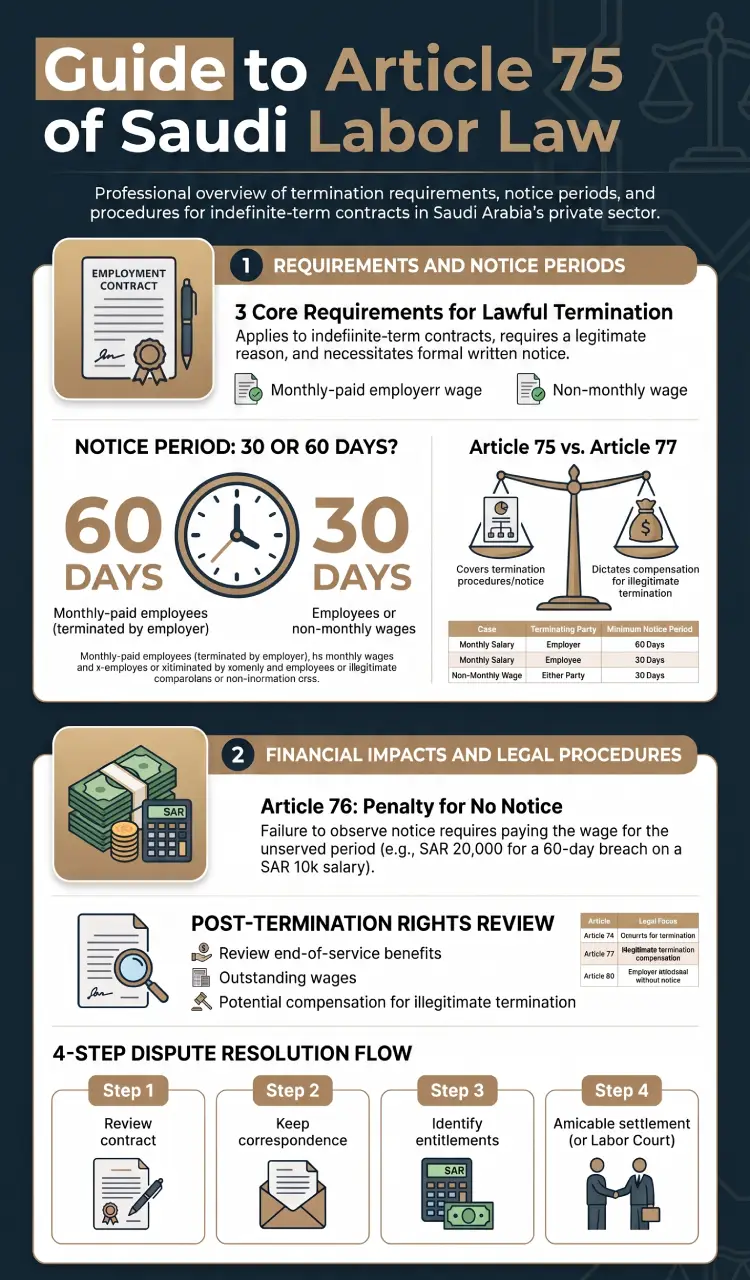
Article 75 can be summarized through three core requirements: the employment contract must be indefinite in duration, termination must be based on a legitimate reason, and the terminating party must provide written notice before the employment relationship ends.
If an employee is paid monthly and initiates termination, the minimum notice period is 30 days. If the employer initiates termination of a monthly paid employee, the minimum period increases to 60 days. Where wages are not paid monthly, the terminating party must generally provide at least 30 days’ notice.
Compliance with the notice requirement does not automatically make the underlying reason legitimate. Likewise, having a legitimate reason does not allow either party to disregard the required notice period. The reason for termination and compliance with notice must therefore be assessed separately when determining whether Article 75 of Saudi Labor Law has been applied correctly.
When Does Article 75 Apply to an Employment Contract?
The rules under Article 75 apply to an indefinite-term employment contract. The first step is therefore to determine the legal nature of the contract before calculating notice periods or potential compensation.
An indefinite-term contract is generally one that does not have a fixed contractual end date under the applicable provisions of Saudi labor legislation. Understanding the contract type is essential because the Saudi Labor Law regulates employment contracts, employee and employer rights, and the different grounds for termination as interconnected legal matters.
A fixed-term contract may become indefinite where the parties continue performing it after the statutory conditions for conversion are met. These include renewal for three consecutive times or where the original contract together with renewals reaches four years, whichever occurs first, while the parties continue performing the employment relationship.
Length of service alone is not enough to determine whether a contract has become indefinite. The original contract, renewals, and the employee’s legal status should all be reviewed.
Article 75 is not the general rule governing fixed-term employment contracts. Termination or expiry of a fixed-term contract is governed by other provisions depending on the circumstances.
The position of non-Saudi employees must also be considered separately. Under Saudi labor rules, a non-Saudi employee’s contract must be written and for a fixed term. If no duration is specified, it is treated as one year from the employee’s actual commencement date.
For this reason, determining the contract type must come before relying on the requirements of Article 75 or calculating a financial claim.
What Is a Legitimate Reason Under Article 75?
Termination of an indefinite-term employment contract under Article 75 of Saudi Labor Law requires a legitimate reason. However, Article 75 does not provide a closed list of every reason that will necessarily qualify as legitimate.
An employer cannot simply write “for a legitimate reason” in a termination decision and assume that the requirement has been satisfied. Similarly, restructuring, performance concerns, or other workplace circumstances should not automatically be treated as legitimate in every case without reviewing the facts.
Where an employer relies on serious misconduct that falls within specific statutory grounds, a different legal framework may apply. Article 80 of Saudi Labor Law identifies specific circumstances in which an employer may terminate employment without an end-of-service award, notice, or compensation when the statutory requirements are satisfied.
Whether a reason is legitimate depends on the actual circumstances, the employment contract, available documents, and the sequence of events leading to termination.
A dispute may concern whether the reason actually existed, whether it was genuinely connected to termination, or whether the available evidence supports the terminating party’s position. In a labor dispute, the court considers the evidence and circumstances presented by both parties rather than treating a single document as automatically decisive.
Searches often refer to “unfair dismissal under Article 75.” From a legal perspective, however, the more precise issue for compensation purposes is whether the contract was terminated for an illegitimate reason.
Article 75 Notice Period: 30 or 60 Days?
The notice period under Saudi Labor Law depends on which party initiates termination and how the employee’s wages are paid.
Where an employee receives a monthly salary and initiates termination, the minimum notice period is 30 days. Where the employer terminates the contract of a monthly paid employee, the minimum period is 60 days.
If wages are not paid monthly, the party terminating the employment relationship must provide at least 30 days’ notice.
| Terminating Party | Wage Payment | Minimum Notice |
|---|---|---|
| Employee | Monthly | 30 days |
| Employer | Monthly | 60 days |
| Either party | Non-monthly | 30 days |
The termination notice must be in writing. The parties should retain evidence showing the content of the notice, its date, and, where relevant, proof that it was received.
Article 75 does not designate one electronic platform as the exclusive method of giving notice. For this reason, documented correspondence and other written evidence may become important depending on the circumstances.
The employment contract should also be reviewed for any contractual notice provisions, provided they do not conflict with the applicable statutory minimum requirements.
What Happens If a Contract Is Terminated Without Notice or a Legitimate Reason?
If an indefinite-term employment contract is terminated without observing the full notice period, the terminating party may be required under Article 76 to pay an amount equivalent to the employee’s wage for the unserved notice period, unless the parties have agreed to a higher amount.
This is commonly described as notice period compensation or payment in lieu of notice. It is legally distinct from compensation arising from termination for an illegitimate reason.
For example, an employer may have a legitimate basis for termination but end the contract immediately without completing the required 60-day notice period. In that situation, a claim relating to the notice period may arise independently of any dispute over the underlying reason.
If termination is based on an illegitimate reason, Article 77 becomes relevant. For an indefinite-term employment contract, and where the contract does not specify compensation, the statutory calculation is based on 15 days’ wages for each year of service, subject to a minimum compensation equivalent to two months’ wages.
For this reason, referring generally to “Article 75 compensation” can be misleading. A claim may concern notice period compensation, compensation for termination without a legitimate reason, or potentially both depending on the facts.
| Issue | Article | Main Legal Effect |
|---|---|---|
| Conditions for termination | 75 | Legitimate reason and written notice |
| Failure to observe notice | 76 | Compensation equal to the notice-period wage |
| Termination for illegitimate reason | 77 | Compensation subject to Article 77 |
For example, if an employee earns SAR 10,000 per month and the employer terminates the contract immediately when a 60-day notice period was required, the notice period compensation may reach SAR 20,000 where Article 76 applies.
Whether additional compensation is available under Article 77 remains a separate question depending on the legitimacy of the termination reason.
Article 75 of Saudi Labor Law,
including the contract type, legitimate reason for termination,
notice period, notice compensation, and related termination consequences.
BMS Legal for Legal Services and Consultations
employee entitlements, and the legal effects of related provisions.
Jeddah – Al-Mushrifah – Palestine Street – Al-Safeer Tower
Based on the Saudi legal provisions referenced in this article.
legal advice for a specific case. The assessment of employment termination
depends on the contract type, termination reason, notice, documents,
and the circumstances of each case.
What Are the Employee’s Rights After Termination?
Employee rights following termination are not limited to notice compensation or damages. Other financial and contractual entitlements arising from the employment relationship must also be reviewed.
Where the employer gives the termination notice, Article 78 grants the employee paid time during the notice period to search for alternative employment, subject to the conditions established by the Saudi Labor Law. The employment relationship and its effects generally continue until the notice period expires.
End-of-service benefits must also be assessed under the provisions governing those entitlements. There is no separate calculation called an “Article 75 end-of-service benefit.”
As a general calculation basis, the end-of-service award is calculated at half a month’s wage for each of the first five years and one month’s wage for each following year, subject to the reason for termination and other applicable provisions.
The employer must generally settle the employee’s entitlements within a maximum of one week where the employer terminates the relationship. Where the employee terminates the employment relationship, settlement is generally required within two weeks.
Article 75 must also be distinguished from resignation. Resignation is now regulated as a separate statutory route, and not every termination initiated by an employee should automatically be classified as resignation. This distinction can affect both procedure and the calculation of certain entitlements.
Article 75 Compared With Related Saudi Labor Law Provisions
Applying the correct article helps avoid significant mistakes when ending an employment relationship. Article 75 regulates termination of an indefinite-term contract, while Article 76 deals with failure to observe the required notice period and Article 77 addresses compensation for termination based on an illegitimate reason.
Article 80 covers specific cases in which an employer may terminate the employee without an end-of-service award, notice, or compensation when its statutory conditions are met.
In circumstances that differ from ordinary termination, Article 81 of Saudi Labor Law identifies situations in which an employee may leave employment without notice while retaining statutory rights, provided the required conditions are satisfied.
| Article | Main Subject |
|---|---|
| 74 | Grounds for termination of employment |
| 75 | Termination of an indefinite-term contract |
| 76 | Failure to observe the notice period |
| 77 | Compensation for illegitimate termination |
| 78 | Employee rights during the notice period |
| 79 bis | Resignation |
| 80 | Employer termination in specified cases |
| 81 | Employee leaving employment without notice |
Accordingly, a comparison between Article 75 and Article 77 or Article 80 should always begin with the actual facts before determining which statutory provision governs the situation.
How Can You Challenge a Termination Under Article 75?
If you believe a termination decision violated Article 75 of Saudi Labor Law, begin by identifying the specific point of dispute rather than simply describing the termination as unfair.
Review the type of employment contract, which party initiated termination, the stated reason, the date notice was issued, the final working day, and any amounts already paid or still outstanding.
Relevant documents may include:
- The employment contract and renewals.
- The written termination notice.
- Professional correspondence.
- Payroll records.
- Performance reports.
- Warnings or other documents connected with the stated reason for termination.
Saudi labor disputes generally begin through the amicable settlement service administered by the Ministry of Human Resources and Social Development. If settlement cannot be reached, the dispute may proceed to the Labor Court through the applicable procedures.
Employees and employers should also avoid unnecessary delay, as Saudi Labor Law contains time limits affecting the acceptance of employment-related claims after the employment relationship ends, subject to statutory exceptions.
Where the termination reason is disputed or the case involves notice compensation or termination damages, consulting a Labor Lawyer in Jeddah may help determine the legal basis of the claim and organize the relevant documents before proceedings begin.
3 Practical Examples of Article 75
The following examples illustrate how Saudi Labor Law Article 75 may operate in practice:
- Example 1: A monthly paid employee under an indefinite-term contract wishes to terminate the employment relationship under Article 75. The legal basis should first be reviewed, and where Article 75 applies, written notice of at least 30 days must be provided.
- Example 2: An employer intends to terminate the indefinite-term contract of a monthly paid employee. Where Article 75 applies, there must be a legitimate reason and the employee must receive at least 60 days’ written notice, followed by settlement of the employee’s entitlements.
- Example 3: An employer terminates a contract immediately for a reason it considers legitimate but does not observe the required notice period. A claim for notice period compensation may arise under Article 76. If the termination reason is also found to be illegitimate, a separate compensation claim under Article 77 may also arise.
Frequently Asked Questions About Article 75 of Saudi Labor Law
1. What is Article 75 of Saudi Labor Law?
It governs termination of indefinite-term employment contracts for a legitimate reason with written notice.
2. When does Article 75 apply?
It applies to indefinite-term contracts when the statutory termination and notice requirements are met.
3. Does Article 75 apply to fixed-term contracts?
Generally, no. Fixed-term contracts are governed by different termination rules.
4. What is a legitimate reason under Article 75?
It is a legally supportable reason assessed based on the facts, contract, and available evidence.
5. What is the notice period under Article 75?
For monthly-paid employees, it is 30 days for the employee and 60 days for the employer.
6. What happens if the contract is terminated without notice?
The other party may be entitled to compensation equal to the unserved notice period under Article 76.
7. What is the difference between Article 75 and Article 77?
Article 75 governs termination requirements, while Article 77 addresses compensation for termination without a legitimate reason.
8. Is every termination under Article 75 considered unfair dismissal?
No. It depends on the termination reason, supporting facts, and compliance with statutory requirements.
Article 75 of Saudi Labor Law: 7 Key Rules After the Update summarizes the main points that should be checked before terminating an indefinite-term employment contract: the contract type, the legitimacy of the reason, which party initiates termination, the notice period, notice-period compensation, potential termination compensation, and final employee entitlements.
Correct application of Article 75 begins with determining the nature of the employment contract before examining the termination reason, the required notice period, and the resulting financial consequences. Article 75 should not be treated as a universal route for every type of employment termination because Articles 76, 77, 79 bis, 80, and 81 regulate different situations.
Employees should review their documents and outstanding entitlements before signing any final settlement. Where a case requires broader review of the contract, financial entitlements, or the dispute route, the team at Law Firm in Jeddah can review the documents and explain the available legal options before further action is taken.
Official Source: