
Commercial Concealment Evidence becomes particularly important when financial or administrative facts raise questions about who actually manages and benefits from a business. The presence of a non-Saudi manager, a financial authorization, or bank transfers does not automatically establish commercial concealment. Each fact must be assessed within its legal and commercial context.
Under the Saudi Anti-Concealment Law, commercial concealment involves an agreement or arrangement enabling a non-Saudi person to engage in an economic activity they are not licensed to conduct. The Law also distinguishes between the crime of commercial concealment and certain violations involving business accounts or instruments of control.
Accordingly, proving commercial concealment in Saudi Arabia requires examining what bank accounts, documents, authorizations, communications, and actual management arrangements reveal. It is equally important to distinguish between a suspicion indicator, a statutory violation, and evidence connected to the underlying crime.
Practical Answer: What Can Commercial Concealment Evidence Reveal?
Commercial Concealment Evidence in Saudi Arabia is not limited to one document or one type of proof. The Law permits proof through all methods of evidence, including electronic evidence.
Depending on the circumstances, the evidence may help identify who makes key decisions, controls revenue, exercises authority over the business, or benefits from the activity in a manner inconsistent with their formal legal status.
The seven principal categories of evidence are:
- Bank accounts, transfers, and financial remittances.
- Actual management and control over the business.
- Authorizations, powers, and instruments of control.
- Contracts, invoices, and commercial documents.
- Financial statements, accounting records, and payroll records.
- Messages, correspondence, and electronic evidence.
- Admissions, witness testimony, and statements from the parties or employees.
The presence of any one category does not, by itself, establish commercial concealment. Its significance increases when other facts help reveal the true relationship between the parties and who actually conducts or benefits from the business.
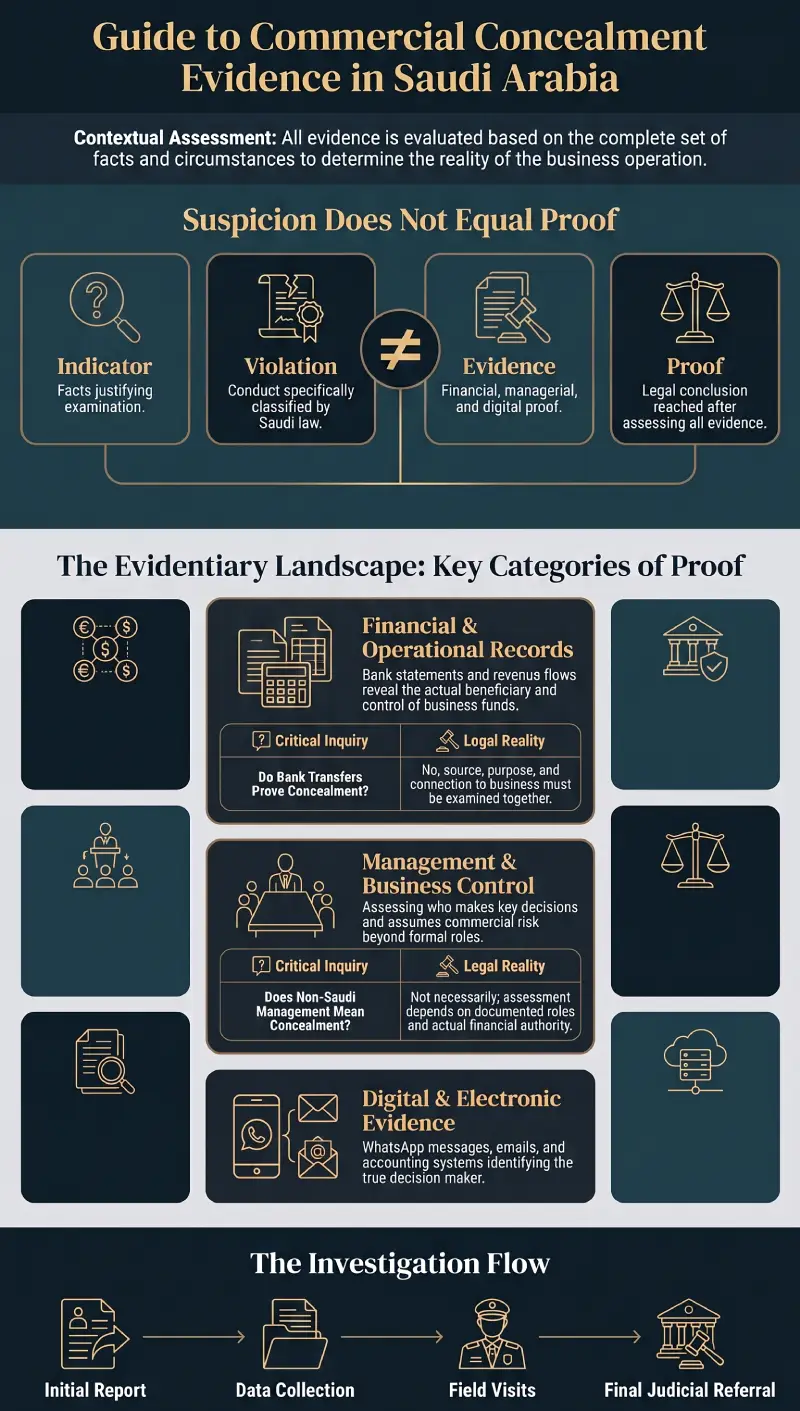
What Is Commercial Concealment Evidence, and What Are Circumstantial Indicators?
Commercial concealment evidence includes facts, information, and documents that may be used to establish a crime or violation under the Saudi Anti-Concealment Law. A suspicion indicator, by contrast, is a fact that warrants further examination but does not amount to a finding against the business or the individuals involved.
Commercial concealment indicators may be financial, administrative, or operational. An unusual financial transaction may require verification, while exceptionally broad powers granted to a non-Saudi person may justify closer examination of how the business is actually managed.
Is There One Piece of Evidence That Proves Commercial Concealment?
The Law does not identify one mandatory piece of evidence that must exist in every case. Instead, it permits all legally recognized methods of proof.
Accordingly, the methods used in proving commercial concealment may include documents, financial data, electronic communications, statements, and facts observed during inspections or investigations.
The weight of each item depends on what it actually proves and how closely it relates to the conduct under examination. There is also no fixed rule under which a specific number of indicators automatically establishes the crime.
How Is Commercial Concealment Proven in Saudi Arabia?
Proving commercial concealment begins by identifying the conduct under suspicion and then examining evidence that clarifies the economic relationship between the parties.
Relevant questions may include who actually manages the business, who makes material decisions, how revenue moves through the business, who bears commercial risk, and who ultimately benefits from the profits.
The Saudi Anti-Concealment Law allows proof through all methods of evidence, including electronic evidence. Contracts, authorizations, accounting records, bank information, correspondence, and other relevant materials may therefore form part of the evidentiary assessment.
The concept of “actual management” should not be treated as proof by itself. A non-Saudi manager may legitimately exercise substantial authority as part of their employment. The proper assessment compares documented powers with actual practice and considers financial decisions, management authority, and the economic position of each party.
What Are the Main Commercial Concealment Suspicion Indicators?
The competent authorities use commercial concealment suspicion indicators to identify cases that may require further examination. An indicator does not establish the crime, but it may lead to closer review of financial records, documents, and the actual management relationship.
Examples of facts that may warrant examination include:
| Fact under review | What it may reveal | Does it prove the crime by itself? |
|---|---|---|
| Unexplained financial transfers | Revenue flow and beneficiary | Not necessarily |
| An account not belonging to the business | Transactions outside the official business account | No |
| Extensive powers held by a non-Saudi | Degree of management control | Requires examination |
| Financial or management communications | Decision-maker and nature of the relationship | Depends on content |
| Day-to-day operational management | Scope of the manager’s role | Not by itself |
Potential commercial concealment indicators become more significant when several financial and administrative facts appear inconsistent with the business’s formally documented structure.
Do Bank Transfers and Bank Accounts Prove Commercial Concealment?
The relationship between bank transfers and commercial concealment requires careful analysis. A payment may be entirely legitimate when it represents salary, reimbursement, documented expenditure, or another identifiable obligation.
Its significance may change where the transfer appears connected to business revenue or profits without a documented explanation consistent with the parties’ legal relationship.
Bank statements can assist in identifying the source and destination of funds, transaction patterns, and whether financial movements correspond with the accounting records. The Anti-Concealment Law also regulates the use of a bank account that does not belong to the establishment for transactions relating to its business activity.
Personal Accounts and Financial Remittances
When examining a bank account in a commercial concealment case, the amount alone is not enough. The account holder, source of funds, purpose of the transaction, and consistency with contracts and accounting records are all relevant.
Accordingly, the answer to “Do bank transfers prove commercial concealment?” is that they may constitute significant evidence, but they do not automatically establish the crime independently of the remaining facts.
When Can a Non-Saudi’s Management of a Business Become a Concealment Indicator?
A non-Saudi person managing a business does not, by itself, amount to commercial concealment. A non-Saudi may lawfully serve as a manager or employee and exercise defined managerial powers.
Closer examination may become necessary when those powers exceed the person’s documented role or effectively give them independent and extensive control over the business and its funds.
Actual management may become relevant to commercial concealment where control over revenue is combined with authority over material business decisions or economic benefits inconsistent with the person’s formal status.
Does Authorizing a Non-Saudi Amount to Commercial Concealment?
An authorization granted to a non-Saudi does not produce the same legal conclusion in every case. Its scope, purpose, actual use, and relationship to the person’s legitimate business role must be examined.
The same applies to signing authority. A manager may legitimately be authorized to execute documents, while the arrangement may warrant closer review where that authority is combined with extensive independent financial and managerial control inconsistent with the declared relationship.
What Documents and Electronic Evidence May Be Used?
Documents relevant to Commercial Concealment Evidence may include contracts, authorizations, invoices, financial statements, bank statements, payroll records, and accounting records.
A document becomes particularly significant when it helps compare the business’s formal legal structure with the way the activity is actually managed in practice.
Electronic evidence may include messages, digital files, electronic records, and accounting-system data connected to the facts under examination. WhatsApp messages, for example, may help identify who issues financial or managerial instructions, but the existence of a message does not automatically prove commercial concealment.
Admissions, statements by the parties, and employee or witness testimony may also form part of the available methods of proving commercial concealment. Their value depends on their content and how they correspond with the documentary and factual evidence.
How Does the Ministry of Commerce Identify Suspected Commercial Concealment?
The Saudi Ministry of Commerce relies on reports, regulatory monitoring, field inspections, data, and suspicion indicators when examining cases that may involve commercial concealment.
The procedure for filing a commercial concealment report in Saudi Arabia is distinct from the subsequent process of proving an alleged crime.
A case may begin with a report or an indicator, followed by review of documents, accounts, and relevant facts. Where the matter raises suspicion of a criminal offence, the Public Prosecution handles the investigation and prosecution, while the competent criminal court determines the criminal case.
The process may be summarized as follows:
- A suspicion indicator appears or a report is received.
- Relevant data, documents, and facts are reviewed.
- A violation is identified or a possible crime is suspected.
- The criminal matter is referred to the competent authority.
- The Public Prosecution conducts the investigation where applicable.
- The competent court hears and determines the case.
What Is the Difference Between Suspicion, a Violation, and Proof of the Crime?
Suspicion means that a fact warrants investigation; it does not mean liability has been established. A violation is conduct expressly classified by the Law as a violation, while the crime of commercial concealment concerns the criminal acts defined under the Anti-Concealment Law.
The consequences of an established offence are addressed separately under the penalties for commercial concealment and the legal effects that may follow.
There is no single answer to the question of whether circumstantial indicators are enough to prove commercial concealment. An indicator may become more significant when supported by accounts, contracts, communications, or other evidence pointing in the same direction.
Conversely, additional documents may provide a legitimate explanation for circumstances that initially appeared suspicious. This distinction prevents a suspicion indicator from being treated as a predetermined finding of guilt or every financial violation from being treated automatically as commercial concealment.
How Should a Business Review Its Position When Concealment Indicators Appear?
If circumstances require review, begin by examining the existing position without altering or destroying previous records. The review should identify who exercises actual decision-making authority, how funds move, and the limits of each person’s powers.
A practical review may include:
- Identifying current authorizations, powers of attorney, and signing powers.
- Reviewing the bank account used for business operations.
- Matching salaries and transfers against contracts and accounting records.
- Identifying who approves material contracts and commitments.
- Reviewing powers granted to non-Saudi managers.
- Documenting the legal relationship between the parties.
- Preserving relevant correspondence and records.
Where bank accounts, authorizations, and managerial powers overlap, or actual practice differs from the documented structure, consulting a commercial lawyer in Jeddah can help identify the relevant legal risks before further steps are taken.
Frequently Asked Questions About Commercial Concealment Evidence
1. What is Commercial Concealment Evidence in Saudi Arabia?
It includes documents, financial records, authorizations, communications, statements, and other facts used to establish a violation or crime under Saudi law.
2. How is commercial concealment proven in Saudi Arabia?
It may be proven through all legally recognized methods of evidence, including documents, financial data, witness statements, and electronic evidence.
3. Are circumstantial indicators enough to prove commercial concealment?
Not automatically. Their value depends on what they show and how they relate to the other evidence and facts of the case.
4. Do bank transfers prove commercial concealment?
Not by themselves. Transfers become more relevant when their source, purpose, beneficiary, and connection to business revenue indicate unusual financial control.
5. Does a non-Saudi managing a business amount to commercial concealment?
Not necessarily. The assessment depends on the person's lawful role, actual authority, financial control, and relationship with the business owner.
6. Does authorizing a non-Saudi amount to commercial concealment?
No, not by itself. The scope, purpose, and actual use of the authorization must be examined before drawing any legal conclusion.
7. Can WhatsApp messages be used as evidence of commercial concealment?
Yes. They may qualify as electronic evidence, but their significance depends on their content, context, and connection with the other evidence.
8. What is the difference between suspicion and proof of commercial concealment?
Suspicion starts the review process, while proof depends on evaluating the relevant evidence through the applicable legal procedures.
Seven types of Commercial Concealment Evidence in Saudi Arabia may become relevant, but their significance depends on what each fact actually proves. The issue is not simply the number of documents or indicators available, but their connection to the business activity and the true relationship between the parties.
Bank accounts, transfers, management powers, authorizations, contracts, records, communications, and statements can play different roles depending on the facts. Saudi law also distinguishes between suspicion indicators, statutory violations, and the crime itself, so the correct legal characterization should come before any conclusion.
Cases involving overlapping compliance, contractual, management, and regulatory risks may require broader review by a Jeddah law firm with experience handling the commercial aspects affecting businesses.
Legal Sources: