
When searching for questions a judge may ask in a marriage annulment case, the purpose is usually not only to understand the concept of annulment, but also to know what the court actually examines during the hearing.
This is important because a marriage annulment claim is not based only on the desire to end the marriage. It requires a valid reason, organised facts, suitable evidence, and a clear understanding of the difference between annulment, Khula, and divorce.
Therefore, the judge does not simply consider the complaint in its general form. Instead, the court examines the complete circumstances of the dispute:
- What is the reason for requesting annulment?
- What facts support this reason?
- What evidence proves these facts?
- Were there attempts at reconciliation?
- Can the marital relationship continue?
Many parties also have concerns about the effect of annulment on compensation, dowry, children, and financial rights.
For this reason, understanding the questions asked by the judge is connected with understanding the requirements for marriage annulment in Saudi Arabia and the circumstances in which filing such a claim may be appropriate.
Quick Answer: Questions a Judge May Ask in a Marriage Annulment Case
The questions usually focus on five main areas:
- The reason behind requesting annulment.
- The facts connected to that reason.
- The evidence supporting those facts.
- Attempts at reconciliation.
- The effect of the judgment on related rights.
The court does not grant annulment simply because one spouse requests separation. It usually considers:
- Whether the reason is clear.
- Whether the facts support the claim.
- Whether the evidence is sufficient.
- Whether the statements are consistent.
- Whether continuing the marriage has become difficult or impossible.
In simple terms, the court does not examine the request only as a desire for separation. It examines whether the legal grounds for marriage annulment are actually established through the facts presented.
Therefore, determining whether the appropriate route is annulment, Khula, or divorce requires proper assessment of the circumstances and the available legal options. A consultation with a Family Lawyer in Jeddah can help identify the suitable legal path.
What Is Marriage Annulment?
Marriage annulment is a judicial process that ends the marital relationship when the court finds a legally recognised reason preventing the continuation of the marriage in its normal form.
The court does not intervene merely because disagreements exist between spouses. Instead, it examines whether the circumstances presented require judicial consideration.
It is important to understand when annulment may be the appropriate route because many people confuse it with Khula or divorce.
The distinction can be summarised as follows:
| Process | General meaning |
|---|---|
| Marriage annulment | A judicial process based on a recognised reason, facts, and evidence |
| Khula | A different process that may involve compensation and has a different legal structure |
| Divorce | A separation process based on its own legal rules and consequences |
Marriage annulment may become relevant in situations involving:
- Harm or mistreatment.
- Failure to provide maintenance.
- Abandonment or absence.
- Serious marital misconduct.
- Other circumstances affecting the continuation of the marriage.
However, when the objective is ending the relationship without relying on a specific harm-based claim, it may be useful to understand the requirements for Khula in Saudi Arabia before choosing the appropriate legal route.
What Are the Questions a Judge May Ask in a Marriage Annulment Case?
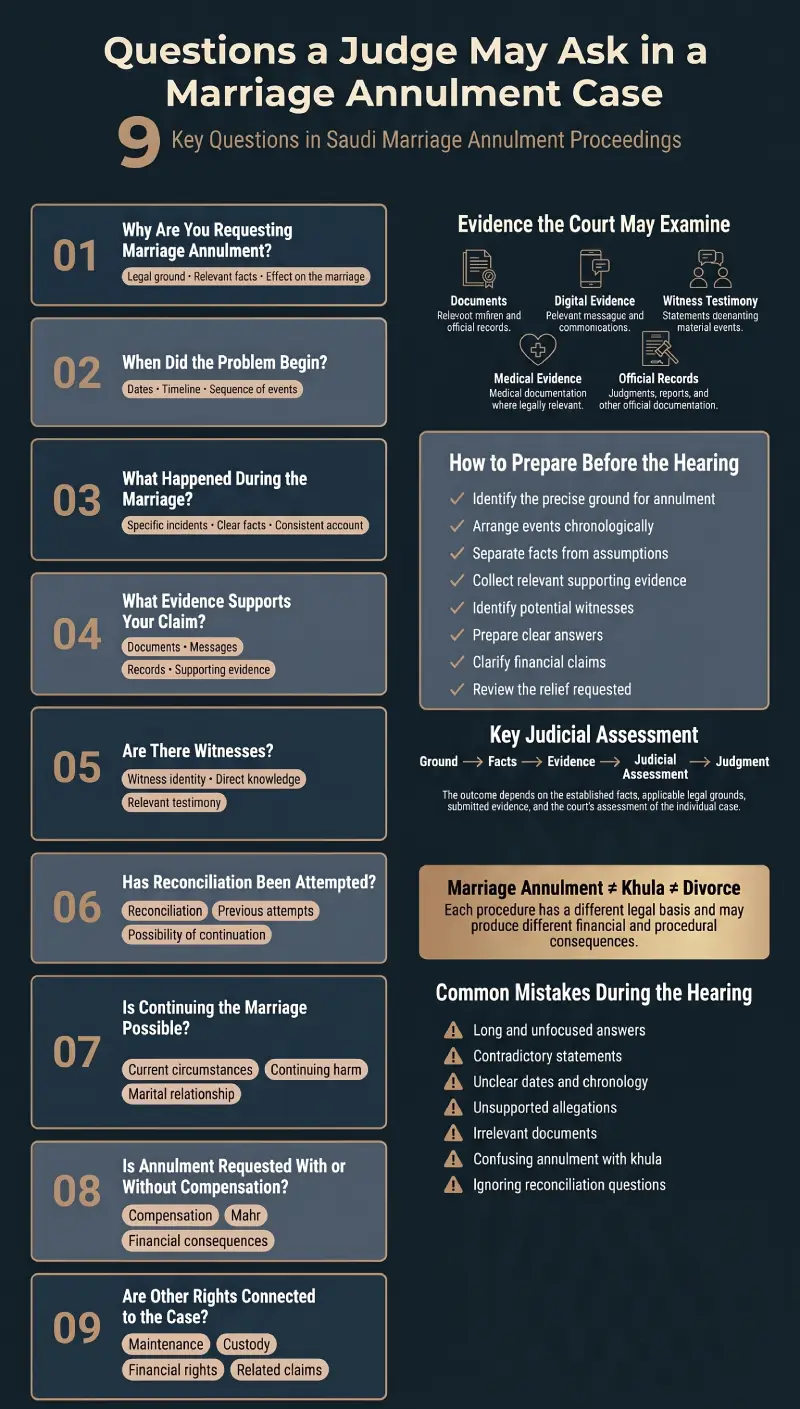
The questions a judge may ask in a marriage annulment case generally focus on five main issues: the reason, facts, evidence, reconciliation efforts, and related rights.
| Area | What the Court Examines | Example Question |
|---|---|---|
| Reason | Identifying the basis of the claim | What is the reason for requesting annulment? |
| Facts | Understanding what happened | When did the harm or abandonment begin? |
| Evidence | Assessing the strength of the claim | Do you have witnesses, messages, or documents? |
| Reconciliation | Considering whether settlement was possible | Were there attempts to resolve the dispute? |
| Related rights | Understanding the consequences | Are there children or disputes regarding dowry or compensation? |
Most Common Questions During the Hearing
During the hearing, the judge’s questions usually focus on understanding the facts behind the claim and whether the legal basis for annulment is supported.
The questions may include:
- What is the main reason for requesting marriage annulment?
- Is this reason ongoing or did it occur only once?
- When did the problem begin?
- Were there any attempts at reconciliation before filing the claim?
- Do you have messages, witnesses, documents, or other evidence?
- Are there children from the marriage?
- Are there any financial claims or disputes regarding dowry or compensation?
The purpose of these questions is not simply to collect information, but to allow the court to evaluate whether the circumstances presented justify ending the marriage through judicial annulment.
How Can Your Answers Be Stronger?
Answers during the hearing are usually stronger when they are:
- Brief and focused.
- Directly connected to the facts.
- Consistent with the statement of claim.
- Supported by evidence or relevant circumstances.
- Presented in a clear timeline.
A strong answer does not necessarily require extensive details. The important point is that the answer should help the court understand the reason for the claim and how the evidence supports it.
What Can Weaken the Answers?
The response may become less effective when it is:
- Too general without specific facts.
- Focused only on emotions.
- Different from the written claim.
- Based on many unrelated details.
- Unsupported by evidence or circumstances.
Therefore, proper preparation does not mean memorising a long explanation. It means understanding what the court is trying to determine through each question.
When Does a Judge Grant Marriage Annulment?
A court does not grant annulment merely because there is disagreement between spouses. The judge generally examines whether there is a recognised reason and whether the presented facts are sufficient to form a judicial basis for the decision.
Practically, the decision often depends on several factors:
- The existence of a clear reason.
- Facts supporting that reason.
- Suitable evidence.
- Whether continuation of the marital relationship has become seriously difficult.
What Strengthens a Marriage Annulment Claim?
A claim is generally stronger when it includes:
- A specific and clearly identified reason.
- Facts arranged in a logical timeline.
- Evidence directly connected to the claimed reason.
- Consistent answers during hearings.
- No contradiction between the written claim and statements before the court.
What Weakens a Marriage Annulment Claim?
A claim may become weaker when it involves:
- General allegations without specific events.
- Multiple reasons presented without organisation.
- Lack of supporting evidence.
- Confusion between annulment and Khula.
- Different versions of events during different stages of the case.
In practice, making an allegation alone is not always sufficient. The court considers what can be established from the complete case file, including facts, evidence, and consistency of statements.
What Reasons and Evidence Can Support a Marriage Annulment Claim?
Common reasons considered in marriage annulment cases may include:
- Failure to provide maintenance.
- Abandonment or absence.
- Harm or serious marital mistreatment.
- Certain defects or circumstances affecting marital life.
- Other situations that make continuation of the marriage extremely difficult.
Evidence That May Support the Claim
The appropriate evidence depends on the reason relied upon. Common forms of evidence may include:
- Witness testimony.
- Messages and conversations.
- Official documents.
- Reports.
- Other relevant circumstances connected to the claim.
The connection between the reason and the supporting evidence is important.
| Reason | Evidence That May Support It |
|---|---|
| Failure to provide maintenance | Documents or facts showing continued failure or disputes regarding support |
| Abandonment or absence | Evidence showing the duration and consequences of absence |
| Harm or mistreatment | Witnesses, messages, documents, or relevant circumstances |
| Defect or serious circumstance | Evidence showing its effect on continuation of marriage |
The Best Way to Organise the Case File
A practical approach is to:
- Identify the main reason first.
- Select only evidence directly related to that reason.
- Remove unnecessary details that do not support the claim.
- Arrange events in a clear chronological order.
A well-organised file helps the court understand the dispute more efficiently.
How to File a Marriage Annulment Claim and What May Help Speed the Process?
The steps for filing a marriage annulment claim generally include:
- Choosing the correct legal route.
- Preparing the statement of claim.
- Collecting important documents.
- Attending hearings and responding to questions.
- Completing any requirements requested by the court.
What Should Be Prepared Before Filing?
It is usually useful to prepare:
- Marriage contract.
- Brief summary of the facts.
- Important messages, documents, or reports.
- Information about children, if any.
- Details related to dowry or other connected rights.
What May Delay the Case?
Common factors that may delay proceedings include:
- Choosing an unsuitable legal route.
- An unclear statement of claim.
- Missing documents.
- Contradictory answers to questions a judge may ask in a marriage annulment case.
- Failure to attend hearings or respond on time.
- Adding excessive details that do not support the main reason.
What May Help the Court Reach a Decision More Efficiently?
The process may become clearer when there is:
- A well-prepared claim.
- A specific legal reason.
- Organised evidence.
- Regular attendance.
- Direct answers.
- A consistent case file.
Is Marriage Annulment Without Compensation?
Marriage annulment without compensation is not an automatic result in every case. Compensation is not determined by one fixed rule that applies to all situations.
The more accurate approach is to understand that:
- Not every annulment case has the same outcome.
- Compensation depends on the circumstances of the claim.
- Evidence may affect the final result.
- Related rights must be examined separately.
When the concern relates to financial consequences, it may also be useful to compare the effects of different marital separation routes, including wife’s rights after Khula in Saudi Arabia.
It is important not to confuse:
- The annulment itself.
- Disputes regarding compensation.
- The wife’s rights.
- Children’s rights.
One frequently searched issue is grounds for marriage annulment without compensation. However, this should not be understood as a fixed rule for all cases. The outcome depends on the reason presented, the evidence available, and the court’s assessment of the circumstances.
Common Mistakes Before Filing a Marriage Annulment Claim
Some mistakes that may weaken this type of case include:
- Filing for annulment when the situation is closer to Khula or divorce.
- Submitting a general claim without clear facts.
- Confusing the reason with the evidence.
- Adding excessive details unrelated to the legal issue.
- Changing the explanation between the written claim and hearings.
- Ignoring the possible effect on compensation and related rights.
When Should You Seek Legal Assessment Before Filing?
Legal assessment becomes particularly important when the facts involve overlapping issues such as:
- Harm.
- Maintenance.
- Compensation.
- Children.
- The difference between annulment and Khula.
At this stage, the main purpose is to understand the facts, organise the documents, and identify the appropriate legal path before taking further action.
Legal Review:
BMS Legal
Jurisdiction:
Saudi Arabia
Practice Area:
Personal Status Law
Frequently Asked Questions About Questions a Judge May Ask in a Marriage Annulment Case
1. What Questions Does the Judge Ask in a Marriage Annulment Case?
The court usually asks about the grounds for annulment, relevant facts, supporting evidence, reconciliation attempts, and related rights.
2. When May the Judge Grant a Marriage Annulment?
The judge may grant annulment when a legally relevant ground is established and the facts and evidence sufficiently support the claim.
3. Can a Marriage Be Annulled Without the Husband’s Consent?
Yes. The court may examine an annulment claim even if the husband objects, but the outcome depends on the grounds and evidence presented.
4. When May the Court Annul a Marriage Without Compensation?
This depends on the grounds for annulment, the evidence established before the court, and the circumstances of the individual case.
5. How Can I Prove the Grounds for Marriage Annulment?
Proof depends on the specific ground and may include witness testimony, messages, documents, reports, or other relevant evidence.
Understanding 9 Questions a Judge May Ask in a Marriage Annulment Case helps parties prepare for the hearing and evaluate the strength of the claim before filing.
The court does not examine only the desire to end the marriage. It considers the reason, supporting facts, evidence, reconciliation efforts, and related rights.
When the circumstances are unclear or there is confusion between annulment, Khula, and divorce, proper legal assessment can help clarify the available options and the next appropriate step.
Official References: