
When searching for marriage annulment conditions in Saudi Arabia, you are probably looking for more than a general legal definition. You want to know whether your circumstances may justify annulment, whether court proceedings are required, whether the husband’s consent is necessary, and how annulment may affect the dowry, compensation, maintenance, and child custody.
For that reason, it is not enough to read a general explanation of marriage annulment. You need to understand which grounds may be legally relevant, which court procedure applies, and what evidence can support the claim from the outset.
If your case involves harm, a dispute over the dowry, or disagreement concerning financial compensation, the first step is to identify the correct legal route. Your circumstances may be better suited to marriage annulment, Khula, or another family-law claim. Where the distinction is unclear, consulting a Khula Lawyer in Jeddah can help clarify when Khula may be the more appropriate procedure.
Quick Answer: Marriage Annulment Conditions
The main marriage annulment conditions in Saudi Arabia involve the existence of a legally relevant ground that makes continuation of the marital relationship harmful or unreasonably difficult. A claim must then be brought before the competent court, supported by evidence or documents appropriate to the circumstances.
Frequently raised grounds include harm, failure to provide maintenance, absence, abandonment, a material defect affecting the marriage, and prolonged marital conflict that makes continued married life untenable.
In practical terms, the following points should be considered from the beginning:
- There must be a clear ground that can be presented to the court.
- The alleged ground should be supported by facts capable of proof.
- The claim is generally brought before the Personal Status Court.
- The statement of claim is filed electronically through the relevant judicial service.
- The potential impact on the dowry, compensation, and related rights should be assessed.
If you are uncertain whether your case should proceed as annulment or Khula, or whether the facts are sufficiently strong, an initial legal assessment may help determine the appropriate route. A Family Lawyer in Jeddah can review the circumstances and identify the procedure most closely aligned with your situation.
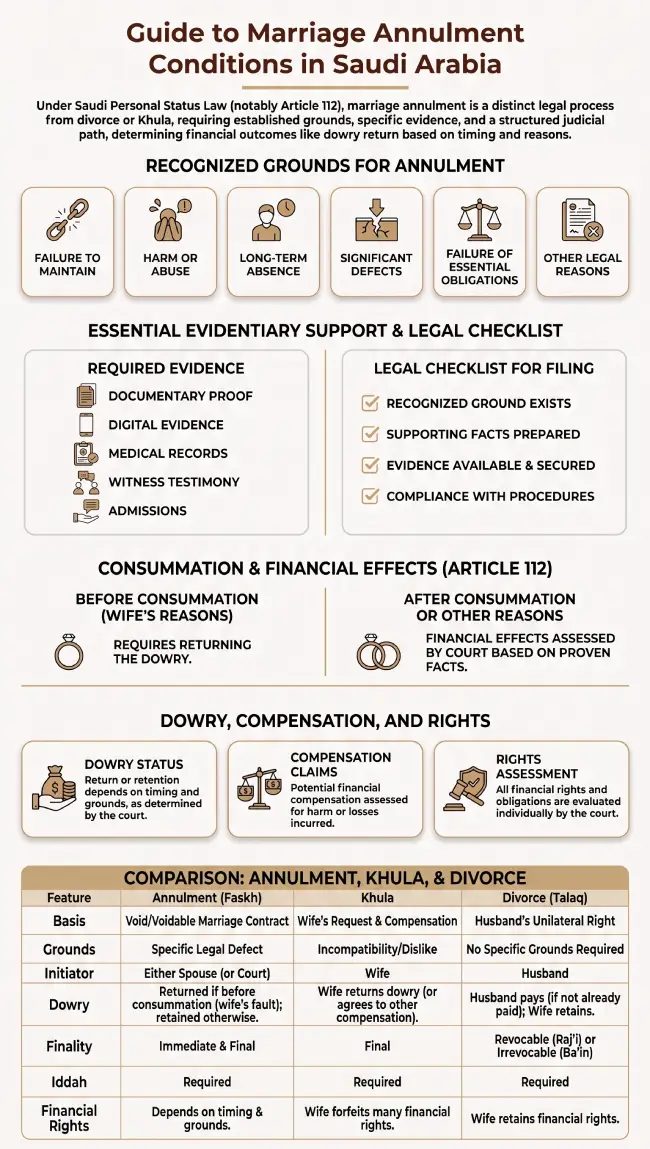
Marriage Annulment vs. Khula and Divorce
Marriage annulment is the judicial termination of a marital relationship where a legally relevant ground prevents its continuation or makes continued married life materially difficult for one of the spouses.
In practical terms, annulment does not arise merely from a private agreement or statements exchanged between the spouses. It requires judicial proceedings before the competent court. It is therefore not simply a wish to separate but a legal remedy based on grounds that the court considers and determines according to the evidence presented.
Khula differs from annulment because Khula generally involves separation in return for financial consideration, whereas marriage annulment is based on a legally relevant ground considered by the court. For a broader understanding of the applicable rules, see the Khula Requirements in Saudi Arabia.
Marriage annulment also differs from divorce in its legal basis, procedure, and manner of termination. An annulment proceeds through a judicial claim, while divorce is governed by its own legal rules and procedures.
The following table provides a general comparison:
| Comparison | Marriage Annulment | Khula | Divorce |
|---|---|---|---|
| Legal basis | Judicial termination based on a legally relevant ground | Separation generally involving compensation | Termination of marriage through divorce |
| Role of the court | Central to reviewing and deciding the claim | Court involvement depends on the applicable procedure | Depends on the circumstances |
| Ground | Harm, non-maintenance, absence, defect, or other relevant grounds | Usually initiated by the wife with compensation | Not based on the same grounds as annulment |
| Financial effect | Depends on the grounds and circumstances | Usually connected to compensation | Depends on the type and circumstances |
| Practical question | Does your case justify annulment? | Is Khula the more appropriate route? | Is divorce the correct legal classification? |
Where the distinction between annulment and other forms of marital separation affects the legal strategy, consulting a Divorce Lawyer in Jeddah may help clarify the practical differences between the available procedures.
When May a Marriage Annulment Claim Be Accepted?
In practice, marriage annulment conditions can be understood through four main elements: a legally relevant ground, filing before the competent court, evidence supporting the allegations, and a clear presentation of the specific facts rather than a general description of marital disagreement.
A wish to separate or general dissatisfaction with the marriage is not, by itself, sufficient. There must be circumstances with legal or factual significance, such as harm, failure to provide maintenance, absence, a material defect, or another ground on which the court may base its decision.
Marriage annulment is also a judicial remedy. The claim should therefore be brought through the competent court and prepared in a clear and properly documented manner.
Common circumstances raised in these cases include:
- Failure or refusal to provide maintenance.
- Harm and serious marital mistreatment.
- Prolonged absence.
- Abandonment or interruption of marital life.
- A material defect affecting the marital relationship.
It is also important to understand that the strength of a Marriage Annulment Case does not depend on describing the situation in broad terms. It depends on the documents, messages, reports, official records, testimony, and other evidence supporting the alleged facts.
The court considers proven facts rather than impressions. Well-organised documents are generally more useful than an unstructured narrative, and connecting each document to a specific allegation makes the case clearer from the outset.
Infographic – Marriage Annulment Conditions
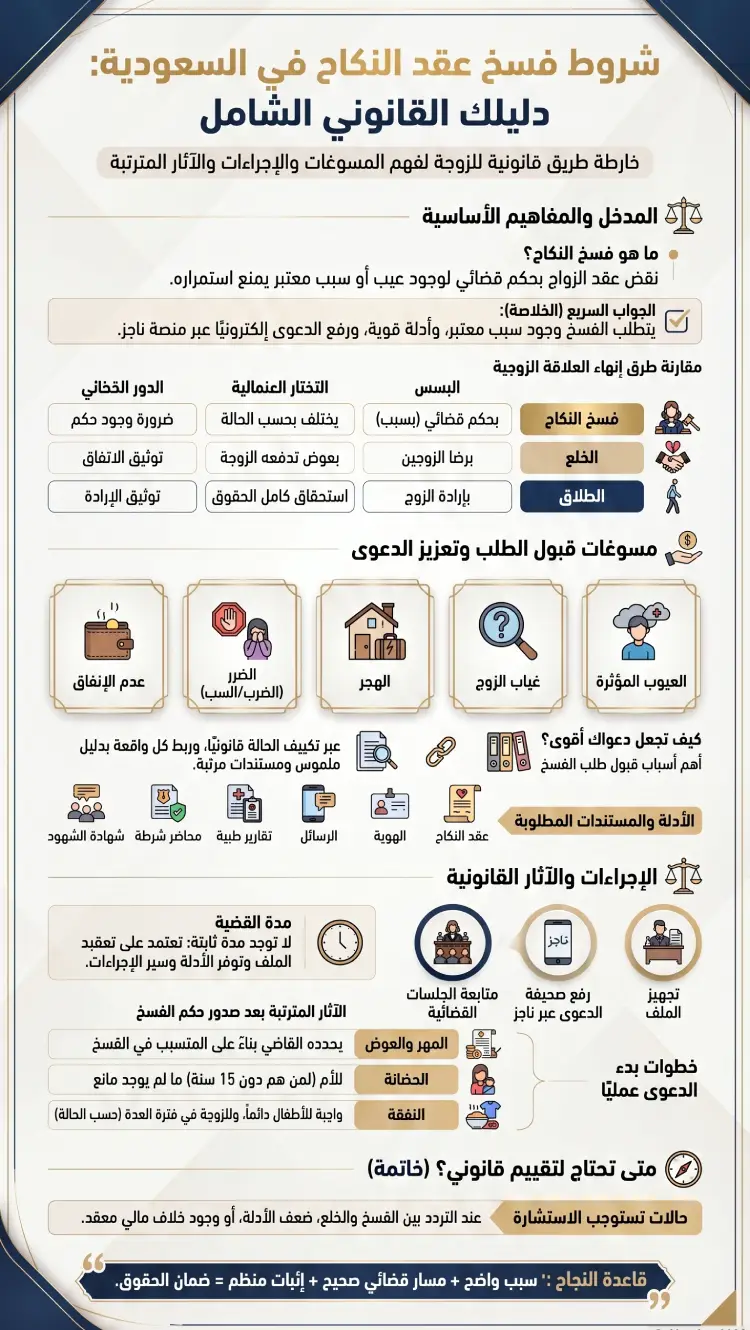
Key Grounds on Which the Court May Base an Annulment
The practical question is not simply whether marriage annulment exists under Saudi law. The more important question is whether your specific circumstances may support such a claim.
Each potential ground requires a different approach to evidence and presentation.
| Ground | What Does It Mean in Practice? | What May Help Support It? |
|---|---|---|
| Failure to provide maintenance | Maintenance is withheld or does not reach the wife | Evidence of non-payment and its effect on living conditions |
| Harm | Physical, psychological, verbal, or behavioural harm | Reports, official records, messages, witnesses, or other evidence |
| Absence | Prolonged separation from the wife and marital life | Duration of absence, circumstances, communication, and financial support |
| Abandonment | Interruption of cohabitation, residence, or the marital relationship | Repeated facts and evidence supporting them |
| Material defect | A defect materially affecting the purposes or continuation of marriage | Evidence establishing the defect and its impact |
Failure to Provide Maintenance
Failure to provide maintenance is frequently raised because it can directly affect the wife’s living conditions and family stability.
However, not every financial disagreement automatically justifies annulment. This ground becomes more significant where the failure to provide maintenance can be clearly demonstrated, has a genuine effect on the wife’s living situation, and is not merely a temporary or isolated problem.
Harm and Marital Mistreatment
Harm can take several forms and should not be reduced to physical violence alone. It may be physical, psychological, verbal, or behavioural.
Examples may include repeated humiliation, threats, intimidation, violence, substance-related conduct, or persistent conflict that makes continuation of married life seriously difficult.
The relevant evidence depends on the type of harm alleged.
Absence and Abandonment
Absence and abandonment may involve a prolonged period during which the wife is effectively left without normal marital life, cohabitation, communication, or support.
Simply stating that the husband is absent may not be enough. It is useful to establish the duration and circumstances of the absence, whether his location is known, whether communication continues, and whether financial support is being provided.
The clearer these facts are, the easier it becomes to present the case coherently before the court.
A Material Defect Affecting the Marriage
A material defect affecting the marital relationship requires particularly careful drafting because medical and personal circumstances differ significantly between cases.
The issue should therefore not be presented in overly general terms. It should be linked to the nature of the condition, when it became known, its effect on the marriage, and the evidence available to establish it.
Is the Husband’s Consent Required, and How Is the Claim Filed?
One of the most common questions concerning marriage annulment conditions is whether the husband must consent.
As a practical matter, marriage annulment does not depend solely on the husband’s approval because it is a judicial claim based on a legally relevant ground. The wife may therefore bring a claim even where the husband objects.
The final determination, however, depends on the facts and evidence established before the court. The husband’s refusal does not prevent a claim from being filed; the court examines the alleged ground and supporting evidence before issuing its decision.
If you are preparing to begin proceedings, the first issue is to identify the correct legal classification. Where the circumstances are more consistent with Khula rather than annulment, reviewing How to File a Khula Case can help explain the procedural difference between the two routes.
A simplified overview of the process is set out below:
| Stage | What Happens? |
|---|---|
| Determine the legal route | Decide whether the matter should proceed as annulment, Khula, or another claim |
| Prepare the case file | Gather the marriage contract, identification, and supporting documents |
| File the claim | Submit the statement of claim electronically through Najiz |
| Follow the proceedings | Complete court requirements and attend to further judicial procedures |
Before filing, it is useful to organise:
- The marriage contract.
- Identification documents.
- Relevant messages or correspondence.
- Reports, official records, or other supporting documents.
- A clear chronological account of the relevant events.
Where the evidence is scattered or the facts are not organised, preparing the file before submission can make the claim clearer and help avoid common errors at the beginning of proceedings.
The first document in a case is not always the strongest piece of evidence, but it establishes the legal relationship around which the rest of the claim is built. For this reason, an Electronic Marriage Contract should not be treated as an ordinary attachment. It establishes the marital relationship that is the subject of the annulment proceedings and provides context for the remaining evidence.
What Evidence Can Strengthen an Annulment Case, and How Long Does It Take?
Before filing or seeking legal advice, it is useful to identify what documents should be collected and how they should be organised.
For marriage annulment conditions, relevant material may include the marriage contract, identification, and evidence supporting the specific ground relied upon, such as reports, correspondence, official records, financial statements, witness testimony, or other evidence.
The key is not simply to accumulate documents. The facts should be arranged chronologically, and each document should be connected to the allegation it is intended to prove. This helps the court, assists anyone reviewing the case, and provides a clearer assessment of its strengths and weaknesses.
Evidence of harm varies depending on the nature of the allegation. Physical harm may be supported by medical reports or official records, while verbal or psychological harm may involve messages, witnesses, repeated incidents, or other surrounding evidence.
There is therefore no single evidentiary template that applies to every case.
Weaknesses in a case file do not always appear from the documents themselves. They often become clear when direct questions are asked during a hearing. Reviewing the Questions a Judge May Ask in a Marriage Annulment Case can help test the factual basis of the claim before it is presented: What is the ground? When did it begin? How can it be proved? How has it affected the continuation of married life?
How Long Does a Marriage Annulment Case Take in Saudi Arabia?
There is no single fixed duration that applies to every marriage annulment case.
The timeline can vary according to the ground relied upon, whether the documents are complete, attendance of the parties, and whether the court requires reports, referrals, expert input, or additional hearings.
Some cases may proceed more quickly where the facts are clear and the evidence is complete. Others may take longer where the circumstances are more complex or additional proof is required.
For the same reason, there is no fixed number of hearings applicable to every annulment claim.
Dowry, Compensation, and Rights After Annulment
Questions about annulment without compensation or whether the dowry must be returned are often driven by concern about the financial consequences of the proceedings.
The practical point is that financial consequences cannot be stated in one formula that applies to every case. The treatment of compensation and the dowry may depend on the ground for annulment, the timing, the facts of the case, and the court’s determination.
Accordingly, annulment may occur without compensation in some circumstances, while the dowry or part of it may become relevant in others. It would be inaccurate to apply one financial outcome to every case.
It is also useful to distinguish these consequences from the rules governing Wife’s Financial Rights After Khula under Saudi Personal Status Law because the legal basis and financial consequences of Khula are not necessarily the same as those of annulment.
The consequences of annulment can extend beyond the immediate termination of marriage. After judgment, questions may arise concerning the dowry, maintenance, child custody, and other related rights.
| Issue | Potential Effect |
|---|---|
| Dowry | May depend on the ground, timing, and circumstances of the annulment |
| Compensation | Does not arise in the same form in every case |
| Child custody | Determined according to the child’s interests and relevant circumstances |
| Maintenance | May involve separate claims or consequences |
| Waiting period | A related issue that depends on the circumstances and legal classification |
Financial consequences should not be reduced to a single general statement. The dowry, compensation, and other financial claims may depend on the legal ground, the stage of the marital relationship, and the particular facts before the court.
Similarly, child custody and maintenance are not automatically determined in exactly the same manner as the annulment itself. They depend on the child’s interests, the claims brought before the court, and the circumstances of the individual case.
The waiting period and related consequences may also require separate consideration according to the legal nature and timing of the separation.
When Is Legal Advice Useful Before Filing?
Legal advice becomes particularly useful where there is uncertainty between annulment and Khula, disagreement over the dowry or compensation, limited evidence, or facts that could potentially support more than one legal route.
In these situations, identifying the correct procedure before filing may save time and prevent errors caused by an inaccurate legal classification.
Seeking advice before filing can be particularly useful where:
- You are uncertain about the correct legal classification.
- Relevant evidence exists but is not properly organised.
- There is a dispute concerning the dowry or compensation.
- You are unsure whether annulment, Khula, or another procedure is more appropriate.
If you want to determine whether your circumstances may support a marriage annulment claim, or you are uncertain whether annulment or Khula is the more appropriate route, you can Contact Us to request an initial assessment of the case.
This article on Marriage Annulment Conditions in Saudi Arabia has been legally reviewed to ensure that the explanations of annulment grounds, supporting evidence, judicial procedure, and potential legal effects are presented clearly and within the applicable Saudi legal framework.
Marriage annulment cases are highly fact-specific. The appropriate legal ground, available evidence, and consequences concerning the dowry or other marital rights may differ according to the circumstances established before the court.
Frequently Asked Questions About Marriage Annulment Conditions
What are the conditions for marriage annulment in Saudi Arabia?
A marriage may be annulled when a legally recognized ground is established and supported by sufficient facts and evidence before the court.
When can a wife request a marriage annulment?
A wife may seek annulment where a valid legal ground exists, such as harm, failure to provide maintenance, absence, or another recognized basis.
Does marriage annulment require the husband’s consent?
Not necessarily. The court may order annulment when the legal requirements are proven, even without the husband’s consent.
What is the difference between annulment and Khula?
Annulment is based on a legally recognized ground, while Khula is a separate method of ending the marriage governed by different rules and financial consequences.
Is the dowry returned after marriage annulment?
It depends on the ground for annulment and the circumstances of the case. The financial effect is determined according to the applicable legal rules and proven facts.
In summary, marriage annulment conditions in Saudi Arabia are not limited to a single requirement. They depend on three connected elements: a clear and legally relevant ground, the correct judicial procedure, and properly organised evidence.
The clearer the facts, the more precisely the legal ground is identified, and the better the documents are arranged, the easier it becomes to understand the strength of the case and determine the appropriate next step.
By contrast, beginning with an inaccurate legal classification or filing a claim based on vague allegations may complicate the proceedings and weaken the case from the outset.
If you are looking for legal support beginning with an initial assessment and identification of the appropriate route, you may seek legal advice from a Jeddah Lawyer experienced in personal status and family-law matters.
Official References: