
If you are searching for the marriage annulment procedure in Saudi Arabia, you are probably looking for more than a general definition. You need to know whether your circumstances may justify filing a case, how the process begins, what the claim should contain, which documents may be required, and how a judgment could affect matters such as the dowry, maintenance, child custody, and waiting period.
Under Saudi law, judicial annulment of a marriage, often referred to as fasakh, may arise from grounds such as failure to provide maintenance, defects, absence, disappearance, marital discord, or harm. These cases fall within the jurisdiction of the Personal Status Courts, while the digital filing process generally begins through a statement of claim on the Najiz platform.
For this reason, starting with a generic template before identifying the correct legal ground is rarely useful. A successful annulment case depends not only on filing the request, but also on organizing the facts, selecting the appropriate legal route, and drafting the marriage annulment claim clearly and precisely.
Quick Answer: How Does the Marriage Annulment Procedure?
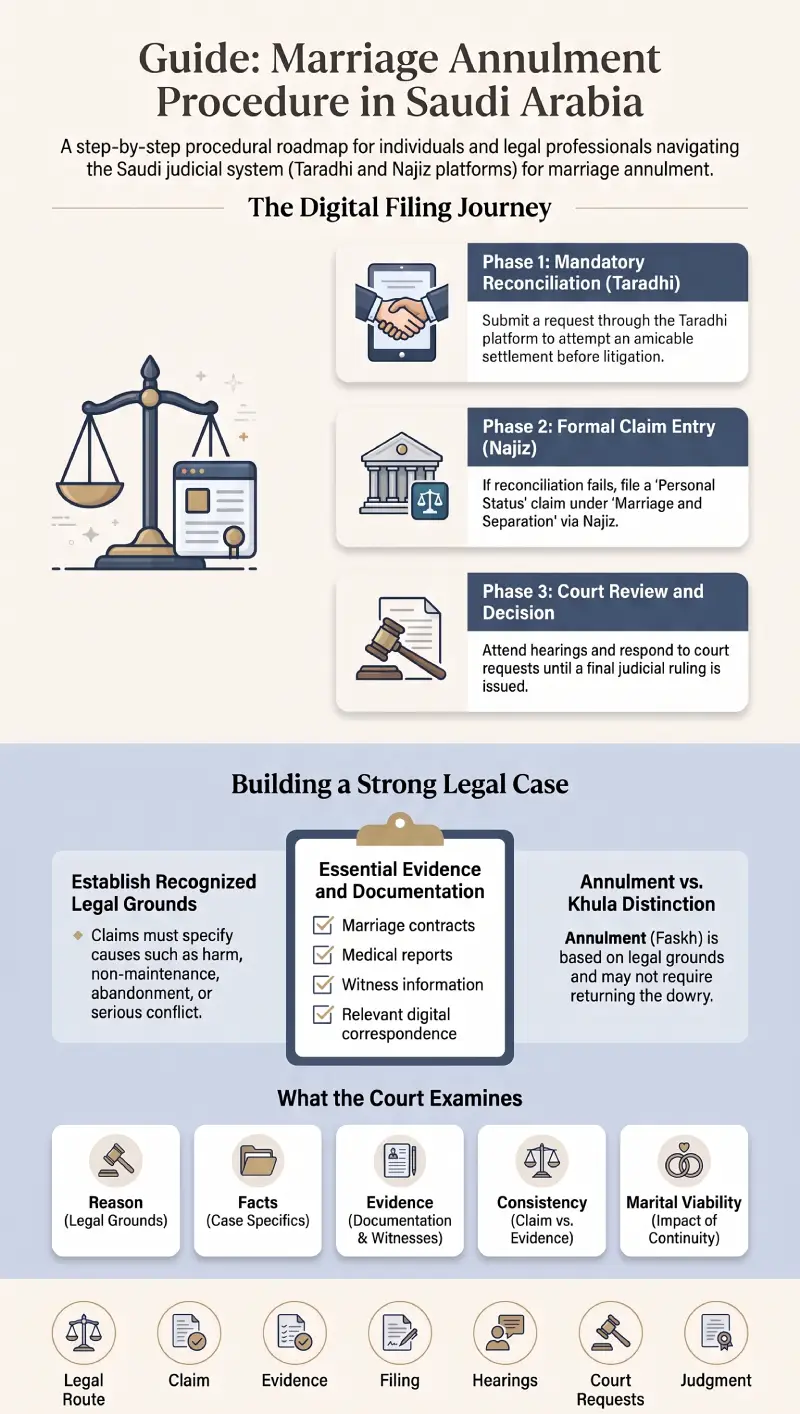
The marriage annulment procedure begins by identifying the relevant legal ground, collecting documents supporting that ground, submitting the claim through the appropriate judicial channel, preparing the statement of claim, attending court hearings, and presenting the evidence supporting the facts.
Marriage annulment is not based solely on a desire to end the relationship. It is a judicial process that ordinarily requires a specific ground that can be presented to the court and supported by documents, circumstantial evidence, testimony, or other appropriate forms of proof depending on the case.
The process can generally be summarized as follows:
- Identify the legal ground for annulment.
- Collect the essential supporting documents.
- File the marriage annulment claim through the statement-of-claim service.
- Prepare the marriage annulment pleading.
- Attend the hearings and submit evidence.
- Await the judgment and determine its legal consequences.
When Can You File a Marriage Annulment Case?
A marriage annulment claim may be appropriate when there are significant circumstances that make continuation of the marital relationship impossible or seriously burdensome and when the alleged ground can realistically be demonstrated before the court.
Saudi personal status law regulates several grounds for annulment. The focus is generally on the legal ground and the evidence supporting it rather than on a general feeling of dissatisfaction or a simple desire to end the marriage.
If no specific ground has been identified, or if the relevant events have not been organized clearly, the case may become weaker or another legal route may be more appropriate.
Common grounds include:
- Failure to provide maintenance: where the husband fails to provide legally required maintenance or where providing it becomes impossible in circumstances recognized by law.
- Harm: including physical, psychological, or other forms of harm depending on the facts that can be established.
- Absence: where prolonged absence affects marital life and causes continuing harm.
- Disappearance: where the husband’s whereabouts become unknown and the wife’s interests are materially affected.
- Defect: where a material defect has a substantial effect on marital life.
- Before or after consummation: some legal effects may differ depending on the stage of the marital relationship.
Understanding the marriage annulment procedure in Saudi Arabia therefore begins with identifying the ground on which the claim will be based. For a broader explanation of the legally relevant grounds, see Conditions for Marriage Annulment under Saudi Law to understand when this route may be suitable.
When Is a Simple Desire to Separate Not Enough?
If the main issue is simply that you no longer wish to continue the marriage, without an established breach or legally relevant ground attributable to the husband, annulment may not be the appropriate route.
A useful question is: Do I have a specific ground that can be presented to the judge and connected to clear facts?
If the answer is uncertain, an initial legal assessment may help before filing. Identifying the correct route at this stage can prevent time from being spent on a claim that does not match the circumstances.
Where the primary issue is a desire to end the relationship without an established ground for annulment, it may be useful to review the Khula Requirements under Saudi Personal Status Law to determine whether Khula may be the more appropriate route.
How to File a Marriage Annulment Claim Step by Step
A well-prepared case begins before the claim is submitted. The first step should not be copying a standard form. Instead, the facts should be organized, the legal ground identified, and each request connected to supporting evidence.
This preparation makes the marriage annulment procedure in Saudi Arabia more structured and reduces the risk of beginning the proceedings with an unclear or inconsistent case.
Filing a Marriage Annulment Claim Through the Digital Court System
The process usually begins through the statement-of-claim service on the Najiz platform.
The applicant generally selects the appropriate judicial classification, enters the parties’ information, provides the marriage contract details, and states the principal requests.
When filing a marriage annulment claim, the information should be accurate, the ground should be clearly identified, and the requested relief should correspond with the facts presented.
Errors in basic information or inconsistencies between the facts and requests may affect the initial filing or cause delays.
What Happens After the Case Is Filed?
Once the case is registered, the ordinary procedural stages begin. These may include service of notice on the other party, scheduling a hearing, and the court’s examination of the facts according to the alleged ground.
At this stage, the court is not concerned with the volume of the narrative. What matters is whether the answers are precise and supported by the facts.
The Questions a Judge May Ask in a Marriage Annulment Case may therefore reveal the strength of the ground relied upon, the organization of the facts, and the connection between the evidence and the relief requested.
General statements such as “mistreatment” are less useful if they are not explained through identifiable events. The facts should be placed in chronological order, the legal ground should be clear, and the documents should relate directly to that ground.
The clearer the case is from the beginning, the easier it is for the court to understand the dispute.
What If a Party Does Not Attend a Marriage Annulment Hearing?
One common concern is whether the proceedings will be delayed if the other party fails to attend.
Failure to attend a marriage annulment hearing does not automatically terminate or suspend the proceedings. At the same time, absence does not necessarily mean that an immediate judgment will be issued.
The procedural effect depends on matters such as valid service of notice, compliance with procedural requirements, and the court’s assessment of the case.
Many wives ask: What happens if the husband does not attend the marriage annulment hearing?
The practical point is that his absence does not replace the need for a properly prepared case. The claim should be supported by organized facts, documents, and evidence rather than by an expectation that the other party will fail to appear.
A well-prepared case remains important whether the husband attends the hearing or not.
Marriage Annulment Pleading: What Should It Include?
A marriage annulment pleading is not the place for emotional language or an unnecessarily long account of the relationship.
Its purpose is to present the relevant facts clearly, connect those facts to the alleged ground for annulment, and conclude with precise requests.
A clear, controlled, and structured pleading is generally easier for the court to understand than a lengthy narrative containing repeated or emotional descriptions.
The pleading should normally include:
- The parties’ details.
- Marriage contract information.
- A concise description of the marital relationship.
- The specific ground for annulment.
- The relevant facts in chronological order.
- Clearly stated requests.
- Reference to the documents or evidence supporting the facts.
How Should the Facts Be Written?
Begin with the date of marriage. Then explain when the relevant problem arose, how it developed, and what practical effect it had.
Conclude by stating the relief requested.
Avoid excessive generalizations and emotional descriptions. Focus instead on identifiable facts such as failure to provide maintenance, absence, harm, abandonment, or another relevant ground that can be clearly presented.
This approach makes the marriage annulment pleading easier to understand and evaluate.
Sample Marriage Annulment Statement of Claim
A general illustrative wording could read:
I am the claimant and the wife of the defendant under a documented marriage contract dated (…). Our marital relationship continued until (…), after which circumstances arose that form the basis of my request for annulment, namely (failure to provide maintenance / harm / absence / defect), beginning on (…). These circumstances have resulted in continuing harm and have made continuation of the marital relationship untenable. I therefore request a judgment annulling the marriage contract and the determination of any consequential matters according to the facts and requests stated in this claim.
This wording is illustrative only. The claim should be adapted to the actual legal ground, the stage of the marital relationship, and any related requests.
Common drafting mistakes include:
- Confusing annulment with Khula.
- Failing to identify the legal ground precisely.
- Repeating emotional allegations.
- Omitting important supporting documents.
- Presenting unrelated or poorly organized requests.
What Documents Can Strengthen a Marriage Annulment Case?
There is no single list of documents that applies to every annulment case.
Certain documents are commonly required, while additional evidence depends on the specific legal ground relied upon. Preparing the same generic document package for every case may therefore be ineffective.
The better question is: Which evidence directly supports the ground on which the annulment claim is based?
Basic documents may include:
- The marriage contract or its registered details.
- Identification documents.
- The statement of claim.
- Documents required to establish the parties’ status and support the requests.
Additional documents vary according to the ground:
- Failure to provide maintenance: material showing the absence or interruption of financial support.
- Harm: evidence of the incident, its consequences, or its repetition.
- Absence or abandonment: material supporting the duration and continuity of the absence.
- Defect or medical condition: relevant medical documentation where necessary.
Evidence that directly relates to the alleged ground is usually more useful than a large collection of unrelated documents.
One clear and relevant document may contribute more to the case than numerous records with no direct connection to the claim.
How Do You Prove the Ground for Marriage Annulment?
Evidence is central to the marriage annulment procedure in Saudi Arabia.
A legal ground alone may not be sufficient if it remains a general allegation. The court needs a coherent picture of what happened, when it happened, how it affected the marital relationship, and what evidence supports it.
The closer the evidence is to the alleged event, the clearer the case becomes.
Proving Failure to Provide Maintenance
In a case based on failure to provide maintenance, the focus should be on demonstrating a consistent pattern of non-payment or interruption rather than merely stating that maintenance was not provided.
Relevant evidence may help establish the duration of the failure, the lack of financial support, and its effect on living circumstances.
Presenting this information chronologically and coherently is generally more effective than relying on broad allegations.
Proving Harm, Abandonment, or Absence
These cases vary significantly depending on their facts.
Some may be supported primarily by documents, while others may depend on witness testimony, circumstantial evidence, communications, or a chronological pattern of events.
There is therefore no universal evidentiary template.
The objective is not to collect the largest possible amount of evidence, but to identify the evidence that most clearly demonstrates the alleged ground and its practical consequences.
What Is the Difference Between Annulment, Khula, and Divorce?
When distinguishing between annulment, Khula, and divorce, the practical difference is not merely terminology. It also affects how the procedure begins.
Marriage annulment generally involves a legal ground that requires judicial examination. The procedure therefore ordinarily begins by filing a court claim and submitting a statement of claim.
The financial aspects of the dispute may also affect how the case should be characterized.
Where the facts involve returning the dowry, paying compensation, or making a financial concession in exchange for ending the marriage, it may be necessary to understand Marriage Annulment in Exchange for Compensation before assuming that the matter is an ordinary annulment claim or confusing it with Khula.
Khula may, in an agreed context, appear as a separate documentation route where the parties agree to end the marriage subject to the applicable terms.
Divorce is different again. Where divorce has already occurred and the objective is to record or establish it formally, the relevant process may involve documenting or proving the divorce rather than filing an annulment action.
| Procedure | When May It Be the Appropriate Route? | Typical Filing Route | Main Focus |
|---|---|---|---|
| Marriage annulment | Where a legally relevant ground requires examination by the court | Court claim through a statement of claim | Ground, facts, documents, and evidence |
| Khula | Where the marriage is to end through an agreed process or in connection with compensation | Khula documentation in agreed cases | Agreement, compensation, and marriage details |
| Divorce | Where divorce has occurred and needs to be documented or established | Divorce documentation or proof | The divorce event and its formal documentation |
How Long Does a Marriage Annulment Case Take?
There is no fixed duration that applies to every case.
The length of proceedings may depend on the ground for annulment, the strength and completeness of the evidence, attendance at hearings, and the complexity of any related claims.
It is therefore inaccurate to assume that all annulment cases will take the same amount of time.
Factors that may affect the duration include:
- Clarity of the legal ground.
- Strength and completeness of the evidence.
- Attendance and procedural compliance.
- Related claims involving maintenance or child custody.
- The need to provide missing documents or additional responses.
A structured case from the outset may help reduce avoidable procedural delays.
How Does the Judgment Affect Other Rights?
The consequences of annulment should not be considered in isolation.
Issues such as the waiting period, child custody, child maintenance, visitation, the dowry, and compensation may depend on the ground for annulment, the stage of the marital relationship, and the claims brought before the court.
They should therefore be assessed according to the circumstances of the individual case.
If you are comparing annulment and Khula in relation to compensation and related rights, see Wife’s Legal Rights After Khula in Saudi Arabia for a clearer explanation of the financial distinctions.
When Should You Seek Legal Advice Before Filing?
Legal advice may be useful before filing when the facts are complicated, the legal characterization is unclear, or several related claims overlap.
This may occur, for example, where the case involves:
- Failure to provide spousal maintenance together with child custody and child maintenance.
- Harm that requires careful presentation and detailed evidence.
- Absence or disappearance involving evidentiary difficulties.
- Disputes concerning the dowry or related financial claims.
In these situations, an initial assessment may help determine whether the appropriate route is marriage annulment, Khula, or another claim within Saudi personal status proceedings.
Where the facts overlap between annulment, Khula, maintenance, and custody, consulting a Personal Status Lawyer in Jeddah may help identify the appropriate legal route before filing the claim.
Why may an initial assessment with BMS Legal be useful?
- A licensed Saudi law firm.
- A team experienced in personal status matters.
- Clear guidance before procedural steps are taken.
- Organized and confidential case follow-up.
- Explanation of the required steps and documents before filing.
The appropriate procedure may depend on the legal grounds relied upon, the facts of the case,
the available evidence, the wording of the statement of claim, and the stage reached before the court.
Family Law Team at BMS Legal
BMS Legal Law Firm and Legal Consultations
7053637679
Marriage annulment procedure, filing steps, evidence, hearings, and related procedural issues in Saudi Arabia.
This content provides general legal information and does not replace a review of the marriage contract,
the grounds for annulment, supporting evidence, requested relief, and the procedural circumstances of each individual case.
Frequently Asked Questions About the Marriage Annulment Procedure
1. How do I start a marriage annulment procedure in Saudi Arabia?
The process generally starts by identifying the correct legal route, preparing the statement of claim, collecting supporting evidence, and filing the case through the appropriate judicial channel.
2. What documents are usually needed for a marriage annulment case?
Common documents may include the marriage contract, a summary of the relevant facts, messages, reports, witness information, and any evidence directly related to the reason for annulment.
3. What happens during a marriage annulment hearing?
The judge may ask about the reason for annulment, the facts, available evidence, reconciliation attempts, children, and any related financial or family rights.
4. What can delay a marriage annulment procedure?
Delays may result from an unclear claim, missing documents, contradictory statements, weak evidence, failure to attend hearings, or choosing the wrong legal route.
5. How long does a marriage annulment procedure take in Saudi Arabia?
The duration varies depending on the complexity of the case, the evidence, court requests, attendance, and whether additional procedures or appeals are required.
If you are researching the marriage annulment procedure in Saudi Arabia, the first step is to identify the correct legal ground. The relevant facts and supporting documents should then be organized before submitting the marriage annulment claim through the appropriate judicial channel.
The pleading should clearly explain the ground relied upon, the events supporting it, and the relief requested.
Following this sequence not only helps the court understand the case more clearly, but also reduces procedural confusion and gives the claimant a better understanding of what should happen next.
To understand the next step and the initial documents that may be required, you may Contact Us to briefly explain the circumstances and request an initial assessment.
Official References: