
Understanding witness testimony in criminal evidence in Saudi Arabia from the investigation stage can help determine how much weight a witness statement may ultimately carry. Where the incident falls within one of the types of criminal cases under Saudi law, the issue is not simply whether a witness exists, but how reliable and persuasive that testimony is when examined and challenged.
Many criminal cases are not resolved by asking, “Is there a witness?” A more important question is whether the testimony is direct, clear, consistent, and free from an interest that may affect impartiality. It is also necessary to consider whether the statement is consistent with the other evidence or can be weakened by contradiction, conflict, or the witness’s limited connection to the incident.
Quick Answer: How Witness Testimony Affects Criminal Evidence
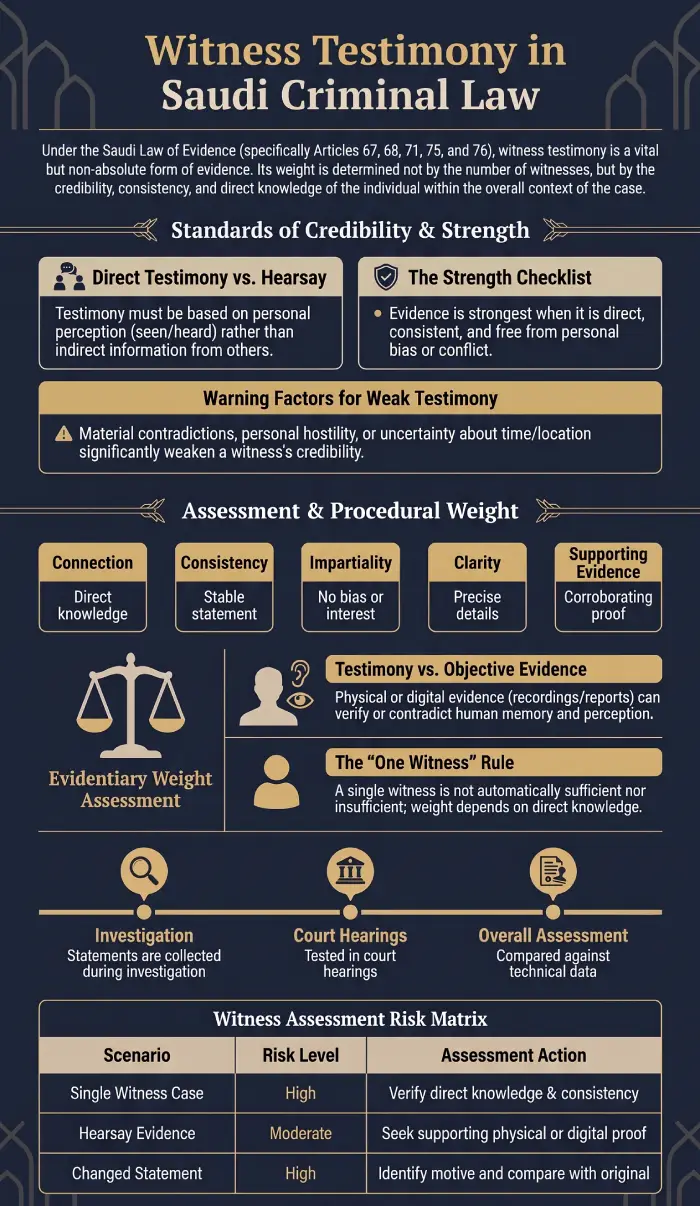
Witness testimony in criminal evidence in Saudi Arabia can be an important form of proof, but it is not automatically decisive in every case. The value of testimony does not depend solely on the number of witnesses. It also depends on each witness’s connection to the incident, the consistency of their statements, the absence of a material personal interest, and the extent to which the testimony corresponds with circumstantial, physical, or digital evidence.
For this reason, a court does not necessarily assess witness testimony in isolation. It examines the testimony within the overall evidentiary picture and considers its strengths and weaknesses before relying on it in reaching a conclusion.
Key points to know:
- Not every witness statement is sufficient on its own to support a conviction.
- Direct testimony generally carries greater practical weight than hearsay testimony.
- A material contradiction is more significant than minor and natural differences in recollection.
- The existence of one witness does not automatically establish either the sufficiency or insufficiency of the evidence.
- Examining and challenging witnesses can be an important part of criminal defence.
- Testimony may be weakened where the witness has a direct interest or a significant personal dispute.
- The strength of witness testimony should always be considered alongside the other evidence in the case.
| Practical Question | Short Answer |
|---|---|
| Is the existence of a witness enough to prove the charge? | No. The strength of the testimony and its connection to the incident must be assessed. |
| Is direct testimony stronger? | Generally, yes, because it is based more closely on the witness’s own perception. |
| Can witness testimony be challenged? | Yes, particularly where there is contradiction, personal interest, or conflict with stronger evidence. |
| Is one witness always enough? | There is no absolute rule. The weight and reliability of the testimony remain central. |
What Is Witness Testimony in Criminal Evidence?
In criminal cases, witness testimony refers to statements made by a person before an investigating authority or court concerning facts that may affect the criminal proceedings. These statements are generally based on what the witness personally perceived or otherwise became directly and materially connected with.
In practical terms, testimony is not simply an opinion, a legal interpretation, or a general impression of what happened. It is an account of a fact or information connected with the alleged offence, its circumstances, or the people involved.
The closer a witness’s statement is to direct personal perception, the easier it may be to examine and compare it with the remaining evidence in the case.
Definition of Witness Testimony in a Criminal Context
A witness does not replace an expert, judge, or lawyer. The witness reports what they saw or heard. By contrast, determining the legal characterisation of the conduct or establishing the mental element may require an assessment of criminal intent and criminal participation under Saudi law according to the circumstances of each case.
A witness statement should also be distinguished from general assumptions or speculation. For example, if a witness says that they saw the accused at a specific location at a particular time, the statement can be tested and compared with other evidence.
If the witness instead gives only broad conclusions or personal assumptions, the practical value of the statement may be reduced because the court needs identifiable facts that can be assessed rather than general impressions that are difficult to verify.
Difference Between Witness Testimony and Circumstantial Evidence
Witness testimony is oral evidence provided by a person describing something they perceived or experienced. Circumstantial evidence, by contrast, involves an inference drawn from established facts.
For example, a witness may say that they saw a person leaving the scene of an incident. That is witness testimony. If other evidence establishes that the same person was near the location at the relevant time, and the court draws an inference from that fact together with other circumstances, this would involve circumstantial evidence.
Witness evidence remains particularly relevant in criminal proceedings because many offences occur in circumstances where there may be no written document or complete forensic record.
Its evidentiary value, however, should not necessarily be considered independently of the surrounding circumstances, reports, records, and other evidence.
Evidentiary Weight and Conditions Affecting Witness Testimony
The evidentiary weight of witness testimony in criminal evidence is not absolute. At the same time, a witness statement does not become worthless merely because there is a possibility of error.
A court is not necessarily required to accept testimony simply because it appears in the case file, nor is testimony automatically disregarded because one party disputes it. Instead, the statement may be examined in terms of its connection to the incident, its internal consistency, and its compatibility with the remaining evidence.
For that reason, the practical factors affecting the strength of witness testimony are often more important than simply describing someone as a “witness.”
When Does Witness Testimony Become Stronger?
Testimony generally becomes stronger when the witness had direct contact with the relevant events.
It may also carry greater weight when the statement is clear, specific, and consistent on material points, and when the witness does not appear to have a direct interest or significant dispute that could affect impartiality.
Testimony may be further strengthened when it corresponds with established circumstantial, physical, or digital evidence.
The practical strength of a witness statement therefore does not depend only on how it is worded. It also depends on whether it withstands examination and whether it can be connected to the relevant time, place, individuals, and events without significant inconsistency.
When Can Witness Testimony Be Weakened?
Testimony may be weaker where it is based primarily on information heard indirectly from another person.
Its value may also be reduced where there is hesitation or contradiction concerning material matters such as the time, location, or manner in which the incident occurred.
A direct personal interest, pre-existing dispute, or relationship of dependency may also affect the assessment of impartiality.
Witness testimony may be particularly vulnerable where it conflicts with stronger evidence, such as a verified recording, technical report, or established physical fact.
It is important to distinguish between minor discrepancies and material contradictions. Small differences in recollection may occur naturally. A contradiction concerning a central fact of the case is more likely to affect the actual evidentiary weight of the testimony.
Practical factors that can strengthen witness testimony in criminal evidence include:
- Direct or close connection to the incident.
- Clarity concerning the time, location, and manner of perception.
- Consistency on material facts.
- Absence of a significant personal interest or serious dispute.
- Compatibility with stronger evidence in the case.
Procedures for Hearing Witnesses During Investigation and Trial
The theoretical value of testimony is not the only relevant consideration. The way in which the testimony enters the case file and is subsequently examined may significantly affect its practical weight.
Its importance becomes clearer when viewed in the context of the stages of criminal proceedings under Saudi law, because the role of a witness statement may differ between the investigation, trial, and subsequent stages.
Assessing witness testimony in criminal evidence therefore often begins at an early stage rather than only after the proceedings have reached court.
Hearing Witnesses During the Investigation Stage
At the beginning of a criminal case, witness statements may be collected and recorded in official records.
This is where the practical assessment of testimony may begin within the criminal investigation stages, because the witness’s identity, connection to the incident, and the limits of what they personally perceived can later become either strengths or weaknesses before the court.
There is also an important distinction between a witness who describes a specific event and one who merely repeats information received from another person.
That difference may affect how the testimony is assessed from the beginning and the degree of evidentiary weight it may ultimately carry.
Hearing and Examining Witnesses Before the Court
The value of witness testimony in criminal evidence may become clearer during court proceedings because hesitation, inconsistency, and the degree of certainty in the witness’s account may emerge more clearly under examination.
This is why the ability to question witnesses and request the hearing of relevant witnesses can become important in practice.
Witness testimony should not be assessed only by reading the words recorded in a statement. Its reliability may also become apparent when the witness is questioned, confronted with other information, and their account is compared with the remaining evidence.
In some cases, a defence witness may be particularly important, not because the witness can disprove every allegation, but because they may identify a material gap or establish a timing or location issue that undermines another version of events.
This is also where obtaining advice from a lawyer experienced in criminal cases may be relevant, particularly when examining witnesses, identifying contradictions, or requesting that a particular witness be heard.
Is Witness Testimony Alone Enough for a Conviction?
This is one of the most common questions for anyone involved in a criminal case that relies heavily on witness statements.
The practical answer is that testimony may be highly influential, but it should not automatically be assessed separately from the remaining evidence.
The central issue is not simply whether statements exist against or in favour of the accused. The question is how reliable those statements appear when compared with the other evidence.
Accordingly, witness testimony in criminal evidence may be a strong element in one case, while in another it may require support from circumstantial evidence, reports, physical evidence, or digital records.
Where a confession also forms part of the case, the witness evidence should be considered together with the requirements for a valid confession in criminal cases where relevant.
Can a Court Rely on a Single Witness?
The number of witnesses alone is not necessarily decisive.
A single witness statement may carry significant weight where it is direct, clear, consistent, and compatible with the other evidence. Conversely, several witness statements may be weaker where they contain substantial inconsistencies, conflicts, or signs of personal influence.
It is therefore inaccurate to apply either of the following statements as an absolute rule:
- One witness can never be enough.
- One witness is always enough.
The actual issue is the weight and credibility of the testimony itself, its consistency with the rest of the case, and its ability to withstand examination.
Which Is Stronger: Witness Testimony or Physical and Digital Evidence?
Where evidence conflicts, physical or digital evidence may in some circumstances carry greater weight if it is more objectively verifiable and less susceptible to memory errors or inaccurate recollection.
Recordings, surveillance footage, technical data, and expert reports may, for example, show that a witness was mistaken about the time, location, or description of an event.
There is nevertheless no rigid hierarchy under which witness testimony is always weaker or always stronger.
The ultimate evidentiary assessment may depend on the combined body of evidence. Witness statements should therefore be read within the full context of the criminal case rather than treated as an isolated form of proof.
| Assessment Factor | When Testimony Is Stronger | When Testimony Is Weaker |
|---|---|---|
| Witness’s connection to the incident | Direct perception of the event | Indirect information or hearsay |
| Consistency of statements | Consistent on material facts | Contradictions concerning time, location, or essential details |
| Impartiality | No significant personal interest or dispute | Personal benefit, hostility, or dependency |
| Relationship with other evidence | Consistent with circumstantial and technical evidence | Conflicts with physical, digital, or established technical evidence |
| Clarity of presentation | Clear and confident | Speculative, confused, or overly general |
Types of Witness Testimony and How It Can Be Challenged
The type of testimony may affect its evidentiary weight, and the way testimony is challenged can affect how persuasive that challenge becomes.
Not every challenge is effective. Likewise, not every discrepancy between two statements destroys the evidence.
An effective challenge generally identifies a specific weakness and explains why that weakness matters to the outcome rather than relying on a general allegation that the witness is unreliable.
Understanding the different types of testimony and the practical grounds for challenging them can therefore contribute to a more structured criminal defence strategy.
Direct Testimony vs Hearsay Testimony
Direct testimony is based on what the witness personally perceived.
For this reason, it generally carries greater practical weight than hearsay testimony based on information communicated to the witness by another person or originating from a source the witness did not directly observe.
This does not necessarily mean that hearsay testimony has no relevance in every situation.
It does mean, however, that such testimony may require more cautious assessment, particularly where it is not supported by other circumstances or evidence.
The distinction between a prosecution witness and a defence witness may also matter in practice. A defence witness may undermine a decisive element of another account even if that witness does not provide a complete alternative explanation of the entire incident.
How Can Witness Testimony Be Effectively Challenged?
An effective challenge begins by identifying the particular weakness in the testimony rather than merely asserting that the witness is not telling the truth.
The challenge may concern:
- Contradictions within the witness’s own statements.
- Differences between that testimony and the statements of other witnesses.
- Conflict between the testimony and established facts in the case.
- A personal interest, dispute, or relationship that could affect impartiality.
- Conflict with a recording, technical report, or objective physical circumstance.
In some cases, requesting that a witness be heard again may also be useful where a significant new issue has emerged or where new evidence requires the witness to be confronted with additional facts.
Common practical grounds for challenging witness testimony include:
- Material contradictions concerning the central facts.
- Weak or indirect connection between the witness and the incident.
- A direct personal interest or significant dispute.
- Conflict with objectively verifiable facts.
- Inconsistency with physical or digital evidence.
Where a criminal case relies on inconsistent witness statements or there may be a personal interest affecting the testimony, consulting a criminal lawyer in Jeddah may assist in assessing the significance of the inconsistency and its potential effect on the proceedings.
Witness Recantation and Common Practical Issues
A witness retracting or changing a statement does not automatically mean that the original testimony disappears or remains fully effective.
Instead, both the earlier and later statements may need to be examined together, including the reason for the change, its timing, and its relationship with the remaining evidence.
In some cases, a recantation can be particularly significant where the witness statement was a central element of the allegation.
In other cases, there may still be independent evidence supporting the relevant facts.
It is therefore not enough simply to say that a witness has “changed their statement.” The important questions are what changed, why it changed, and how the change affects the overall evidentiary picture.
What Happens if a Witness Recants or False Testimony Is Alleged?
If there are indications that a witness knowingly provided false information, serious questions may arise concerning both the credibility of the witness and the reliability of the relevant part of the case.
A bare allegation of false testimony, however, is not enough by itself. The allegedly false statement, its relationship to the material facts, and its effect on the case should all be identified.
Where the issue involves only a correction or change in certain details, it is also necessary to distinguish between minor discrepancies and material changes.
The legal and practical effect will depend on the nature and significance of the difference.
When Should You Obtain a Specialist Legal Assessment?
Early legal assessment becomes more important where the case depends on:
- A single witness.
- Hearsay testimony.
- A witness who has withdrawn or changed their statement.
- A conflict between witness testimony and digital evidence.
- A conflict between testimony and a technical or forensic report.
Such an assessment may become particularly important where you are preparing a criminal appeal in Saudi Arabia and need to determine whether the treatment of witness testimony affected the judgment.
At this stage, the usual starting point is to prepare a concise summary of the incident, identify the current procedural stage, review the available witness statements, and compare them with any official records, physical evidence, or digital material.
Information that may assist in evaluating the case includes:
- A short summary of the incident.
- The current stage of the criminal proceedings.
- A copy of the relevant record or available sections of it.
- The statement of the witness or witnesses.
- Any digital or physical evidence connected to the incident.
To discuss the appropriate next step based on the circumstances of your case, you can contact us and provide a brief summary of the case together with the available documents.
Frequently Asked Questions About Witness Testimony in Criminal Evidence
Can one witness be enough for a conviction in Saudi Arabia?
Possibly. The court considers the credibility, consistency, and overall evidentiary weight of the testimony.
Is direct witness testimony stronger than hearsay?
Generally, yes. Direct testimony is based on what the witness personally saw or heard.
Can witness testimony be challenged in a criminal case?
Yes. It may be challenged for material contradictions, bias, personal interest, or conflict with stronger evidence.
What happens if a witness changes their statement?
A change does not automatically cancel the earlier testimony. Both statements may be compared and assessed with the rest of the evidence.
Is digital evidence stronger than witness testimony?
Not automatically. Digital evidence may carry greater weight where it is more objective or directly contradicts the witness’s account.
Witness Testimony in Criminal Evidence: 9 Saudi Rules is not simply about statements recorded during an investigation or repeated before the court.
Witness evidence can affect the outcome of a criminal case to different degrees depending on the quality of the witness’s perception, the clarity and consistency of the statement, the witness’s impartiality, and the extent to which the testimony corresponds with the remaining evidence.
The practical question therefore does not begin with: “Is there a witness?”
It begins with: How strong is this testimony? Was it handled properly within the proceedings? Can it be challenged, weakened, or supported depending on your position in the case?
In criminal proceedings in particular, an early understanding of the evidentiary value of witness testimony may make a substantial difference to the next procedural step, whether during an investigation, when preparing a defence, when challenging a judgment, or when assessing the risks before further escalation.
For more legal guides and services relating to criminal cases, you can visit the main website of our Jeddah law firm.
Official Reference:
ملاحظة واحدة مهمة: رابط «الاستئناف في الأحكام الجزائية في السعودية» في المقال العربي الأصلي جاء كـAnchor Text من دون URL، لذلك ترجمته إلى criminal appeal in Saudi Arabia لكن لم أختلق له رابطاً غير موجود في المصدر. إذا زودتني بالرابط الإنجليزي المقابل يمكن إدخاله مباشرة