If you find that your book, photographs, training course, software or design has been copied or offered for sale without your permission, knowing the copyright infringement penalty in Saudi Arabia matters, but your first question is usually not “what is the violator’s penalty?” but “how do I stop the infringement and protect my right without making a procedural mistake?” This article is written for the injured rights holder: what to gather, where to apply, and which conditions could defeat your complaint if neglected. The legal framework changed in 2026: the new Copyright Law replaced the Copyright Protection Law issued in 1424 AH (Article 59). We therefore rely on the text of the new Law and its Executive Regulation, and flag what we could not confirm from the texts.
What Does the Copyright Law Protect in Saudi Arabia?
The Law defines a work as any original creation, whatever its type, form of expression or purpose (Article 1). Article 3 gives non-exhaustive examples, including books, lectures, artistic, musical and audiovisual works, photographs, maps, designs, architectural works, computer programs and applications, and databases that are original in their selection or arrangement. Protection does not extend to ideas, procedures, systems, official documents or ordinary news (Article 4). The author holds perpetual moral rights that do not lapse by time and cannot be waived (Article 7), including attribution of the work and objection to distorting modification. Economic rights generally last for the author’s lifetime plus fifty years after death (Article 22), with different terms for some categories.
Copyright Infringement Penalty in Saudi Arabia
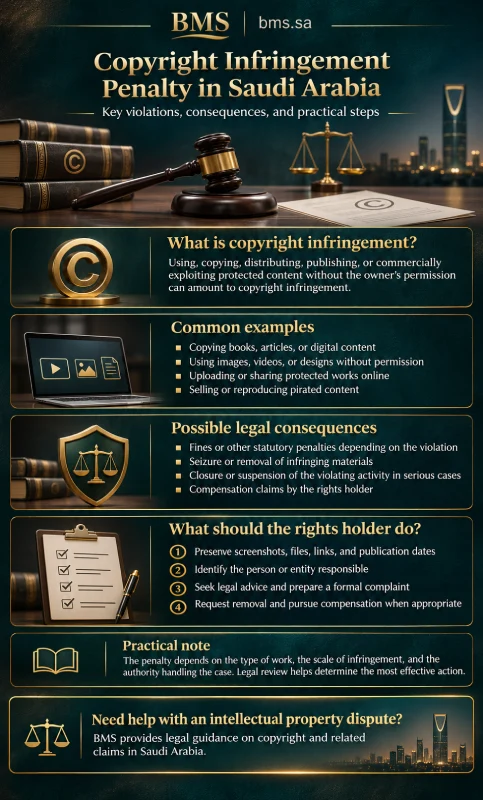
Article 47 of the Law provides for imprisonment of up to one year, a fine of up to SAR 1,000,000, or either of these penalties, without prejudice to any harsher penalty provided by another law. The Public Prosecution is competent to investigate these violations and prosecute them before the competent court (Article 46).
| Topic | What the Law provides | Source |
|---|---|---|
| Examples of violations (Art. 47) | Commercial exploitation of a right without permission, publishing a work one does not own while claiming ownership, making it available to the public without prior permission, circumventing technical protection measures, removing rights-management information, and importing or possessing counterfeit copies for commercial purposes. The text contains nine violations. | Article 47 |
| Principal penalty | Imprisonment of up to one year, a fine of up to SAR 1,000,000, or either | Article 47 |
| Repeat offence | The maximum penalty is doubled for a repeat offence. A repeat offender is anyone who commits the violation while serving a sentence or within three years of its expiry or of a pardon | Article 48 |
| Confiscation and destruction | The court must order confiscation and destruction of infringing works or their disposal outside commercial channels, and may confiscate tools used mainly in the violation | Article 53 |
| Publication of the judgment | The judgment may order publication of its summary once it becomes final | Article 50 |
| Temporary closure | In necessary cases the head of SAIP may close the place of the violation until seizure procedures are completed, for no more than seven working days | Article 43 |
| Settlement | SAIP may settle the violation under rules approved by its board, for consideration not exceeding twice the maximum fine together with destruction of the infringing materials; settlement ends the criminal action without prejudice to third parties’ right to compensation | Articles 56 to 58 |
The penalty is imposed through the competent authorities, and rights holders cannot determine it. What is required of you is to prepare a complete complaint and evidence that can be examined.
Tell us about your problem before you file a complaint
Send us a short summary: the type of work, where it was published or sold, the date you discovered it, and whether you have anything proving your ownership. Do not send ID photos, banking details or original files in your first message. After an initial assessment we will tell you which documents are needed.
7 Steps to File a Complaint and Protect Your Rights When Copyright Is Infringed
Step 1: Identify the protected work and prove it is yours
Start by identifying the work precisely: its title, creation date, original version and who contributed to it. A person who publishes a work attributed to them is considered its author unless the contrary is proven (Article 19), but evidence remains the foundation: source files, drafts, delivery messages and commissioning contracts if you work for someone else. Article 42 gives registration of the work with SAIP a rebuttable presumption of ownership, and under the Regulation registration does not itself create the right (Article 61).
Step 2: Document the infringement before any correspondence
Record the link or place where the work appeared, the date and time of viewing, screenshots, a copy of the page where possible, and the account or store name. When a complaint is filed, the Regulation requires a technical examination report setting out the facts of the infringement and the subject and location of the claim, in a template approved by SAIP, and reports that do not meet it are disregarded (Articles 64 and 65). Do not rely on a screenshot alone.
Step 3: Notify the infringer or the platform
The Regulation (Article 64) refers to notifying the infringer and anyone who contributed to the infringement before a complaint is filed, where SAIP considers this possible given the nature of the violation. If the content is on a platform or website, the injured party may send a notice to the content provider stating the name and capacity of the sender, a description of the protected right and the facts, the link, and a declaration of ownership or authorization, that no licence was given for the use, and of good faith (Article 83). The provider is exempt from liability if it removes the content or disables access within the specified period, including 48 working hours from knowledge or a complete notice (Article 85). Keep a copy of the notice and proof that it was sent.
Step 4: Check the exceptions before you accuse anyone
The Law permits use of a work without permission in specified cases, including short quotation with attribution to the author (Article 27), and personal copying of a lawful copy and non-profit educational and research use with the source cited (Article 26). Article 37 requires that the use not conflict with the normal exploitation of the work or unjustifiably harm the right holders’ interests. A use that looks like infringement to you may fall within an exception. The Regulation also warns against bad-faith complaints: SAIP may close the complaint and take legal action against the complainant if bad faith is established (Article 68).
Step 5: File a complaint with the Saudi Authority for Intellectual Property
SAIP employees designated by decision of the President handle seizure, evidence-gathering and receipt of reports and complaints concerning Article 47 violations (Article 43). The copyright infringement complaint service page on the SAIP website (in Arabic) states that the service is digital and free, and that filing is done through the Respect for Intellectual Property portal by signing in with the Unified National Access (Nafath), then going to complaint management, filing a complaint, choosing its type, meeting the requirements and attaching documents. The Executive Regulation (Article 64) requires the following:
- The complaint must be filed by the rights holder or their representative under a valid authorization, with proof of identity and representation.
- Attach the technical examination report in the approved template.
- Notify the infringer before filing where SAIP considers this possible.
- No more than five years may have passed since the date of the violation.
- A declaration that there is no pending case on the same subject before any court, and that the original work can be made available for examination on request.
SAIP may reject the complaint or suspend consideration of it until the conditions are met, and may request additional technical requirements. According to SAIP, its unified contact number is 920021421. The Regulation (Articles 66 to 77) provides for examination of the complaint, then completion of evidence-gathering and seizure, then referral of the file to the Public Prosecution or settlement. We noticed that the service page on the SAIP website still describes a stage before a committee and a 60-day grievance period, worded by reference to the former Copyright Protection Law, and we found no text reconciling it with the Regulation in force. Rely on the Regulation, and ask SAIP which procedure applies at the time you file your complaint.
Step 6: Follow the examination, seizure and referral
SAIP examines the complaint in form and substance and requests what is missing (Article 66), and completes evidence-gathering within 90 days of receiving complete documents, which may be extended where necessary (Article 67). In seizure and inspection, enforcement officers may enter and inspect the premises, seize infringing materials, take samples, hear statements and preserve digital evidence (Article 71). The case file is referred to the Public Prosecution 15 days after the infringer is notified that procedures are complete, unless settlement is requested within that period (Article 77). A complaint may be closed at any stage for reasons including an existing court judgment on the same subject or insufficient information (Article 68); closure does not prevent re-filing once the reason ceases, nor the right to sue unless a final judgment has been issued (Article 69).
Step 7: Separate the penalty from compensation and seek urgent measures where needed
The rights holder may bring an action before the competent court to demand that the infringement stop and for compensation, including the infringer’s profits and disclosure of information about participants (Article 51). In urgent cases the court may temporarily order a halt to copying, publication or distribution and a precautionary attachment of copies (Article 52). For imported counterfeit goods, the Regulation allows a request to the Zakat, Tax and Customs Authority in coordination with SAIP, on conditions including proof of capacity and ownership and an undertaking to cover damages if the infringement is not established (Article 90).
Documents to prepare before filing
- Proof of your identity or commercial registration, and a valid authorization if someone else is filing on your behalf.
- The original copy of the work and proof of its creation date and your ownership of it (source files, drafts, a registration certificate if any).
- The technical examination report in the template SAIP approves.
- Screenshots, links, dates of viewing and any saved copy of the infringing page.
- Proof of the notice you sent to the infringer or platform, and their replies if any.
- Proof that no permission or licence was given, identifying any earlier licence if one exists.
SAIP complaint or civil action? A quick comparison
| Point of comparison | SAIP complaint (criminal route) | Court action (civil route) |
|---|---|---|
| Purpose | Detecting and proving the violation and referring it to the Public Prosecution or settling it | Stopping the infringement and claiming compensation |
| Basis | Articles 43, 46 and 47 and Articles 64 to 77 of the Regulation | Articles 51 and 52 |
| Key condition | Technical report, no more than five years since the violation, and no pending case on the same subject | Proof of the right, the harm and the infringer’s connection to the infringement |
| Does it produce compensation? | A fine and imprisonment are penalties and do not automatically mean compensation for you | It is the route designed for claiming compensation |
Hypothetical examples showing why the right step differs
These are simplified examples, not real cases, and do not replace a review of your documents.
When do you need a lawyer in a copyright case?
Many simple cases are resolved by a well-structured notice, but some deserve assessment before you act:
- The work was done for a client or employer, and you dispute who owns the rights.
- You previously licensed the infringer or wrote to them in terms that could be read as consent.
- The infringer is outside the Kingdom or cannot be identified, or the content is on a foreign platform.
- You need urgent action to stop ongoing publication or sale, or a precautionary attachment.
- You are considering combining a SAIP complaint with a civil action and want to know the order.
- You have been offered a settlement or a sum and want it drafted without weakening your right.
The BMS Legal team usually reviews the original work and what proves ownership, the evidence of infringement, earlier notices and any licence or contract. The aim is to identify the route, deadlines and documents; it does not include a promise of any result. To see our criminal and commercial practice areas, you can visit the page for a criminal lawyer in Jeddah or a commercial lawyer in Jeddah. Note the difference between two issues: the photographer’s or image creator’s right in the image as a protected work, which is the subject of this article, and the privacy of the person shown in it, which other laws address, such as the Anti-Cyber Crime Law. If your question is about publishing a person’s photo without their permission, rather than the photographer’s right in their own photo, see Private Right in Cybercrime in Saudi Arabia for cybercrime-related content.
Frequently Asked Questions About the Copyright Infringement Penalty in Saudi Arabia
Must a work be registered before filing a complaint?
We found nothing in the texts we reviewed that makes registration a condition for accepting a complaint; Article 64 of the Regulation does not list it among the acceptance conditions, and it requires proof of the capacity of the rights holder or their representative and the technical examination report. The Regulation provides that protection arises without any formal procedure (Article 3) and that entry in the register is a documentary step that neither creates nor restricts the right (Article 61). Article 42 of the Law makes registration optional and gives it a rebuttable presumption of ownership. Registration therefore makes proof easier, but the text does not show it as a condition for a complaint.
How long do I have to file a complaint?
The Regulation (Article 64) requires that a complaint not be filed after five years from the date of the violation. Even so, do not wait: digital evidence may be deleted, and every day of delay weakens documentation.
Does the infringer’s fine mean I will receive compensation?
Do not assume so. A fine and imprisonment are criminal penalties. A claim for compensation is made before the competent court under Article 51 of the Law and, according to the text, includes the infringer’s profits. Even if the violation ends in a settlement with SAIP, Article 58 preserves the right of anyone other than the settling party to claim compensation.
Can I bring a court action and file a SAIP complaint at the same time?
The Regulation requires a declaration that there is no pending case on the same subject before any court when the complaint is filed (Article 64). The two routes therefore need to be sequenced before you start, rather than assumed to always run in parallel.
I found my content on a social media platform. Should I start with a complaint?
You usually start by notifying the content provider or platform under the notice-and-removal procedures in the Regulation (Articles 83 to 85). The provider is exempt from liability if it removes the content or disables access within the specified period. According to the Regulation, SAIP steps in if the provider does not respond, cannot be reached or the violation is repeated.
Does the new Law apply to an infringement that occurred before it took effect?
The Law takes effect 180 days after its publication in the Official Gazette (Article 61) and replaces the former Copyright Protection Law (Article 59). We found no express transitional provision in the Law or the Regulation on violations that occurred before the Law took effect or continued after it; the transitional provision we did find (Article 24) concerns the terms of protection of works. We therefore do not assert which law applies to an earlier or continuing incident; it requires a legal assessment based on the dates of the events.
Conclusion
The copyright infringement penalty in Saudi Arabia does not replace dealing with the infringement itself, and it is not dealt with in one step. Prove your ownership, document the infringement with a technical report, notify the infringer or platform, check the exceptions, then choose between a SAIP complaint and a civil action according to your goal: catching the infringer, stopping the infringement or claiming compensation. Do not delay starting: digital evidence may disappear, and a SAIP complaint must be filed within five years of the violation.
Has your right in a work been infringed? Start by assessing the most suitable step
Send a short summary of what happened, and we will tell you the likely route and the documents required, without promising any result. Avoid sending account numbers or ID photos in your first message.