
Direct answer:
- First step: get the bank’s return slip stating the reason and date of the return, keep the original cheque, and note the issue date written on it and the date you presented it to the bank.
- The two routes: an enforcement request aims to recover the amount from the debtor’s assets. A criminal complaint aims to hold the drawer accountable for the offence where its elements, including bad faith, are met.
- Using both: whether the two routes can be pursued together, and in what order, depends on the facts and documents of each case, so do not assume it is available in every situation.
If you hold a bounced cheque in Saudi Arabia, the question on your mind is probably how to get paid, not what penalty the drawer might face. This article is written for the cheque holder who has been harmed: what to do first, which route fits, and which time limits you cannot afford to ignore.
We separate four issues that are often confused: the period for presenting the cheque to the bank, the period for recourse claims, the general limit for accepting an enforcement request, and what actually happens after an enforcement order is issued. We also explain what has not yet entered into force under the new Commercial Transactions Law, so it is not mixed up with the cheque law your case is built on today.
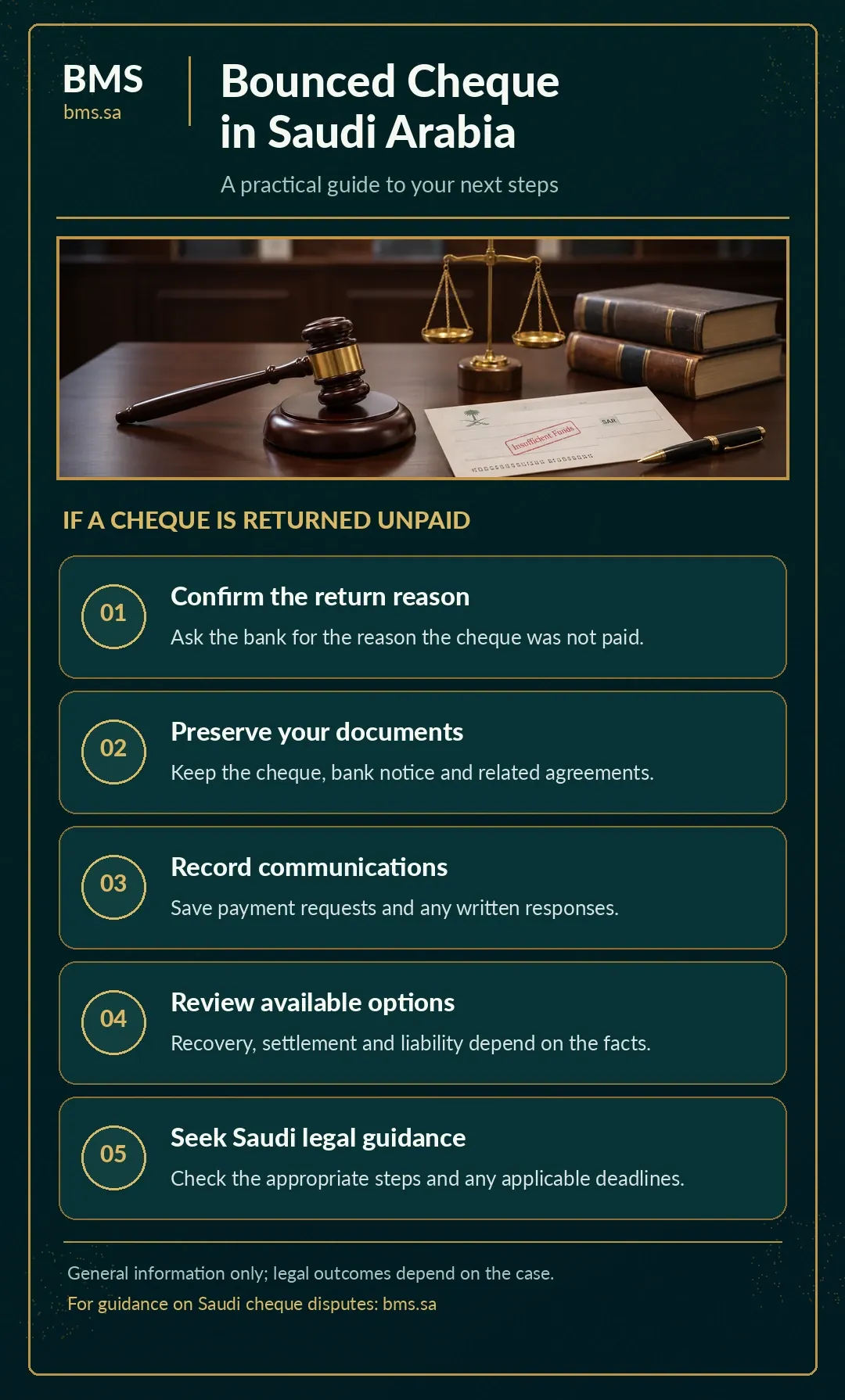
What to Do When a Cheque Bounces in Saudi Arabia
Before any filing, check three things calmly: whether the cheque was presented to the bank within the legal period, whether the cheque details and the drawer’s name match your papers, and what you actually want from the process. These answers decide whether an enforcement request is enough or whether another step is needed.
Should You File a Lawsuit or an Enforcement Request for a Cheque Without Sufficient Funds?
As a rule, a cheque is an enforceable instrument. Article 7 of the Enforcement Law requires an enforceable instrument for a specific right that is due, and lists cheques among such instruments in paragraph (1)(e). A cheque holder therefore does not usually start with a lawsuit on the merits. But if the cheque has a defect that weakens its status as an enforceable instrument, or the dispute concerns the underlying right, the route may change, and that is a matter for legal assessment.
Enforcement Request or Criminal Complaint: A Quick Comparison
| Point | Enforcement request | Criminal complaint |
|---|---|---|
| Purpose | Recover the cheque amount from the debtor’s assets | Hold the drawer accountable for the offence, if established |
| Basis | Article 7, Enforcement Law | Article 118, Commercial Papers Law (as amended) |
| Core requirement | An enforceable instrument for a specific right that is due | One of the listed acts, committed in bad faith |
| Where it starts | The Najiz portal, enforcement package | A report to the competent criminal-investigation authority, then the Public Prosecution (details below) |
| Does it return the money? | It is the route designed for recovery; the result depends on the debtor having assets | Its aim is punishment, not collection as such |
Review your situation before choosing a route
Send us a short summary first: the cheque date, the reason it was returned, and what you have done so far to claim payment. Please do not send ID photos, account numbers or any banking details in the first message. After an initial assessment we will tell you which documents we need.
Time Limits for a Bounced Cheque: Four Separate Issues
The most dangerous mistake a cheque holder can make is to treat all the periods as one. The texts below come from the Commercial Papers Law and the Enforcement Law, and each has its own scope.
1) The period for presenting the cheque to the bank (Article 103)
A cheque drawn in the Kingdom and payable in it must be presented for payment within one month. If it is drawn outside the Kingdom and payable in it, it must be presented within three months. The period runs from the date shown on the cheque as its date of issue. Presenting the cheque to a recognised clearing house counts as presenting it for payment.
2) The effect of missing the presentation period (Article 115)
Missing the presentation period does not mean the right is automatically lost in every case. Article 115 provides that if the presentation or protest periods pass, the holder loses his rights against the drawer, the endorsers and other obligors, except the drawee. However, the drawer cannot benefit from this loss unless he had provided the funds covering the cheque (the cover), the cover remained with the drawee until the end of the presentation period, and it then disappeared for a reason not attributable to the drawer. Whether that exception applies depends on the facts of each cheque.
3) Hearing of recourse claims (Article 116)
The first paragraph of Article 116 provides that the holder’s recourse claims against the drawee, the drawer, the endorser and other obligors are not heard after six months from the date the cheque’s presentation period expired. The scope of the text is recourse claims based on the cheque. It should not be read to mean that every claim lapses after six months, nor that it is the provision that sets the time for an enforcement request. Your rights arising from the underlying relationship for which the cheque was issued are a separate question, assessed according to the documents.
4) The general limit for enforcement requests (Article 11)
Article 11 of the Enforcement Law provides that an enforcement request is not accepted after ten years from the due date, without prejudice to the relevant statutory provisions. Ten years is the general limit; it is not a guaranteed deadline for enforcing every cheque. How the periods specific to commercial papers interact with this general limit in a particular case needs legal assessment before you delay, so do not wait in reliance on the ten years.
Procedural time is not the same as recovering your money
Once the request is accepted, the enforcement order is issued and the debtor is notified (Article 14). Compulsory enforcement against assets begins five working days after he is notified without paying (Article 18), and ten more working days are added if he provides a sufficient bank guarantee. These are procedural periods, not a promise of when the money will arrive. Actual recovery depends on whether there are assets that can be enforced against, the debtor’s conduct, and any objections to the request. The new Enforcement Law and its regulations took effect on 29 October 2026 according to the Ministry of Justice announcement; procedural details are in the Implementing Regulations published in Umm Al-Qura.
How to File an Enforcement Request Through Najiz
According to the Ministry of Justice guide (in Arabic), the request starts by signing in to the Najiz portal, then going to electronic services, the enforcement package, the “Submit an enforcement request” service, and choosing a new request. The system shows six consecutive screens where you select the type of instrument and the capacity of the applicant, enter the party and instrument details, and attach the mandatory documents. Screen details may change, so follow what the system shows when you file.
Documents to prepare
- The original cheque and a clear copy.
- The bank’s return slip stating the reason and date of return.
- The drawer’s details (name and ID or commercial registration) and address if available.
- A correct IBAN in your name for transfer of recovered amounts.
- Proof of why the cheque was issued if the matter is disputed: a contract, invoice or correspondence.
Check that names match the instrument before you submit; a mismatch is one reason a request stalls.
Does a dispute over the underlying right stop enforcement?
Enforcement does not stop automatically just because the debtor disputes the underlying right. Article 47 of the Enforcement Law provides that a pending dispute, a challenge to the underlying right, or a grievance against an enforcement step does not stop the proceedings unless the authority hearing the dispute or grievance decides otherwise. If the disagreement concerns the validity of the enforceable instrument itself, the conditions for enforcing it, or jurisdiction, that is an “enforcement dispute” under Article 45, which has its own rules.
Settlement, partial payment and ending the enforcement request
Article 42 requires the enforcing party to end the request after the right under the instrument has been collected, within the period set by the Implementing Regulations. Article 43 sets out the cases in which a request ends, including payment of the debt, the creditor ending it by agreement or for another reason, and release of the debtor. The situations differ:
- Full payment: once you have received the whole right, you must end the request within the legal period; do not leave it open after collection.
- Partial payment: receiving part of the amount does not mean the right has been collected. Record what you received and consider how to pursue the balance; do not end the request before a ground for ending it exists.
- Instalment agreement: if you intend to end the request by agreement with the debtor, draft the agreement with its amounts, dates and what follows if he defaults. Check how ending the request affects your ability to return to it, since the law indicates that ending in certain cases does not prevent the creditor from resuming the request, subject to the Regulations’ controls. There is no single formula that suits every agreement.
Ending the enforceable instrument through Najiz also, according to the Ministry of Justice guide, lifts the decisions issued in the enforcement file against the debtor, so do not end it before you are sure that what you received justifies that. Ending the enforcement file does not necessarily affect an independent criminal complaint, which has its own authority and rules. The debtor, for his part, may submit a request for a grace period or postponement through the dedicated service.
If the debtor objects or does not respond
Follow the request on Najiz and watch its status and notifications. If the period after notification passes without payment, compulsory enforcement against assets begins. Distinguish two avenues: an “enforcement dispute” (Article 45) concerns the validity of the instrument, the conditions for enforcing it and jurisdiction, while a “grievance” (Article 46) concerns enforcement orders and decisions specified in the Regulations. The grievance period is ten working days from the day after the decision or order is made available for review; it applies only to what falls under Article 46 and should not be applied to every objection. The Regulations list what may be challenged, so it is wise not to handle an objection without advice. For the body that handles enforcement, see the Enforcement Court in Jeddah, and for financial claims in general, debt collection in Jeddah.
Where to File a Complaint About a Cheque Without Sufficient Funds
If you believe the drawer acted in bad faith in one of the ways Article 118 punishes, the report is made to the competent criminal-investigation authorities, including police stations. The Criminal Procedure Law (in Arabic) requires criminal-investigation officers to accept reports and complaints in all crimes, examine and record them in a report, and notify the Public Prosecution immediately. Its Implementing Regulations (in Arabic) state that a report submitted to an authority that is not competent by location is recorded and referred to the competent one. The Public Prosecution is responsible for bringing and conducting the criminal case before the competent courts. The file may involve both a public right and a private right, and the effect of a waiver or settlement on each is for the specialist to assess and should not be assumed. We do not rely here on any particular electronic channel for this report, so check the channel available when you file with the competent authority. Documents normally prepared are the original cheque, the bank’s return slip and proof of the relationship between the parties.
Hypothetical Examples of How the Right Step Differs
These are simplified illustrations, not real cases, and do not replace a review of your papers.
When Do You Need a Lawyer to Claim the Value of a Cheque?
Many requests proceed without complication, but some situations deserve specialist assessment before you act:
- The presentation period has passed, or you are not sure when the cheque was presented.
- The cheque was issued by a company or in the name of more than one person, or it carries an endorsement.
- The drawer denies the relationship or claims the cheque was given as security.
- A settlement or instalment plan has been offered and you want it drafted without weakening your right.
- You are considering combining an enforcement request with a criminal complaint.
- The amount is large, there are several cheques, or the parties’ details are incomplete.
BMS Legal normally reviews the original cheque, the bank’s return slip, the issue and presentation dates, what shows why the cheque was issued (a contract, invoice or correspondence), the drawer’s details, and any earlier agreement or notice. To see how this work is scoped, read about our cheques service in Jeddah. The purpose of the review is to identify the route, the time limits and the documents; it does not include a promise to recover the amount or any particular court result.
Penalty for a Dishonoured Cheque in Brief
The drawer’s punishment is not the subject of this article, but you should know its limits. Article 118 of the Commercial Papers Law, as amended punishes with imprisonment of up to three years, a fine of up to fifty thousand riyals, or either penalty, anyone who in bad faith commits one of the specified acts, including drawing a cheque without existing cover that can be drawn on, withdrawing the cover after issue, ordering the drawee not to pay, and endorsing or delivering a cheque knowing it has no cover. On repetition within three years of the judgment, the penalty is imprisonment of up to five years, a fine of up to one hundred thousand riyals, or both. The penalty is set only by the courts and does not mean your money is recovered.
The New Commercial Transactions Law: What Has Not Yet Entered Into Force
FAQs About a Bounced Cheque in Saudi Arabia
Do I lose my rights if I did not present the cheque to the bank within one month?
What is the difference between a returned cheque and a cheque without sufficient funds?
Is a photo of the cheque enough?
Do these rules apply to promissory notes and bills of exchange?
Conclusion
A bounced cheque is not handled with one step or one time limit. Start with the bank’s return slip and the original cheque, check the dates, and choose the route that serves your goal: recovering the amount, holding the drawer accountable, or both, depending on your case. Do not put off studying the time limits, because some of them are short.
Have a returned cheque and want to know the next step?
Send a short summary of the problem first and we will tell you the likely route and the documents needed, without promising any result. Please avoid sending account numbers, ID photos or banking details in the first message.