
A criminal investigation begins when the competent authority examines a report or incident suspected of involving a punishable crime. This stage aims to collect information, verify evidence, hear the parties, and determine the legal characterization of the incident before the proper decision is made.
Being summoned or becoming subject to a criminal investigation does not mean the charge is proven. Likewise, referring a case to court does not mean a conviction has been issued. The court reviews the evidence, examines the defenses, checks the validity of the procedures, and then issues its judgment according to what is established before it.
A criminal investigation in Saudi Arabia usually passes through evidence-gathering, referral to the Public Prosecution, questioning, expert review, and search procedures where needed. It may end with case closure, release of the suspect, or referral to the Criminal Court when the evidence is sufficient.
Before the First Step: How Does Criminal Investigation in Saudi Arabia Work?
If you receive a summons for investigation, first check your legal status in the case, the authority requesting your attendance, and the scheduled procedure. A summons alone does not prove that a crime occurred, nor does it automatically mean that an arrest or detention order has been issued.
Arrange the sequence of events, keep documents and correspondence in their original form, and avoid deleting files or reacting emotionally toward the other parties. Reviewing the summons and the facts before the appointment helps determine the relevant documents and the appropriate position during the investigation.
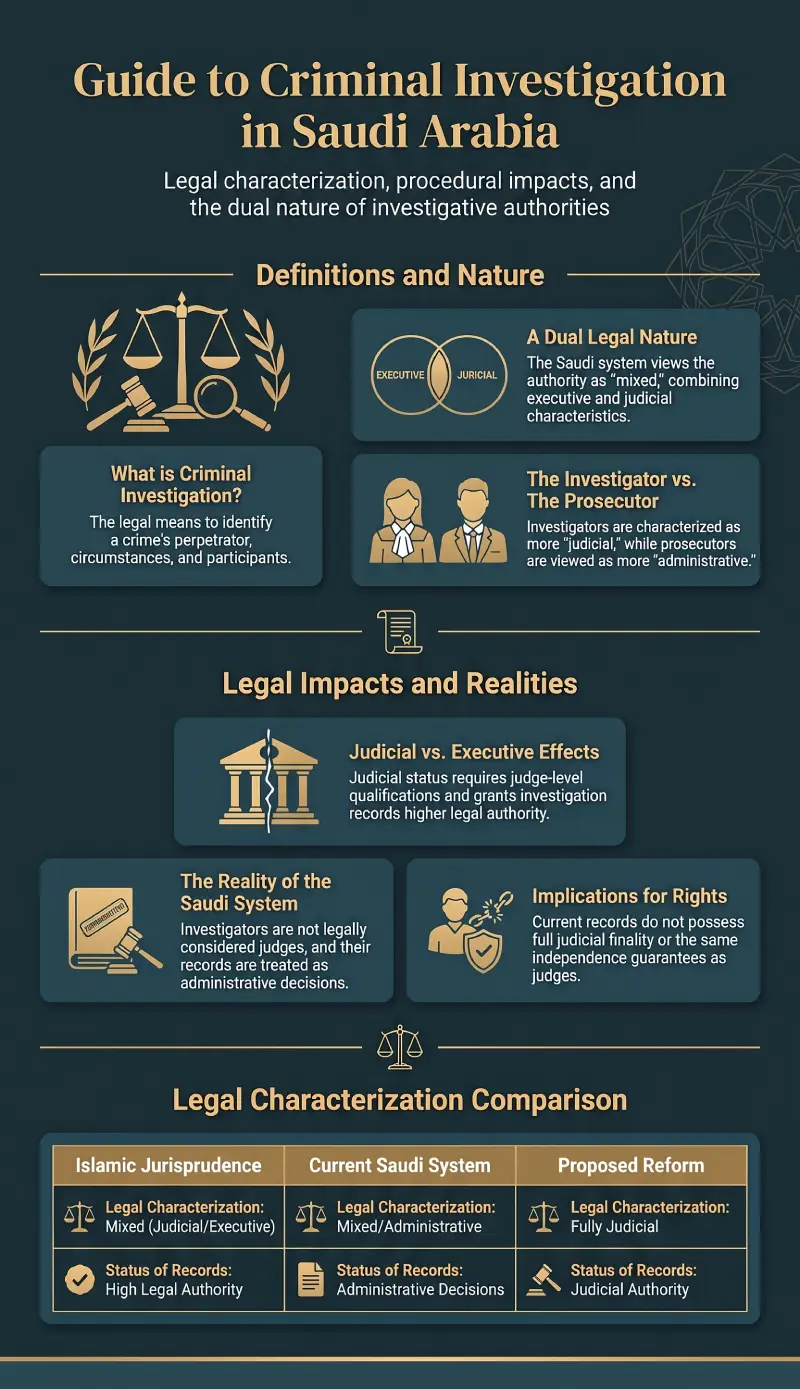
What Is Criminal Investigation in Saudi Arabia?
A criminal investigation in Saudi Arabia consists of procedures conducted by the Public Prosecution to verify whether a crime occurred, examine the evidence, and determine the suspect’s connection to it. The investigation is not limited to collecting material that supports the accusation; it also includes facts and defenses that may negate liability or change the legal characterization of the case.
The Public Prosecution examines the suspect’s statements, witness statements, documents, seized items, expert reports, and digital data connected to the incident. It then determines whether further procedures are required, whether the case should be closed, or whether it should be referred to court when sufficient evidence exists.
The Public Prosecution conducts investigation and public prosecution functions, while criminal investigation officers collect preliminary information and evidence. Their work includes receiving reports, inspecting locations, hearing those present, and preserving objects and traces connected to the crime.
Not every report leads to a charge or detention. The facts may turn out not to have a criminal character, or the available evidence may be insufficient to continue the procedures against a specific person.
The Difference Between Investigation Procedures and Similar Terms
Confusing evidence-gathering, investigation, questioning, and detention can lead to an inaccurate understanding of the person’s legal position. Each procedure has a specific purpose, a competent authority, and a different effect on personal liberty and the course of the case.
| Term | Meaning | Practical Effect |
|---|---|---|
| Evidence-gathering | Collecting preliminary information, inspecting the incident, and hearing statements | Determines whether a formal investigation is needed |
| Criminal investigation | Examining evidence, facts, and potential liability | May end with closure or referral |
| Hearing statements | Recording what a person knows about the incident | May involve a witness, complainant, or suspect |
| Questioning | Confronting the suspect with the accusation and evidence | Records the suspect’s position and defenses |
| Summons | Requesting a person to attend at a specific time and place | Does not by itself mean arrest or detention |
| Arrest | Placing a person under the authority of the competent body | Certain procedural periods may start from it |
| Detention | Holding the suspect in a designated place by a legal order | Continues within specific periods and controls |
Criminal search work is connected with inquiry, gathering information, identifying suspects, and reaching preliminary evidence. Criminal investigation, however, includes broader formal procedures, such as questioning the suspect, appointing experts, and issuing detention or release decisions.
A person’s name appearing in inquiries does not make them convicted. Such information remains subject to examination and comparison with other evidence. The investigation may disprove preliminary information or establish that the person has no connection to the reported incident.
Hearing statements is used to collect what a person knows about the incident. The person may be a witness, complainant, or someone with an indirect relationship to the facts. Questioning is different because it concerns the suspect and includes informing them of the charge and discussing the related facts and evidence.
Stages of Criminal Investigation in Saudi Arabia
The details of criminal investigation stages vary according to the type of crime, number of parties, nature of evidence, and need for technical expertise. Still, most cases pass through ten basic stages, starting with the report and ending with closure or referral to court.
| Stage | Usual Procedure | Possible Outcome |
|---|---|---|
| 1. Filing the report | Recording the incident and party details | Accepting the report or requesting completion |
| 2. Collecting information | Hearing statements and conducting inquiries | Excluding suspicion or continuing examination |
| 3. Inspection and seizure | Examining the scene and seizing traces or documents | Preserving evidence and preparing records |
| 4. Referral to the Public Prosecution | Sending records, seized items, and the suspect where applicable | Opening investigation or requesting completion |
| 5. Informing the suspect | Verifying identity and stating the charge | Recording the initial position |
| 6. Questioning | Discussing facts and confronting the suspect with evidence | Admission, denial, or presentation of defenses |
| 7. Witnesses and experts | Hearing witnesses and appointing experts | Statements or technical reports |
| 8. Digital search | Examining premises or devices within legal controls | Seizing data or excluding its relevance |
| 9. Detention or release | Assessing evidence and investigation interest | Detention or follow-up while released |
| 10. End of investigation | Reviewing evidence and defenses in full | Closing the case or referring it to court |
The stages of criminal investigation begin with collecting information and preserving evidence, then the papers move to the Public Prosecution when there is reason to investigate. If a person has been arrested, the procedures relate to statutory periods that start from the date of arrest and differ from a mere summons to attend.
After the file is referred, the suspect is informed of the charge, and their statements are discussed in light of documents, witness statements, and technical reports. The investigator may complete the file through confrontation, expert review, or search, then determine its outcome based on sufficiency of evidence and procedural validity.
Questioning Procedures and Suspect Safeguards
Questioning combines discussing the facts with the suspect and documenting their answers, while observing the integrity of their will and their right to defense. The safeguards include reviewing the record, assessing any confession in light of its circumstances, and enabling the suspect to seek legal assistance and present defenses.
Criminal Investigation Questions and the Questioning Record
There is no single list covering all criminal investigation questions, because questions change depending on the incident, evidence, and the status of each party. However, the questions usually focus on the suspect’s relationship with others, their location, the timing of their actions, and the documents or devices linked to the case.
The investigator may ask about the reason for a bank transfer, the source of a document, ownership of a phone, or the suspect’s connection to an online account. They may also discuss inconsistencies in statements, request an explanation of a message, or confront the suspect with another witness’s or suspect’s statement.
The importance of these questions is not limited to recording answers in the file; it also lies in what those answers reveal about the person’s knowledge of the act and the direction of their will. Understanding criminal intent under Saudi lawcan help when reading a questioning record, especially if the dispute concerns intent, mistake, or the interpretation of a phrase attributed to the suspect.
Answer what you know clearly. Do not guess information you do not remember, and do not mix what you personally saw with what you heard from others. If an answer requires checking a document or date, say so instead of giving inaccurate information that may later be understood differently.
Evidence may be challenged based on its source, the soundness of its extraction, the completeness of its context, or its attribution to a person. For example, a screenshot of a conversation does not by itself conclusively establish the identity of the account holder or prove that the content was not extracted out of context or altered.
Before signing the investigation record, read it fully and make sure the written answers match what you said without changing the meaning. Review names, dates, amounts, accounts, devices, and phrases attributed to you, and ask for any error to be corrected before signing.
If the record omits an essential defense or summarizes an answer in a misleading way, ask for the note to be recorded clearly. If you refuse to sign, the investigator records the refusal and its reason, and refusal alone does not cancel the procedure.
Confession, Retraction, and Invalid Procedures
A confession is the suspect’s acknowledgment of a criminal fact attributed to them. It is not examined separately from the circumstances in which it was made and the remaining evidence. The competent authority looks at its clarity, voluntariness, and consistency with the facts, reports, and documents in the case file.
The value of a confession is not measured merely by its presence in the record. It depends on the validity requirements of a criminal confession, the integrity of the suspect’s will, and the consistency of the statements with the rest of the evidence.
When a confession concerns a crime punishable by death, amputation, or qisas, it is confirmed before the competent court within the cases specified by law. This procedure does not extend to all major crimes, because its scope is tied to the crimes specifically identified by the law.
The suspect may retract previous statements or state that they are incorrect, but retraction does not automatically cancel the confession or other evidence. The competent authority examines the reasons for the retraction, the circumstances of the first statements, and whether independent evidence supports or contradicts them.
If the suspect claims that their statements resulted from threat, coercion, or inaccurate recording, they must identify the relevant event. It becomes important to specify the time of coercion, the people present, and any medical report or indication that may support the objection.
Physical or moral harm to an arrested person is prohibited, as is torture or treatment that degrades human dignity. During questioning, coercion, pressure affecting the suspect’s will, requiring an oath from the suspect, or using unlawful pressure is also prohibited.
Not every formal error invalidates the entire investigation. The effect depends on the nature of the violation and its impact on rights. Some errors may be corrected, while a violation becomes more serious when it affects a fundamental safeguard or produces evidence through an unlawful method.
Suspect Rights and the Lawyer’s Role During Investigation
Every suspect has the right to seek legal assistance from a lawyer during the investigation and trial stages. The suspect must also be informed of the charge when questioned. They may present defenses and documents, ask for their notes to be recorded, and object to evidence or procedures they believe are improper.
The main rights of the suspect during investigation include:
- Knowing the charge and the procedure for which they are appearing.
- Seeking assistance from a lawyer during investigation and trial.
- Presenting documents, defenses, and requests to the investigator.
- Asking that important notes be recorded in the file.
- Protection from physical or moral coercion.
- Knowing the reason for arrest or detention.
- Contacting a person of their choice to inform them of the detention.
- Objecting to detention or its extension.
The investigator may not separate the suspect from their lawyer who is present with them, while the management of questioning remains within the investigator’s authority. The lawyer may not interfere in the questions without permission, but may submit a written memorandum of observations to be added to the case file.
The role of a lawyer in a criminal case extends to reviewing records, submitting legal memoranda, and following up on release and objection requests according to the stage of the file.
Detention and Search During Criminal Investigation
Detention and judicial search under Saudi law are different procedures. The first restricts the suspect’s liberty, while the second concerns premises, devices, or data. Each requires a legal basis, a competent authority, and a scope and period that must be checked according to the circumstances of the case.
Arrest, Detention, and Requesting Release
Arrest, search, or detention may only take place in cases permitted by law and for the periods determined by the competent authority. A summons differs from arrest, and temporary arrest differs from detention issued by a reasoned order in the interest of the investigation.
If, after questioning, sufficient evidence appears in a major crime, or if the interest of the investigation requires detention, the investigator issues a reasoned order. The first order begins for a period not exceeding five days from the date of arrest, and any extension is subject to the statutory authorities and periods.
| Stage | Competent Authority | General Statutory Limit |
|---|---|---|
| Initial detention | Investigator | Five days from the date of arrest |
| Next extension | Head of the Public Prosecution branch or delegate | Up to forty days in total |
| Longer extension | Attorney General or delegate | Periods not exceeding thirty days each |
| Limit before referral or release | Competent authorities | One hundred and eighty days from the date of arrest |
| Exceptional cases | Competent court | Reasoned extension as determined by the court |
Each case is governed by its own decisions and facts. Therefore, the table should not be applied without reviewing the actual arrest date and extension orders. A detained person may object to the detention order or its extension, and the objection is decided within the period set by law.
The suspect may be released if release does not harm the investigation and there is no valid fear of escape or disappearance. The suspect must appear when requested and designate an address for receiving notices and communications connected to the case and later procedures.
In some files, bail in criminal cases in Saudi Arabia may arise when discussing attendance guarantees and release procedures linked to the decision of the competent authority.
Searching the Home, Phone, and Digital Evidence
Searching a residence is a procedure affecting privacy. It must therefore be based on a legal reason and a written, reasoned order or permission from the competent authority. The location, purpose, and crime under investigation must be identified, and the implementing regulations set the period for executing the search order at no more than seven days.
The officer conducting the search prepares a record showing those present, the places searched, the items seized, and how they were found and preserved. Seized items are preserved in a manner appropriate to their nature, with their details recorded to prevent tampering, replacement, or alteration.
Seizing a phone and examining the data inside it is different from monitoring calls or non-public messages over a future period. Each procedure has its own basis and controls, so the rules governing communication monitoring should not automatically be applied to every seized phone.
Monitoring or recording conversations requires a reasoned authorization for a specific period, while examining a seized phone depends on its connection to the incident. The objection may concern the scope of examination, the soundness of extraction, user identity, or whether the procedure exceeded its specified purpose.
WhatsApp conversations, camera recordings, or calls may form part of the evidence, but they are not treated alone as conclusive proof. The authority examines the source of the content, its completeness, how it was obtained, its attribution to the person, and its direct connection to the incident.
When the incident is connected to a phone or online account, a cybercrime lawyer in Jeddah reviews how the data was collected, how it is attributed to its user, and whether its context is sound.
Rights of Investigation Parties and Final Decisions
Rights and procedures differ according to a person’s position in the file. The suspect has safeguards connected to defense and questioning, while the victim may submit evidence and follow up on claims. After the investigation is completed, the Public Prosecution determines the case outcome based on the facts and available evidence, either by closure or referral.
What Rights Does the Victim Have During a Criminal Investigation?
The victim may file a report, explain the harm suffered, and attach documents and evidence supporting the reported facts. They may also state their private right claim, follow up on the procedures, and present any new information or evidence that later appears.
Filing a report does not mean that all requests will automatically be accepted. The competent authority examines the criminal characterization, evidence, and the suspect’s connection to the incident. It may request completion of a document, hearing a witness, obtaining a report, or clarifying the harm caused by the alleged act.
When a closure decision is issued, the reason for closure, the capacity of the person seeking review, and the evidence that was not previously presented must be checked. New evidence may allow the file to be reopened if it is significant enough to strengthen the accusation or change the assessment of the incident.
The private right differs from the public right. A waiver may end the private claim without necessarily ending the public right in every case. The result depends on the type of crime, the facts, and the special laws governing the effect of settlement or waiver.
How Does a Criminal Investigation End?
A criminal investigation ends after the necessary procedures are completed and the evidence, defenses, and technical reports linked to the case are reviewed. The result may be case closure, release with some procedures continuing, or referral to the competent Criminal Court.
The end of the investigation differs from the end of the criminal case under Saudi law, because the case may move after referral to trial and continue until a judicial decision is issued or it ends for a legal reason.
If the investigator considers the evidence insufficient, or there is no basis to bring the case, the investigator recommends closure under the specified procedures. The closure decision must be reasoned, and the private right claimant must be notified according to the rules governing notice and objection.
Closure does not prevent reopening the case if new evidence appears that may strengthen the accusation against the person under investigation. New evidence may include testimony, a document, a report, or a record that was not previously presented before the closure decision was issued.
Case closure is different from acquittal. Closure is issued during the investigation stage before the case is presented to court. Acquittal is a judicial judgment issued after the case, evidence, and defenses are examined, and it carries its effects according to its procedural status.
If the Public Prosecution sees sufficient evidence, it files the case before the competent court through a statement identifying the suspect, the crime, the evidence, and the claims. The trial stage then begins, during which the court hears the parties, examines the evidence, and considers the defenses submitted.
Referral is not a conviction. It means that the Public Prosecution sees a sufficient basis to present the case to the court for determination. The court remains competent to assess the evidence, summon witnesses, request expertise, and complete whatever it considers necessary to reach judgment.
The effect of criminal investigation does not end only when the case is referred to court. Investigation records, evidence, and procedural defenses may become important when challenging a judgment later. Understanding the path of a criminal judgment appeal helps show how the investigation stage may affect assessment of the judgment after it is issued.
When Do You Need a Criminal Investigation Lawyer?
The need for a criminal cases lawyer in Jeddah increases when a summons is issued in the capacity of a suspect, detention continues, or there is a disputed confession or digital evidence.
Legal review is also important when a residence or phone has been searched, digital evidence exists, or statements differ between records. The case may require a release request, legal memorandum, objection to a procedure, or technical report addressing digital evidence.
Before seeking review, prepare the available documents:
- A copy of the summons, arrest order, or detention decision.
- Case number and name of the authority conducting the investigation.
- Records or decisions you have lawfully obtained.
- Documents and messages connected to the incident without alteration.
- A timeline showing the important events and dates.
- Witness or expert details connected to the facts, if any.
Avoid deleting messages, altering files, reacting emotionally toward parties, or posting case details on social media. An unorganized narrative may harm the position, especially where the facts involve dates, amounts, or multiple accounts.
Common Mistakes That May Weaken Your Position During Investigation
Some uncalculated actions may affect the clarity of statements or the integrity of documents submitted during the investigation. Records, evidence, and communication with parties should therefore be handled carefully, while avoiding the following mistakes:
- Giving answers based on guesswork: If you do not remember an incident or date, state that you need to check the document instead of giving inaccurate information. An estimated answer may later appear as inconsistency or a change in the narrative.
- Signing before reviewing the full record: Read all recorded answers, and do not rely only on the final page or a quick review. Check names, dates, amounts, and phrases attributed to you, and ask for any correction to be recorded before signing.
- Deleting conversations or altering files: Keep original copies of messages and documents, and do not extract selected parts without context. The competent authority may request examination of the device or full copy to verify the integrity and sequence of the content.
- Discussing the case publicly or emotionally: Avoid posting details of the incident or accusations on social media, because new content may become part of the evidence. Protect confidentiality, especially where the case involves reputational issues or private data.
FAQ About Criminal Investigation in Saudi Arabia
Warning: Undefined array key "name" in /home/u798195860/domains/bms.sa/public_html/wp-content/plugins/seo-by-rank-math-pro/includes/modules/schema/shortcode/faqpage.php on line 31
Warning: Undefined array key "text" in /home/u798195860/domains/bms.sa/public_html/wp-content/plugins/seo-by-rank-math-pro/includes/modules/schema/shortcode/faqpage.php on line 32
What is criminal investigation in Saudi Arabia?
It is a formal process for examining a criminal incident, collecting evidence, hearing the parties, and deciding whether to close the case or refer it to court.
What are the stages of criminal investigation?
They usually include the report, evidence-gathering, inspection, referral to the Public Prosecution, questioning, expert review, search, detention or release, and closure or referral.
What happens after filing a criminal report?
The competent authority collects information, verifies the incident and parties, then completes the procedures or refers the file to the Public Prosecution.
Does a Public Prosecution summons mean the charge is proven?
No. A summons only requires attendance for a specific procedure and does not by itself prove liability or guilt.
What is the difference between hearing statements and questioning?
Hearing statements records what a person knows about the incident, while questioning confronts the suspect with the accusation and evidence.
Does the suspect have the right to attend with a lawyer?
Yes. A suspect may seek legal assistance during investigation and trial, and may not be isolated from a lawyer who is present.
Can the suspect refuse to sign the investigation record?
Yes. Refusal may be recorded with its reason, but it is usually better to request clear correction of any error before refusing to sign.
Can a confession be retracted?
Yes. A confession may be retracted, but its effect depends on the circumstances, supporting evidence, and the reasons for retraction.
How long does a Public Prosecution investigation take?
There is no single duration for all cases. It depends on the evidence, expert reports, number of parties, detention decisions, and further procedures.
How is a release request submitted?
A release request should explain why detention is no longer justified, confirm attendance guarantees, and attach supporting documents when available.
Criminal Investigation in Saudi Arabia: 10 Key Stages and Rights to Know summarizes a path that begins with a report but does not always end with an accusation or trial. Each stage depends on the evidence, the person’s legal capacity, the integrity of records, and the decisions issued by the competent authority.
Referral does not prove guilt, just as release does not mean the case has ended. Each decision depends on its reasons and procedural stage. Understanding investigation procedures and related rights gives you a better ability to organize documents, avoid mistakes, and take the right step.
If you have an upcoming investigation appointment, a detention decision, or a device search, you may submit the initial information through the contact us page to identify the required documents and the appropriate next step.
Official Sources: