
A drug case clemency petition begins with identifying the current stage of the judgment and the specific outcome being requested, rather than simply copying a generic template. A request made while the case is still before the court differs from a clemency petition submitted after a final judgment. It also differs from an appeal, a pardon request, or conditional release.
The type of drug offense, wording of the judgment, prior record, personal circumstances, and supporting documents can all affect the appropriate course of action.
If the judgment remains open to appeal, reviewing the judgment and its legal grounds may take priority over filing a separate clemency request. Once the judgment becomes final and the sentence is being enforced, the available options may depend on the prisoner’s circumstances, the competent authority, medical or family considerations, and any deportation order involving a non-Saudi national.
The first step is therefore to determine the procedural status of the case and then prepare the request accordingly, without assuming that clemency automatically leads to a reduced sentence or release.
Drug Case Clemency Petition: 3 Factors That Determine the Right Path
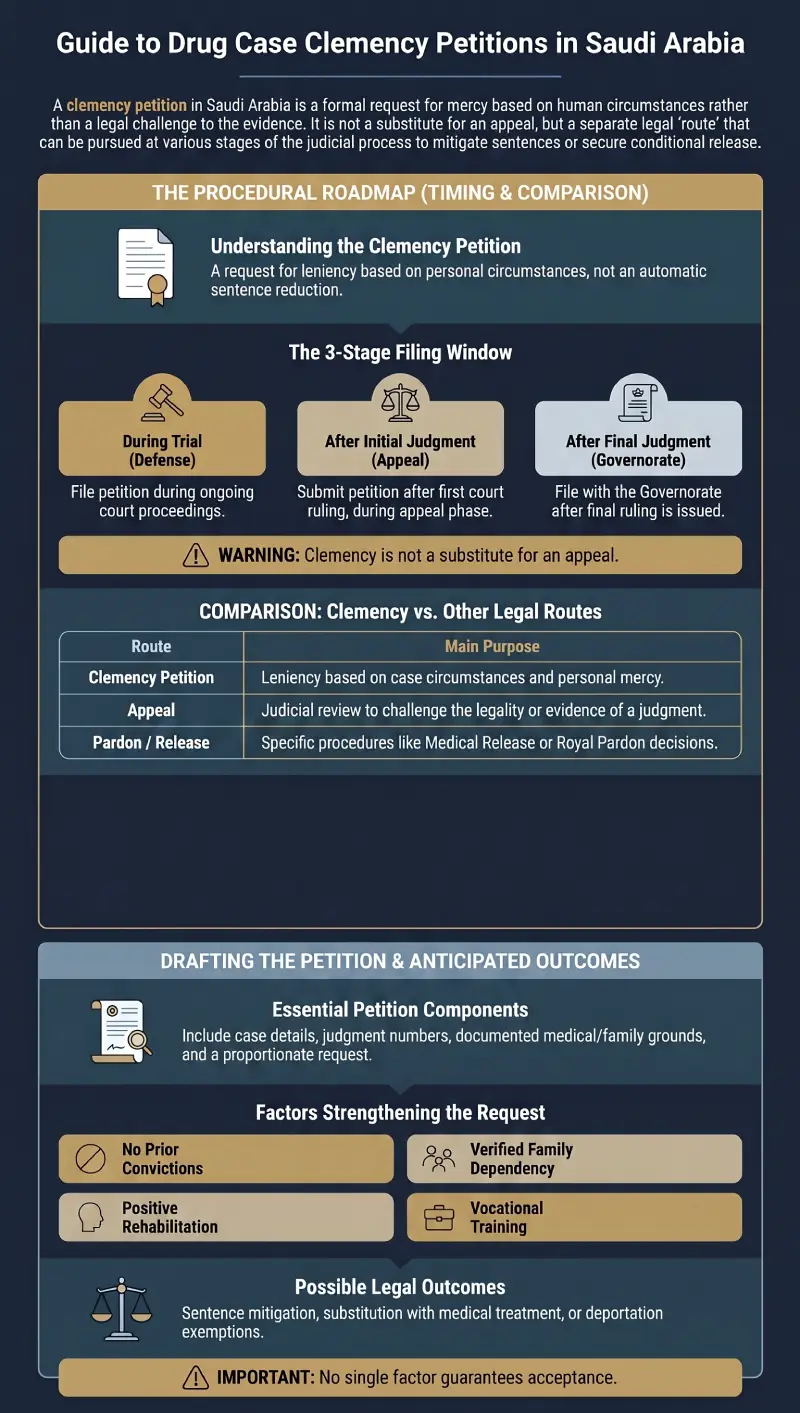
A drug case clemency petition generally depends on three connected factors: the stage of the judgment, the outcome being requested, and the documented circumstances supporting the request.
If the criminal case is still before the court, the appropriate approach may involve presenting grounds for mitigation as part of the defense. If a judgment has been issued but remains appealable, the available appeal route should be assessed before moving to another procedure. After a final judgment, different options may arise depending on the prisoner’s position, pardon rules, or sentence-enforcement procedures.
A clemency petition does not replace an appeal. Nor does submitting one automatically qualify a prisoner for conditional or medical release. Each procedure has its own legal basis and requirements, and using the wrong form or route may result in a request being directed to an unsuitable authority.
| Route | Primary Purpose | When It Is Considered |
|---|---|---|
| Appeal | Judicial review of the judgment | Before the judgment becomes final |
| Clemency petition | Request for leniency based on the case and circumstances | Depending on the judgment and enforcement stage |
| Pardon | Subject to the applicable pardon decision and conditions | When an applicable pardon is in force |
| Conditional release | Sentence-enforcement procedure | When its statutory requirements are met |
| Medical release | Related to qualifying medical circumstances | When the required medical conditions exist |
| Exemption from deportation | Relevant to non-Saudi nationals | Where deportation applies |
How Do You Draft a Drug Case Clemency Petition?
A drug case clemency petition should prioritize clarity, accuracy, and relevance over lengthy emotional language. Begin with the convicted person’s details, case information, and judgment, then explain the basis for the request and the circumstances supporting it.
If the petition relies on illness, financial dependency, family circumstances, rehabilitation, or positive conduct, supporting documents should be attached whenever available.
A generic clemency request should not be treated as a single template suitable for drug use, possession, and promotion cases. The criminal classification, judgment, and procedural stage can differ significantly between these cases.
Care should also be taken not to include statements that conflict with a pending appeal or unintentionally admit disputed facts.
If the case is still being heard and the criminal liability or evidence remains disputed, the priority may instead be examining the available acquittal defenses in drug cases before preparing a clemency petition.
The petition should generally identify:
- The convicted person’s name and relevant case details.
- The judgment number and the court that issued it.
- The current stage of the judgment and sentence, where applicable.
- The petitioner’s capacity and relationship to the convicted person.
- The reason for requesting clemency.
- Relevant medical or family circumstances.
- Documents supporting the stated circumstances.
- A clear and proportionate final request.
Sample Drug Case Clemency Petition
In the Name of Allah, the Most Gracious, the Most Merciful
To His Royal Highness the Governor of (…) Region, may Allah protect him,
Peace, mercy, and blessings of Allah be upon you.
I respectfully submit this request concerning (…) in Case No. (…), in which a judgment was issued imposing (…).
I respectfully ask that his circumstances and the matters supported by the attached documents be considered.
The grounds for this request include (…), supported by the attached documents showing (…). I therefore respectfully request that the matter be considered in accordance with the applicable laws, regulations, and jurisdiction.
With sincere respect and appreciation.
Petitioner: (…)
Capacity/Relationship: (…)
Contact Number: (…)
Attachments: (…)
This sample is provided for guidance only. A clemency petition should be adapted to the judgment, procedural stage, competent authority, and circumstances of each individual case.
What Can Affect a Drug Case Clemency Request?
There is no checklist that guarantees acceptance of a drug case clemency petition. However, certain circumstances may carry greater weight when they are relevant to the case and supported by reliable evidence.
Saudi anti-narcotics law allows the court, within the circumstances specified by law, to consider certain factors concerning the convicted person and the offense when applying provisions relating to mitigation or suspension of a sentence. The importance of a factor therefore depends on its legal relevance and supporting evidence rather than the amount of emotional language used in the petition.
A first drug offense may be relevant to the assessment, but it does not by itself guarantee acceptance of the request or suspension of the sentence. The same applies to education, family dependency, and illness, which should be supported by appropriate evidence.
Relevant factors may include:
- No relevant prior criminal record.
- Medical circumstances supported by official reports.
- Documented family or dependency responsibilities.
- Positive conduct and rehabilitation while serving the sentence.
- Participation in education or vocational training.
- A clear request appropriate to the procedural stage.
Avoid exaggerating medical or family circumstances, copying a template written for a different case, or using clemency as a substitute for an appeal whose deadline remains open.
When Should a Drug Case Clemency Petition Be Submitted?
The appropriate time for a clemency request changes across three main procedural stages. It cannot be determined properly without first establishing the status of the judgment.
While the criminal case is still before the court, the priority remains the defense, evidentiary issues, legal arguments, and any available requests for mitigation.
If the judgment remains appealable, an appeal brief in a drug case may be the procedure that needs to be assessed before relying on a clemency petition.
- Stage One: Before the judgment becomes final. Clemency should not replace a defense or appeal where legal grounds remain available for challenging the judgment.
- Stage Two: After judgment is issued. Determine whether the judgment remains appealable and whether the objective is to challenge the conviction or sentence, or instead seek mitigation.
- Stage Three: After a final judgment. The judgment, sentence-enforcement status, and circumstances arising after conviction become more relevant when identifying the appropriate request and authority.
This distinction is especially important when seeking a reduced drug sentence because judicial mitigation during the trial is not the same procedure as a clemency petition submitted after litigation has concluded.
How and Where Is a Drug Case Clemency Petition Submitted?
The stage of the case determines which authority or procedural route should be considered. There is no single filing channel for every drug-related clemency request.
Saudi Arabia’s Absher platform provides the Tawasul – Regional Emirates service for submitting and following up requests electronically with relevant sectors or regional governorates. However, the availability of an electronic service does not mean every drug case clemency petition follows the same channel or that a regional governorate has authority over every requested outcome.
For a clemency petition addressed to a regional governor, the relevant governorate, available service, and status of the judgment should first be identified.
Similarly, a search for a clemency petition to the King in a drug case should be approached according to the nature of the request and the official channel available at the time of submission. The Royal Court should not be treated as a substitute for the court or an available judicial appeal route.
| Status of the Case | What Should Be Reviewed First? |
|---|---|
| Case still before the court | Defense, evidence, and mitigation requests |
| Judgment remains appealable | Grounds of judgment and appeal deadline |
| Final judgment | Prisoner’s status and appropriate request |
| Petition directed to a regional governorate | Jurisdiction and available official service |
| Non-Saudi subject to deportation | Judgment, offense type, and deportation status |
There is also no single processing period that applies to every clemency request. Processing time depends on the authority, the circumstances of the case, supporting documents, and any additional procedures required.
What Are the Possible Outcomes After Filing?
Submitting a drug case clemency petition does not itself mean that the sentence will be reduced or that the prisoner will be released. Any outcome depends on the applicable legal route, circumstances, and authority considering the matter.
Some outcomes commonly associated with clemency searches are governed by separate legal procedures.
Conditional release, for example, is regulated under Article 25 of the Saudi Prison and Detention Law and is subject to specific requirements relating to the period served, conduct, and obligations arising from the offense. The law also contains a separate framework for medical release.
A clemency request should therefore not be based on an assumption that illness automatically extinguishes the sentence or that serving a specific period guarantees release.
The same applies to a new Royal Pardon. The applicable pardon decision, its conditions, and the categories it covers must be checked at the relevant time. Conditions from an earlier pardon should not automatically be applied to a current case.
A clemency petition is also distinct from a pardon in drug cases because each follows different requirements, effects, and procedures.
Clemency for Prisoners and Foreign Residents in Drug Cases
A clemency petition for a prisoner in a drug case should focus on the judgment, the period already served, and developments arising during sentence enforcement.
Medical or family circumstances, prison conduct, and participation in rehabilitation programs may be relevant when they are connected to the request and properly documented. If the intended outcome is conditional release, its statutory requirements should be assessed separately from the clemency petition.
A drug case clemency petition for a foreign resident requires additional attention because of the potential deportation consequences.
Saudi anti-narcotics law includes specific provisions concerning the deportation of non-Saudi nationals after serving a sentence, subject to the applicable legal provisions and instructions. Government services also exist for requests concerning exemption from or non-enforcement of deportation in certain circumstances. However, the availability of such a service does not mean that every request for exemption from deportation in a drug case will be accepted.
The position of a foreign resident in a drug-use case also depends on the judgment issued, particularly given the consequences associated with drug use penalties for foreign nationals and deportation.
Ministerial Decision No. 1809 appears in Saudi government records under the title Regulatory Provisions Concerning the Deportation of Expatriates. The judgment and applicable instructions should therefore be reviewed rather than reducing the assessment to a specific prison term or the absence of prior offenses.
The drafting also differs between clemency requests involving drug use, possession, and promotion because the legal classification and judgment affect the available options.
When Should You Consult a Lawyer Before Filing?
Legal review becomes particularly important when the judgment remains appealable, the case involves drug promotion, prior convictions exist, or a non-Saudi national faces deportation.
It is equally important when you are uncertain whether the appropriate procedure is clemency, an appeal, or another sentence-enforcement route.
The role of a lawyer handling a drug case clemency petition is not limited to improving the wording of a letter. The review begins with the judgment and its procedural status, followed by identifying the requested outcome and the documents capable of supporting it. In some cases, that assessment may show that filing a clemency petition is not the immediate priority.
When a judgment and the appropriate procedural route require review before filing, the drug lawyer in Jeddah team at BMS Legal can assess the stage of the case, relevant documents, and the legal step requiring consideration.
Frequently Asked Questions About a Drug Case Clemency Petition
Is clemency accepted in drug cases?
A clemency request may be submitted depending on the case and the appropriate legal route, but filing it does not guarantee acceptance or a reduced sentence.
Is clemency a substitute for an appeal?
No. If the judgment is still appealable, the available appeal route and its legal grounds should be assessed separately.
When should a clemency petition be submitted?
The timing depends on the stage of the case, particularly whether the matter is still pending, the judgment remains appealable, or the judgment has become final.
Can clemency reduce a drug sentence?
Not automatically. The effect of the request depends on the procedural stage, the applicable legal provisions, and the authority considering the case.
How can I submit a drug clemency request through Absher?
Absher provides services for communicating with regional governorates. The appropriate service and jurisdiction should be confirmed before submitting the request.
How long does a clemency request take?
There is no fixed processing period for all requests. Timing varies according to the authority, case circumstances, and required procedures.
What are the main documents for a clemency petition?
They generally include the judgment, case details, and documents supporting any medical, family, or other circumstances relied upon in the request.
Does a first drug offense help with clemency?
It may be a relevant circumstance, but a first offense alone does not guarantee acceptance or suspension of the sentence.
Can the prisoner's family submit a clemency petition?
A family member may submit the request through the appropriate channel, while identifying their relationship and supporting the circumstances relied upon.
Can a foreign resident request exemption from deportation?
Government procedures exist for certain exemption or non-deportation requests, but acceptance depends on the judgment and the applicable laws and regulations.
3 stages for a drug case clemency petition in Saudi Arabia can clarify the decision before the request is drafted: Is the case still being heard, does the judgment remain appealable, or has it become final and entered the enforcement stage? Once that stage is identified accurately, the appropriate authority, request, and supporting documents become easier to determine.
The strength of a drug case clemency petition does not depend on emotional language or a generic template. It depends on its connection to the judgment, documented circumstances, and a request that corresponds with the correct procedural route. Cases involving prisoners, foreign residents, and deportation require particular care because pardon, release, and exemption from deportation are governed through different procedures.
Where the case requires a review of the judgment and the appropriate route before filing, the BMS Legal law firm in Jeddah team can assess the stage of the case, available options, and documents relevant to the request.
Official Sources: