
Deportation from Saudi Arabia for drug offenses can be a significant legal consequence for a non-Saudi convicted in a drug-related case. The issue goes beyond the original criminal penalty and raises further questions about when deportation takes place, whether the person may return to the Kingdom, and whether the judgment can still be challenged.
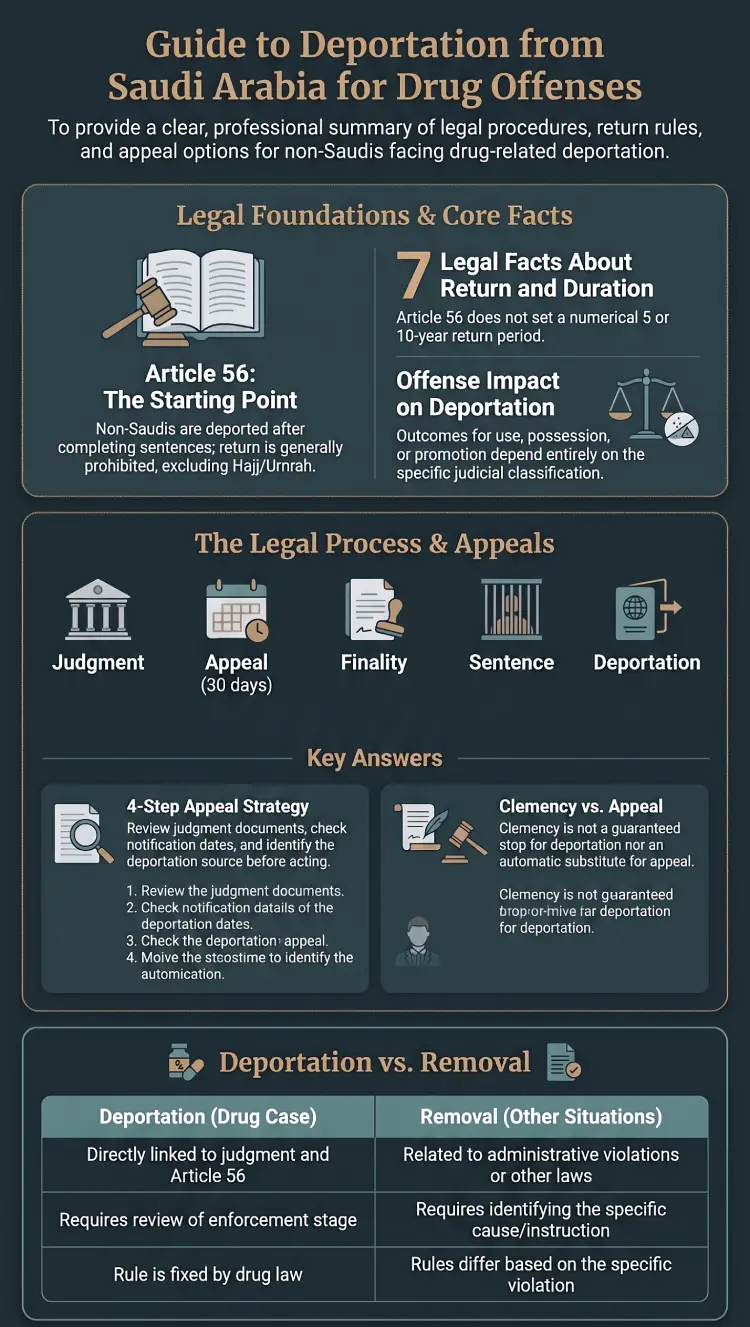
Article 56 of the Saudi Anti-Narcotics and Psychotropic Substances Law is the main legal starting point. It links deportation to the completion of the sentence imposed on the non-Saudi and provides that return to the Kingdom is not permitted, subject to what the applicable Hajj and Umrah instructions may allow.
For this reason, expressions such as “first offense” or “small quantity” are not enough on their own to determine the outcome. The nature of the offense, the stage of the judgment, and the applicable legal basis must all be reviewed together.
Deportation from Saudi Arabia for Drug Offenses: 4 Key Answers
If you are a non-Saudi who has been convicted in a drug case, the general rule is that deportation takes place after the sentence has been served. Article 56 does not state that the person may automatically return after five or ten years. Instead, it provides for non-return, subject to what is permitted under the relevant Hajj and Umrah instructions.
An appeal, however, is a separate issue. Whether a judgment can still be challenged depends on the stage of the case and whether the statutory appeal period remains open.
| Question | Short Answer |
|---|---|
| Who may be deported? | A non-Saudi convicted under the Anti-Narcotics and Psychotropic Substances Law |
| When is deportation enforced? | After completion of the sentence imposed |
| Is there a fixed deportation period? | Article 56 does not specify a numerical period for return |
| Can the deported person return? | The general rule is no, subject to Hajj and Umrah instructions |
If the judgment was issued recently, start by reviewing the judgment document and the date of notification before considering any other application. The appropriate next step depends on the wording of the judgment, the stage of the proceedings, and whether the appeal period is still running.
1. When Does Deportation Apply in a Drug Case?
Deportation due to a drug offense is linked to a judgment against a non-Saudi, rather than merely to suspicion, arrest, or the opening of an investigation. It is also important to distinguish between the original criminal sentence imposed by the court and the subsequent legal consequence affecting the non-Saudi’s status in the Kingdom.
Accordingly, deportation of a foreign national in a drug case or deportation of an expatriate resident cannot be assessed accurately without examining both the judgment and the applicable legal provision.
When reviewing the case, focus on the legal classification of the offense, the operative wording of the judgment, the procedural stage, and the notification date. If the judgment is still open to appeal, the available course of action differs from that applicable after the judgment has become final.
Where the dispute concerns whether the drug offense was proved in the first place, the grounds for acquittal in drug cases relate to the evidence, criminal liability, and available defenses before the consequences of deportation are considered.
2. Does Deportation Differ Between Drug Use, Possession, and Promotion?
Drug use, possession, and promotion are legally distinct offenses with different elements, classifications, and possible penalties. However, the effect of deportation on a non-Saudi must still be assessed by reference to the final judgment and the applicable law.
It is therefore inaccurate to assume that deportation after drug use is automatically excluded, that deportation for drug possession always follows a less serious rule, or that deportation applies only in drug promotion cases.
The same caution applies to a first drug offense by a foreign national. A first offense does not, by itself, create a general exemption from Article 56.
If the dispute concerns the criminal intent, the evidence, or the legal classification of the conduct, those issues should be addressed through the defense and appeal process at the appropriate stage. Reviewing the evidence and legal characterization is more reliable than relying on broad descriptions such as “first offense” or “personal use only.”
A first offense alone therefore does not determine whether deportation will follow. The first drug offense in Saudi Arabia must be assessed according to the facts, the judgment, and the procedural circumstances of the case.
3. When Is a Deportation Order Enforced After a Drug Case?
Article 56 provides that a non-Saudi is deported after completing the sentence imposed. If the sentence includes imprisonment, deportation therefore follows the completion of that sentence rather than merely the issuance of an initial judgment.
This directly addresses two common questions: when deportation is enforced and whether deportation takes place after imprisonment.
The timing of enforcement does not make the appeal stage irrelevant. If the judgment is not yet final, reviewing the reasons supporting it may take priority before the case reaches the enforcement stage.
The period for filing an appeal or requesting review is generally 30 days. For that reason, the notification date should be identified promptly and the judgment should not be left unreviewed until the deportation stage approaches.
Likewise, deportation after completion of the criminal sentence does not mean that every case follows exactly the same procedural sequence. The status of the judgment and the enforcement stage must be considered in each individual case.
4. How Long Does Deportation Last, and Can You Return to Saudi Arabia?
Article 56 does not set the duration of deportation from Saudi Arabia for drug offenses at five years, ten years, or any other fixed numerical period.
Instead, the provision states that the non-Saudi is not permitted to return to the Kingdom after deportation, except as allowed under the applicable Hajj and Umrah instructions. This means there is no single numerical answer to the question, “How many years does deportation last after a drug conviction?”
The same principle applies to returning to Saudi Arabia after deportation for a drug offense. It should not be assumed that the passage of a particular number of years automatically removes the restriction on entry.
Nor should deportation under Article 56 be treated as equivalent to other forms of removal arising from different immigration, residency, or employment violations.
Hajj and Umrah represent the specific exception referred to in Article 56. Any entry under that exception remains subject to the instructions governing those purposes.
A person seeking to determine whether they may return to Saudi Arabia after a drug case should therefore verify the legal basis for the entry restriction and their current status with the relevant authorities.
5. Can Deportation Be Appealed or Cancelled?
When considering the cancellation of deportation due to a drug offense, the first question is whether the challenge concerns the criminal judgment itself or a separate administrative decision.
If the judgment remains open to appeal or review, the applicable period is generally 30 days. The appeal should address the legal and factual grounds of the judgment rather than simply request that deportation be prevented.
The review normally begins with the judgment document, notification date, arrest and investigation records, and any technical or evidentiary reports relevant to the case.
Potential grounds may concern the legal classification of the conduct, the sufficiency of the evidence, or a procedural issue that affected the outcome. Once the judgment becomes final, however, it becomes necessary to identify the source of the deportation measure, the enforcement stage, and the legal basis for any further application.
There is therefore no single form or procedure that guarantees the cancellation of a deportation decision in every case.
Where the judgment is still open to challenge, preparing a drug case appeal memorandum should begin with the reasoning of the judgment, the evidence, and the legally relevant grounds rather than a request to stop deportation alone.
6. Can a Clemency Request Prevent Deportation for a Drug Offense?
A clemency request does not guarantee that deportation will be stopped, and it should not automatically be treated as a substitute for a judicial appeal.
If the judgment is still within the appeal period, the first issue is whether there are legal grounds to challenge it through the prescribed judicial procedure.
A request for relief from deportation or another form of clemency must instead be assessed according to the stage of the case, the source of the measure, and the competent authority.
Family or humanitarian circumstances alone should not be presented as guaranteeing that the request will be accepted or that deportation will be cancelled.
Before submitting any request, determine whether the judgment is final, where the deportation measure originates, and whether another legal remedy remains available.
A drug case clemency request therefore requires careful assessment of its timing and the current stage of the case. It should not be treated as an automatic alternative to an appeal while the appeal period remains open.
7. What Is the Difference Between Deportation and Removal in Saudi Arabia?
The terms deportation and removal are sometimes used interchangeably in everyday language, but their legal effects cannot be determined by terminology alone.
In drug cases, Article 56 is the primary legal reference governing the deportation of a non-Saudi after completion of the sentence. Removal may also arise in other contexts involving residency, employment, immigration, or separate administrative measures, each of which may have a different legal basis.
| Situation | What Should Be Reviewed |
|---|---|
| Deportation following a drug conviction | The judgment, Article 56, and the enforcement stage |
| Administrative deportation decision | The issuing authority and legal basis |
| Removal for another violation | The type of violation and applicable instructions |
| Request to return to Saudi Arabia | The legal basis of the entry restriction and current recorded status |
You should therefore not rely on a general assumption that every removal order lasts three years or that every deportation measure follows exactly the same procedure.
Identifying the source and legal basis of the measure is the first step before determining whether an appeal, objection, or other procedure may be available.
If you have a recent judgment or an ongoing case, a drug lawyer in Jeddah at BMS Legal can review the judgment, the procedural stage, and the available documents before explaining the appropriate legal next step.
Frequently Asked Questions About Deportation from Saudi Arabia for Drug Offenses
1. What is the deportation rule for non-Saudis convicted of drug offenses?
Article 56 provides for deportation after the imposed sentence has been completed.
2. How long does deportation from Saudi Arabia for drug offenses last?
Article 56 does not specify a fixed five- or ten-year period.
3. Is deportation for drug offenses permanent?
The general rule is no return, subject to Hajj and Umrah instructions.
4. When is deportation enforced after a drug conviction?
It is enforced after completion of the sentence imposed on the non-Saudi.
5. Does deportation take place after imprisonment?
Yes, where imprisonment is imposed, deportation follows completion of that sentence.
6. Does a first drug offense prevent deportation?
No. A first offense alone does not create a general exemption from deportation.
.
7. Does deportation differ between drug use, possession, and promotion?
The offenses differ, but deportation depends on the judgment and applicable law.
8. Can a deported person return to Saudi Arabia?
Generally no, except as permitted under applicable Hajj and Umrah instructions.
9. Can deportation for a drug offense be cancelled?
There is no guaranteed cancellation. The available options depend on the case stage and legal basis.
10. How can I appeal a judgment that includes deportation?
If appeal remains available, the general appeal period is 30 days.
After these 7 Facts: Deportation from Saudi Arabia for Drug Offenses and return to the Kingdom, the most important question is not simply, “How can deportation be cancelled?” It is: “What stage has the case reached now?”
The judgment, completion of the sentence, the appeal period, and the source of the deportation measure all affect the legal options that may still be available. Article 56 does not establish a five-year or ten-year return period. Instead, it provides for non-return while preserving the exception allowed under Hajj and Umrah instructions.
For anyone who needs their case reviewed within a structured legal framework, a law firm in Jeddah such as BMS Legal can assess the stage of the proceedings and the available documents before identifying the legal options and next step appropriate to the circumstances.
Legal Sources: