
Property seizure by bank in Saudi Arabia does not usually appear suddenly at the auction stage. It often begins with a small default, followed by a claim, then documents that must be reviewed before the concern turns into an enforcement procedure against the property.
Bank seizure of a house does not mean ownership has immediately transferred to the bank. It also does not mean sale is the only possible result. The path depends on the financing contract, the debt amount, the validity of notices, and whether settlement or objection remains available.
When you receive a bank claim or enforcement notice, the question is not only: can a bank seize my property? The more important issue is the stage your file has reached, the document the bank relies on, and whether there is a procedural or financial defect before auction.
The provisions of the [Saudi Real Estate Mortgage Law] remain the legal basis for understanding the effect of mortgage over property. Practical handling, however, begins from the moment of default: how to review the claim, when to object, and when settlement or a request to stop auction becomes the key step.
Property Seizure by Bank: The Quick Answer and 7 Steps Before Auction
Property seizure by bank is an enforcement measure that may arise when real estate financing is in default and the debt remains unresolved. The bank does not own the property merely because of delay; the path depends on the contract, mortgage, claim, and enforcement stage.
The risk usually begins when unpaid real estate financing continues, followed by a late-payment or default notice. The bank may then demand payment, and the matter may move to the Enforcement Court if the debt is not addressed.
The validity of seizure is different from the validity of creating a mortgage. [Real estate mortgage conditions] relate to the deed, mortgagor, and secured debt before enforcement is reached.
If you receive a claim or enforcement notice, do not wait for an auction announcement before acting. Review the contract, deed, updated debt statement, notices, and any previous settlement before responding, paying, or signing.
| Step | What Happens? | What You Should Do |
|---|---|---|
| 1 | Payment delay | Do not ignore the first notice |
| 2 | Late-payment or default notice | Request an updated debt statement |
| 3 | Bank claim | Review the contract and claimed amount |
| 4 | Enforcement request | Check the instrument, deadline, and notice |
| 5 | Property seizure | Verify deed and property details |
| 6 | Property valuation | Review the value and object if defective |
| 7 | Auction announcement | Request suspension if there is a valid reason |
If the matter has reached a claim or enforcement notice, it is no longer a general question about the bank’s right to seize. The contract, deed, debt statement, and notices must be reviewed before any step is taken. At this stage, contacting a Jeddah law firm can help identify the closest legal path before the file advances toward auction.
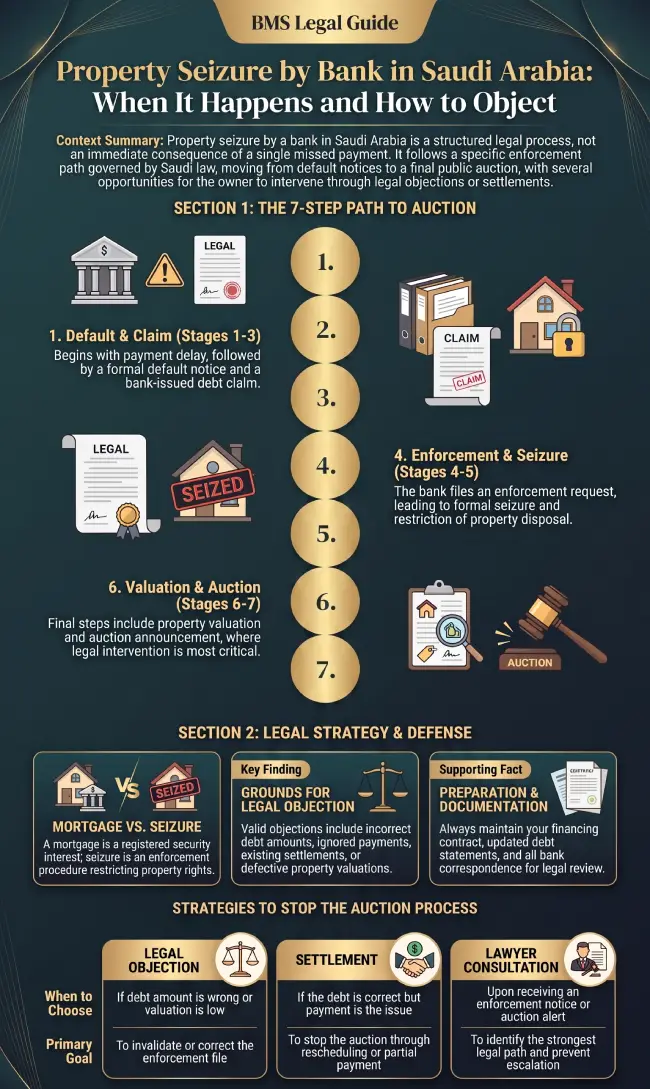
The Difference Between Mortgage and Seizure
A real estate mortgage is a registered security interest in favor of the bank or financing entity. Seizure, however, is a later enforcement procedure. A property may remain mortgaged for years without being seized or listed for auction.
Seizure of a mortgaged property by bank appears when default continues or when there is an enforceable claim. At this stage, the property becomes restricted by a procedure that may prevent free disposal and may lead to valuation and sale.
This distinction matters when someone says: the bank seized the house. The file may still be at the claim stage, enforcement request stage, seizure stage, or auction stage. Each stage requires a different response.
If the file is related to selling the property or transferring the debt before default, then [mortgage transfer requirements] become relevant before reaching seizure.
There is no single timeframe that applies to every case when asking: when can a bank seize a house? The answer depends on the contract, number of delayed installments, notices, and the client’s position on payment or settlement.
Therefore, do not treat seizure of property due to a real estate loan as an automatic result of the first delay. More accurately, it is a path that begins with late payment, then default, then claim, then enforcement if no solution is reached.
Property Seizure Procedures and Objection
Property seizure procedures by bank do not begin with sale immediately. They pass through connected stages that require clear documents. The first practical step is to collect the financing contract, deed, payment schedule, account statement, bank notices, and any settlement agreement.
Before objection, a [property deed inquiry] helps match ownership and registered restrictions with the enforcement request.
It is not enough to ask whether the bank has the right to seize the property. You must know whether the debt is actually due, whether the amount is correct, whether notices were sent, and whether there are uncounted payments or an unimplemented settlement.
Once the file moves to enforcement, timing matters. Every delay may weaken the chance of objection or settlement, especially if valuation has started or the auction date is approaching.
From Bank Claim to Seizure and Auction
The serious stage often begins with a clear bank claim. If no solution is reached, an enforcement request may appear. After that, a procedure may be issued against the property, followed by valuation and then auction if non-payment or non-settlement continues.
When seizure occurs, review the property description, area, deed number, boundaries, and condition. Also check whether there are heirs, partners, tenants, or an earlier dispute that may affect valuation or sale.
The auction should not be treated as a foregone conclusion. Objection may be possible if there is an error in the debt, a defect in notice, an existing settlement, or a valuation that does not reflect the property’s value.
Practical grounds for objection include:
- An error in the debt amount or calculation method.
- Ignored previous payments or a written clearance.
- A settlement that was not reflected in the claim.
- Defect in property or deed details.
- Low valuation that does not reflect market value.
- Auction procedure before resolving a material objection.
If the defect relates to the financing entity’s conduct before enforcement, a complaint against the real estate bank may support the objection route.
It is not enough to say: I want to stop the bank from selling the house. The request must clearly identify the procedure to be stopped, the legal reason, and the documents proving the defect.
Settlement, Lifting Seizure, and When You Need a Lawyer
Settlement before property sale may be the less costly option when the debt is correct but the problem is payment ability. It differs from objection because its purpose is to organize repayment, not cancel the claim.
Settlement may include rescheduling the real estate financing, making a meaningful partial payment, or signing a written agreement that stops escalation. Do not sign any arrangement before understanding its effect on the total debt, term, and charges.
Lifting the seizure means removing the effect of the enforcement procedure over the property. It is not always the same as releasing the mortgage. The seizure may end through payment, settlement, or accepted objection, while the mortgage restriction remains until its release is completed.
At this stage, advice from a real estate lawyer in Jeddah can help review the contract, deed, and debt statement before choosing settlement or objection.
Prepare these documents before requesting legal review:
- Real estate financing contract.
- Copy of the deed or ownership document.
- Updated debt statement.
- Installment and payment schedule.
- Notices from the bank or financing entity.
- Enforcement notice or auction announcement.
- Any clearance, settlement, or previous correspondence.
BMS Legal for Law and Legal Consultations in Jeddah reviews these files confidentially. The team explains available options before any step, in line with the principle of clarity before procedure.
FAQs About Property Seizure by Bank
Can a bank seize property in Saudi Arabia?
Yes. A bank may request enforcement against a mortgaged property when there is a due debt and an enforceable instrument, subject to applicable procedures.
When can a bank seize a house?
The risk usually appears when default continues, notices are not addressed, and the claim moves to the Enforcement Court.
Does the bank take the house immediately after late payment?
No. Late payment does not immediately transfer ownership, but it may open the path to claim, default, and later enforcement.
How many missed installments lead to property seizure?
There is no single answer for all contracts. Repeated delay may amount to default depending on financing terms and applicable controls.
What is the difference between mortgage and property seizure?
A mortgage is a registered security for debt. Seizure is an enforcement procedure that restricts disposal and may lead to sale.
Can an auction of a mortgaged property be stopped?
It may be possible if there is an error in the debt, procedural defect, existing settlement, or material objection.
How can property seizure be lifted?
Seizure is usually lifted through payment, settlement, accepted objection, or a decision ending the cause of enforcement.
Does lifting seizure mean releasing the mortgage?
Not always. Lifting seizure removes the enforcement effect, while releasing the mortgage removes the registered mortgage restriction.
Does objection to a bank claim stop enforcement?
Not always. A specific request to stop a particular procedure may be required, supported by relevant documents.
When do I need a lawyer for property seizure by bank?
You need legal support when an enforcement notice, auction, debt error, refused settlement, or continuing seizure affects the property.
Property seizure by bank: 7 steps before auction is not just a search phrase; it is a practical map at the first sign of risk. Notice, claim, enforcement request, and valuation are not passing stages when the property is mortgaged and the file is moving toward sale.
Do not wait until auction becomes the only option. Start by reviewing the financing contract, deed, debt statement, bank notices, and any enforcement request. Then choose the appropriate path: payment, settlement, rescheduling, objection, request to stop auction, or lifting seizure.
If you are unsure which stage your file has reached, you can send the details through the [Contact Us] page to identify the required documents.
Official Sources: