
Last updated: November 18, 2026 | Last checked against official legal sources: November 19, 2026
The new Enforcement Law in Saudi Arabia (2026) regulates the procedures for enforcing judgments and enforceable instruments and sets out what follows once the party against whom enforcement is sought is notified of the enforcement order, including the payment period, attachment of assets and grievances against decisions. If you receive a message from the Enforcement Court through Najiz, it is important to know the type of notice and the date of notification before taking any step.
The Law came into force on October 29, 2026 and reorganized the procedures for compulsory enforcement, salary attachment, travel bans and enforcement disputes. Among its key provisions, compulsory financial enforcement begins after five working days have passed from notification of the enforcement order, or its lawful announcement, without compliance, under Article 18, subject to the stated exceptions.
This guide explains what to do after a Najiz notice, how to verify the enforcement request, and the options for payment, grace periods, disputes and grievances, through to ending the request and lifting measures, under the new Enforcement Law of 1447 AH and its Implementing Regulations.
Quick answer: what should you do after a Najiz notice?
Check the enforcement request on Najiz and identify the type of notice, the enforceable instrument, the amount claimed and the date of notification. If the obligation is valid, review the appropriate payment or grace-period route. If you have a dispute over the instrument or the enforcement measure, check the statutory route and deadline without delay.
Under Article 18 of the new Enforcement Law in Saudi Arabia, compulsory financial enforcement begins after five working days from notification of the enforcement order, or its lawful announcement, without compliance, with a special provision for a sufficient bank guarantee.
Have you received an enforcement message and need to decide the right step? You can benefit from the review of Enforcement Court cases service at BMS Legal to assess the instrument, the amount, the notification date and your payment position before deciding on the appropriate legal step.
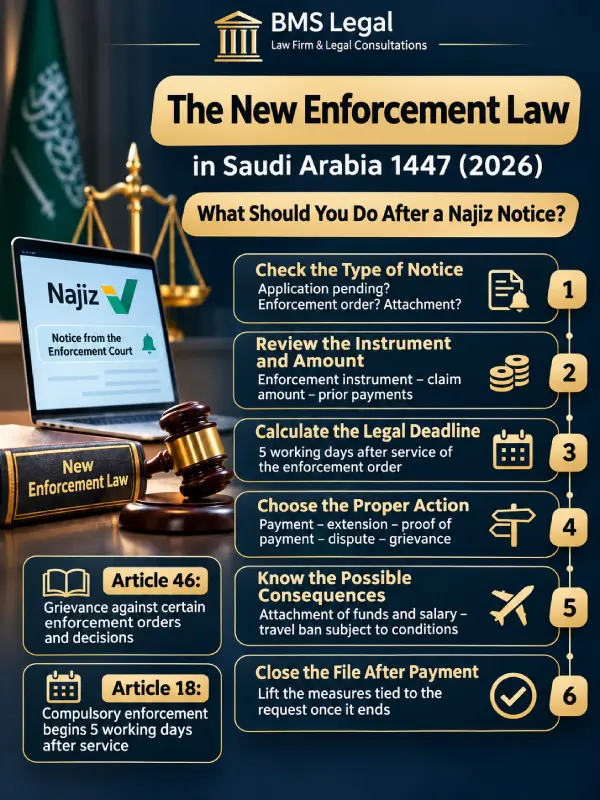
The new Enforcement Law in Saudi Arabia: what should you do as soon as a Najiz notice arrives?
The appropriate step depends on the measure you were notified of. A notice that a request has been registered is not necessarily notification of the enforcement order; an attachment decision differs from a travel ban; and dealing with payment differs from disputing the enforceable instrument.
What is the right step depending on the type of Najiz notice?
| Situation | What to verify | Possible step |
|---|---|---|
| Notice that an enforcement request has been registered | The instrument, the amount and the status of the request | View the request and verify its details |
| Notification of the enforcement order | The date of notification and the obligation | Comply, consider a grace period, or pursue the appropriate legal route |
| A claim part of which was already paid | Proof of payment and the remaining amount | Prove the payment or resolve the dispute |
| Attachment decision | The attached asset, the amount of the debt and the date of the decision | Review the limits of the attachment and the possibility of a grievance |
| Travel ban | The conditions of the decision, its duration and the total debts | Consider grounds for lifting the ban or a grievance |
| Request ended but a measure continues | The status of the request and whether other requests exist | Follow up on lifting the measures linked to the ended request |
This table is a means of initial guidance and does not settle the legal step before the instrument and the actual decisions are read.
How do you verify that a message from the Enforcement Court is genuine?
Log in to Najiz through official channels, and do not rely on an unknown link in a text message or a call from someone claiming to be from the court.
The Ministry of Justice offers the enforcement request verification service to view the data, decisions, procedures and financial movements linked to the request as of the latest update.
Managing a request you are a party to, or filing a new procedure on it, may require logging in through National Single Sign-On (Nafath) and choosing the appropriate service.
What data should you review?
Review the request number, the name of the enforcement applicant, the type of instrument, its due date, the amount, previous payments, the measure issued and the date of notification.
Example: a notice arrives for a claim of SAR 70,000, while transfers prove that SAR 25,000 was paid. Here you should match the amount against the payment documents and determine how to prove what was paid, without ignoring the notice or paying the full amount again without review.
What are the main changes in the new Enforcement Law of 1447 AH in Saudi Arabia?
The Enforcement Law is the legal framework that governs the satisfaction of rights established in enforceable instruments, and what falls within the Enforcement Court’s jurisdiction of notification, disclosure, attachment, enforcement and disputes.
The new Law redistributes the provisions across more specific articles, most notably Article 18 on compulsory financial enforcement, Article 19 on travel bans, and Articles 45 and 46 on disputes and grievances.
When did the new Enforcement Law in Saudi Arabia take effect?
The Law was issued by Royal Decree No. (M/237) dated 3 Dhu al-Qi’dah 1447 AH, published in the Official Gazette on May 1, 2026, and came into force on October 29, 2026.
It replaced the Enforcement Law issued in 1433 AH, subject to the transitional provisions in the issuing decree, which also addressed the status of judgments, orders and decisions issued before the Law took effect.
You should therefore know the date of the decision and the Law under which it was issued before applying an old explanation to an existing case.
You can refer to the official text of the Enforcement Law published in the Umm Al-Qura Gazette to verify the articles in force.
Can an instrument that fell due ten years ago be enforced?
Article 11 of the new Enforcement Law in Saudi Arabia provides that an enforcement request is not accepted on an instrument whose due date passed more than ten years ago, subject to the related legal provisions.
Article 12 of the Regulations clarifies that the period is calculated separately for each payment or instalment where the obligation is periodic or the debt is payable in instalments.
It is therefore not enough to look at the date the instrument was drawn up; you must examine the due date, the nature of the obligation and the provisions that apply to it.
What is the payment period under the new Enforcement Law in Saudi Arabia after a Najiz notice?
Compulsory financial enforcement begins after five working days from notification of the enforcement order, or its lawful announcement, if the obligation is not performed, under Article 18.
This period does not necessarily start from the date the request was registered or from a text message announcing a status update.
What is the difference between registering a request and notification of the enforcement order?
Registering a request means recording the enforcement request on the basis of an instrument submitted by the right-holder. The enforcement order, by contrast, is the order the court issues when the instrument meets its legal conditions, and it is then served on the party against whom enforcement is sought under Article 14.
If notification is not possible, the Law permits announcing the enforcement order by the approved means, and the effects of notification run from the date of the announcement.
This distinction is one of the most important provisions of the new Enforcement Law in Saudi Arabia for anyone who has received a message from the Enforcement Court, because it affects when the period begins.
How is the five-working-day period calculated?
The date of notification of the enforcement order or the lawful announcement is used, and working days are counted taking official holidays and the rules on calculating periods into account.
Hypothetical example: if notification takes place on a Monday and there is no exceptional official holiday, the following five working days may be Tuesday, Wednesday, Thursday, Sunday and Monday, assuming Friday and Saturday are the weekend.
This example must not be used to determine the end of the period in an actual request without reviewing the date recorded in the request.
Is there a period before an enforcement request is filed?
Yes, in specific cases. Article 13 of the Regulations requires the debtor to be notified of the demand for payment at least five working days before the enforcement request is registered, including where there is an agreement on notification, where the debtor is a private legal entity, or where a right that was deferred when created has fallen due.
This period is different from the compulsory enforcement period after notification of the enforcement order.
| Measure | Period | Reference |
|---|---|---|
| Notifying the debtor before registering the request, in the specified cases | At least five working days | Article 13 of the Regulations |
| Disclosure of assets by the enforcement debtor after notification | Within five working days | Article 15 of the Regulations |
| Start of compulsory financial enforcement on non-compliance | After five working days | Article 18 of the Law |
| Additional period when a sufficient bank guarantee is provided | Ten additional working days | Article 18 of the Law |
The Implementing Regulations of the Enforcement Law distinguish between pre-request notification, notification of the enforcement order and asset disclosure.
Can you get ten additional days?
Yes. Article 18 provides for giving the enforcement debtor ten additional working days if they provide a bank guarantee sufficient to satisfy the right being enforced.
But this is not an automatic period for everyone who asks for a postponement or shows financial difficulty; it depends on providing a guarantee that meets the conditions.
What happens after the period ends under the new Enforcement Law in Saudi Arabia?
If the statutory period passes without the obligation being performed, and there is no circumstance that postpones or stops enforcement, the compulsory financial enforcement procedures set out in Article 18 begin.
Does a bank account attachment start immediately?
The measures include notifying the licensed credit-information companies of the non-compliance, and attaching the assets of the enforcement debtor, and what comes to them in future, and enforcing against them, in accordance with the Law.
However, the new Enforcement Law in Saudi Arabia does not permit attachment without limits. Article 25 provides that an attachment must not exceed the amount of the debt claimed, unless the asset is indivisible.
The enforcement debtor may also, if they prove that their assets exceed the right claimed, designate an asset to be enforced against first, unless that prejudices the interest of enforcement.
Example: if the debt is SAR 40,000 and the debtor has several assets exceeding that amount, it may be appropriate to consider identifying the asset from which the debt can be satisfied, under the conditions of Article 25.
Does the court impose a fine of SAR 5,000 per day?
Article 18 permits imposing a fine not exceeding SAR 5,000 for each day that non-compliance continues, but the fine is not automatic in every request.
Article 18 of the Regulations caps the total fine so that it does not exceed the value of the debt being enforced, with special provisions for periodic obligations and instalment debts.
The court may also cancel the fine or part of it once the obligation is performed, and its proceeds go to the State Treasury after the statutory conditions are met.
Does non-payment lead to criminal liability?
Failure to pay a debt does not in itself establish a crime. But the Law imposes criminal liability for specific acts, such as concealing or smuggling assets with the intent of preventing the right from being satisfied, or deliberately providing misleading information, subject to the conditions of the relevant provisions.
For this reason, use the lawful routes for payment, dispute or grace, and avoid actions aimed at obstructing enforcement.
How do payment or grace periods work under the new Enforcement Law in Saudi Arabia?
How to deal with the request depends on the position of the enforcement debtor. Someone able to pay differs from someone who has paid part of the amount, needs time, or disputes the validity of the instrument or the amount.
How do I pay the enforcement amount through Najiz?
Start by reviewing the amount claimed, the financial movements and previous payments, then follow the payment mechanism available through the official channels for the request.
Keep proof of payment, its date and the transaction number, and do not rely on a bank account or payment link sent by a source you cannot verify.
If the instrument is for SAR 90,000 and SAR 30,000 of it has already been paid, first verify the remaining amount and prove the earlier payment, rather than treating the original value of the instrument in isolation from the payments.
Can you request a grace period or instalments for the enforcement amount?
A grace period is a period granted to perform the obligation under the approved procedure, whereas instalments are an arrangement to pay in several payments. There is no automatic right to instalments merely by submitting a request.
The Ministry of Justice provides the request for a grace period or postponement of an enforceable instrument service under its conditions and the capacity of the applicant.
An accepted grace period may lift certain orders for its duration according to the decision issued, but submitting the request alone does not guarantee acceptance and does not stop enforcement automatically.
If the dispute is commercial and calls for an agreement on instalments or a documented settlement, you can look at the commercial settlement services at BMS Legal depending on the nature of the relationship between the parties.
How do I prove payment outside court?
If you paid the enforcement applicant directly, keep the transfer receipt, the release or the document that states the amount paid and the obligation it relates to.
The Ministry of Justice provides the proof of payment service to submit evidence of amounts paid outside court, under the service’s conditions and the status of the request.
You must distinguish between proving payment of part of the right and proving full satisfaction; the request does not end automatically if part of the claim remains due.
When does the new Enforcement Law in Saudi Arabia allow disputes and grievances?
A dispute and a grievance are different routes. An enforcement dispute concerns the validity of the instrument, the conditions for its enforcement or the court’s jurisdiction, whereas a grievance concerns specific enforcement orders and decisions.
When is an enforcement dispute appropriate?
Article 45 of the new Enforcement Law in Saudi Arabia regulates the enforcement dispute claim, allowing an interested party, whether a party to enforcement or others, to raise issues concerning the validity of the enforceable instrument, the conditions for its enforcement or the jurisdiction of the Enforcement Court.
The ground of the dispute must be identified precisely and the related evidence submitted, without confusing matters concerning enforcement procedures with disputes about the underlying right, which may fall within the jurisdiction of other bodies.
What is the grievance period against an attachment decision or travel ban?
Article 46 gives an interested party the right to file a grievance against the orders and decisions specified in the Regulations, within ten working days from the day after the date the order or decision was made available for viewing.
The decisions covered, under Article 49 of the Regulations, include identifying the asset to be enforced against, imposing or lifting an attachment, imposing or lifting a travel ban, and certain fine and disclosure decisions.
The date the decision was made available for viewing therefore becomes an important element in determining the period, and a general objection is not enough without identifying the decision being challenged and the grounds.
Do a dispute or grievance stop enforcement?
Filing a dispute or grievance does not automatically stop enforcement proceedings. Article 47 provides that enforcement continues unless the competent authority decides otherwise.
A stay of enforcement also does not in itself lift an existing attachment on assets, unless the authority issuing the stay decides otherwise, under Article 50 of the Regulations.
You should therefore distinguish between filing an objection, the issuing of a decision staying enforcement, and the issuing of a separate decision, or one that includes lifting the attachment.
Do you object to the enforcement amount, an attachment decision or a travel ban? You can present the type and date of the decision and a summary of the facts through the Enforcement Court service at BMS Legal or contact the company via WhatsApp to assess the appropriate route, without sending sensitive documents in the first message.
What is the difference between the old “Decision 46” and Article 46 of the new Enforcement Law in Saudi Arabia?
The phrase “Decision 46” was commonly used for the measures taken against a debtor who failed to comply with enforcement under the previous Law.
Article 46 of the current Law, by contrast, regulates grievances against certain orders and decisions relating to enforcement procedures, and it does not mean the same provision formerly referred to as Decision 46.
Where did the compulsory enforcement provisions go?
Article 18 regulates the start of compulsory financial enforcement after the period, while Article 19 deals with travel bans and their conditions.
The provisions on attachment, its limits and exempt assets appear in other articles, including Articles 25 and 26.
| Term | Meaning |
|---|---|
| Decision 34 under the previous Law | A term linked to the enforcement order under the old Law |
| Decision 46 under the previous Law | A term linked to non-compliance procedures under the old Law |
| Article 18 of the new Law | Start of compulsory financial enforcement |
| Article 19 of the new Law | Travel bans and their conditions |
| Article 46 of the new Law | Grievance against specific enforcement orders and decisions |
You should therefore know the date of the decision and the Law under which it was issued before applying an old explanation to an existing case.
Attachment of assets and salaries under the new Enforcement Law in Saudi Arabia
The new Enforcement Law in Saudi Arabia sets limits on attaching the assets of the enforcement debtor, and exempts certain assets in consideration of their livelihood and that of their dependants, subject to the statutory conditions and exceptions.
What percentage of a salary or pension can be attached?
Article 26 sets the percentages that may be attached from wages, salaries and retirement pensions, with a special rule for maintenance debts.
| Type of income | Maintenance debt | Other debts |
|---|---|---|
| Salary or wage | Up to half of the gross amount | Up to one third of the gross amount |
| Civil or military retirement pension | Up to half of the gross amount | Up to one quarter of the gross amount |
Where a maintenance debt competes with other debts, special rules apply to distribute the attachable portion, so the maximum percentages are not added together automatically.
Example: if the gross salary is SAR 9,000 and the claim is an ordinary debt unrelated to maintenance, one third of the salary equals SAR 3,000, subject to other provisions that may apply to the request.
What assets are exempt from attachment?
The assets protected under Article 26, subject to its conditions, include public funds, housing and transport to the extent sufficient for the enforcement debtor and their dependants, the tools needed to practise their own profession or craft, personal necessities, and government aid.
But the protection is not absolute in every case; the rule may differ if the asset is mortgaged to the creditor or is the very property of the enforcement applicant, under the statutory exceptions.
In assessing sufficiency, the Regulations also take into account the number of family members the enforcement debtor supports and their health and social circumstances.
Is a travel ban automatic under the new Enforcement Law in Saudi Arabia?
A travel ban is not issued merely because a Najiz notice arrives. It is a separate measure governed by Article 19, issued at the request of the enforcement applicant after the period has expired and the statutory conditions are met.
When can a travel ban decision be issued?
The Regulations clarify that a ban is issued only if attachment on assets sufficient to satisfy the right is not possible or there is an obstacle to satisfying it from them, after verifying the decision’s conditions and the effect of the ban in prompting the enforcement debtor to comply.
The original ban period does not exceed three years and may be extended on a new request, provided the total periods do not exceed six years.
The ban ends when the enforcement request ends or its period expires, unless an extension is issued under the Law.
Is a travel ban lifted if the debt is SAR 50,000 or less?
Article 19 of the Regulations treats the total unsatisfied debts subject to enforcement, where they do not exceed SAR 50,000, as minor amounts for the purposes of the provision on lifting a ban.
There are other cases for lifting a ban under the Law, including the need for treatment outside the Kingdom, a profession that requires travel, or the availability of assets sufficient to satisfy the debt from which it can be recovered, depending on the conditions of each case.
You must look at the total unsatisfied debts, not the amount of one claim while ignoring the other enforcement requests.
How does an enforcement request end under the new Enforcement Law in Saudi Arabia?
An enforcement request ends when one of the grounds for ending specified by the Law is met, most importantly satisfaction of the right in the enforceable instrument.
You must distinguish between the obligation actually ending and recording the payment or completing the electronic procedure for ending the request.
When must the enforcement applicant end the request?
Article 42 requires the enforcement applicant to end their request after the right is satisfied.
Article 46 of the Regulations clarifies that the request ends when the right is satisfied through enforcement procedures, but if satisfaction occurs outside them, the enforcement applicant must end the request within one working day of the date of satisfaction.
The Ministry of Justice provides the enforcement request termination service under its conditions, in the case of settlement, waiver or other grounds for ending.
Is the attachment lifted after the enforcement request ends?
Article 47 of the Regulations provides for lifting the orders and enforcement measures linked to the request immediately upon its end, without the need for a separate request.
But this does not mean that a measure issued in another request that is still pending ends; you must therefore check the source of each decision and the status of the request it is linked to.
What should you do if you paid the amount and the request remains open?
Gather proof of payment, review the financial movements and the status of the request, and use the proof-of-payment procedure if its conditions apply.
If the dispute continues, determine whether it concerns the enforcement applicant not acknowledging satisfaction, a remaining amount, or a delay in the procedure to end the request despite proven satisfaction.
You must also distinguish between a request ending through payment and ending for other reasons, such as impossibility of enforcement or lack of assets, as the Law may allow enforcement to resume in some cases if its conditions are met.
A practical guide to dealing with a Najiz notice
If you receive a notice from the Enforcement Court, start with these steps:
- Verify the source: use Najiz and official channels, and do not rely on an unknown link.
- Identify the type of notice: registration of a request, notification of the enforcement order, or a later decision.
- Review the instrument and amount: check the type of instrument, its due date and previous payments.
- Determine the notification date: do not start counting the period from a message whose legal effect you have not verified.
- Choose the appropriate route: payment, grace period, proof of payment, dispute or grievance.
- Keep the documents: notices, decisions, transfers and releases.
- Follow the request: monitor the effect of payment or the new decision, and do not assume proceedings have ended before verifying.
Applied example: an enforcement notice arrives for SAR 100,000, and the enforcement debtor has documents proving that SAR 35,000 was paid. The step begins with reviewing the instrument and the amount recorded in the request, then submitting proof of payment by the appropriate route, taking account of the deadline and any existing decision.
The aim of this guide is to use the rights and procedures the new Enforcement Law in Saudi Arabia offers without ignoring obligations or taking actions that may obstruct enforcement.
Legal review and content reliability
BMS Legal Law and Legal Consultancy Company — Jeddah
The Saudi Enforcement Law of 1447 AH and its Implementing Regulations,
in particular Articles 11, 14, 18, 19, 25, 26, 45, 46 and 47.
Legal review methodology The content relies on official legal texts and on verifying the relevant periods and procedures.
Legal notice:
The information provided is for general legal awareness and does not replace reviewing the enforceable instrument and the facts and documents of the case before determining the appropriate rights and procedures.
Frequently asked questions about the new Enforcement Law in Saudi Arabia and Najiz notices
I received an enforcement message but the request does not appear on Najiz. What should I do?
Verify the request number and the source of the notice through the Ministry of Justice's official channels. If you cannot access its details, enquire about the status of the request and the recorded notification. The request not appearing on a particular screen is not enough to conclude that the notice is invalid.
Can an attachment be imposed on assets exceeding the amount of the debt?
As a rule, the attachment must not exceed the amount of the debt, unless the asset is indivisible. Article 25 also allows the enforcement debtor, under its conditions, to designate an asset to be enforced against first if they prove that their assets exceed the value of the right claimed.
I paid part of the claim before the notice. Can I object?
You can submit proof of payment by the route appropriate to the status of the request. Depending on the nature of the dispute, the remedy may be proving payment or an enforcement dispute concerning the instrument or the conditions for its enforcement. A partial payment does not automatically end the rest of the obligation.
Does a travel ban continue if the debt is SAR 50,000 or less?
The Regulations treat total unsatisfied debts not exceeding SAR 50,000 as minor amounts for the purposes of the provision on lifting a travel ban. You must verify the total debts, the decision and the conditions for lifting, not just the amount of a single claim.
When does the grievance period against an attachment decision begin?
The ten-working-day period under Article 46 begins from the day after the date the decision covered by the grievance was made available for viewing. Filing a grievance alone does not automatically stop enforcement proceedings.
The enforcement request has ended but the attachment still appears. What should I do?
Verify that the request has ended and that there are no other requests linked to the asset. The Regulations require lifting the measures linked to an ended request immediately, without a separate request, and you can follow up with the competent authority if a related measure continues.
Conclusion
The new Enforcement Law in Saudi Arabia sets out a defined path for notification, periods, payment, attachment, grievances and ending an enforcement request. If you receive a Najiz notice, start by verifying the instrument, the amount, the type of measure and the notification date, then decide the appropriate step for your position.
Not every notice is the start of an attachment, not every objection stops enforcement, and not every payment closes the request without completing its procedures.
Where there is a dispute over the instrument, the amount or an enforcement decision, you can benefit from the Enforcement Court services at BMS Legal Law and Legal Consultancy Company to assess the facts and documents and determine the appropriate legal route.
This content is for general legal awareness and does not replace reviewing the enforceable instrument, the decisions, the documents and the deadlines relating to each request.