
Last updated: November 19, 2026 | Last checked against official legal sources: November 19, 2026
Article 46 of the new Saudi Enforcement Law governs the right to file a grievance against specific orders and decisions issued during enforcement proceedings, including attachment decisions, travel bans and certain fines. An interested party may request a review of the decision within ten working days from the day after it was made available for viewing, although filing a grievance does not by itself stop enforcement.
This provision differs from the well-known “Decision 46” under the previous Enforcement Law. In the law now in force, Article 46 concerns the review of enforcement measures, not the measures that used to be taken against a debtor who refused to pay.
If a decision affects your assets or bars you from travelling, or if you are a right-holder harmed by an enforcement measure, the starting point is to identify the type of decision and the date it was made available for viewing. This guide explains the rules governing grievances, the decisions they cover, how the deadline is calculated, the documents you need, and the difference between a grievance and an enforcement dispute, under Saudi law and its Implementing Regulations.
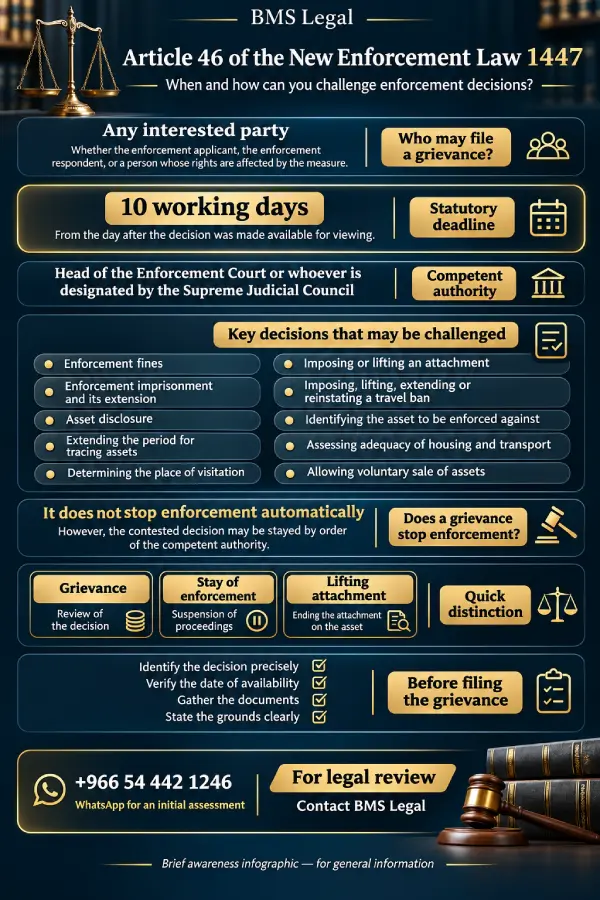
Quick answer: how do you file a grievance under Article 46 of the new Enforcement Law?
Any interested party may file a grievance against the enforcement orders and decisions specified in the Implementing Regulations, before the head of the Enforcement Court or whoever the Supreme Judicial Council designates, within ten working days from the day after the decision was made available for viewing. You must identify the decision, the grounds for objection and the supporting documents. Enforcement does not stop merely because a grievance is filed, but the competent authority may order a stay of the contested order where the interest justifies it.
Has an attachment or travel-ban decision been issued against you?
Review the type of decision and the date it was made available for viewing before the deadline expires. The BMS Legal team helps you assess the documents and identify the appropriate legal route.
Company phone: +966 54 442 1246
What does Article 46 of the new Enforcement Law provide?
A grievance against an enforcement measure is a request to review a specific enforcement order or decision before the competent authority, where the interested party believes there is a legal ground to cancel, amend or stay it.
This route does not reopen the judgment that established the debt or right. The enforceable instrument may be valid, yet a later dispute can arise over the attachment of a particular asset, a travel-ban decision, or the imposition of a fine.
Article 46 sets out three main rules: the right of every interested party to file a grievance against the decisions specified in the Regulations; the competent authority and the statutory deadline for hearing it; and the possibility of staying the decision pending determination where the interest justifies it. It also provides that the decision issued on the grievance is final.
You can review these provisions in the official text of the Enforcement Law published in the Umm Al-Qura Gazette, under Part Five, which covers enforcement disputes and objections to enforcement measures.
Who may file a grievance against an enforcement decision?
Any person whose interest is affected by a decision covered by this route may file a grievance, whether the enforcement applicant, the party against whom enforcement is sought, or another person whose rights are connected to the measure.
A debtor may object to the choice of an asset for attachment, a creditor may object to a decision lifting an attachment, and a third party may have an interest in reviewing a measure that affects property they claim to own.
However, an interest alone is not enough for a grievance to be accepted: the decision must be one covered by the Law and the Regulations, and the request must be filed within the specified period and in accordance with the prescribed procedures.
Example: if an asset is attached and a third party claims it belongs to them, the nature of the dispute must be identified first. The objection may target the attachment decision itself, or it may concern a dispute over ownership of the asset that requires a different judicial route. It should not be assumed that every ownership dispute is resolved by an Article 46 grievance.
Which authority hears the grievance?
Article 46 assigns the hearing and determination of grievances to the head of the Enforcement Court or whoever the Supreme Judicial Council designates.
This matters where the measure was issued by the competent department or by a private-sector body exercising enforcement functions within the powers legally assigned to it; the authority that hears the grievance is still determined by the same Article.
You should therefore distinguish between the body that issued the measure and the body empowered to review the decision, and avoid choosing an objection route merely because of the name of the body that sent the notice.
Which decisions can be challenged under Article 46 of the new Enforcement Law?
Not all enforcement decisions can be challenged in the same way. Article 49 of the Implementing Regulations specifies the decisions and orders that may be challenged under Article 46, along with provisions on refusals to issue decisions that fall within its scope.
Table of decisions that may be challenged
| Order or decision | What may be subject to review |
|---|---|
| Identifying the asset to be enforced against | The choice of asset and whether the conditions for enforcing against it are met |
| Imposing or lifting an attachment | Whether the conditions for attachment, or the grounds for lifting it, are met |
| Assessing the adequacy of housing and transport | The needs of the enforcement debtor and their dependants |
| Allowing the enforcement debtor to sell their assets voluntarily | The conditions for permitting it and the interest of enforcement |
| Imposing, lifting, extending or reinstating a travel ban | The lawfulness of the decision and whether its grounds persist |
| Direct enforcement against a person at a private legal entity who caused obstruction of enforcement | Whether the conditions for attributing the obstruction to that person are met |
| Enforcement imprisonment or its extension | The conditions for imprisonment under the direct enforcement provisions |
| Fines specified in Articles 18 and 36 | The reason for the fine and the limits of imposing it |
| Asset disclosure directed at someone other than the enforcement debtor | The justifications for the disclosure and its scope |
| Extending the time period for tracing assets | Whether the grounds for extension exist |
| Determining the place of visitation | The suitability of the measure in enforcing a visitation instrument |
| Other decisions specified by the Ministry | Checking the regulation that included them |
The objection must be linked to the actual decision and the provisions that govern it. For example, the conditions for attachment differ from the conditions for a travel ban, and a fine relating to financial enforcement differs from a fine relating to direct enforcement.
The statutory list appears in the Implementing Regulations of the Enforcement Law, and this table does not replace reviewing the text of the decision and its grounds.
When may you challenge an asset attachment decision?
Enforcement attachment is a measure that earmarks an asset to satisfy a right established by an enforceable instrument, within the limits and controls set by the Law.
Article 25 provides that an attachment must not exceed the amount of the debt claimed, unless the asset is indivisible. It also allows the enforcement debtor, subject to its conditions, to designate an asset to be enforced against first if they prove that their assets exceed the value of the claimed right.
Grounds for reviewing an attachment decision may arise from the choice of asset, a dispute over the scope of the attachment, whether assets exempt by law were taken into account, or documents that affect the amount of the remaining right.
Practical example: if the claim is SAR 70,000 and a decision attaches several assets whose total value exceeds that amount, the attachment cannot be declared invalid on value alone. You must examine whether the asset is divisible, other debts and requests, and whether priority can be given to an asset sufficient to satisfy the right without prejudicing the interest of enforcement.
A grievance against an attachment decision should also be distinguished from proving an earlier payment. If the dispute is that a sum already paid was not counted toward the claim, it may be necessary to prove payment and have the amount dealt with, rather than merely challenging the attachment.
When is a grievance against a travel ban appropriate?
A travel ban is a separate measure governed by the Law, and it is not issued automatically merely because a Najiz notice arrives.
The decisions that may be challenged include the ban order and its lifting, extension and reinstatement. Assessing the decision requires reviewing why it was issued, its conditions, its duration, and any later facts that affect whether it continues.
Example: if a travel ban linked to an enforcement request that has ended remains in place, the appropriate step may be to follow up on removing the effect of the ended request. If the request is still pending and there is a dispute over whether the conditions for the ban were met when it was issued, a grievance or another suitable statutory request should be considered.
The difference matters, because a request to lift a ban based on a later event is not always the same as a grievance against the lawfulness of the original decision.
Can fines or enforcement imprisonment be challenged?
Yes. The Regulations cover certain fines and some orders for enforcement imprisonment and its extension.
But the statutory basis of each decision must be identified. The fine in Article 18 relates to financial enforcement, whereas Article 36 relates to direct enforcement where the obligation is to do or refrain from doing something.
Likewise, enforcement imprisonment, which is prescribed under specific conditions in direct enforcement, must not be confused with a person’s mere inability to pay a financial debt.
For this reason, no single objection template suits all these cases.
What is the right step for the problem you face?
Identifying the correct legal route comes before drafting the grievance. The measure in front of you may be open to a grievance, while the real problem lies in the enforceable instrument, proof of payment, or the closure of the request.
| The problem | The route to consider | Main reference |
|---|---|---|
| An attachment decision was issued and there are grounds to object to the measure | Grievance against the attachment decision | Article 46 and Regulation Article 49 |
| The dispute concerns the validity of the instrument or the conditions for enforcing it | Enforcement dispute | Article 45 |
| You paid an amount that was not counted | Proving payment and having the amount dealt with | The procedures governing payment and enforcement |
| A travel ban was issued and its conditions are disputed | Grievance against the ban decision | Article 46 and Regulation Article 49 |
| A measure must be stayed while the grievance is being heard | A request for a stay, setting out its justifications | Article 46 |
| The enforcement request has ended but a related measure remains | Following up on ending the effects of the request | Provisions on the termination of enforcement |
| The department refused to register the enforcement request after the deficiency process was completed | Considering a grievance against the refusal of registration | Article 13 |
This table is a guide to identifying the likely route, not a prejudgment of any individual case. The facts, documents and date of the decision may affect the correct route.
When does the grievance deadline against an enforcement decision begin?
The grievance deadline under Article 46 is ten working days from the day after the date on which the decision or order was made available for viewing.
This differs from the five-working-day period tied to the start of compulsory financial enforcement after notification of the enforcement order under Article 18.
You should therefore not confuse the date of notification of the enforcement order, the date a later decision was issued, and the date it was made available to the person entitled to file the grievance.
What does “the date the decision was made available for viewing” mean?
Availability for viewing means that a lawful means has been established enabling the interested party to learn of the decision or obtain it. The Regulations set out the related provisions, including notification, enabling the party to receive a copy of the decision, or announcement under the approved rules.
Accordingly, the count does not always start from the moment a text message is opened, nor must the decision be received on paper in every case.
If there is a dispute over when the deadline began, review the notification records, the procedural log and whatever proves the date of availability.
Practical example: calculating ten working days
Suppose an enforcement decision was made available for viewing on a Sunday, that there are no additional official holidays in the period, and that Friday and Saturday are the weekly days off.
| Day | Order in the period |
|---|---|
| Monday | 1 |
| Tuesday | 2 |
| Wednesday | 3 |
| Thursday | 4 |
| The following Sunday | 5 |
| Monday | 6 |
| Tuesday | 7 |
| Wednesday | 8 |
| Thursday | 9 |
| The following Sunday | 10 |
This example only illustrates the counting. The actual deadline is calculated from the correct date of availability, the working days and the holidays that apply to the case.
Note: do not postpone checking the deadline until you finish drafting a long memorandum. Fix the date first, then organize the grounds for the grievance and the documents around it.
How do you file a grievance under Article 46 of the new Enforcement Law?
A good grievance is a clear request that identifies the decision, the legal ground for reviewing it, the supporting documents and the relief sought.
It is not enough to say that the decision harmed the person filing; the harm or error must be tied to a violation or fact that affects the lawfulness of the measure under its governing provisions.
First: identify the decision you are challenging
Gather the enforcement request number, the date of the decision, its type, the body that issued it and the date it was made available for viewing.
The Ministry of Justice offers the enforcement request verification service to view the request details as far as the service and the user’s capacity allow.
Do not settle for saying “I object to the enforcement”; instead, identify the attachment decision, travel ban, fine or other covered decision.
Second: verify the ground for objection
The ground may relate to an unmet legal condition, an error in the facts relied on, failure to respect attachment limits, or a document that affects how the decision is assessed.
The ground must relate to the decision itself, not merely retell the original dispute between creditor and debtor.
Third: prepare the necessary documents
Documents vary with the type of measure, but the file may include:
- A copy of the decision or its details.
- Proof of the date it was made available for viewing.
- Documents showing capacity and interest, where needed.
- Proof of payment or ownership of the asset, or other documents supporting the ground for objection.
- A statement of the final relief sought and what it relies on.
It is not advisable to attach many papers unrelated to the decision; what matters is that the evidence is productive and tied to the ground on which the grievance relies.
Fourth: draft the grievance specifically
The request can be organized in four parts: identifying the decision, setting out the relevant facts, explaining the grounds of the grievance, and stating the final relief sought.
Guidance example: if assets were attached while earlier payments did not appear in the claim details, you can present the dates, amounts and evidence of those payments, then explain their possible effect on the scope of the attachment, and specify the action requested.
This is an example of organizing facts, not a legal template suitable for all cases; proof of payment or another route may be needed if the dispute concerns the amount of the debt itself.
Fifth: submit the request through the approved route and follow up on the outcome
The grievance is submitted to the competent authority under the approved procedures and means, observing the statutory period. It should not be assumed that the “Objection to a Judgment” service on Najiz is the same as the route for a grievance against an enforcement measure.
After submitting the request, keep proof of its registration and date, and follow what is issued on it.
If continued enforcement of the decision may have an effect that calls for a temporary stay, a request for a stay can be considered with its grounds stated, without assuming that filing the request alone stops enforcement.
If it is unclear whether the right route is a grievance or an enforcement dispute, you can benefit from the review of Enforcement Court decisions and measures service at BMS Legal to assess the decision and documents and identify the appropriate legal step.
Does a grievance stop enforcement or lift the attachment?
As a rule, filing a grievance does not automatically stop enforcement proceedings. Article 47 provides that enforcement continues despite a dispute or grievance, unless the competent authority decides otherwise.
However, Article 46 allows the contested decision to be stayed until the grievance is determined, where the interest justifies the stay.
What is the difference between a grievance, a stay of enforcement and lifting an attachment?
| Measure | Effect |
|---|---|
| Filing a grievance | A request to review an enforcement decision |
| Stay of enforcement | Suspension of the proceedings covered by the stay decision |
| Lifting the attachment | Ending the attachment on a specific asset within the scope of the decision |
These measures are not synonyms, and confusing them may lead to expecting a result the Law does not provide.
Does the attachment continue after a stay of enforcement is issued?
Yes, it may. Article 50 of the Regulations provides that a stay of enforcement proceedings does not in itself lift the attachment on assets, unless the authority issuing the stay decides otherwise.
Example: a decision is issued staying enforcement proceedings until a grievance concerning the attachment is determined. The proceedings covered by the stay may stop while the asset remains attached, if the decision does not provide for lifting the attachment.
You should therefore review the operative part of the stay decision and not assume that you can deal with the assets again as soon as it is issued.
The stay also suspends the proceedings and time limits relating to what the decision covers, within the limits set by the Law.
What is the difference between an enforcement dispute and a grievance against enforcement measures?
An enforcement dispute is a claim concerning the validity of the enforceable instrument, the conditions for enforcing it, or the jurisdiction of the Enforcement Court, under Article 45.
A grievance under Article 46, by contrast, concerns specific enforcement orders and decisions listed in the Regulations.
| Point of comparison | Enforcement dispute | Grievance against enforcement measures |
|---|---|---|
| Statutory basis | Article 45 | Article 46 |
| Subject | Validity of the instrument, conditions for its enforcement, or jurisdiction | A specific enforcement order or decision |
| Hearing authority | The Enforcement Court, according to its jurisdiction | The head of the court or whoever the Council designates |
| Procedure | The dispute provisions prescribed by law | The grievance provisions and deadline |
| Objecting to the outcome | Under Article 45 and what the Council specifies | The decision issued on the grievance is final |
| Effect of filing | Does not automatically stop enforcement | Does not automatically stop enforcement |
Example: if the problem is that the claim document does not meet the conditions of an enforceable instrument, the route may be an enforcement dispute. But if the instrument is valid and a decision attaches an asset whose owner believes the conditions for attaching it are not met, a grievance against the measure should be considered.
An enforcement dispute does not automatically open the way to re-adjudicating the underlying right established by a court judgment; the Enforcement Court’s power to examine the instrument is governed by the limits of Article 4.
What is the difference between the old “Decision 46” and the new Article 46?
The old “Decision 46” does not carry the same meaning as Article 46 of the new Enforcement Law.
In the previous Law, the term “Decision 46” was linked to the measures taken when a debtor refused to comply with enforcement. That is why searches still show phrases such as “Decision 46 Enforcement Court” and “What happens after Decision 46?”.
In the Law in force since October 29, 2026, Article 46 now governs grievances against certain enforcement decisions.
Article 18 regulates compulsory financial enforcement procedures and Article 19 regulates travel bans, while the attachment provisions are spread across other articles.
Why does the date of the decision matter?
A decision issued under the previous Law may differ in basis and effects from one issued after the new Law took effect.
You should therefore look at the date and content of the decision and the relevant transitional provisions, rather than applying an old explanation based only on a matching article number.
In short: if you are looking for the effects of a “Decision 46” issued before the new Law took effect, first check the date of the decision and the Law under which it was issued. If you are looking for a grievance against an enforcement measure under the new Article 46, the route, deadline and competent authority are the subject of this guide.
What happens after a grievance is accepted or rejected?
The decision on the grievance is issued on the basis of its subject matter, its grounds and the documents before the competent authority.
The decision may uphold, amend or cancel the measure, as the competent authority determines within its powers.
What should you do if the grievance is accepted?
Read the operative part of the decision to determine its effect, then check how it affects the related proceedings.
If it concerns an attachment, confirm whether it lifted the attachment, amended its scope or stayed another measure, because these outcomes have different effects.
Is the decision on the grievance final?
Yes. Article 46 provides that the decision issued on the grievance it provides for is final.
This differs from judgments issued in enforcement disputes under Article 45, which are subject to other rules on objection depending on the type of dispute and the provisions governing it.
What if the grievance deadline is missed?
Missing the statutory period may affect whether the grievance is accepted, but this cannot be asserted before reviewing the date the decision was made available for viewing, the method of notification and the calculation of working days.
Some later events, such as paying the debt or the end of the enforcement request, may call for separate procedures depending on their nature. But they are not an automatic extension of the grievance deadline.
Practical checklist before filing a grievance
Review these seven points before taking action:
- Type of decision: is it one the Regulations specify for grievance?
- Date of availability: when was it made available for viewing in the lawful way?
- Deadline: what is the last day of the ten working days?
- Interest: what right was affected by the decision?
- Ground: what is the legal basis for objecting to the measure?
- Evidence: which document supports the ground?
- Request: what specific outcome are you seeking?
Do not confuse a grievance against an attachment decision, proof of payment of the debt, and a dispute over the validity of the enforceable instrument; each has its own subject and procedures.
Legal review and content reliability
Publisher BMS Legal Law and Legal Consultancy Company — Jeddah
Legal reference The Saudi Enforcement Law of 1447 AH and its Implementing Regulations, particularly the provisions governing enforcement disputes, grievances and stays of proceedings.
Methodology and professional review This article was drafted with reference to official legal sources. The name and licence number of the licensed lawyer will be added after they actually review and approve the article.
This content is for general awareness and does not replace reviewing the decision, the enforceable instrument, the documents and the deadlines specific to the individual case.
Frequently asked questions about Article 46 of the new Enforcement Law
Can a grievance be filed against a refusal to register an enforcement request?
Yes. Article 13 gives the applicant for registration the right to file a grievance against non-registration within ten working days from the date the request is deemed rejected, under the grievance provisions of Article 46. You should check that the period for completing deficiencies has ended and the date on which the request was deemed rejected.
Can the enforcement applicant object to a decision lifting an attachment?
They may file a grievance if their interest is established and the decision lifting the attachment is one covered by the Regulations, subject to the grievance deadline and provisions. This right is not limited to the party against whom enforcement is sought.
Does Article 46 cover decisions issued by private-sector bodies?
The Article covers the orders and decisions specified in the Regulations, whether they were issued by the court, the competent department or a private-sector body exercising enforcement powers under the Law.
Can a refusal to lift a travel ban be challenged?
The grievance provisions cover decisions on imposing, lifting, extending and reinstating a travel ban, as well as refusals to issue decisions that fall within the scope of Article 49 of the Regulations, depending on the conditions of each case.
Can a decision determining the place of a child's visitation be challenged?
Yes. The Regulations list the decision determining the place of visitation among the decisions that may be challenged. Assessing it requires reviewing the enforceable instrument, the decision and the circumstances in which the visitation is carried out.
What information do I need before contacting a lawyer about an enforcement decision?
Prepare the type of decision, the request number if available, the date it was made available for viewing and a summary of the ground for objection. The necessary documents can be identified after the initial assessment, without sending sensitive personal data in the first message.
Conclusion
Article 46 of the new Enforcement Law gives an interested party a route to review certain orders and decisions issued during enforcement, within a set deadline and with specific rules on stays of proceedings and the finality of the decision.
The right course begins with identifying the decision and the date it was made available for viewing, then choosing the appropriate step and presenting clear grounds and relevant documents. Not every enforcement dispute is a grievance, and filing a grievance does not automatically lift an attachment or stop enforcement.
Where a decision concerns asset attachment, a travel ban or other measures, you can benefit from the review of Enforcement Court cases service at BMS Legal to assess the facts and documents before taking the next step.
Legal notice: the information provided is for general legal awareness and does not replace reviewing the decision, the enforceable instrument, the date it was made available for viewing and the case documents before taking any legal action.
The information provided is for general legal awareness and does not replace reviewing the decision, the enforceable instrument, the date it was made available for viewing and the case documents before taking any legal action.