
The penalty for killing during a fight in Saudi Arabia cannot be understood by asking about punishment alone. It requires a full legal reading of the incident.
A case may begin with a sudden dispute or a spontaneous physical fight, then end with a death that opens a sensitive criminal file. At that point, the central question is not only: what is the penalty? The more important questions are: how did the death occur? Who committed the decisive act? Was there intent to kill? What was the role of each participant?
In Saudi Arabia, the outcome of a killing case arising from a fight depends on the legal and Sharia-based classification of the incident, within the wider framework of homicide offences. The case may be treated as intentional killing, quasi-intentional killing, accidental killing, or a fatal assault that led to death.
This classification does not depend on the final result alone. It depends on intent, the weapon or tool used, the location of the injury, the forensic report, witness statements, available recordings, and the role of each person involved.
For that reason, any fight resulting in death must be handled carefully from the first moment. A rushed statement, deletion of footage, publication of a video, or an unorganized version of events may later affect how criminal responsibility is understood.
Quick Answer: The Penalty Starts With Legal Classification
The penalty for killing during a fight in Saudi Arabia differs according to the legal classification of the incident. There is no single penalty that applies to every case.
When there is evidence of a direct intent to take life, or the use of a deadly tool in a dangerous area of the body, the case may move toward intentional killing. When there is an assault but no proven intent to kill, the competent authority may examine whether the case is quasi-intentional killing or a fatal assault.
Where there is no intent to assault, or the death resulted from an error in conduct or judgment, the case may be examined as accidental killing. This is where the difference appears between a fight resulting in death and an ordinary assault that did not lead to death.
In short, the penalty for killing during a fight in Saudi Arabia depends on classification, not on the word “fight” alone. Intent, the tool used, the injury, the forensic report, and each participant’s role must be reviewed before the legal direction is assessed.
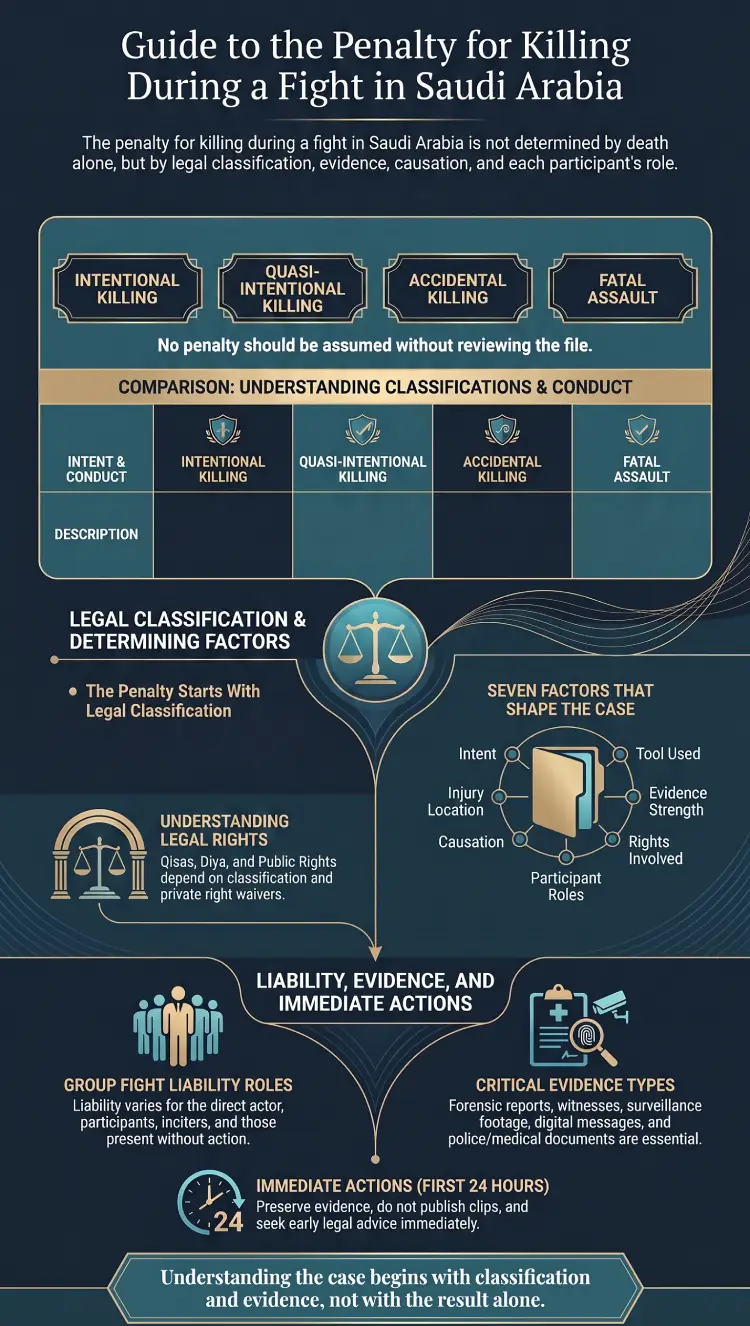
7 Factors Affecting Combat Homicide Penalties
There is no fixed penalty for every fight that ends in death in Saudi Arabia, because a criminal incident is not classified by outcome alone.
A person may die after one blow, after a fall, or because an injury connected to the fight interacted with a medical condition. One participant may have caused the decisive injury, while another may have been merely present, holding the victim, assisting another person, or provoking the incident.
For that reason, the phrase “penalty for a fight that led to death” is not enough to determine the outcome. The file requires a clear link between the act and the death, followed by an examination of intent, tool, surrounding circumstances, and available evidence.
The most important factors are:
- The actor’s intent at the time of the assault, and whether the purpose was killing, fighting, or pushing someone away.
- The tool used, and whether it was deadly by nature or ordinary within the context of the fight.
- The location of the injury, because a blow to a sensitive area differs from an incidental injury.
- The causal link between the act and death, and whether death directly resulted from the fight.
- The role of each participant, especially when several people were involved and accounts conflict.
- The strength of evidence, including forensic reports, witnesses, cameras, and previous messages.
- The effect of private right and public right, especially when there is waiver, settlement, or reconciliation.
People often ask: what is the penalty for killing in a street fight? The competent authority examines a different question: what exact act occurred, who committed it, what tool was used, and was death directly caused by that act?
Intentional, Quasi-Intentional, and Accidental Killing During a Fight
The difference between intentional killing and quasi-intentional killing during a fight usually turns on intent, the tool used, and the manner of assault.
In intentional killing, the issue is whether there was an intent to take life or strong evidence pointing to that intent. In quasi-intentional killing, the assault is intentional, but death occurs without proven direct intent to kill. Accidental killing usually involves the absence of intent to assault or an error in conduct or judgment.
When Can a Fight Be Treated as Intentional Killing?
A fight may be treated as intentional killing when the facts indicate an intent to kill or the use of a tool that is deadly by nature. Relevant indicators include the type of weapon or tool, the location of the injury, repeated blows, previous threats, or chasing the victim after the fight had already ended.
A fight may be treated as intentional killing when the facts indicate an intent to kill or the use of a deadly tool. This is why understanding the penalty for intentional killing in Saudi Arabia can help distinguish ordinary fight-related liability from the more serious classification of intentional homicide.
A defendant does not always need to admit an intention to kill. The judicial authority may infer intent from outward conduct, especially where a dangerous tool was used or directed at a lethal area of the body.
This is why early statements, video clips, threats, and prior messages should not be treated casually. They may become important indicators when the case is reviewed.
When Does the Case Become Quasi-Intentional or Accidental?
A case may become quasi-intentional killing when a person intended to assault another but no direct intent to cause death is proven. This may appear in some cases involving hand strikes, tools not usually considered lethal, or a sudden fight that produced a more serious result than expected.
Accidental killing during a fight may arise where there was no intent to assault, or where death occurred because of an unintended error. For example, a person may push someone away, the person falls unexpectedly, and the authority then examines whether the push was causally connected to the death.
Unintended killing during a fight does not automatically remove responsibility. It may shift the discussion from intentional killing to quasi-intentional or accidental killing, depending on intent, the act, and the result.
When the conduct shows a serious intent to kill but death does not occur, the legal discussion moves away from fight-related death and toward the penalty for attempted murder in Saudi Arabia.
Fatal Assault, One Blow, and Push-and-Fall Cases
The penalty for a fatal assault depends on the causal connection between the assault and the death, together with the nature of the act and the surrounding circumstances.
A fatal assault in Saudi Arabia means that the conduct began as a physical assault but ended with the victim’s death. The focus is not on the word “assault” alone. The authority examines the force used, the location of the injury, repetition, the victim’s condition, and whether death directly resulted from the act.
One blow may lead to death, but that fact alone does not determine the criminal classification. The location of the blow, its force, the tool used, the victim’s reaction, and the medical cause of death must all be examined.
A push-and-fall case also requires careful review because it combines act, result, and surrounding risk. A push may be a clear assault, an attempt to repel danger, or an act that took place in a highly dangerous location.
The key questions are: was the fall foreseeable? Was the place dangerous? Did the person intend harm? Did death directly result from the fall? These questions may determine whether the incident is treated as accidental killing, quasi-intentional killing, or another classification.
Where the act was intended to repel an immediate danger, the case may require a separate analysis of necessity, proportionality, and the penalty for killing in self-defense in Saudi Arabia.
Qisas, Diya, and Public Right in Killing During a Fight
Qisas, diya, and public right in a killing during a fight are not determined by the word “fight.” They depend on the type of killing and the evidence established in the file.
Qisas may arise where intentional killing is proven and its conditions are met. Diya may arise in settlement, quasi-intentional killing, accidental killing, or other contexts depending on the classification of the case. Public right may remain present even where there is waiver or reconciliation in the private right.
| Classification | What the authority examines | Possible legal effect |
|---|---|---|
| Intentional killing | Intent, tool, injury location, indicators | Qisas, private right, and public right may arise |
| Quasi-intentional killing | Intent to assault without proven intent to kill | Diya and discretionary consequences may arise depending on the file |
| Accidental killing | Absence of intent to assault or error in conduct | Liability differs according to cause and harm |
| Fatal assault | The link between assault and death | Depends on the technical report and other evidence |
Qisas may be considered when intentional killing is proven and its conditions are satisfied. However, the mere fact that death occurred during a fight is not enough by itself to reach that classification.
Diya may arise where it has a place under the classification of the incident, settlement, or private right. It should not be treated as an automatic substitute for all legal consequences, because public right may continue depending on the facts.
A waiver by the victim’s family may affect the private right, but it does not always end the criminal case. The state considers the impact of the crime on public security, the seriousness of the conduct, the behavior of the offender, and the circumstances of the fight.
Liability and Evidence in Group Fights
In a group fight, liability is not equal merely because several people were present. The decisive issue is the role of each person.
One person may have delivered the decisive blow. Another may have held the victim. A third may have been present without participating. Another may have incited the fight beforehand. For this reason, liability for participation in a fight resulting in death differs according to the act attributed to each person.
Is Mere Presence Enough to Create Liability for Killing?
Mere presence at the location of the fight is not enough by itself to hold a person liable for the death. Presence may become legally relevant if it is connected to an act, such as holding the victim, preventing escape, inciting the fight, or assisting the assailant.
The competent authority usually looks for the direct actor, the assistant, the inciter, and the person present without an effective act. A person’s legal position may differ between witness, participant, inciter, or principal offender depending on the evidence.
Forensic Report, Cameras, and Digital Evidence
Proving a killing during a fight depends on collecting evidence and connecting it to the sequence of events and each participant’s role. The file may include the police report, party statements, witness testimony, hospital records, and forensic reports.
The forensic report helps identify the cause of death, the type of injury, its location, and its connection to the act attributed to the accused. Surveillance cameras may help identify the moment of striking, falling, or using a tool.
Digital evidence may include threatening messages, videos, audio recordings, or conversations that preceded the fight. Publishing clips on social media may create a separate legal problem, so evidence should be preserved and submitted to the competent authority instead of being circulated.
What to Do in the First 24 Hours After a Fight Resulting in Death
The first 24 hours after a fight resulting in death may affect the case more than many people expect.
At this stage, excessive talking, emotional defense, or publication of videos is not helpful. The priority is to protect the legal position, preserve evidence, organize the facts, and avoid any conduct that may later be interpreted against you.
Do the following:
- Do not publish any clip or image connected to the incident.
- Preserve messages, recordings, and conversations linked to the fight.
- Avoid contacting witnesses to influence or direct their statements.
- Collect reports, medical documents, and official notices.
- Write down the sequence of events without exaggeration or omission.
- Do not provide a detailed account before understanding your legal position.
- Seek early criminal-law advice if there is arrest, summons, or investigation.
These steps are not about hiding the truth. They are about handling a serious file in an organized way. Cases that begin with a fight and end in death require clarity, not confusion or rushed reactions.
When Do You Need a Criminal Lawyer in a Fight-Related Killing Case?
You may need a criminal lawyer in a fight-related killing case from the moment the incident turns into a death or investigation.
The lawyer’s role does not begin only in court. It may begin with understanding the account, organizing documents, reviewing medical reports, analyzing each participant’s role, and identifying what should or should not be said during early stages.
Legal assistance may be needed where there is arrest, summons, multiple participants, camera footage, forensic reports, or a need to understand the effect of waiver and settlement.
A criminal lawyer in Jeddah may help review the facts and identify the legal direction, especially where the case is in Jeddah or nearby areas.
FAQ: Penalty for Killing During a Fight in Saudi Arabia
What is the penalty for killing during a fight in Saudi Arabia?
The penalty depends on the classification of the incident. It may involve intentional killing, quasi-intentional killing, accidental killing, or fatal assault.
Is every fight that ends in death treated as intentional killing?
No. The competent authority examines intent, the tool used, the cause of death, injury location, evidence, and each participant’s role.
When can a fight be treated as intentional killing?
A fight may be treated as intentional killing when facts indicate intent to kill or use of a deadly tool in a dangerous area.
When does a fight become quasi-intentional killing?
It may become quasi-intentional when there is intent to assault, but no proven direct intent to take the victim’s life.
What is the penalty for fatal assault in Saudi Arabia?
It depends on the cause of death, the force of the assault, the injury location, the forensic report, and the accused person’s role.
Can qisas arise in a killing during a fight?
Qisas may arise where intentional killing is proven and its conditions are met. Death during a fight alone is not enough.
Does diya or waiver remove public right?
Diya or settlement may affect private right, but public right may remain depending on the facts and seriousness of the case.
Who is liable in a group fight resulting in death?
Liability depends on each person’s role, such as the direct actor, participant, inciter, or person merely present without effective action.
What is the role of the forensic report?
The forensic report helps identify the cause of death, injury type, injury location, and connection to the act attributed to the accused.
When should a criminal lawyer be contacted?
A criminal lawyer should be contacted when there is death, arrest, summons, investigation, conflicting accounts, forensic evidence, or video footage.
The 7 factors that shape the penalty for killing during a fight in Saudi Arabia may be the difference between viewing the case as intentional killing, quasi-intentional killing, accidental killing, or fatal assault. The issue is not settled by the news of death alone, nor by one party’s account.
The decisive point begins with how the incident is legally described. Was the act intentional assault? Was a dangerous tool used? Was the injury a direct cause of death? Evidence then clarifies intent, each participant’s role, and the effect of waiver or settlement on private right and public right.
When a fight ends in death, do not treat the file as an ordinary dispute with a tragic result. Preserve the evidence, avoid publishing clips, do not provide an unorganized account, and seek specialized legal review before taking any step that may affect the direction of the case.
In files involving death, investigation, conflicting evidence, and private right, the family or accused person may need a law firm in Jeddah that handles the matter with a clear method and explains the available options before any critical procedure.
Official References: