
Search and Seizure in Saudi Arabia is not an unrestricted investigative measure. A search directly affects personal privacy, which is why Saudi law places clear limits on its legal basis, the authority permitted to order it, the scope of its execution, and the items that may lawfully be searched for. Saudi Criminal Procedure Law also recognizes the inviolability of persons, homes, offices, and vehicles and prohibits entry or search except in circumstances permitted by law.
Quick Answer: When Can a Search Be Invalid in Saudi Arabia?
A search is generally valid when it is based on a clear legal ground, connected to an offense under investigation, authorized by the competent authority where authorization is required, and carried out within the permitted scope relating to the person, place, or item concerned.
When a search has no valid legal basis, exceeds its authorized purpose, is executed after the authorization has expired, or extends to a person other than the accused without strong indications justifying it, the validity of the search—and potentially the evidentiary value of what it produced—may become open to challenge.
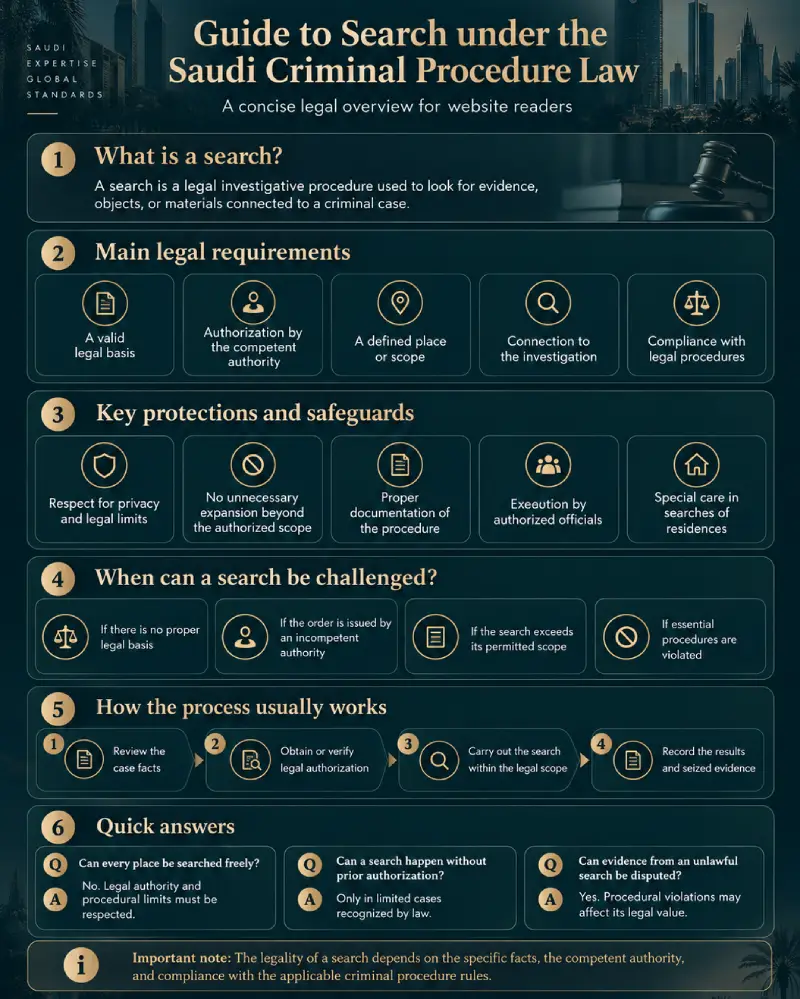
What Are the Requirements for a Lawful Search?
For Search and Seizure in Saudi Arabia to be legally sound, the relevant circumstances should generally include:
- An actual offense or serious incident under inquiry or investigation.
- Indications or evidence sufficient to justify the search.
- A search order or authorization where required.
- Execution by a competent authority.
- Compliance with the authorized purpose and scope.
- No unjustified expansion to other persons or places.
When Can a Search Be Invalid or Subject to a Strong Challenge?
The legality of a search may require particular scrutiny where:
- It was conducted without a valid legal basis.
- A home was entered or searched without circumstances permitted by law.
- The search order or authorization was executed after its validity period expired.
- The search expanded beyond the purpose for which it was authorized.
- A person other than the accused was searched without strong indications.
- The special requirements governing the search of a woman were not followed.
- There is a material discrepancy between what occurred and what was recorded in the official report.
| Situation | Preliminary Assessment |
|---|---|
| Clear legal basis, valid authorization, and controlled execution | More likely to be valid |
| No legal basis or search conducted beyond its scope | Strong basis for review or challenge |
| Defect involving timing or execution | Requires careful examination |
| Case primarily based on items seized during the search | Reviewing the search becomes particularly important |
Because a search is part of the broader criminal process, understanding the stages of a criminal case in Saudi Arabia helps clarify where the search occurs and when it may affect the direction of the case.
What Does Search Mean Under Saudi Criminal Procedure Law?
A search under Saudi Criminal Procedure Law is a legal procedure intended to locate evidence relating to an offense that has already occurred. It is not a general mechanism for conducting unrestricted inquiries into people or their property without a specific legal basis.
A search is also different from arrest and seizure, although all three procedures may arise in the same criminal case.
Because a search is linked to an alleged criminal offense, understanding the types of criminal cases in Saudi Arabia can help place the procedure within its proper legal context.
An arrest restricts a person’s liberty and may prevent them from fleeing or interfering with the investigation. A search, by contrast, is intended to locate evidence or items relevant to establishing the facts. Seizure refers to taking possession of an item that has been discovered, securing it, and formally recording it.
A criminal search should therefore not be confused with a temporary stop or an initial identity check.
A temporary stop is a limited procedure. A criminal search is more intrusive because it affects privacy and therefore requires a clearer legal basis and more precise limits.
| Procedure | Practical Meaning | Purpose |
|---|---|---|
| Arrest | Restricting a person’s liberty | Preventing escape or interference with the investigation |
| Search | Looking for evidence or items connected to an offense | Supporting the investigation and establishing the facts |
| Seizure | Taking and securing an item connected to the offense | Preserving and documenting evidence |
In some cases, the evidentiary picture does not depend on the search alone. It may also involve the conditions for a valid criminal confession and whether a confession can properly be relied upon or challenged.
Infographic Search and Seizure in Saudi Arabia
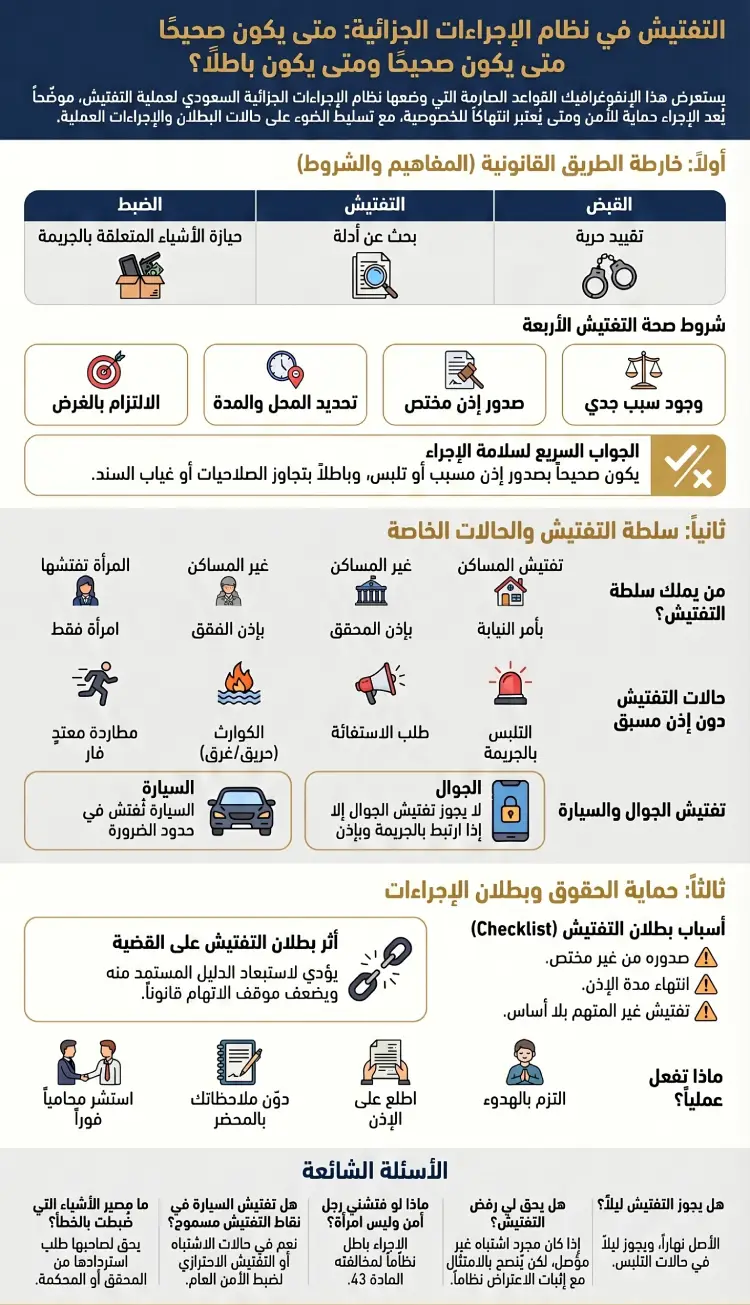
Requirements for a Valid Search in Saudi Arabia
The validity of Search and Seizure in Saudi Arabia does not depend on a single requirement. Several connected legal conditions must be considered. If a material requirement is missing, the validity of the procedure may be weakened or become subject to challenge.
The main requirements include the following:
- A serious legal basis must exist:
General suspicion alone is not enough. There should be indications or evidence capable of justifying the search, together with an offense that has actually occurred and sufficient indications connecting it to the person to be searched. The Implementing Regulations link the validity of a search to the occurrence of an offense and the existence of sufficient evidence indicating its attribution to the person concerned. - Authorization must come from the competent authority:
A search cannot properly rely on authorization issued by an authority that lacks jurisdiction. Homes receive particular protection. Entry into or search of a home is therefore permitted only pursuant to a reasoned order from the Public Prosecution in the circumstances prescribed by law. For premises other than homes, authorization from the competent investigator is generally sufficient. - The place and validity period must be defined:
Search authorization is not open-ended. It should identify the place, person, or item to be searched and specify the period during which it may be executed. It must not be carried out after that period expires. The Implementing Regulations also provide that an order or authorization permits only one search unless a new authorization is issued. - The search must remain within its authorized purpose:
Search authorization is not permission to conduct an unrestricted investigation. The search should remain connected to items relating to the offense under inquiry or investigation. Expanding it without a clear connection to that offense may create a stronger basis for questioning its legality.
| Requirement | Why It Matters |
|---|---|
| Serious legal basis | Prevents searches based on mere suspicion |
| Authorization from a competent authority | Establishes the legal basis of the procedure |
| Defined place and duration | Restricts execution and prevents overreach |
| Compliance with the authorized purpose | Limits the search to matters connected with the offense |
Who Has Authority to Conduct a Search?
Not every person involved in Search and Seizure in Saudi Arabia has the same legal authority. Saudi law distinguishes between the authority that orders or authorizes a search and the authority responsible for carrying it out.
This distinction matters because some challenges may relate not merely to the fact that a search occurred, but to the chain of authority on which the procedure was based.
For homes, Saudi law provides greater protection and links entry and search to a reasoned order issued by the Public Prosecution. For premises other than homes, authorization from the competent investigator is generally sufficient.
A criminal investigation officer may execute the search within its permitted limits, but execution cannot be transformed into an unrestricted examination without a valid reason or connection to the offense.
Saudi law also does not permit the search of a person other than the accused, or a residence other than that of the accused, unless strong indications suggest that the search will assist the investigation.
Where the person being searched is a woman, the search must be conducted by a woman designated by the criminal investigation officer.
| Type of Search | What Should Be Examined? |
|---|---|
| Search of a person | Legal basis, permitted scope, and related personal items |
| Search of a home | Basis of authorization, reason for entry, and limits of execution |
| Search of a person other than the accused | Whether strong indications justified the procedure |
| Search of a woman | Compliance with the specific requirements governing execution |
When Can a Search Be Conducted Without Prior Authorization?
The general rule is that a search cannot be conducted without legal limitations. Saudi law, however, recognizes certain exceptional situations that should not be interpreted more broadly than necessary.
These may include flagrante delicto, a request for assistance from inside a residence, fire, flooding, structural collapse or similar emergencies, or entry while pursuing an offender for the purpose of arrest.
Such situations should be assessed within the limits of the specific reason that permitted entry or search.
Common situations that raise questions include:
- Flagrante delicto or being caught in the act.
- A request for assistance from inside the premises.
- Fire, flooding, structural collapse, or a similar emergency.
- Pursuit of an offender for the purpose of arrest.
Mobile phones and vehicles are better assessed within the general legal framework governing searches rather than treated as entirely separate categories.
The correct question is not simply: Can a mobile phone be searched?
The relevant questions include whether there is a clear connection between the phone and the alleged offense, whether the examination remained within its proper purpose, and whether an applicable legal basis or authorization covered the examination.
The same approach applies to vehicles. A vehicle search should be assessed according to the circumstances giving rise to the procedure and the permitted scope of the search.
| Situation | Correct Question |
|---|---|
| Mobile phone search | Is there a clear connection between the device and the offense? |
| Vehicle search | Do the circumstances or authorization permit the search? |
| Search without prior authorization | Does a genuine statutory exception apply? |
| Flagrante delicto | Were the legal requirements for the situation actually satisfied? |
When Can a Search Be Invalid in Saudi Arabia?
A serious challenge to Search and Seizure in Saudi Arabia may arise where:
- The search had no valid legal basis.
- Authorization was issued by an authority lacking jurisdiction.
- The authorization was executed after its validity period had expired.
- The search exceeded the permitted person, place, or purpose.
- A person other than the accused was searched without strong indications.
- The specific requirements governing the search of women were violated.
- The official report does not accurately reflect what actually occurred.
Main Grounds for Challenging the Validity of a Search
A challenge to a search does not arise merely because the procedure felt intrusive or uncomfortable. There must generally be a material defect affecting the legal basis of the search or the manner in which it was carried out.
The most significant grounds include:
- Absence of a valid legal basis:
Where a search required a valid order or authorization and no such legal basis existed, the legality of the procedure may be challenged from the outset. - Authorization issued by an authority lacking competence:
This may appear to be a technical issue, but it can be fundamental. The legal competence of the authority issuing an order or authorization forms part of the validity of the procedure itself. - Expired authorization:
The date of execution is not a minor administrative detail. The Implementing Regulations provide that a search order or authorization may not be executed after its period has expired. It also permits only one search unless a new authorization is issued. - Exceeding the authorized scope:
A practical problem may arise when a search begins for a specific reason and then expands beyond that reason. This may involve additional rooms, persons, devices, or items that have no clear connection with the offense being investigated. Saudi law limits the search to items connected to the offense under inquiry or investigation. - Searching someone other than the accused without sufficient grounds:
A person’s relationship with the accused, or mere presence at a particular location, is not by itself sufficient. Strong indications should exist showing that searching that person is likely to assist the investigation.
| Ground for Challenge | Why It Matters |
|---|---|
| No valid legal basis | Undermines the legality of the search from the outset |
| Authorization by an incompetent authority | Weakens the legal foundation of the authorization |
| Expired authorization | Places execution outside the permitted period |
| Search exceeded its scope | Turns the procedure into something broader than its legal basis |
| Search of another person without sufficient indications | Interferes with third-party rights without adequate justification |
| Material defect in execution | May affect the strength or admissibility of resulting evidence |
An important distinction should be kept in mind: not every procedural defect produces the same legal consequence.
The key question is whether the defect is material and whether it affects the legality of Search and Seizure in Saudi Arabia or the evidentiary value of what resulted from it.
What Is the Effect of an Invalid Search on Evidence?
Once the validity of a search is challenged, the next question is its effect on the evidence.
The more accurate answer depends on the role that the search plays within the case as a whole. Where the prosecution case is primarily based on evidence obtained through the search, examining the legality of the procedure becomes particularly important.
Where other independent evidence exists, such as witness testimony in criminal evidence, the evidentiary assessment and the significance of the challenge may differ.
It is therefore more accurate not to say that every invalid search automatically results in an acquittal.
Instead, a material procedural defect may weaken the evidence obtained through the search or support an argument for excluding particular evidence, depending on the circumstances of the case as a whole.
How Can a Defect Affect the Evidence?
- It may weaken the evidentiary value of material obtained through the search.
- It may support an argument for excluding particular evidence.
- It may affect the structure of the prosecution case.
- It may change the direction of the defense strategy from an early stage.
What Should You Do in Practice?
- Remain calm.
- Do not physically obstruct the procedure.
- Write down what happened as soon as possible after the search ends.
- Review the official search and seizure report carefully.
- Note any differences between what occurred and what was recorded.
- Obtain an early legal assessment of the circumstances.
When Is a Prompt Legal Assessment Particularly Important?
- When the seized items form the main evidence in the case.
- When the search involved a home or mobile phone.
- When there is doubt about the legal basis or authorization.
- When execution appears to have exceeded the permitted scope.
- When you are asked to sign a report that does not accurately reflect what occurred.
Where a home or mobile phone was searched, or where seized items form the basis of the criminal case, understanding the role of a lawyer in criminal cases may help clarify which procedural issues should be reviewed at an early stage.
How Can BMS Legal Assist?
In cases involving search and seizure, the practical assessment begins with a careful review of what actually happened and what was recorded in the official report.
BMS Legal for Law and Legal Consulting can assist with:
- Reviewing the search and seizure report.
- Assessing the legality of the procedure.
- Determining whether a challenge to the search may be relevant.
- Explaining the available legal options and procedural steps.
- Providing representation before the competent authority or court where required.
If your case involves a search or seizure report, early review may help clarify whether the procedure complied with the applicable requirements. You can contact us to explain the circumstances and identify the next appropriate step.
Legal Review
Criminal Procedure Content
Saudi Arabia
Legal Review & Content Verification | BMS Legal
This article has been reviewed for legal clarity, structural accuracy, and reader usefulness by the legal content review team at BMS Legal. It is intended to explain the general legal framework governing search procedures under Saudi criminal procedure law in a clear and practical way.
Important note: This content is provided for general informational purposes only. Whether a search is lawful under Saudi criminal procedure law depends on the specific facts, the competent authority, the scope of the search, and compliance with the applicable procedural rules.
Frequently Asked Questions About Search and Seizure in Saudi Arabia
What are the requirements for a lawful search under Saudi Criminal Procedure Law?
A lawful search requires a valid legal basis, competent authority, defined scope, and compliance with the purpose and period of the search.
When can a search be conducted without a warrant in Saudi Arabia?
A search may be conducted without prior authorization in specific statutory situations, such as certain cases of flagrante delicto or other legally recognized exceptions.
When can a search be considered invalid?
A search may be challenged if it lacks a legal basis, is authorized by an incompetent authority, exceeds its scope, or is carried out after the authorization expires.
Who has the authority to authorize a search?
The competent authority depends on the place and circumstances. Searches of residences generally require a reasoned order from the Public Prosecution.
What happens to evidence obtained from an invalid search?
An unlawful search may affect the admissibility or evidentiary weight of evidence obtained through it, depending on the nature of the violation and the facts of the case.
Search and Seizure in Saudi Arabia is not an unrestricted legal procedure, and the fact that a search was carried out or resulted in the discovery of evidence does not by itself establish its validity.
The central question is whether the procedure complied with the requirements of Saudi Criminal Procedure Law.
A defect in the legal basis, competent authority, validity period, or scope of execution may significantly affect how the resulting evidence is assessed and how the criminal case is structured.
Where a judgment is issued without adequately addressing a material challenge concerning the search, it may also become important to understand the procedure for an appeal against criminal judgments and how the grounds of objection should relate to the judgment and the procedural defect raised.
Official References: