
Ways to prove bribery in Saudi Arabia do not depend on a cash payment, recording, or witness alone. What matters is what each piece of evidence establishes about the alleged conduct and how it relates to the other elements of the case. The evidence may concern a request for a benefit, its acceptance or receipt, its connection to an official act, or the intent revealed by the sequence of events.
Messages, conversations, recordings, bank transfers, witness testimony, admissions, and circumstantial evidence may all form part of a bribery case, depending on the facts. The value of evidence is therefore determined not simply by its type, but by what it actually proves and how well it aligns with the surrounding facts and the procedures through which it was obtained.
How Is Bribery Proven in Saudi Arabia?
Bribery is proven through evidence showing the alleged conduct and its connection to the benefit, the official act, and the required intent under the applicable legal characterization. A case may involve messages, recordings, financial transfers, testimony, admissions, or a combination of related circumstances.
The existence of one of these forms of evidence does not automatically establish the offense. A bank transfer may prove that money moved between two accounts without establishing why it was transferred. A message may reveal one part of the circumstances without proving the remaining elements, while a recording must be assessed in light of its source, content, and context.
The assessment of bribery evidence therefore begins with a simple question: What fact does this particular piece of evidence prove, and how does it connect to the rest of the case?
When Is a Bribery Offense Established in Saudi Arabia?
A distinction must be made between conduct that falls within a statutory bribery offense and the evidence required to prove that conduct. The Saudi Anti-Bribery Law covers situations in which a public official requests, accepts, or receives a promise or benefit in return for performing an act within their official duties, or an act they claim falls within those duties. Actual receipt of money is therefore not required in every form of the offense.
When assessing the case, it is not enough merely to prove that money changed hands or that two people communicated. The evidence must also establish the relevant connection between the benefit and the official conduct, together with what the surrounding circumstances reveal about the parties’ intent.
Money or communication alone will not establish the offense unless the evidence supports the elements required for the relevant elements of bribery under Saudi law, including the alleged conduct, its connection to official duties, and criminal intent.
What Must the Evidence Establish?
Evidence may be directed at proving that the person is a public official or falls within a legally equivalent category, that a request, acceptance, or receipt occurred, the nature of the benefit, and its relationship to the relevant official act. Intent may also become a disputed issue where the circumstances are open to more than one interpretation.
For that reason, an equation such as “there was a bank transfer, therefore there was bribery” is insufficient. The transfer itself may be undisputed, while the reason for the payment and its connection to the underlying transaction remain matters that require proof.
Is Direct Evidence Required?
A bribery case does not necessarily depend on a witness who personally observed the transaction or a recording that captures the entire event. Several pieces of evidence and circumstantial facts may combine to explain the sequence of events, while even direct evidence may require interpretation in light of the rest of the file.
Likewise, the absence of a witness or recording does not by itself make proof impossible, just as the presence of either does not automatically establish all of the legal elements.
What Are the Main Ways to Prove Bribery in Saudi Arabia?
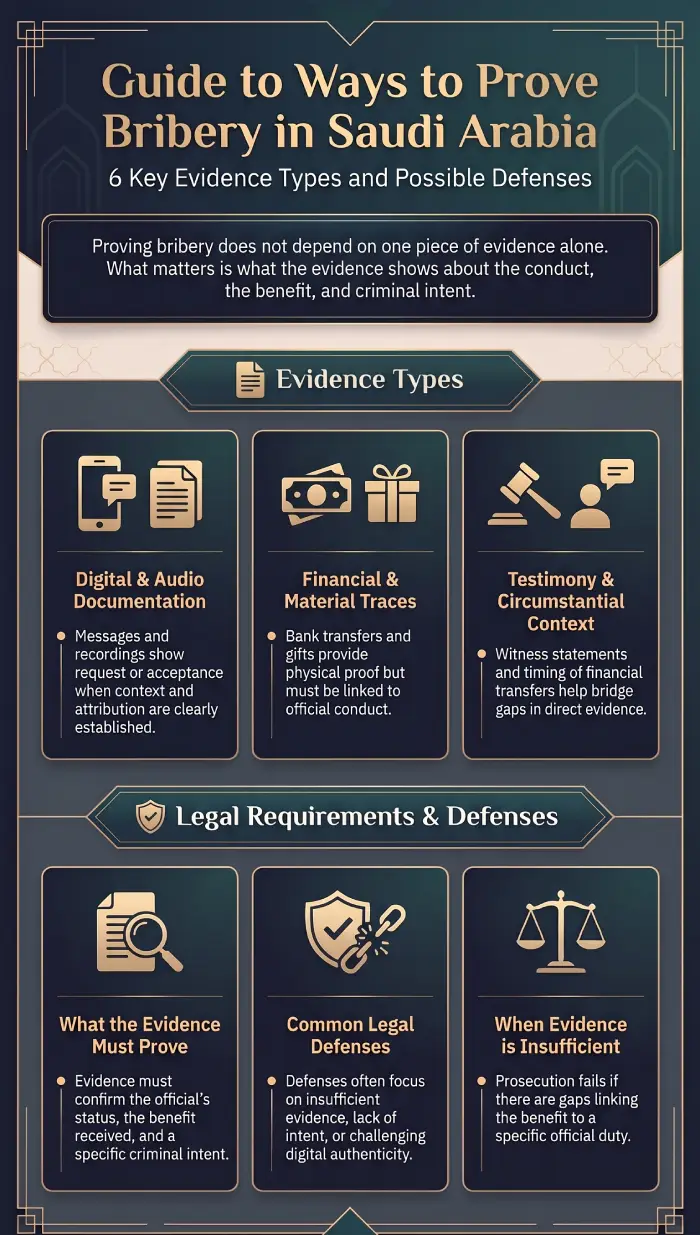
The evidence most commonly relevant to these cases can be grouped into six main categories. This distinction helps identify what each piece of evidence actually contributes instead of treating every item as conclusive on its own.
| Evidence | What it may help establish | What requires examination |
|---|---|---|
| Messages and conversations | A request, acceptance, or agreement | Attribution, content, and context |
| Recordings | The content of a conversation or alleged conduct | Source, legality, and attribution |
| Financial transfers | Movement and timing of funds | Reason for the transfer and connection to the case |
| Witness testimony | Facts known to the witness | Source of knowledge and consistency |
| Admissions | A person’s acknowledgment of specific facts | Accuracy, circumstances, and content |
| Circumstantial evidence | Connections between multiple facts | Strength of the overall evidential link |
Proving a Request for or Acceptance of a Bribe
Proving a request can be particularly important because some forms of bribery do not depend on the benefit actually reaching the official. A request may appear expressly in a conversation or message, or it may be inferred from a sequence of conduct and communications connected to the underlying event.
Proof of acceptance, by contrast, concerns evidence showing acceptance of the promise or benefit and its relationship to the relevant official purpose. A single sentence should therefore not be extracted from a longer conversation where the surrounding context materially changes its meaning.
Proving Receipt of Money or Another Benefit
The relevant benefit is not necessarily limited to cash. Depending on the facts and the applicable provision, it may take the form of a material or non-material advantage. Financial records, ownership documents, correspondence, and other materials may help establish that a benefit was received.
However, proving receipt does not by itself establish that the benefit was a bribe. The reason for the transfer or benefit and its relationship to the official act or omission remain central to the analysis.
Proving Criminal Intent
Proving criminal intent in a bribery case depends on what the circumstances reveal about the person’s knowledge of the nature of the benefit, its connection to official conduct, and their intention in relation to that arrangement.
Messages, timing, the relationship between the parties, and the sequence of conduct may all be relevant. Criminal intent should not be inferred from the existence of money alone or solely from a prior relationship between the parties.
Once the legal characterization of the conduct is established, the penalty for bribery in Saudi Arabia depends on the form of the offense, the status of the parties, and the statutory provisions applicable to the case.
Digital Evidence in Bribery Cases
Digital evidence can be particularly significant where the parties communicated through messaging applications, email, or telephone calls. However, the fact that evidence exists in digital form does not automatically make it decisive. Its attribution, content, context, integrity, and source must still be examined.
Where available, original conversations and files should be preserved. An isolated screenshot or excerpt may fail to show the full context in which a statement was made.
Can WhatsApp Messages Prove Bribery?
WhatsApp messages may form part of the evidence used to prove bribery where they are connected to the alleged conduct and can be attributed to the relevant person. They may reveal a request, acceptance, or agreement, or help explain the meaning or timing of a financial transaction.
The mere existence of a conversation does not, however, establish the offense automatically. The wording may be explicit, open to more than one interpretation, or insufficient without supporting evidence.
The more useful question is therefore: What does the conversation actually prove, and is that meaning consistent with the rest of the sequence of events?
Can an Audio Recording Prove Bribery?
A recording may have evidential value where it captures facts relevant to the allegation, but its assessment requires consideration of its source, content, attribution, and the circumstances in which it was obtained.
The Saudi Criminal Procedure Law regulates matters including the collection of information, flagrante delicto situations, seizure of communications, monitoring of conversations, investigation, witness testimony, and interrogation. Monitoring of communications by competent authorities is subject to procedural safeguards.
A single rule should therefore not be applied automatically to every type of recording. Each recording must be considered according to its source, circumstances, and the role it plays within the case.
Proving Bribery Through Bank Transfers, Testimony, and Circumstantial Evidence
A bribery case may contain a combination of financial evidence, witness testimony, communications, and circumstances linked to timing or official conduct. These forms of evidence are strongest when they explain and support one another rather than merely appearing together without a clear evidential connection.
The significance of a bank transfer or witness statement therefore varies according to what it contributes to the overall understanding of the facts.
Does a Bank Transfer Alone Prove Bribery?
A bank transfer does not prove bribery merely because it exists. It establishes that money moved between accounts, but characterizing that payment as consideration for an official act requires evidence connecting the payment to the alleged conduct.
Relevant circumstances may include the timing of the transfer, the relationship between the parties, related communications, and the nature of the official transaction or decision.
In some cases, the dispute is not whether the transfer occurred, but what it meant: whether it represented an unlawful benefit or had another explanation supported by the documents.
Proving Bribery Through Witness Testimony
A witness may help establish an event they personally saw, heard, or otherwise directly learned about. The significance of the testimony depends on the source of the witness’s knowledge and how consistently it aligns with the rest of the case file.
It is therefore not appropriate to state categorically that one witness will always be sufficient or will never be sufficient. The testimony must be evaluated together with the other evidence and the circumstances of the case.
Admissions and Circumstantial Evidence
An admission may be an important part of a bribery case, but its significance depends on its accuracy, content, the circumstances in which it was made, and how well it corresponds with the remaining facts.
Circumstantial evidence may connect separate facts such as the timing of transfers, the frequency of communications, official conduct, and the relationship between the parties. This does not mean that any collection of suspicious circumstances is sufficient; there must be a meaningful evidential connection to the alleged conduct.
Must the Bribe-Taker Be Caught in the Act?
Being caught in the act is not a mandatory condition for proving every form of bribery. Evidence may establish a request, acceptance, or connection between a benefit and an official act even where the person was not caught physically receiving money.
A flagrante delicto situation may be significant because of its proximity to the alleged conduct and the ability to document events as they occur. Even then, the legality of the procedures and what the seizure or observation actually establishes remain relevant.
Can Bribery Be Proven Without a Witness or Recording?
A case may include messages, documents, financial transfers, admissions, or other circumstantial evidence even where no direct witness or audio recording exists.
The absence of these two forms of evidence does not automatically end the case. The question becomes whether the remaining evidence is sufficient to establish the required elements and whether significant gaps or alternative explanations remain.
What Defenses May Be Raised Against Bribery Evidence?
There is no single list of defenses that applies to every bribery case. Any challenge must arise from the particular allegation, the actual evidence, and the procedures used in the case rather than from general arguments detached from the facts.
The dispute may concern the sufficiency of the evidence, the connection between the benefit and the official act, criminal intent, attribution of digital evidence, or the meaning of financial records.
Insufficient Evidence or Failure to Establish the Connection to Official Duties
A defense may focus on whether the evidence establishes all of the elements required for the allegation or whether the connection between the money or benefit and the relevant official conduct remains insufficiently supported.
There may also be a pre-existing personal or financial relationship between the parties that explains some of the facts. The significance of that explanation depends on supporting documents, timing, and whether it is consistent with the rest of the evidence.
It is not sufficient merely to argue that the act was outside the official’s formal authority, because the Saudi Anti-Bribery Law also addresses certain situations involving an act that the official claims falls within their duties.
Challenging Digital or Financial Evidence
A challenge to digital evidence may concern attribution of an account or device, whether the full conversation is available, the interpretation of ambiguous language, or the legality of the procedure through which the evidence was obtained.
With financial evidence, the dispute may concern the reason for a payment and its relationship to the transaction rather than whether the payment itself occurred. Documents, communications, and the sequence of events may therefore be central to assessing such a challenge.
Challenging Criminal Intent
A dispute may focus on whether the facts establish that the person knew the benefit was connected to official conduct and intended to participate in the alleged arrangement.
This issue requires assessment of the case as a whole. Criminal intent should not be presumed merely because money or communication existed, nor does it disappear simply because an unsupported alternative explanation is offered.
When a case has reached the summons or investigation stage, consulting a criminal lawyer in Jeddah can help identify the evidence and procedural issues that require attention at that stage.
What Should You Do When the Evidence Conflicts?
Start by arranging the events chronologically, then connect each event to the evidence associated with it: a message, transfer, recording, witness statement, or employment-related document. This helps reveal whether the evidence supports other parts of the case, conflicts with them, or relates to a different issue altogether.
Preserve original conversations, recordings, and documents. Do not delete or alter material connected to the case. Full context and original data may be necessary to understand what happened or to allow technical examination of the evidence.
Where the matter has reached the investigation or trial stage, identifying the precise points of disagreement is generally more useful than attempting to build a legal position around one isolated piece of evidence.
Frequently Asked Questions About Ways to Prove Bribery
What are the main ways to prove bribery in Saudi Arabia?
Evidence may include messages, recordings, bank transfers, witness testimony, admissions, and circumstantial evidence.
Can WhatsApp messages prove bribery?
They may contribute to proof if properly attributed and relevant to the alleged conduct, especially when supported by other evidence.
Does a bank transfer alone prove bribery?
No. It proves movement of money, but its connection to official conduct must be established separately.
Must the bribe-taker be caught in the act?
No. Being caught in the act is not the only way to prove bribery.
When is bribery evidence insufficient?
Evidence may be insufficient when it does not establish the required elements or leaves material gaps in the link between the benefit, official conduct, and criminal intent.
Ways to Prove Bribery in Saudi Arabia: 6 Key Evidence Types ultimately depend on understanding the function of each piece of evidence rather than its mere existence. Messages may reveal a request or agreement, while a bank transfer proves movement of funds without necessarily proving why the money was transferred.
Where the evidence conflicts, or the matter has reached the summons or investigation stage, the priority is to determine what each item proves, what it does not prove, and whether there are material issues concerning the connection to official duties, criminal intent, or the legality of the procedure.
You may request an initial review of the case from a law firm in Jeddah to identify the relevant evidence and the appropriate legal step before taking further action.