
The removal of a waqf nazir in Saudi Arabia is not available simply because there is a disagreement with the nazir. It requires a significant violation that touches the founder’s condition, the interest of the waqf, or the rights of the beneficiaries. The request may rest on a breach of the founder’s condition, mixing of funds, or a breach of the rules on disposing of waqf assets, among other grounds that the regulation sets out.
Before thinking about procedure, read the waqf deed and identify the nazir’s powers and the applicant’s capacity. Not every problem calls for removal straight away. Sometimes the better route is a complaint, a request for accounts, or a change of nazir where the deed allows it.
For a wider picture of the nazir’s powers and responsibilities, see our guide to waqf law in Saudi Arabia before assessing a removal route.
Facing a dispute over a waqf nazir’s conduct?
A lawyer can review the waqf deed, the evidence of the violation and your capacity, and help identify the right route before you file.
Enquiries are handled confidentially · No specific court outcome can be guaranteed
When Can a Waqf Nazir Be Removed?
A removal request becomes arguable where it is shown that the nazir breached the founder’s condition, harmed the interest of the waqf, refused to distribute revenue, mixed waqf funds, or dealt with the asset without a clear regulated route. A personal quarrel is not enough. The applicant needs capacity, a real interest, and documents that prove the violation and its effect.
Before filing, organise the case in this order:
- Review the waqf deed and the limits of the nazir’s powers.
- Identify the type of violation: the founder’s condition, the revenue, the asset, or a conflict of interest.
- Collect evidence such as correspondence, statements, contracts or deeds.
- Decide the right request: a complaint, removal, appointment of a replacement, or a change of nazir.
- Avoid building the request on general statements that do not prove a specific event.
The General Authority for Awqaf Law gives the Authority the power, where necessary, to bring a claim before the courts to remove a nazir who fails to achieve the purposes of the waqf or loses a condition of trusteeship.
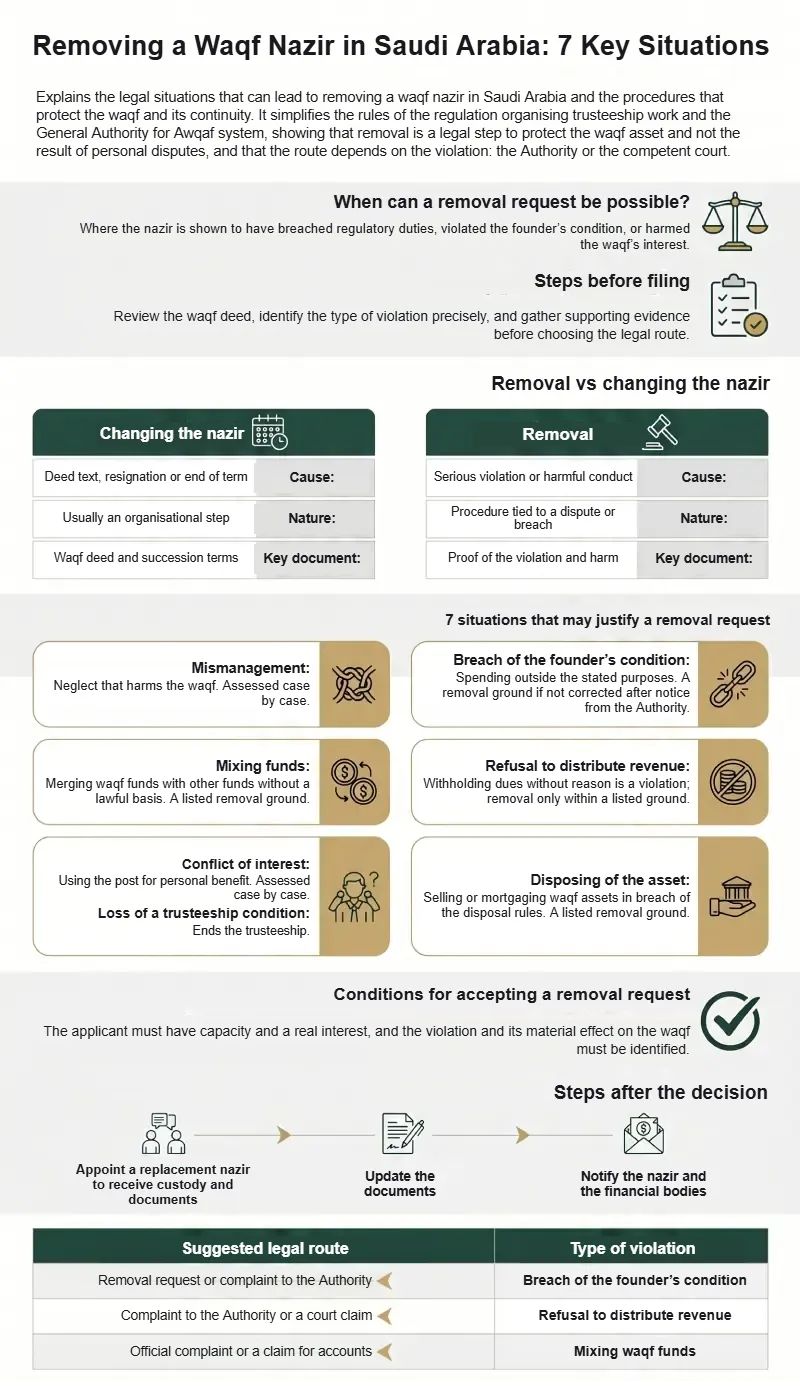
What Removal Means Legally
Removing a waqf nazir means ending the nazir’s authority over the administration of the waqf because of a significant violation, loss of a condition of trusteeship, or conduct that harms the asset, the revenue or the beneficiaries. The aim is to protect the waqf from continuing damage, not simply to punish the nazir or escalate a dispute.
Removal differs from changing the nazir. Removal is usually tied to a violation or significant harm. A change may rest on a provision in the deed, a resignation or the end of a term. That is why it helps to understand the types of waqf in Saudi Arabia and the deed’s own terms before choosing a route.
Removal can follow two routes. Administratively, the General Authority for Awqaf can sanction a nazir under the trusteeship regulation, from a warning or a fine of up to SAR 500,000 to suspension for up to 90 days or removal, weighing the seriousness of the violation, its repetition and its effect. Judicially, a beneficiary or interested person can complain to the Authority or take the matter to the competent court, and the Authority itself can ask the court for removal. A nazir suspended or removed by an Authority decision can challenge it before the competent circuit within 30 days of its issue, while a decision limited to a warning or fine is challenged before the Administrative Court.
| Comparison | Removal | Changing the nazir |
|---|---|---|
| Cause | A violation, loss of a condition, or significant harm | A provision in the deed, resignation or end of a term |
| Nature | A procedure tied to a dispute or breach | Usually an organisational step |
| Result | Ending the nazir’s authority because of the violation | Trusteeship passes to another nazir |
| Key document | Evidence of the violation and the harm | The waqf deed and the conditions for change |
The regulation governing trusteeship work defines a nazir as the natural or legal person who holds the trusteeship of a waqf, and defines the founder’s condition as the conditions set for the waqf, its revenue, its spending purposes or its nazir.
7 Situations That May Justify Removal
The grounds for removing a nazir revolve around breach of trust, breach of the founder’s condition, or harm to the beneficiaries. Not every administrative mistake leads to removal. The competent body normally looks at how serious the violation is, how often it happened, and its effect on the waqf asset, its revenue or the beneficiaries.
Not every situation in the table is a separate, named ground for removal under the regulation. The regulation names specific grounds: a crime, a breach of the founder’s spending conditions that is not corrected after notice, mixing waqf funds without a lawful basis, sham transactions, refusing to open a bank account for the waqf, breaching the rules on disposing of waqf assets, and refusing an Authority review. Refusal to distribute revenue, mismanagement and conflict of interest are breaches or harm that are assessed case by case. They may lead to a warning, a fine, a suspension, a complaint or a court claim, and support removal only where they fall within a listed ground or the court finds the harm serious enough.
| Situation | When it matters | Suitable evidence |
|---|---|---|
| Breach of the founder’s condition | Spending outside the stated purposes or changing beneficiaries | The deed and spending records |
| Mismanagement | Falling revenue or lost assets through clear neglect | Contracts, reports, correspondence |
| Refusal to distribute revenue | Beneficiaries deprived without a clear reason | Beneficiary requests and account statements |
| Mixing waqf funds | Waqf money merged with other funds | Bank statements and transfers |
| Dealing with the waqf asset | Sale, mortgage or investment without a clear route | Deeds, contracts, approvals |
| Conflict of interest | The nazir or a relative benefits from waqf decisions | Contracts and proof of the relationship |
| Loss of a condition of trusteeship | Loss of capacity, integrity or ability to manage | A judgment, an official document, or proof of the lost condition |
A breach of the founder’s condition is one of the strongest grounds for removal, especially where the nazir spent revenue outside the stated purposes, changed the order of beneficiaries or exceeded the limits of authority. It is not enough to say a breach occurred. The text of the condition must be shown, tied to a specific act, and its effect on the waqf or the beneficiaries explained.
Mismanagement means a pattern of conduct that harms the waqf, such as leaving the asset without maintenance, signing contracts that weaken revenue, or neglecting the administration of assets. These cases need documented harm, because “the nazir does not manage the waqf well” does not prove anything by itself.
Refusal to distribute revenue is among the most common causes of dispute. Where the deed names beneficiaries, shares or a method of spending and the nazir refuses without a clear reason, removal may not be the only step. A personal status lawyer in Jeddah can help assess whether the better question is what happened to the revenue, what was spent, and whether accounts show how the waqf was actually run.
Mixing waqf funds with the nazir’s own money, or with other bodies’ money, weakens the independence of the waqf and makes income and expenses harder to trace. It becomes serious when the waqf’s revenue, expenses or the beneficiaries’ shares cannot be determined.
Loss of a condition of trusteeship, whether capacity, integrity or the real ability to manage, may also justify considering removal. A general allegation is not enough: proof is needed that the nazir no longer meets the required condition, or that continuing in post harms the waqf or the beneficiaries.
Before Asking for Removal: Review the Basis of the File
In waqf cases the strength of a request does not begin with describing the dispute. It begins with linking the deed to the violation and the documents.
1. The founder’s condition. Is there a clear text on the nazir’s powers or the spending of revenue?
2. The effect of the violation. Did the act affect the waqf asset, the revenue or the beneficiaries’ rights?
3. Practical evidence. Are there letters, statements, deeds or contracts that prove what happened?
Professional note: a personal dispute with the nazir is not enough for a removal request. The strongest route shows capacity, interest, the violation and its effect on the waqf or the beneficiaries.
Conditions for Accepting a Removal Request
The conditions for removing a nazir do not rest on a general objection. They rest on proper capacity, a clear interest and a violation that can be proved. The request should therefore link the waqf deed, the nazir’s act and the harm that act caused.
The main practical conditions are:
- The applicant has capacity, for example as a beneficiary or a person with a direct interest.
- There is a real interest, not just a personal dispute with the nazir.
- The violation is clearly identified, such as breach of the condition or withholding revenue.
- Documents prove or support the event.
- The effect of the violation on the waqf or the beneficiaries is explained.
- The request is precise: removal, appointment of a replacement, or a corrective step.
If capacity is not clear, the request can be weakened before the violation itself is examined. Attach whatever links the applicant to the waqf, such as the waqf deed, proof of beneficiary status, or any document showing direct harm.
Who Can Ask for Removal?
Anyone with capacity and an interest connected to the waqf may ask for the removal of a nazir. Capacity varies with the type of waqf, the founder’s condition and the nature of the harm. That is why not every heir or relative automatically has the right to apply.
| Party | When they have capacity |
|---|---|
| A beneficiary of the waqf | When the right to revenue or usufruct is affected |
| The founder | If alive and with a right reserved in the deed |
| Heirs | If they are beneficiaries or have a waqf-related interest |
| The General Authority for Awqaf | Where there is a regulatory or legal failure |
| A person with an interest | If they show direct harm from the nazir’s administration |
Beneficiaries are the party most closely tied to this kind of request, especially where revenue is withheld or the accounts are unclear. Heirs need careful checking, because a waqf is not always treated as an ordinary estate once created. They may have capacity only if they are beneficiaries or are harmed by the nazir’s administration.
Practical Steps
How a nazir is removed starts with reading the waqf deed, not with drafting the claim. The right route is decided once the nazir’s powers, the type of violation, the applicant’s capacity and the available documents are known.
- Review the deed: to learn the founder’s condition and the powers of the nazir and the beneficiaries.
- Identify the violation: such as refusing revenue or dealing with the asset.
- Collect evidence: letters, statements, contracts or deeds.
- Define the request: removal, or appointment of a replacement.
- Choose the route: a complaint to the competent body, or a claim where needed.
- Follow the file: answer responses and explain the effect of the violation.
| Situation | Likely first route | What to prepare |
|---|---|---|
| A clear breach of the founder’s condition | A removal request or a complaint | The deed and evidence of the breach |
| Refusal to distribute revenue | A request to compel payment, or removal where harm is proved | Letters and statements |
| Mixing waqf funds | A complaint or a claim | Statements and transfers |
| Dealing with the waqf asset | Legal review, then a claim if needed | Contracts and deeds |
| A provision allowing change | Changing the nazir | The deed and the appointment document |
The Najiz portal offers a statement of claim service. Its steps include signing in, choosing the electronic services, entering the judiciary package, then submitting the statement of claim with its data and documents.
Where the case combines waqf, heirs and beneficiaries, or involves a dispute about revenue or about dealings with the asset, reading the deed and documents becomes the essential first step. In files like these, an inheritance and estates lawyer in Jeddah can help establish capacity, review the documents and choose the closest legal route.
If you hold a waqf deed and letters or accounts that are unclear, begin with a legal consultation to decide whether a complaint, a removal request or the appointment of a replacement nazir is the better step.
Required Documents
Documents vary with the reason for the request, but some are essential. They prove the waqf itself, the nazir’s capacity, the applicant’s right, and the violation alleged.
- The waqf deed.
- The deed or decision appointing the nazir and setting the nazir’s powers.
- Whatever proves the applicant’s capacity as a beneficiary or interested party.
- Letters asking for revenue, accounts or documents.
- Statements or financial documents where revenue is disputed.
- Contracts or acts connected with the waqf asset.
- Evidence that the founder’s condition was breached or the beneficiaries were harmed.
The waqf deed is the most important document, because it sets the founder’s condition, the spending of revenue and the nazir’s powers. Without it, it is hard to say whether the nazir went beyond the limits of authority or breached a fixed obligation.
What Happens After a Removal Decision?
After a removal decision, the next stage must be organised so that the administration of the waqf and the beneficiaries’ rights are not interrupted. Ending the nazir’s authority is not enough: delegations, documents, the handover of custody and the appointment of a replacement all have to be arranged.
| Step | Purpose |
|---|---|
| Notify the removed nazir and interested parties | Stop dealings under the former capacity |
| Update the documents linked to the waqf | Refresh the official capacity and details |
| Cancel financial delegations | Protect accounts and assets |
| Appoint a replacement nazir | Continue administration without interruption |
| Hand over custody and documents | Allow the new nazir to start work |
The regulation governing trusteeship work explains that a removal decision leads to notifying interested parties, amending the documents relating to the waqf, and cancelling the financial delegations linked to the removed nazir. Some decisions may be objected to before the competent circuits within the statutory periods.
Mistakes That Weaken the File
Some requests weaken because of poor preparation, not because a right is missing. Organise the file before any complaint or claim, and separate proved facts from general impressions.
- Filing before reading the waqf deed.
- Confusing a family dispute with a regulatory violation.
- Using general phrases such as “the nazir is dishonest” without proof.
- Not identifying the violation or its effect on the waqf.
- Ignoring proof of the applicant’s capacity.
- Asking for removal with no plan for a replacement nazir.
- Attaching many documents without arranging them by event.
The best way to strengthen a request is to turn each allegation into a specific event. Instead of saying the nazir mismanaged, state the act, its date, its effect and the document that proves it.
When Do You Need a Waqf Lawyer?
Legal review is needed when the dispute concerns the waqf deed, the distribution of revenue, the nazir’s acts or the appointment of a replacement. These files do not follow a single template: they need a careful reading of the deed and the documents.
Review matters in cases such as a dispute over revenue or beneficiaries, suspected breach of the founder’s condition, dealings with the waqf asset, a need to remove the nazir and appoint a replacement, an overlap between the waqf and heirs, or financial documents that need legal examination.
Trust and Legal Basis
Legal basis
This guide is based on the General Authority for Awqaf Law and trusteeship regulation and the Najiz statement-of-claim service listed below, and is written for general legal awareness rather than as advice on a specific case.
Published by: BMS Legal Law and Legal Consultancy Company.
Address: Jeddah, Al-Mishrifah District, Palestine Street, Al-Safeer Tower
Frequently Asked Questions About Removing a Waqf Nazir
When can a waqf nazir be removed in Saudi Arabia?
A removal request can be made where there is a significant violation touching the founder's condition, the interest of the waqf or the beneficiaries' rights, supported by documents that prove the violation and its effect.
What are the main grounds for removing a waqf nazir?
The regulation organising trusteeship work lists specific grounds on which the General Authority for Awqaf may remove a nazir: committing a crime through the waqf or the nazir’s role; breaching the founder’s spending conditions after notice from the Authority without correcting it; mixing waqf funds without a lawful basis; sham transactions in the waqf’s name; refusing to open a bank account for the waqf; breaching the rules on disposing of waqf assets; and refusing an Authority review or its requests for documents. Loss of a condition of trusteeship ends the trusteeship separately. Other conduct, such as mismanagement or a conflict of interest, is judged on its seriousness and may support a lesser sanction, a complaint or a court claim.
What are the conditions for accepting a removal request?
The applicant needs capacity and an interest, the violation must be identified clearly, and documents must show its effect on the waqf or the beneficiaries.
Can heirs ask to remove a waqf nazir?
Yes, if they have capacity and an interest connected to the waqf, for example as beneficiaries or people harmed by the nazir's administration. Kinship to the founder alone is not enough.
Is a refusal to distribute waqf revenue a ground for removal?
Not by itself. The regulation requires revenue to be paid according to the deed’s purposes and dates and, where the deed sets no date, within three months of the end of the waqf’s financial year. A breach is a violation that can lead to a warning, a fine or a suspension. It can support removal only where it also amounts to a breach of the founder’s spending conditions that the nazir failed to correct after notice, or comes with another listed ground.
What is the difference between removal and changing the nazir?
Removal is usually tied to a violation, harm or loss of a condition of trusteeship. A change of nazir may follow a provision in the waqf deed, a resignation or the end of a term.
Conclusion
The removal of a waqf nazir in Saudi Arabia summarises the core point: a disagreement with the nazir is not enough. There must be a significant violation, proper capacity and documents that support the request. The right route therefore starts with reviewing the waqf deed, then identifying the violation, then choosing the suitable step.
That step may be a complaint, a removal request, the appointment of a replacement nazir, or a change of nazir where the deed allows it. The clearer and better organised the file, the more accurate the assessment and the closer it gets to protecting the waqf and its beneficiaries. A law firm in Jeddah can help you arrange the waqf deed and correspondence before choosing the route.
Need help with removing a waqf nazir? Send us the deed and your documents for an initial review of the route that fits your case.
Need help with removing a waqf nazir?
Speak with a BMS Legal lawyer in Jeddah for an initial review of the waqf deed, your documents and the route that protects your rights.
Enquiries are handled confidentially · No specific court outcome can be guaranteed
Official Legal and Government Sources
- General Authority for Awqaf Law, Bureau of Experts at the Council of Ministers (Arabic-language official page).
- Regulation Organising Trusteeship Work, General Authority for Awqaf (Arabic-language official document).
- Najiz: statement of claim service (Arabic-language official service page).
Disclaimer: This article is for general legal awareness and is not advice on an individual case, and reading it does not create a lawyer–client relationship. The legal assessment varies with the facts, the documents and the rules that apply to each case.