
Anyone searching for the WhatsApp insult penalty in Saudi Arabia tends to expect a single figure for imprisonment or a fine, but the law does not treat every abusive message in the same way. The analysis starts with the content of the message and the context in which it was sent, and then turns to whether it can be proven before the competent authority.
This guide explains the WhatsApp insult penalty in Saudi Arabia in practical terms: when the conduct may fall within the Anti-Cyber Crime Law, what changes between a private message and a group, how to preserve the evidence before it is lost, and where to take the matter.
What Is the WhatsApp Insult Penalty in Saudi Arabia?
Quick Answer
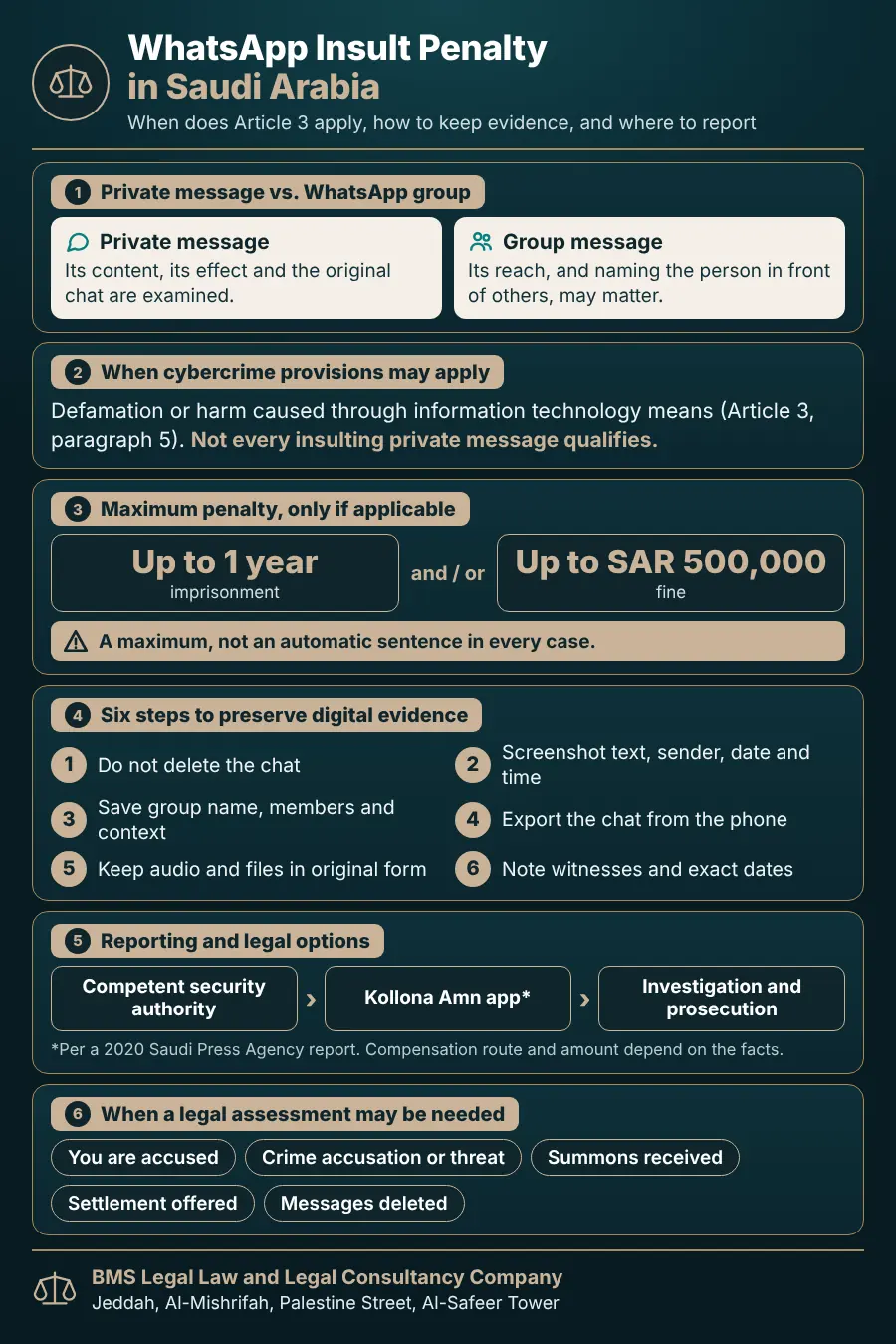
The WhatsApp insult penalty in Saudi Arabia is not a single figure that fits every abusive message. If the incident involves defaming a person or causing them harm through information technology means, it may fall under Article 3 of the Anti-Cyber Crime Law, which provides for imprisonment of up to one year and a fine of up to SAR 500,000, or either penalty. That is a maximum, not an automatic sentence: a private insult is not cyber defamation simply because it was sent, and conduct that does not meet the elements of the provision is assessed under other applicable rules. Proof of the incident and the assessment of the competent authority remain decisive.
Were you abused on WhatsApp, or accused of it?
Before deleting any conversation or replying to the other person, BMS Legal can review the incident and the available evidence and explain the options open to you under the law.
Enquiries are handled confidentially · No specific court outcome can be guaranteed
When Does Article 3 Apply to the WhatsApp Insult Penalty in Saudi Arabia?
When examining the WhatsApp insult penalty in Saudi Arabia, the focus is paragraph 5 of Article 3 of the Anti-Cyber Crime Law (official English translation; the Arabic text governs). It addresses “defamation and infliction of damage upon others through the use of various information technology devices”, and sets the penalty at imprisonment of up to one year and a fine of up to SAR 500,000, or either of the two.
The provision does not use the word “insult” and does not mention WhatsApp by name. It speaks of defamation and harm caused through information technology means. It is therefore not enough that a message was abusive and was sent through WhatsApp: what was said, its effect on the person concerned, and whether the meaning of the provision is met are all examined, and the competent authority makes that assessment on the facts of each case. Accordingly, not every private message of insult or verbal abuse is automatic cyber defamation, and the paragraph may not apply at all to abusive words that involve neither defamation nor provable harm.
The penalty stated is also a maximum, which does not mean it will be imposed automatically, and the court assesses what suits each case. For a paragraph-by-paragraph reading, see this explanation of Article 3.
Private Message, Group or Status: What Changes?
The text does not distinguish between WhatsApp features by name, but context affects the facts that are examined, such as how widely the abuse spread, its effect and whether it can be proven. The table below summarises what may be examined in each situation when considering the WhatsApp insult penalty in Saudi Arabia, without deciding the characterisation in advance.
| Situation | What may be examined | What to preserve |
|---|---|---|
| A private message to the injured person only | The content: abusive words only, or an accusation or threat, and its effect on the person | The original conversation with its dates and the sender’s number |
| A message in a group | How many people saw it and whether the person was named in front of others | The group name, its members, the time sent and the surrounding messages |
| An abusive WhatsApp Status | Who could see it and its effect; it may disappear within 24 hours | A screenshot showing the Status, the account name and the time, taken before it disappears |
| A voice message | The content of the recording and attributing the voice to its owner | The original audio file, not a recording of it |
| A message accusing someone of a specific act or threatening them | The characterisation may shift from insult to defamation, false accusation (qadhf) or a threat, depending on the words and the context | The complete message with whatever shows the context before and after it |
If a message accuses someone of adultery or immorality, the matter may go beyond insult to false accusation (qadhf) in its Sharia sense, which has its own rules. Abuse published to a wide audience is the territory of defamation.
Does a Waiver End the Case? Public Right and Private Right
An injured person may waive the private right or settle with the other party, but that does not always end the whole case. Under the Law of Criminal Procedure (official Arabic text), the Public Prosecution is responsible for initiating and pursuing the public criminal action before the competent courts (Article 15), and the injured person has the right to bring a private action (Article 16).
A waiver affects the WhatsApp insult penalty in Saudi Arabia only within limits. Article 23 provides that the private criminal action lapses on pardon by the injured person or their heir, without preventing the public-right action from continuing because of that pardon. The effect of a waiver therefore depends on its scope and wording, so the content of any waiver should be reviewed before it is signed. For more detail, see the private right in cybercrime.
How Do You Preserve Evidence Before Reporting?
Before the WhatsApp insult penalty in Saudi Arabia is even considered, the question is what can be proven, and what most often weakens proof is deleting the conversation, editing it or keeping only part of it. The sequence below helps preserve the incident more clearly.
Practical guide: six steps to preserve the evidence
- Do not delete the conversation or close the account, and avoid replying with matching abuse.
- Take screenshots showing the text of the message, the sender’s name or number, and the date and time, without cropping out the context.
- In groups, record the group name, its members and the time sent, and keep the messages before and after the abusive one.
- Keep an original copy of the conversation on the same phone, and export the chat using WhatsApp’s “Export chat” option where possible.
- Keep voice messages, photos and files in their original format rather than only photographing them.
- Note who saw the abuse, the names of witnesses, and the exact date of each incident.
When submitting a report or claim, you may be asked for your personal details, the other person’s details where available (such as their name or phone number), the preserved evidence and anything that shows the harm, depending on the competent authority and the type of route.
A Screenshot or Full Digital Evidence?
A screenshot is an image of part of a conversation, and it can raise questions about whether the context is complete and whether the message can be attributed to the sender. Full digital evidence includes the original conversation with its dates and the details of the parties, and whatever can be examined technically. It cannot be said that a screenshot is always sufficient or always rejected: the weight of the evidence is assessed according to the facts, the other evidence and the body hearing the case.
In civil and commercial transactions, the Law of Evidence (official Arabic text) defines digital evidence and lists digital correspondence and means of communication among its types, and allows it to be submitted in its original form or by another digital means. That text concerns those transactions, so it should not be assumed to transfer automatically to every criminal case.
Where Do You Report, and What Is the Process?
A report can be made to the competent security authority, including the Kollona Amn app, which a 2020 Saudi Press Agency report (Arabic) indicated receives reports of cybercrimes. The authority responsible for investigation and prosecution handles crimes under the Law in accordance with Article 15, and Article 14 provides for technical support to the competent security agencies while these crimes are being investigated and tried.
For the practical steps, see how to report cybercrime in Saudi Arabia, and if the route is a private claim, how to file an insult and defamation case may help. As for compensation, its route, conditions and assessment are determined by the competent authority according to the facts and the harm shown, and no fixed amount should be assumed before the situation is reviewed.
Two Hypothetical Examples of How Characterisation Differs
Hypothetical example 1: One person sends another a private message containing abusive words, without accusing them of any specific act and without anyone else seeing it. The first question is whether the elements of defamation or harm are met. The original conversation and the sender’s number are the most important things to preserve, and the assessment may differ from a case in which the abuse was published in front of others.
Hypothetical example 2: A message in a work or neighbourhood group accuses a person of embezzlement in front of dozens of members. The wide readership and the accusation of a specific act may lead to defamation or another characterisation being examined, depending on the words and context, and the members’ names, the time of the message and the surrounding messages become important evidence.
These are hypothetical examples for illustration only. They do not represent an actual case or a court ruling.
When Should You Get a Legal Assessment Before Acting?
An assessment becomes more important when you are the person accused of the abuse, when the messages contain an accusation of a crime or a threat, when a summons arrives, when you are offered a waiver or settlement, or when the messages have been deleted. In these situations, a criminal lawyer in Jeddah can help organise the evidence and identify the most suitable route.
In short, the WhatsApp insult penalty in Saudi Arabia depends on the content of the message, its context and whether it can be proven, and assessing that is for the competent authority, not the reader.
Before contacting anyone, it helps to prepare a short summary covering three points: What was said and when? Who saw it? What evidence has been preserved?
Do you need the evidence and your legal options assessed?
Whether you were harmed by the abuse or are accused of it, BMS Legal can study the incident and the available conversations and explain the appropriate legal route.
Enquiries are handled confidentially · No specific court outcome can be guaranteed
Frequently Asked Questions About the WhatsApp Insult Penalty in Saudi Arabia
What is the difference between insulting someone on WhatsApp and defaming them?
Insult, in its general sense, means abusive or demeaning language. Defamation involves publishing something that harms a person's reputation or hurts them in front of others, and the two can overlap in a single message. Because the legal provision on information technology means addresses defamation and causing harm, the content of the message, how widely it spread and its effect are examined before the conduct is characterised.
How can I prove that a message came from a particular person?
A screenshot showing an account name is usually not enough on its own. It helps to preserve the phone number, the conversation dates and the full context, together with anything showing that the person used that number, such as earlier dealings, an admission or witnesses. The competent authority decides what technical verification is needed in light of the facts.
What should I do if the sender deletes the message or leaves the group?
Keep whatever screenshots, copies and conversations you still hold, and note when the message was deleted and who had seen it. Avoid recovering messages with unreliable tools that could alter the evidence. Then submit what you have to the competent authority: deletion does not necessarily mean the incident is lost if other evidence exists.
Can I claim compensation for abuse sent on WhatsApp?
An injured person may be able to claim compensation for harm that can be proven. The route, the conditions and the assessment depend on the facts and on the competent authority. No fixed amount should be assumed before the case is reviewed, because the assessment is affected by the seriousness of the abuse, how widely it spread and its effect on the person.
When can my own reply to the abuse affect my legal position?
An abusive reply may be read together with the rest of the messages and affect how the incident is viewed, and it should not be assumed that the other person's abuse justifies a reply in kind. It is better not to respond with abusive language, to keep the conversation exactly as it is, and to have the situation assessed before sending anything further.
Trust and Legal Basis
Legal basis
This guide relies on the provisions of the Anti-Cyber Crime Law (Articles 3, 14 and 15), the Saudi Law of Criminal Procedure issued by Royal Decree No. (M/2) dated 22/1/1435H (Articles 15, 16 and 23), and the Law of Evidence as it relates to digital evidence in civil and commercial transactions.
Last source check: 14 November 2026.
Published by: BMS Legal Law and Legal Consultancy Company.
Address: Jeddah, Al-Mishrifah District, Palestine Street, Al-Safeer Tower
Disclaimer: This article is for general legal awareness and is not advice on an individual case, and reading it does not create a lawyer–client relationship. The legal assessment varies with the facts, the documents and the rules that apply to each case.