
Resignation under Saudi Labor Law is governed by specific rules covering how the request is submitted, how long an employer has to respond, when acceptance may be deferred, and when an employee may withdraw the request.
The applicable route also depends on the type of employment contract: statutory resignation primarily concerns fixed-term contracts, while termination of an indefinite-term contract follows a different framework.
The reason employment ends and the employee’s length of service may also affect the end-of-service benefit, unused leave, and the deadline for final settlement.
The starting point is therefore to identify the contract type and the date the resignation request was submitted before leaving work or signing a final settlement.
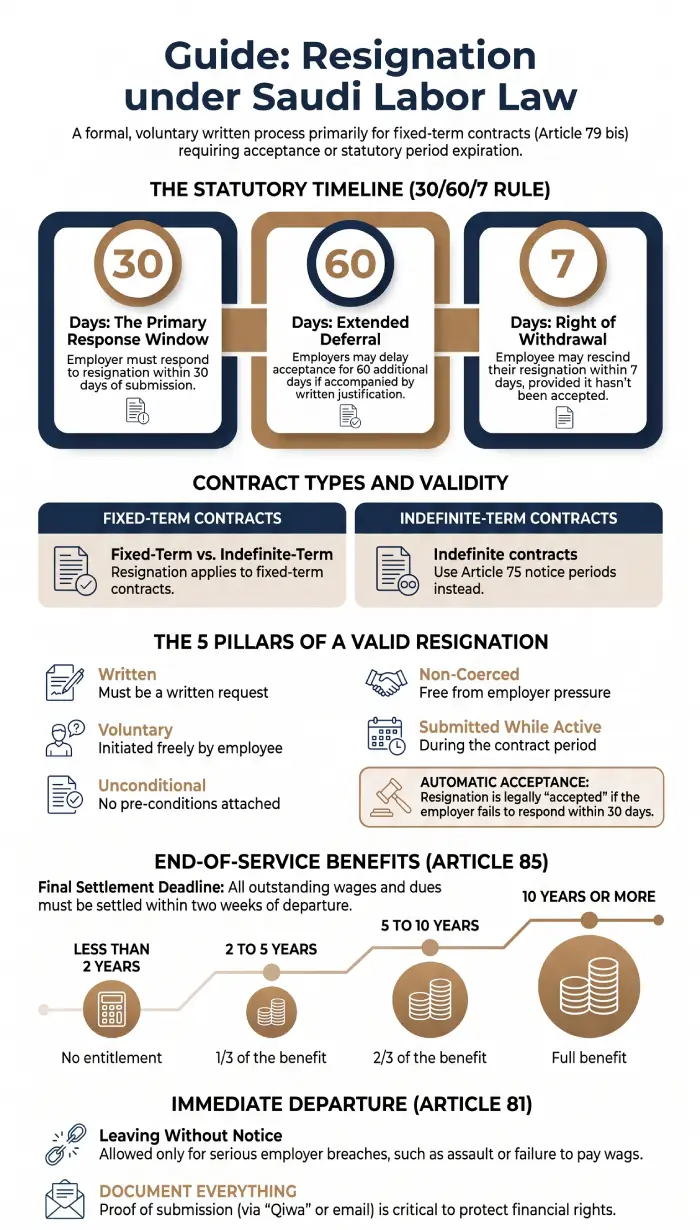
For a fixed-term contract,
resignation under Saudi Labor Law
is deemed accepted if
30 days
pass without an employer response. Acceptance may be deferred for up to
60 days
with a written, reasoned explanation, while the employee may withdraw the request within
7 days
unless the employer has already accepted it.
What Is Resignation under Saudi Labor Law?
Under Saudi Labor Law, resignation is a written expression by an employee of the intention, without coercion, to terminate a fixed-term employment contract without making the request conditional on a particular event or requirement.
Resignation is now treated as a distinct ground for ending an employment contract, alongside expiry of the contract term, mutual agreement, and other statutory grounds. The wider framework is addressed under the New Saudi Labor Law, which governs the employment relationship from formation through termination and the settlement of employee rights.
How Does Article 79 bis Apply to Resignation?
Article 79 bis regulates the period between submission of a resignation request and the point at which it takes legal effect. It addresses the employer’s response period, possible deferral of acceptance, the employee’s right to withdraw the request, and the continuation of the employment contract while the request remains pending.
Submitting a resignation does not therefore terminate the employment relationship immediately. The employee and employer remain bound by the contract until the resignation takes effect under the applicable statutory rules.
The date on which the request was submitted, and the date and nature of any employer response, are consequently important when identifying the employee’s final working day.
What Are the Conditions for Resignation under Saudi Labor Law?
The main conditions for resignation under Saudi Labor Law are that the request must be made in writing, originate from the employee voluntarily and without coercion, relate to a fixed-term contract, and not be subject to a condition.
The resignation request must also not specify a deferred effective date. The official amendments to the Saudi Labor Law set out these requirements as part of the statutory resignation framework.
A resignation letter does not need to be lengthy. What matters is that the employee’s intention is clear and that the date of submission can be established, because subsequent statutory periods are calculated by reference to that date.
Does the Employment Contract Continue After Resignation Is Submitted?
Yes. The employment contract remains in force while the resignation request is pending, and both parties must continue performing their contractual obligations until the employment relationship legally ends.
Submitting the request does not, by itself, permit the employee to stop attending work the following day.
Keeping a copy of the resignation request, evidence of when it was submitted, and any employer response can reduce later disputes about when the statutory period began or when employment actually ended.
When Is a Resignation Deemed Accepted?
A resignation is accepted when the employer expressly approves the request or when 30 days pass from the date of submission without a response.
The employer may defer acceptance where the interests of the business require it, but the law places conditions and a maximum period on that deferral.
The resignation acceptance period must also be distinguished from a notice period applying to termination of certain indefinite-term contracts. These are separate legal concepts governed by different provisions.
What Happens If the Employer Does Not Respond Within 30 Days?
If the 30-day period expires without a response, the resignation request is deemed accepted, unless the employer has validly notified the employee of a deferral in accordance with the statutory requirements.
The summary of the Saudi Labor Law amendments issued by the Ministry of Human Resources and Social Development links termination to acceptance of the resignation, expiry of the 30-day period, or expiry of a valid deferral period.
When Can Acceptance Be Deferred for Up to 60 Days?
An employer may defer acceptance for no more than 60 days where business interests require the employee to remain temporarily.
The employer must provide the employee with a written and reasoned explanation before the original 30-day response period expires.
The 60-day period runs from the date the explanation is delivered to the employee. It is therefore inaccurate to describe every resignation as automatically following a fixed 90-day timetable.
As to whether an employer can simply refuse a resignation, the more precise answer is that the law gives the request a defined path: acceptance, deemed acceptance after the statutory period, or a permitted deferral. The request cannot remain suspended indefinitely.
Can an Employee Withdraw a Resignation?
Yes. An employee may withdraw a resignation request within 7 days of submitting it, provided the employer has not already accepted the resignation.
If acceptance takes place before the employee attempts to withdraw the request, the employee can no longer rely on the seven-day withdrawal period.
The withdrawal should be documented in a way that allows its date of delivery to be established, particularly where the seven-day period is close to expiring or there is a disagreement over when acceptance occurred.
A resignation request must also not state a future effective date. This rule concerns resignation under Article 79 bis and should not automatically be confused with every date field that may appear in an electronic employment service.
What Is the Difference Between Fixed-Term and Indefinite-Term Contracts?
The contract type determines the legal route for ending employment. Statutory resignation primarily concerns a fixed-term employment contract, while termination of an indefinite-term contract is governed by separate provisions dealing with a legitimate reason and written notice.
Describing an employee’s decision simply as a “resignation” is therefore not enough. The contract type, wage payment method, reason for termination, and applicable procedure must first be identified.
Resigning From a Fixed-Term Employment Contract
An employee may submit a resignation from a fixed-term employment contract under Article 79 bis.
The 30-day response rule, any permitted deferral, and the seven-day withdrawal period then apply.
The fact that time remains on the contract does not prevent an employee from submitting a resignation request. The employment relationship must, however, continue through the applicable statutory process so that the effective termination date and resulting rights can be determined.
Ending an Indefinite-Term Employment Contract
Where an employee works under an indefinite-term contract and is paid monthly, the employee may terminate the contract for a legitimate reason by giving the employer at least 30 days’ written notice.
If the employer terminates a monthly paid employee’s indefinite-term contract, the statutory notice period is at least 60 days.
The rules governing this route are addressed in Article 75 of the Saudi Labor Law, which is distinct from the resignation process under Article 79 bis.
For that reason, the phrase “notice period for resignation” is not technically accurate in every case. What is described informally as a resignation may legally be termination of an indefinite-term contract.
How Is an Employment Contract Ended Through Qiwa?
An employee may use the electronic contractual relationship termination service through Qiwa where the service requirements are met.
The process generally begins by logging in to Qiwa Individuals, opening the employment contracts section, selecting the relevant contract, choosing the reason for termination, reviewing the information, and submitting the request.
The Contractual Relationship Termination Service through Qiwa states that the employee must have an active contract registered on Qiwa and that there must not already be another pending termination request for the same contract.
The service is automated and does not require additional supporting documents to be uploaded as part of the electronic process.
Using Qiwa does not remove the need to select the correct legal reason for termination. Resignation, expiry of a fixed term, termination under Article 75, and leaving employment under Article 81 are legally distinct situations and may produce different consequences.
What Rights Does an Employee Have After Resignation?
Employee rights after resignation may include wages due up to the end of employment, an end-of-service benefit where the applicable conditions are met, compensation for unused annual leave, and any other established contractual or statutory amounts.
The employee’s entitlement cannot be determined merely by identifying the end of employment as a resignation. Length of service, wage, contract type, and the legal basis on which the employment relationship ended may affect the final amount.
End-of-Service Benefit After Resignation
Where employment ends by resignation, Article 85 determines the proportion of the end-of-service benefit payable according to the employee’s completed service.
An employee who has completed at least two consecutive years but no more than five years is entitled to one-third of the benefit.
Where service exceeds five years but remains below ten years, the employee is entitled to two-thirds. An employee who has completed ten years or more is entitled to the full benefit.
The rules under Article 85 of the Saudi Labor Law determine the applicable resignation percentage, while the underlying benefit calculation remains dependent on the employee’s wage and actual length of service.
Unused Annual Leave When Employment Ends
If the employment relationship ends while the employee has accrued annual leave that has not been used, the employee may be entitled to payment for the unused days.
Article 111 of the Saudi Labor Law governs compensation for unused annual leave when employment ends. The employee should therefore compare the accrued balance, leave already taken, and the amount included in the final settlement.
Employee entitlements after resignation may also include outstanding wages, commissions, or other amounts established by the contract and employment records.
When Must Entitlements Be Paid After Resignation?
Where the employee is the party ending the employment contract, the employer must settle the employee’s rights in full within no more than two weeks from the date the employment relationship actually ends.
The two-week period does not begin merely because a resignation request has been submitted while the employment contract remains in force.
Article 88 of the Saudi Labor Law on final settlement deadlines distinguishes between termination by the employer and termination initiated by the employee. This distinction is important when calculating the payment deadline.
If the final settlement differs from the wages, end-of-service benefit, or unused leave you believe is due, review the employment contract, length of service, wage records, leave balance, and actual termination date before signing a final release.
When May an Employee Leave Work Without Notice?
A search for “immediate resignation” or “resignation without notice” does not mean that an employee has an unrestricted right to leave work immediately.
Saudi Labor Law identifies specific circumstances in which an employee may leave employment without notice while retaining statutory rights. These include situations where the employer fails to meet substantial contractual or statutory obligations.
Other circumstances may include certain forms of misrepresentation at the time of contracting, assault, unjust treatment, or a serious workplace hazard.
The rules under Article 81 of the Saudi Labor Law distinguish these statutory cases from an ordinary resignation.
A disagreement about salary, management, or workplace conditions does not automatically bring a case within Article 81. The facts must correspond with one of the statutory grounds, and relevant evidence should be preserved in case the classification of the termination is later disputed.
What Is the Difference Between Resignation and Other Ways Employment Ends?
The legal reason employment ends affects the applicable timelines, procedures, and financial rights. Resignation, expiry of a fixed term, termination of an indefinite-term contract, mutual agreement, and leaving under Article 81 should therefore not be used interchangeably.
| Situation | Main Legal Basis | Basic Procedure |
|---|---|---|
| Resignation | Article 79 bis | Employee request subject to statutory acceptance rules and timelines |
| Indefinite-term contract termination | Article 75 | Termination for a legitimate reason with written notice |
| Expiry of fixed term | Article 74 | Contract ends when its term expires unless renewed |
| Termination by mutual agreement | Article 74 | Agreement between both parties, with the employee’s written consent |
| Employee leaving on statutory grounds | Article 81 | Leaving without notice where a specified statutory ground is established |
Identifying the correct category prevents the wrong notice period or entitlement rule from being applied and helps determine the actual termination date and the correct basis for the final settlement.
What Should You Do If a Dispute Arises After Resignation?
Start by identifying exactly what is disputed: the date the resignation was submitted, whether it was accepted or deferred, the date employment ended, or the amount of the employee’s final entitlements.
Then organize the employment contract, resignation request, employer responses, payroll records, leave balance, and any document connected with the reason employment ended.
If the matter cannot be resolved directly, an employment claim generally begins through the Amicable Settlement of Labor Disputes process before proceeding to the Labor Court where settlement is unsuccessful.
The strength of the claim depends more on clear facts and supporting documents than on the number of messages exchanged. Establishing the date of resignation, the contract type, and the amounts being claimed helps define the dispute more precisely.
Where the dispute concerns acceptance of the resignation, the end-of-service benefit, unused leave, or a delayed final settlement, an employment lawyer in Jeddah can review the contract and supporting documents and help identify the appropriate claim route before escalation.
Common Mistakes When Resigning
One of the most significant mistakes is stopping work immediately after submitting the request while the employment contract remains in force.
Other recurring problems include failing to retain proof of when the resignation was submitted and confusing the 30-day resignation response period with the notice period applicable to an indefinite-term contract.
A dispute may also arise where an employee relies on Article 81 without first checking whether its requirements apply, or signs a final settlement before verifying wages, the end-of-service benefit, and unused leave.
A safer sequence is to identify the contract type first, determine how and when the employment relationship will end, and only then calculate the financial rights resulting from termination.
This content was prepared to explain
resignation under Saudi Labor Law
and to distinguish it from termination of an indefinite-term contract and leaving work in circumstances permitted by law.
The legal position may vary depending on the
type of contract,
date of submission,
employer’s response,
length of service,
wage,
and
available documents.
Each case should therefore be assessed individually before leaving employment or signing a final settlement.
Frequently Asked Questions About Resignation under Saudi Labor Law
How Long Does an Employer Have to Accept a Resignation in Saudi Arabia?
A resignation request is deemed accepted if 30 days pass from the date of submission without an employer response. Acceptance may be deferred for up to 60 days where business interests require it, provided the employee receives a written and reasoned explanation before the original 30-day period expires.
Can an Employer Refuse a Resignation?
The law does not allow a resignation request to remain pending indefinitely. The employer may accept the request or defer acceptance subject to the statutory conditions. If 30 days pass without a response or valid deferral, the resignation is deemed accepted under the applicable rules.
Can an Employee Withdraw a Resignation After Submitting It?
Yes. The employee may withdraw the resignation within seven days of submission, provided the employer has not already accepted it. Once the employer accepts the resignation before withdrawal, the employee can no longer rely on the seven-day period to cancel the request.
Can an Employee Resign Before a Fixed-Term Contract Expires?
Yes. Saudi Labor Law regulates resignation from a fixed-term employment contract and sets rules for acceptance, deferral, and withdrawal. The remaining contract period is not the only relevant factor; the submission date, effective termination date, and resulting financial rights must also be considered.
Does Resignation Cancel the End-of-Service Benefit?
Not in every case. Article 85 determines the percentage payable to a resigning employee according to length of service. The statutory resignation entitlement begins after two consecutive years of service and increases from one-third to two-thirds, reaching the full benefit after ten years or more.
When Must an Employee’s Final Dues Be Paid After Resignation?
Where the employee terminates the employment contract, the employer must settle the employee’s rights within no more than two weeks from the date the employment relationship actually ends. The date the resignation request is submitted is therefore not necessarily the date on which the settlement period begins.
Resignation under Saudi Labor Law: 8 Rules Before You Leave starts with identifying the type of employment contract before the request is submitted. The next issues are whether the request is in writing, the 30-day response period, any permitted deferral, the seven-day withdrawal period, and the continuation of the contract until employment legally ends.
Acceptance of the resignation is only part of the process. The employee should also review outstanding wages, the end-of-service benefit, unused annual leave, and the deadline for final settlement. Where the decision to leave is based on an employer breach, the case may fall outside an ordinary resignation and require consideration of provisions such as Article 81.
Keep the employment contract, resignation request, any acceptance or deferral notice, wage records, and leave information before signing a final settlement. These documents are central to identifying when employment ended and what financial rights remain outstanding.
Where a dispute concerns resignation acceptance, the effective termination date, or unpaid employment entitlements, a law firm in Jeddah can review the documents and clarify the appropriate legal route before a claim is filed or a final release is signed.