
The punishment for theft in Saudi Arabia depends on how the property was taken, whether the offense is proven, and whether the conditions for the Sharia-prescribed hadd punishment or the grounds for discretionary ta’zir punishment are met. Where hadd theft is proven, its conditions are satisfied and no impediments exist, the punishment is the prescribed hadd. Acts punishable by ta’zir, by contrast, are left to the court’s assessment based on how the facts are characterized and the rules that apply to them. That is why no single prison term applies to every theft case.
Not every taking of property amounts to theft in the criminal sense. It may instead be financial fraud, breach of trust or a civil dispute. Understanding the types of criminal cases in Saudi Arabia helps explain why the correct legal characterization has to come before any question about the penalty.
This guide explains the difference between hadd theft and ta’zir theft, what may affect the penalty for a first offense, the effect of waiving the private right, and how reports, investigations and evidence are handled, based on Saudi Sharia and statutory sources.
Statutory sources last verified: 13 November 2026.
Facing a Theft Accusation in Saudi Arabia?
The outcome depends on how the property was taken, the evidence and the stage of the case. Whether you are accused or the victim, BMS Legal can assess your circumstances and explain the legal options available under Saudi law.
Call BMS LegalExplore Criminal Legal Services
Confidential handling of enquiries · No guaranteed case outcome
What Is the Punishment for Theft in Saudi Arabia?
Quick Answer
The punishment for theft in Saudi Arabia depends on whether the act is proven and how the court characterizes it. If hadd theft is proven, its conditions are met and no impediments exist, the Sharia hadd is applied. If a punishable act is proven but the grounds for hadd are not met, a person convicted of the offense may receive a ta’zir (discretionary) punishment under the applicable characterization. If guilt is not proven, no punishment may be imposed. A waiver by the victim does not automatically end the public right.
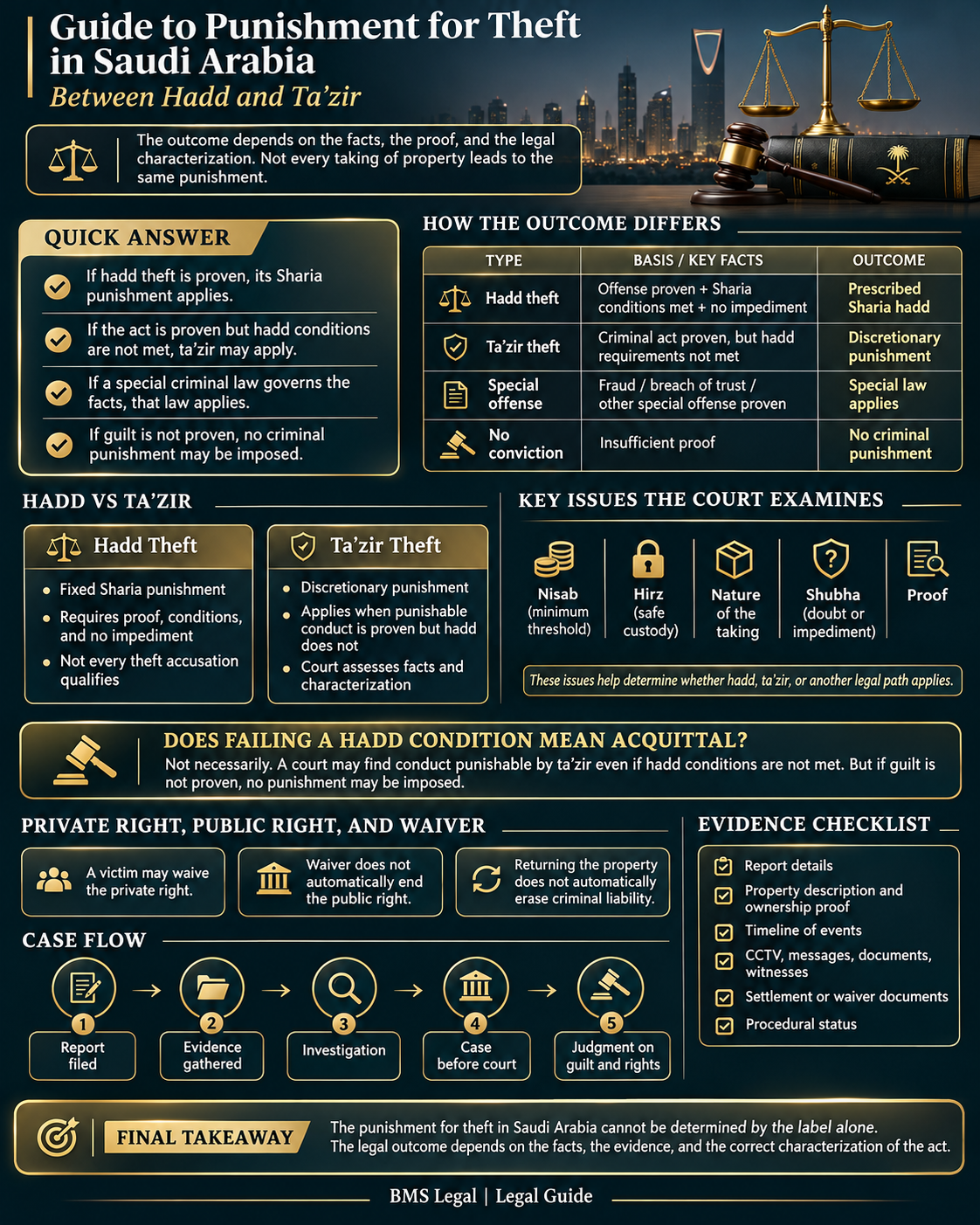
It is therefore incorrect to assume that every theft accusation leads to amputation of the hand, or that every theft falling short of hadd carries a fixed prison term. Filing a report does not prove the accusation either: Article 3 of the Saudi Law of Criminal Procedure provides that no criminal punishment may be imposed until guilt is established in accordance with the prescribed procedures.
Hadd, Ta’zir or No Conviction: How the Outcome Differs
| Situation | Basis | Possible outcome |
|---|---|---|
| Hadd theft | The offense is proven, the conditions for the Sharia hadd are met and no impediments exist | Application of the prescribed Sharia hadd |
| Theft punishable by ta’zir | A criminal act is proven that does not meet the hadd requirements, and no different special statutory characterization applies | A ta’zir punishment based on the characterization and the facts |
| Facts governed by a special criminal law | The elements of a special offense, such as fraud or breach of trust, are proven | The applicable special provision applies; a theft penalty is not assumed |
| No conviction | There is insufficient proof that an act prohibited by Sharia or statute was committed | No criminal punishment may be imposed |
Note: This table explains how the legal path is determined; it is not a schedule of fines or prison terms. Such figures require a specific provision that applies to the facts and cannot be inferred merely because the conduct is described as theft.
What Is the Difference Between Hadd Theft and Ta’zir Theft?
The difference lies in the Sharia characterization of the offense and the conditions for proving it, not only in the value of the property or the number of times the act was committed.
First: When Is Theft Subject to Hadd?
The hadd for theft is a fixed Sharia punishment rooted in Surat Al-Ma’idah, verse 38, which in meaning reads: “As for the male thief and the female thief, cut off their hands.” The hadd does not apply to every act people describe as theft; the offense must be proven, the Sharia conditions must be met and all impediments must be absent.
Among the issues that jurisprudence and the courts examine when considering hadd theft are the nisab (minimum value threshold), hirz (safe custody), how the property was taken, and whether there is a doubt (shubha) capable of affecting the outcome. The research paper “The Nisab of Theft and Its Contemporary Values,” published in Al-Adl journal (in Arabic), explains the importance of the nisab among the conditions of hadd.
This paper is a scholarly reference for understanding the jurisprudential question; it is not legislation that alone determines the outcome of any case.
Whether the hadd applies cannot be decided from a brief description of the facts, or by comparing the value of stolen property with a figure circulating online. It is the competent court that examines the evidence, the conditions and the impediments.
Second: When Is Theft Subject to Ta’zir?
If the grounds for the theft hadd are not met, the act may still be punishable by ta’zir if the elements of the offense are proven and the grounds for punishment exist. Not applying the hadd does not mean the act is permissible, nor that the accused is automatically guilty.
For ta’zir offenses for which no special law sets a specific penalty, the court considers the act, the evidence and the circumstances in light of Sharia rules and the applicable laws. Offenses that carry specific statutory penalties are governed by their own provisions once their conditions are met.
In practice: Asking about the value of the stolen property is not enough to determine the penalty. What matters is what actually happened, how it happened, and what the evidence proves.
What Are the Conditions for the Theft Hadd, and What Can Prevent It?
When the hadd is examined as part of the punishment for theft in Saudi Arabia, Sharia questions arise about the property, the act, the person accused of it and the method of proof. These cannot be reduced to a single condition.
The main issues that need to be examined include:
- Nisab: Did the value of the property reach the threshold recognized in Sharia under the applicable rules?
- Hirz (safe custody): Where was the property kept, and how was it protected?
- Nature of the taking: Does the incident match the form of hadd theft, or a different characterization?
- Doubt (shubha): Is there any doubt about ownership, permission or a relationship that could affect the characterization?
- Proof: Was the offense proven by the evidence required to impose the hadd?
These elements are not an exhaustive list of every hadd condition and impediment, and the presence of some of these facts does not settle the outcome in advance.
Be careful not to treat a fixed amount in riyals as an approved nisab for all times and all cases without checking how it was calculated and the appropriate Sharia and judicial source.
Does Failing a Hadd Condition Mean Acquittal?
Not necessarily.
There is a difference between the grounds for hadd not being proven and no criminal act being proven at all. A court may be satisfied that an act punishable by ta’zir took place even though the conditions for the hadd are not met.
Conversely, if the act attributed to the accused is not proven to the standard required for conviction, ta’zir cannot be presumed simply because there is an accusation or a suspicion.
That is why distinguishing between the hadd not applying and there being no conviction is one of the most important points to understand in theft cases.
What Is the Penalty for a First-Time Theft in Saudi Arabia?
Under the rules governing the punishment for theft in Saudi Arabia, a first offense does not mean an automatically reduced penalty or an exemption. The starting point is whether the act is proven and how it is characterized: as hadd theft or as an act punishable by ta’zir.
When a ta’zir punishment is being determined, the circumstances of the incident and of the person may be relevant to the extent the court is permitted to consider them. But having no prior record does not guarantee a fine-only sentence or rule out imprisonment.
Nor is it correct to apply the outcome of stealing a small sum to stealing a car, or to misappropriating funds entrusted under an employment relationship; the characterization itself may differ before the penalty does.
Is There a Fixed Prison Term for Petty Theft?
A single prison term cannot be set for every incident described as “petty theft” without identifying the offense and the applicable provision.
The term is common in everyday speech, but on its own it does not tell you whether the incident is hadd theft, ta’zir theft or an offense governed by a special law.
You should therefore not rely on claims such as “the penalty for a first theft is six months” or “one year in prison for every phone theft” without an official source that applies specifically to the act.
Does the Penalty Differ by the Type of Property Stolen?
The nature and characterization of the case, and therefore the punishment for theft in Saudi Arabia, may change depending on how the property was taken, the means used and the relationship between the parties.
Stealing property from a secured place is not the same as a case involving property handed to the accused in trust, and obtaining money through deception does not necessarily equal taking it without the owner’s consent.
Theft vs. Financial Fraud vs. Breach of Trust
| Incident | Decisive question | Possible characterization |
|---|---|---|
| Taking property from a place without it being handed over or permission to take it | How did the taking occur, and are the elements of the offense proven? | Theft, depending on the facts |
| Obtaining property by persuading the owner to hand it over through lies or deception | Was the handover the result of a fraudulent means? | Financial fraud |
| Receiving property through work or in trust, then appropriating it without right | Was the handover lawful at the outset? | Breach of trust |
| A dispute over ownership of shared property or a contractual obligation | Is there a criminal act, or a dispute over the underlying right? | Possibly a civil or commercial dispute |
This is where the Law on Combating Financial Fraud and Breach of Trust, published in the official gazette Umm Al-Qura (in Arabic) becomes relevant. It sets specific penalties for the acts described in its first and second articles.
For financial fraud under Article 1, the penalty may reach seven years’ imprisonment and a fine of SAR 5 million, or either penalty. For breach of trust under Article 2, it may reach five years’ imprisonment and a fine of SAR 3 million, or either penalty.
These are not general theft penalties. They are penalties for two separate offenses when their statutory conditions are met, so they cannot be carried over to any case simply because property passed from its owner to someone else.
Example: An Employee Accused of Taking Company Property
Suppose an employee is accused of misappropriating a device owned by the company.
If he entered the storeroom and took the device without it having been handed to him, the incident may be examined as theft. If the company had handed him the device for his work and he then appropriated it without right, the matter may point toward breach of trust, provided its conditions are met.
If the dispute is about ownership of the device or the employee’s right to hold it, there may be a dispute that affects the criminal characterization.
This is a hypothetical example for illustration only and does not represent a case from the firm’s client files.
What About Car, Phone or Shop Theft?
Naming the stolen item is not enough to trigger a separate penalty automatically. Stealing a phone, a car or goods from a shop requires looking at how the property was taken and kept, the evidence and the circumstances surrounding the act.
If force, unlawful access to an electronic system or a fraudulent means was used, other legal characterizations may arise that require separate analysis.
One outcome therefore cannot be applied to all of these scenarios based only on where the act happened or the type of item involved.
Does Waiving a Theft Claim End the Public Right?
A victim’s waiver of their private right does not automatically end the public right. The public criminal action and the private criminal action each have their own rules and effects.
Under Article 15 of the Law of Criminal Procedure, the Public Prosecution has jurisdiction to bring and pursue the public criminal action before the competent courts, while Article 16 gives the victim, their representative or their heir the right to bring the private action in accordance with its rules.
Article 23 provides that the private criminal action ends with a final judgment or with a pardon by the victim or their heir, and that this pardon does not prevent the public action from continuing.
What Happens If the Accused Returns the Stolen Property?
Returning the property, paying compensation or reaching a settlement may matter in resolving the private right and in proving payment or settlement, but none of these automatically erases the criminal characterization or ends the public action.
It is important to distinguish between returning the property without any waiver, waiving a specific claim, and a settlement that involves mutual obligations.
You should also review which rights the agreement covers before treating all financial claims as settled.
When Does the Public Action End in a Theft Case?
Article 22 of the Law of Criminal Procedure sets out the grounds on which the public criminal action ends. They include a final judgment, a pardon by the ruler in matters open to pardon, repentance where it applies under the Sharia rules that cancel the punishment, and the death of the accused.
This does not mean there is a single limitation period after which every theft case lapses. You can follow the differences between these grounds and their effects in the BMS guide to the criminal statute of limitations in Saudi Arabia.
Facing a theft accusation, or considering waiving your claim? The right next step depends on how the incident is characterized, the type of right involved and the procedural stage. You can learn about the services of a criminal lawyer in Jeddah at BMS Legal before making a decision that needs legal review.
How Does a Theft Case Proceed From Report to Judgment?
The Law of Criminal Procedure governs the general stages of reporting, investigation, prosecution and trial, although the detailed procedures vary with the facts.
1. Filing the Report and Examining the Incident
Article 27 makes criminal investigation officers responsible for receiving reports and complaints, examining them, gathering related information and notifying the Public Prosecution.
A report is more useful when it clearly describes the property, how it went missing or was taken, the time and place, and any available evidence or witnesses.
2. Gathering Evidence and Taking Statements
Evidence may include camera recordings, documents, correspondence, witness statements or other circumstantial evidence.
Gathering evidence should not be confused with proving guilt; it is the court that decides the case based on the evidence and the applicable rules.
3. Investigation and Possible Detention
The facts and evidence are examined by the competent authority, and measures such as arrest or detention may be taken if their statutory grounds exist.
Detention does not mean the person is guilty, nor does it set the penalty in advance. The detention period is also not the same as the investigation period or the sentence. For more detail, see our guide to Public Prosecution investigation duration and the procedures that apply during it.
Under Article 4 of the Law of Criminal Procedure, the accused has the right to the assistance of a lawyer during both the investigation and the trial.
4. Bringing the Case Before the Competent Court
If a decision is made to bring the case, the facts, the evidence and the characterization attributed to the accused are presented to the court, and the parties are able to exercise their procedural rights.
The description in the report is not, by itself, the final basis for the penalty; the facts, the proof and the court’s legal characterization must all be considered.
5. Judgment on Guilt and Related Rights
The court decides whether guilt is established, the type of offense and its consequences, and it considers any private claims submitted under the applicable rules.
Outcomes can range from no conviction, to a proven act punishable by ta’zir, to proven hadd theft with all its conditions, or to a different characterization with its own rules.
What Evidence Matters in Proving or Disproving Theft?
No single piece of evidence can be said to decide every theft case just by existing. The weight of evidence depends on how it relates to the act, its integrity and what exactly it proves.
Is CCTV Footage Enough to Prove Theft?
A recording can be important evidence, but on its own it does not prove every required element in every case.
A camera may show a person taking or moving property, yet questions may remain about who owns it, whether there was permission to take it, the integrity of the recording, the person’s identity, and what happened before or after.
The original recording and its data should therefore be preserved and left unaltered, together with any supporting evidence that is lawfully available.
What About Witness Testimony?
Testimony can help establish what a person saw or heard, but its relevance to the incident and its consistency with the rest of the evidence need to be assessed.
The general rules for proving an offense should also not be equated with the special requirements for imposing the Sharia hadd. See the BMS guide to witness testimony in criminal evidence for how testimony, circumstantial evidence and contradictions are weighed.
What Might the Defense Examine in a Theft Case?
Lines of defense may include whether the act can be attributed to the accused, who owns the property, whether there was a handover or permission, how the taking occurred, whether the procedures were sound, and whether the criminal characterization applies.
There may be evidence that disconnects the accused from the act, raises a genuine dispute about its characterization, or shows that the dispute is contractual rather than criminal.
Our explanation of criminal defences in Saudi Arabia shows how evidence and procedures can be challenged, without assuming that every defense necessarily leads to acquittal.
Practical Guide: How to Prepare a Theft Case File
Whether you own the property or are the person accused of the act, organizing your documents from the start helps separate the confirmed facts from what still needs to be proven.
| Item | What to prepare | Why it matters |
|---|---|---|
| Report details | The report or record number, the date of the procedure and the competent authority | Establishes the status of the case |
| Property in dispute | A description of the property, its value and proof of ownership or possession | Defines the subject of the incident |
| How it was taken | Where the property was, how it was kept and how it was moved | Helps with the legal characterization |
| Timeline | When the incident was discovered and the steps taken afterward | Reveals gaps in time |
| Evidence | Recordings, correspondence, witnesses and documents | Identifies what can be examined |
| Settlement or waiver | Any written agreement or proof that property was returned | Assesses its effect on the rights involved |
| Procedural status | Summons, investigation, hearing or judgment | Identifies the next step |
If You Are the Victim of Theft
Start by keeping proof of your ownership and possession of the property and of the incident you are reporting, record the timeline, and do not alter any evidence.
If there is camera footage or electronic data, keep the original copies wherever possible, along with information that shows their source and date.
Do not assume that recovering the property means every procedure has ended without checking the status of the report and the related rights.
If You Are Accused of Theft
First identify the incident attributed to you, the property involved in the accusation and the evidence linking you to it. Keep any documents or correspondence lawfully available to you that may clarify ownership, permission or why you held the property.
Do not destroy or alter evidence, and do not provide false information. If you have received a summons or are part of an ongoing investigation, it is important to know your procedural rights and the relevant deadlines.
Hypothetical Example: Goods Missing From a Shop
A shop owner discovers that stock is missing and then finds a recording showing an employee moving boxes out of the storeroom.
The recording may be important, but on its own it does not settle whether the move was authorized or whether the goods left the business’s possession unlawfully.
A full picture requires reviewing inventory records, invoices, the employee’s authority, entry and exit times, and any delivery orders.
The practical point: Evidence is not read in isolation from its context. How the property changed hands can affect the legal characterization before the question of the penalty is even reached.
When Do You Need a Legal Assessment of a Theft Case?
When the punishment for theft in Saudi Arabia is at stake, legal review becomes especially important if the case involves an official summons, detention, an accusation whose evidence is unclear, a waiver of a private right, or a dispute over whether the incident is theft, fraud or breach of trust.
Before getting in touch, it helps to prepare a short summary covering three points: What happened? What evidence is available? What stage has the case reached?
Facing a theft accusation, or need to claim your rights?
The right next step depends on the characterization of the act, the evidence and the procedural stage, not on the name of the offense alone. You can contact BMS Legal Law Firm & Legal Consultancy to request an initial assessment of your situation and define the appropriate scope of assistance.
Contact Us About a Criminal Case on WhatsApp
To get started, a short summary is enough; there is no need to share documents or sensitive information in your first message. No specific court outcome can be guaranteed before the facts are reviewed.
Frequently Asked Questions About the Punishment for Theft in Saudi Arabia
Does every theft in Saudi Arabia lead to amputation of the hand?
No. Under the rules on the punishment for theft in Saudi Arabia, the hadd has Sharia conditions and impediments that must be examined, and it is not applied merely because a report was filed or property went missing. The court decides the characterization of the incident, the evidence and whether the grounds for hadd exist. If the hadd does not apply, ta’zir liability may be considered if a punishable act is proven. If guilt is not proven, no criminal punishment may be imposed.
How long is the prison sentence for theft in Saudi Arabia?
There is no single prison sentence that applies to all theft cases. It depends on the characterization the court finds proven, the provisions that apply to it and the circumstances of the case. A victim’s waiver of their claim does not automatically end the public criminal action. A published sentence should therefore not be relied on without a source specific to the type of offense and the facts in question.
What is the penalty for shoplifting from a supermarket for the first time?
There is no uniform penalty simply because the incident took place in a supermarket or was a first offense. The property, its value, how it was taken, the evidence and the surrounding circumstances must all be identified. If an offense punishable by ta’zir is proven, the court determines the penalty according to the applicable characterization. Having no prior record does not mean an automatic exemption or reduction.
Does the public right end if the owner of the property waives the claim?
A pardon by the victim or their heir in the private action does not prevent the public criminal action from continuing, under Article 23 of the Law of Criminal Procedure. The effect of a waiver on the property, compensation and other claims depends on its scope and terms. It is therefore important to check the content of any settlement and the current procedure before assuming the case has ended.
Is CCTV footage enough to convict someone of theft?
CCTV footage can be important evidence, but it does not automatically decide every case. Its integrity, source and date must be examined, along with how clearly it shows the incident and the people involved, and how it relates to other evidence. Proving the grounds for the Sharia hadd also has its own rules. The power to assess evidence and establish guilt remains with the competent court, not with simply watching the recording.
What is the difference between theft and breach of trust?
The key difference lies in how the property reached the person and what they did with it. An incident may be theft if the property was taken without a lawful handover, whereas breach of trust may apply when the property was handed to the person through their work or in trust and they then appropriated it without right, subject to the conditions of the special law.
Conclusion: How Is the Punishment for Theft in Saudi Arabia Determined?
The punishment for theft in Saudi Arabia is determined only after the act is proven and correctly characterized. The incident may be hadd theft where its conditions are met and no impediments exist, an act punishable by ta’zir, or a different offense governed by a special law. Guilt may also not be proven at all.
Waiving the private right does not automatically end the public right, and no single prison term fits every case.
In an active case, the first step is therefore to establish how the property was taken, what evidence relates to it and which procedural stage has been reached, before deciding on a report, a defense or a settlement. Where a case needs individual assessment, consulting a legal professional after organizing the documents is a better approach than relying on a generic published penalty that ignores the facts.
Trust & Legal Basis
Legal Basis
This guide is based on the provisions of the Saudi Law of Criminal Procedure issued by Royal Decree No. (M/2) dated 22/1/1435 AH, and the Law on Combating Financial Fraud and Breach of Trust issued by Royal Decree No. (M/79) dated 10/9/1442 AH.
The scholarly study published in Al-Adl journal on the nisab of theft was used to understand part of the jurisprudential conditions, not as an independent law or a court judgment in a specific case.
Sources last verified: 13 November 2026.
Publisher: BMS Legal for Law and Legal Consulting
Office: Jeddah – Al-Mushrifah District – Palestine Street – Al-Safeer Tower
Legal Notice: This article provides general legal information and does not constitute advice on any individual case. Reading it does not create a lawyer-client relationship. Any legal assessment depends on the facts, documents and rules that apply to each case.