
The conditions for selling property in Saudi Arabia start with verifying the seller’s ownership, confirming that each party has the legal capacity to act, and making sure the property is free of restrictions that could block conveyance. Signing a sale contract or paying a deposit is not enough to transfer ownership, because ownership passes only through conveyance or official registration with the competent authority.
Conveyance is the formal procedure by which ownership moves from the seller to the buyer. The Ministry of Justice explains that electronic conveyance is available through the Najiz portal in cases that meet the requirements.
Selling a property in Saudi Arabia?
Before you sign or pay a deposit, our real estate team can review the title deed, power of attorney, restrictions and tax position.
Enquiries are handled confidentially · No specific court outcome can be guaranteed
Conditions for Selling Property in Saudi Arabia: What to Check Before Signing
A lawful sale rests on seven core elements: a valid title deed, clear capacity of the parties, no restrictions that affect the property, a defined price and payment method, complete documents, payment of the real estate transaction tax where it applies, and completion of conveyance or official registration. Once the title deed, the parties’ capacity, the tax and the documents are in order, the steps for transferring property ownership in Saudi Arabia become the practical route that decides how ownership passes to the buyer.
| Condition | What it means in practice | When to check more closely |
|---|---|---|
| Valid title deed | Proof that the seller owns the property | If the deed is old or needs updating |
| Capacity of the parties | Authority of the seller and buyer to act | If an agent, a company or a minor is involved |
| No restrictions on the property | No mortgage or attachment that affects the sale | If there is financing or an existing dispute |
| Clear price | The sale amount and how it is paid | If there is a deposit or deferred payments |
| Complete documents | Deed, identity and power of attorney ready | For heirs, companies or a minor |
| Tax paid | Handling the real estate transaction tax | If the parties disagree on who bears the tax |
| Conveyance completed | Official transfer of ownership to the buyer | If approvals are missing or a party refuses |
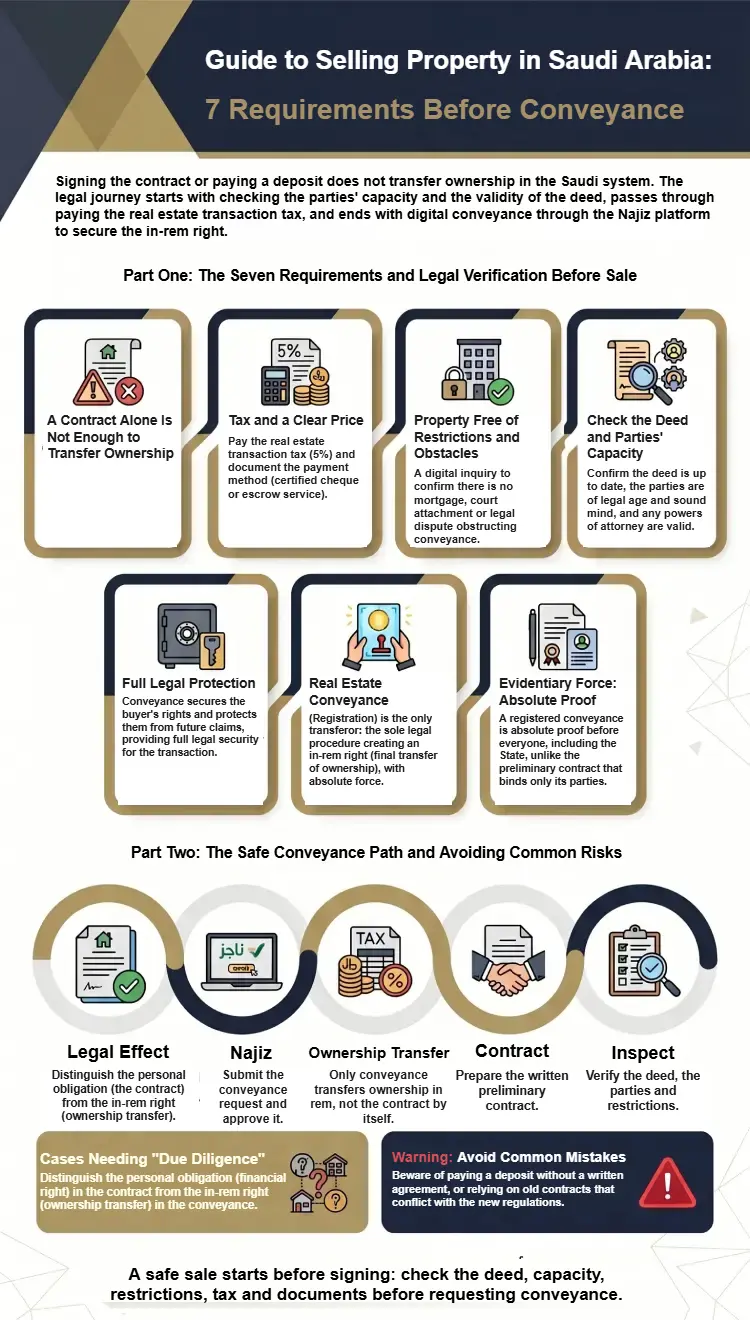
Basic Conditions of Sale
The basic conditions are the requirements that let the property be disposed of without delaying conveyance or creating a dispute after signing. They cover the soundness of the title deed, the capacity of the parties, a clear price, and awareness of any restriction that affects the transfer of ownership. Before selling, check the following points:
- Electronic title deed: verify the owner’s name, the deed number, the area, the boundaries and the location of the property.
- Updating the deed before sale: this is needed if the deed is old, its data is incomplete, or the property details need correcting.
- Capacity of the parties: confirm the identity of the seller and the buyer, the authority of any agent, and the authority of a company representative.
- Restrictions that matter: review any mortgage, attachment, dispute, or the presence of co-owners and heirs.
- Payment method: set the price, the deposit, the payment date, and the effect of delay or withdrawal.
A title deed inquiry before the sale helps reveal the deed data and ownership status before a deposit is paid or a contract is signed. In legal terms, real estate means immovable property that cannot be moved without changing its nature, and it generally includes land and whatever is permanently attached to it. A sale is therefore not just a financial agreement: it is a disposition of a real right that requires checking both ownership and restrictions.
Documents Required to Sell Property
The papers required to sell property show whether the deal is ready for conveyance or needs a prior step. The clearer the documents, the lower the chance that the request stalls or that a dispute arises between seller and buyer. The documents usually include the title deed, the parties’ identity documents, payment details, and a power of attorney where an agent acts. If one party is a company, check the commercial registration and the authority of the manager or delegate to sell and buy real estate.
| Type of document | Examples | Key notes |
|---|---|---|
| Parties’ documents | Identity, residence permit, commercial registration | Confirms the capacity of seller and buyer |
| Property documents | Title deed, area and boundary data | Shows whether the property can be conveyed |
| Representation documents | Power of attorney, authorisation, partners’ resolution | Important when an agent or a company acts |
| Special documents | Inheritance determination, mortgagee consent, court permission | Appear in mortgage, heirs and minor cases |
General documents are not enough in special cases. Property owned by heirs needs an inheritance determination and the powers of attorney; mortgaged property needs the mortgagee’s consent or an arrangement to release the mortgage; and a minor’s property may need permission from the competent court depending on the nature of the disposition.
Steps to Sell and Convey Property Through Najiz
The conditions for selling property in Saudi Arabia matter most in practice when the deal moves from the initial agreement to conveyance and the transfer of ownership. Selling property electronically is now available in many cases once the legal and technical requirements are met through the digital justice services.
The sale usually follows these stages:
- Review the property data: check the deed, area, boundaries, restrictions and the seller’s capacity before paying a deposit or signing.
- Prepare the contract: set the price, the deposit, the conveyance date, the payment method and each party’s obligations.
- Register the disposition and the tax: verify the real estate transaction tax where it applies, and agree in writing who bears it.
- Request conveyance: conveyance is made through Najiz in cases that qualify, and the conditions for electronic conveyance through Najiz vary with the deed and the capacity of the parties.
- Complete the transfer: the procedure needs the other party’s acceptance and the required authentication, until the deed is issued in the buyer’s name.
The conditions for transferring ownership overlap with the conditions of sale, but they are not the same thing. Sale is the agreement between the parties; transferring ownership is done through conveyance or official registration with the competent authority.
Sale Contract vs Conveyance: What Is the Difference?
Many sellers and buyers confuse a property sale agreement with conveyance. The contract records an obligation between the parties, while conveyance is the procedure that transfers ownership officially. A template contract is only a starting point and is not enough for complex cases: a mortgage, heirs, jointly owned property, a large deposit or deferred payments all call for more careful drafting. Documenting the sale contract helps prove the agreement, but it does not replace conveyance. The contract should state the price, the payment method, the deposit, the conveyance date, who bears the tax, the status of any mortgage, and the effect of failure to transfer ownership.
| Comparison | Sale contract | Conveyance |
|---|---|---|
| Function | Records the parties’ commitment | Transfers ownership officially |
| Effect | Sets the price, deposit and timing | Changes the owner in the competent register |
| Risk if missing | Unclear obligations | Ownership stays in the seller’s name |
| Why it matters | Defines the parties’ rights | Proves the transfer of ownership |
Cases That Need Special Checks
Not every property deal is equally simple. Some cases need a wider review before signing, because the problem is not the parties’ wish to sell but their capacity, a restriction, or the way ownership is transferred. In cases involving a mortgage, heirs, a power of attorney, joint ownership or a dispute over the deed, advice from a real estate lawyer in Jeddah helps check the documents before signing or paying a deposit.
| Case | Where the risk lies | What to verify |
|---|---|---|
| Power of attorney | The agent exceeds their authority | That the power of attorney is valid, covers conveyance, and covers receiving the price |
| Mortgage or financing | Transfer of ownership is held up | The mortgagee’s consent, the mortgage release, and how the debt is settled (see selling a mortgaged property) |
| Heirs | The sellers’ capacity is incomplete | Determination of heirs, powers of attorney, consent of the right holders, and the position of any minor |
| Joint ownership | The share being sold is unclear | The share ratio, the effect on co-owners, and limits on use or division |
| Dispute over the deed | Conveyance may stop | The type of dispute, the existing restriction, and its effect on the transfer of ownership |
Before Conveyance: Do the Deed, Capacity and Restrictions Allow Ownership to Transfer?
In a property sale, agreeing on the price or paying a deposit is not enough. What matters most is the soundness of the title deed, the seller’s valid capacity, and the absence of restrictions that could stop conveyance or delay the transfer of ownership.
Important notice: this content is for general awareness. It does not replace checking the deed, the contract and the documents specific to each case before a sale contract is signed or a deposit is paid.
Reviewed by: Real Estate and Contracting Team – BMS Legal Law and Legal Consultancy Firm
Commercial Registration: 7053637679
Off-Plan Sales
An off-plan sale differs from selling a ready property with a completed deed. If the property is part of a project under construction, checking the deed, the price and the conveyance date is not enough: you must also confirm the project licence, the developer’s capacity, the sale contract, the payment schedule and the delivery date.
In this type of sale the practical risk relates to delays in execution, changes in specifications, the payment method, and protection of the buyer’s rights until the project is complete. The off-plan sale contract should therefore be read carefully, and the project should be confirmed as subject to the regulatory controls approved by the Real Estate General Authority (REGA). If the sale concerns a ready property that can be conveyed, the priority is to check the deed, the parties’ capacity, the tax, the restrictions and the way ownership is transferred. REGA explains that its off-plan sales and leasing platform is linked to qualifying those who wish to practise the activity and to licensing incomplete projects. See also types of real estate development in Saudi Arabia.
Common Mistakes Before Selling Property
Most sale disputes arise from an unclear early step. The defect may lie in the contract, the deed, the deposit, the tax, or the capacity of the person signing. The main mistakes to avoid are:
- Relying on a ready-made contract template that does not suit the property.
- Paying a deposit without defining the effect of withdrawal or failed conveyance.
- Not checking the deed and restrictions before signing the contract.
- Ignoring the real estate transaction tax and who bears it.
- Letting an agent sign without checking the scope of the power of attorney.
- Buying a jointly owned share without understanding the effect of the co-owners.
- Dealing with a mortgaged property without a written arrangement with the mortgagee.
- Treating the contract alone as transferring ownership, without official conveyance.
Ignoring the tax or leaving it to a verbal agreement may delay conveyance or open a dispute at documentation, so the effect of the real estate transaction tax should be set out in the contract before it is signed.
When Do You Need Legal Review Before Selling Property?
Legal review is advisable if the property is mortgaged, owned by heirs, jointly owned, or sold through an agent. It becomes more important where there is a large deposit, deferred payments, a discrepancy in the deed data, or an existing dispute. At BMS Legal, the real estate and contracting team can review the deed, the contract, the power of attorney, the tax and the mortgage status before conveyance is requested. This is done to clarify the appropriate legal route, without promising a particular outcome. If the deal involves a restriction or an unclear document, you can send the details through the contact page to request an initial review of the deed and the contract.
| Case | Reason for review | What to check |
|---|---|---|
| Existing mortgage | Prevent conveyance from stalling | The mortgagee’s consent or an arrangement to release the mortgage |
| Estate property | Confirm the capacity of the sellers | Determination of heirs, powers of attorney and the position of any minor |
| Sale by power of attorney | Prevent the agent from exceeding authority | The text of the power of attorney and authority to receive the price |
| Jointly owned property | Clarify the share being sold | The deed, the share, and the agreement between co-owners |
| Claim or restriction | Assess the effect of the dispute | The type of claim and its effect on the transfer |
Trust and Legal Basis
Legal basis
This guide draws on the Ministry of Justice and Najiz information on electronic conveyance, the ZATCA Real Estate Transaction Tax page, the Real Estate General Authority, and the Arabic original reviewed by BMS Legal’s real estate and contracting team. It is general information and not advice on a specific case.
Published by: BMS Legal Law and Legal Consultancy Company.
Address: Jeddah, Al-Mishrifah District, Palestine Street, Al-Safeer Tower
Frequently Asked Questions About Selling Property in Saudi Arabia
What are the conditions for selling property in Saudi Arabia?
A lawful sale generally rests on a valid title deed, clear capacity of the seller and buyer, no restriction that affects the property, a defined price and payment method, complete documents, handling of the real estate transaction tax where it applies, and completion of conveyance or official registration. Which of these apply depends on the property and the parties.
Is a sale contract enough to transfer ownership of a property?
No. A sale contract records the agreement between the parties and helps prove it, but ownership passes only through conveyance or official registration with the competent authority. Until conveyance is completed, ownership generally remains in the seller's name.
What documents are usually needed to sell a property?
The documents usually include the title deed, the identity documents of the parties, payment details, and a power of attorney where an agent acts. A company needs its commercial registration and proof of the representative's authority. Special cases need more, such as an inheritance determination for heirs, the mortgagee's consent for a mortgaged property, or court permission for a minor's property.
Can a property be conveyed through Najiz?
The Ministry of Justice explains that electronic conveyance is available through the Najiz portal in cases that meet the requirements. The conditions vary with the deed and the capacity of the parties, and the other party's acceptance and the required authentication are needed before the deed is issued in the buyer's name.
Who pays the real estate transaction tax when a property is sold?
The Arabic guidance advises checking the real estate transaction tax where it applies and agreeing in writing who bears it. Leaving it to a verbal agreement may delay conveyance or cause a dispute, so the contract should state its effect before it is signed. For the current rules, refer to the ZATCA page listed in the sources.
When should I get legal advice before selling a property?
Legal review is advisable if the property is mortgaged, owned by heirs, jointly owned, or sold through an agent. It matters more where there is a large deposit, deferred payments, a discrepancy in the deed data, or an existing dispute. A review of the deed, contract and power of attorney before signing helps identify the appropriate route, without promising any outcome.
Conclusion
The conditions for selling property in Saudi Arabia are not just an information list. They are practical checks that show what to verify before signing the contract or paying a deposit. A safe decision starts with the deed, the capacity of the parties and the restrictions, then moves to the tax, the documents and the way ownership is transferred. The clearer the property data, the written obligations and the restrictions, the more stable the sale. In mortgage, heirs, power of attorney or dispute cases, a legal review before signing helps identify the right route before a conveyance request is filed.
Before signing a property sale contract or paying a deposit, confirm the deed, the seller’s capacity, the effect of the tax and the conditions of conveyance. The real estate and contracting team at BMS Legal Law and Legal Consultancy Firm can review the documents and clarify the appropriate legal route for your property.
Need a review before conveyance?
Send us the details of your property and we will review the deed, the contract and the documents before you request conveyance.
Enquiries are handled confidentially · No specific court outcome can be guaranteed
Official Legal and Government Sources
- Najiz portal (Ministry of Justice): electronic conveyance and e-services.
- Ministry of Justice: official information on real estate conveyance.
- ZATCA: Real Estate Transaction Tax Law: the current tax rules.
- Real Estate General Authority (REGA): off-plan sales and project licensing.
Disclaimer: This article is for general legal awareness and is not advice on an individual case, and reading it does not create a lawyer–client relationship. The legal assessment varies with the facts, the documents and the rules that apply to each case.