
The real estate mortgage law in Saudi Arabia is the Registered Real Estate Mortgage Law, issued by Royal Decree No. M/49 dated 13/8/1433 AH. It regulates how a mortgage is created, what effects it has, and what rights it gives to the owner who provides the property and to the creditor who accepts it as security for a debt.
The law does not work alone. It sits alongside the real estate registration, finance and enforcement rules, so reading the finance contract is not enough: the condition of the property, the way it is registered and the stage of any dispute all affect which procedure fits.
This guide covers the conditions of a mortgage contract, registration, the rights of the mortgagor and the mortgagee, selling a mortgaged property, transferring a debt, early repayment, release of the mortgage, default and enforcement, and what happens on death. It ends with the documents to collect before you act.
Is your mortgage file ready for review?
Gather the finance contract, the debt statement, the ownership document and the financier’s letters. A BMS Legal lawyer in Jeddah can give them an initial review.
Enquiries are handled confidentially · No specific court outcome can be guaranteed
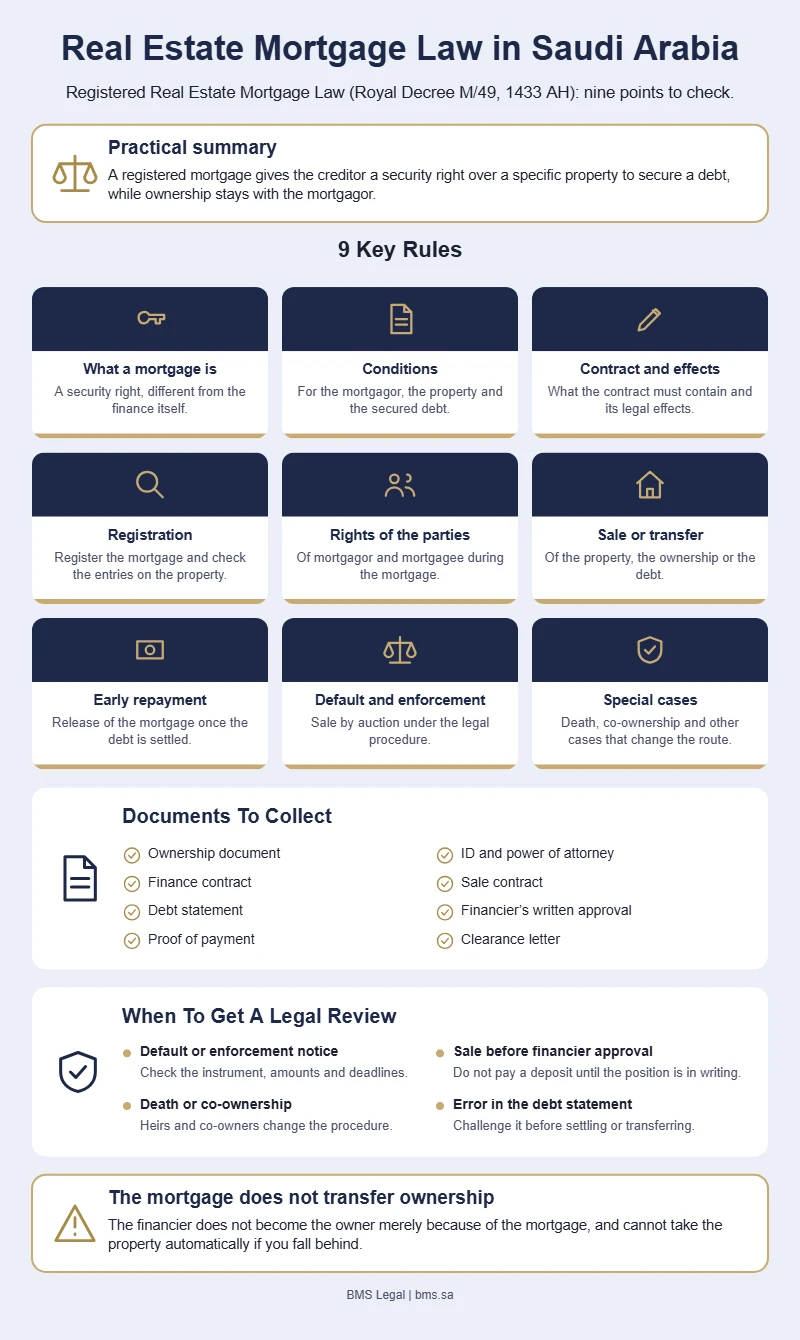
Practical Summary of the Real Estate Mortgage Law in Saudi Arabia
A registered mortgage gives the creditor a security right over a specific property to guarantee a debt, while ownership stays with the mortgagor. The creditor may recover the debt from the sale price at enforcement, according to its rank and the legal procedures that apply.
The financier does not become the owner by the mere fact of the mortgage, and it cannot take the property automatically if the debtor falls behind. However, a mortgage can affect a sale, a transfer of title or a division of the property, because the mortgagee’s right has to be dealt with first.
The main provisions fall into nine connected areas:
- What a mortgage is and how it differs from finance.
- The conditions for the mortgagor, the property and the secured debt.
- The contents and legal effects of the mortgage contract.
- Registration and checking the entries on the property.
- The rights of the mortgagor and the mortgagee during the mortgage.
- Selling the property or transferring ownership or the debt.
- Early repayment and release of the mortgage.
- Default, enforcement and sale by auction.
- Death, co-ownership and special cases.
When the debt is fully paid, the debt ends, but the mortgage entry does not disappear in practice until the release procedure is completed and the ownership document is updated. Keep proof of payment, a clearance letter and any correspondence showing that you asked for the entry to be removed.
What Is a Mortgage and What Conditions Apply to the Contract?
A registered mortgage is a contract that depends on a debt. It gives the creditor a right over a specific, registered property, with priority in recovering the debt and the ability to follow the property if it passes to another holder.
A mortgage is different from real estate finance. Finance sets the amount, the instalments and the cost of the term, whereas the mortgage is the security tied to the property that guarantees repayment. The difference between a loan and real estate finance in Saudi Arabia explains why the obligations of the beneficiary and the rights of the financier depend on the contract type.
The conditions start with the mortgagor’s ownership of the property, capacity to dispose of it, and a valid power of attorney where a representative signs. A person may mortgage their property to secure another person’s debt, in which case they are often called a real surety. If someone mortgages property they do not own, whether the mortgage takes effect depends on the true owner’s position and the legal rules on such dealings, so check the ownership document, the capacity of the mortgagor and the agent’s powers before signing or paying anything.
The mortgaged property must be identified clearly enough to avoid uncertainty, be capable of being sold under the law, and have a known location, area and boundaries. The mortgage may extend to buildings, plantings, attachments and later improvements unless a valid agreement says otherwise.
The secured debt should be specified or capable of being specified, with a maximum amount where the mortgage secures a changing balance. A clear amount, cost of the term and fees reduce disputes about the size of the debt or the scope of the security.
Before signing a mortgage contract, review these items:
- The parties’ details, capacities and the contact methods agreed.
- The description of the property, the document number, area, location and boundaries.
- The debt amount, or the maximum amount the mortgage secures.
- The finance term, instalment dates and the cases of breach.
- The terms on early repayment, assignment and transfer of the debt.
- The insurance terms, exclusions and the complaints procedure.
- Responsibility for maintenance, damage and any fall in the value of the security.
Check before you sell, release or object
Compare the finance contract, the debt statement, the entry on the property document and the financier’s written position. Paying the debt does not remove the mortgage entry until the release is completed.
Enquiries are handled confidentially · No specific court outcome can be guaranteed
Registering the Mortgage and the Parties’ Rights
Registration records the right and its rank on the property document or register, whereas the contract records the parties’ intentions and obligations. The channel used depends on the condition of the property and whether it falls within the areas announced for in-kind (title-based) registration.
The digital real estate services allow a mortgage to be created, released, transferred or its value amended, alongside some other dealings such as division or merger. The process normally starts by reviewing the ownership document, then entering the property details, the mortgage value and the mortgagee, and having the authorised parties approve the request.
Registration usually follows these steps:
- Verify the owner, the capacity of the applicant and any power of attorney used.
- Review the property document and the rights and entries already registered.
- Enter the mortgage value, the mortgagee’s details and the linked contract.
- Review the declarations and have the relevant parties approve the request.
- Register the entry and obtain a document showing the updated status of the property.
When buying a property, do not rely on the seller’s verbal assurance that it is free of mortgages or obligations. Ask for a recent ownership document, review the entries, and obtain a debt statement and the financier’s position before paying a deposit. The accuracy of a mortgage entry starts with ownership data that matches the real property, which is why the procedures for registering a property in Saudi Arabia matter when establishing the owner and the rights recorded against the unit.
The mortgagor remains the owner. They may use and manage the property within limits that do not harm the security or breach the contract, which may include living in it or renting it out, while remaining responsible for maintenance and preserving its value.
The mortgagee has a security right and may object to acts that expose the property to damage or substantially reduce its value. It also has priority in recovering the debt at enforcement, subject to its rank and to any legal rights that rank ahead of it.
The contract cannot validly provide that ownership passes to the mortgagee automatically on non-payment, because enforcement has to follow the legal procedures. Equally, a mortgage does not give the financier a right to live in or use the property merely because it exists, unless a separate valid right has been agreed.
Selling a Mortgaged Property and Transferring Ownership or the Debt
A mortgaged property can be sold, but an agreement between seller and buyer does not remove the mortgagee’s right and does not guarantee that title will be transferred. Fix the outstanding debt, the way it will be paid, the timing of the release and the financier’s position before you sign a final commitment. Our guide on selling a mortgaged property goes through this scenario in more detail.
The sale is usually handled through one of these routes:
- Paying off the debt, releasing the mortgage, then transferring title.
- Deducting the debt from the sale price under a documented arrangement.
- Moving the mortgage to another financier once the approvals are complete.
- Assigning the finance contract to a beneficiary the financier accepts.
- Completing a transaction that allows the mortgage to remain, under an approved route.
Take a property worth SAR 1,000,000 with a remaining debt of SAR 400,000. The seller does not receive the full price: the part owed goes to the financier in the agreed order, and the mortgage is released or moved before the balance is handed over. This is an illustration, not a fixed formula, because the actual procedure depends on the contract, repayment fees, the financier and the way title is transferred. It does show why the real debt must be known before agreeing a deposit or a transfer date.
Assigning a finance contract needs the financier’s written approval after it reviews the assignee’s eligibility and capacity. Handing over the property or signing a private agreement does not release the original borrower towards the financier, and the practical points are covered in the real estate loan assignment template in Saudi Arabia. Transferring a finance debt, by contrast, means moving the obligation to a new financier under the required rules and approvals. It is different from a change of ownership, because a new owner does not automatically take over the debt or end the debtor’s responsibility.
Before buying a mortgaged property, check the following:
- The ownership document matches the seller’s identity and the property offered.
- A recent statement shows the total outstanding debt.
- The financier’s position is obtained in writing before any deposit is paid.
- The deposit is linked to the release of the mortgage and completion of the transfer.
- Who bears repayment and transfer fees is stated.
- What happens to the money if the deal fails is documented.
Early Repayment and Releasing the Mortgage
A beneficiary may ask for early repayment. The amount is calculated under the rules and the contract that apply to the finance. The beneficiary does not necessarily bear the whole cost of the remaining term, though documented, permitted expenses and compensation may be charged.
A contract may include a period during which early repayment is restricted, as long as it stays within the limit the rules allow. Ask for a written statement showing the balance, the method of calculation, the expenses and the date until which the payoff figure is valid before you transfer money.
After full payment, release starts with proof of payment and a clearance letter, then approval of the request to remove the entry. In regulated contracts the financier is expected to do this within the approved period, unless the delay comes from the beneficiary or a related government body.
Releasing a real estate mortgage generally involves these steps:
- Request a statement of full settlement and review its details.
- Pay the amount within the validity period of the statement.
- Obtain the clearance letter or final discharge.
- Have the release request approved through the competent channel.
- Check the document and confirm the entry has actually been removed.
If you have paid the debt and the entry is still there, send the financier a written request with proof of payment, the clearance letter and the property document. Then file a documented complaint and escalate it to the supervisory body or the appropriate legal route if the delay continues.
The competent court or body is not the same in every dispute, because jurisdiction depends on the type of financier, the contract and the relief sought. Review the documents before filing a claim to release a mortgage or to claim compensation for a blocked sale.
Default and Enforcement Against the Property
Missing one instalment does not move the property to the financier, but it needs early handling before obligations build up. The contract and the rules define what counts as late payment or breach, when notices must be given, and what rights each party then has.
The path usually begins with a notice setting out the amounts due and the need to pay, which may develop into a notice of default or breach. Settlement or rescheduling can be discussed with the financier, though acceptance is not an automatic right in every case.
If non-payment continues, the mortgagee may seek enforcement on the strength of its document and the approved procedures, after which the property is valued and offered for sale. The financier may not evict the owner or take the property outside the legal process, and any surplus from the sale is dealt with under the law and the sale record.
An enforcement step can be challenged where there is an effective reason, such as a mistake in the amount of the debt, payments that were ignored, or defective notification. A challenge may also concern enforcement against property outside the security, a claim beyond the scope of the document, or amounts that have been proved but not counted.
A valuation does not guarantee that the auction price will equal the expected market value, since the final price depends on bidding and the procedure. Review the valuation, the claimed amount and the notifications before the sale is completed whenever there is a legal ground to object.
Late payment is not automatically a crime, but it may lead to financial claims, credit consequences and enforcement steps. The effects of not repaying a real estate loan differ with the length of the delay, the amount of the debt, the notices given and the stage of enforcement. See also the penalty for not repaying a real estate loan in Saudi Arabia for the detail on those effects.
If you receive a default or enforcement notice, gather the finance contract, the instalment schedule, the debt statement, the financier’s messages and the enforcement notifications. These documents help you assess whether to pay, settle or object before the deadlines expire.
Death, Co-Ownership and Special Cases
The mortgage does not lapse because the borrower or the mortgagor dies. Rights and obligations pass according to the contract, the law and the position of the estate, and the effect on the debt depends on any release terms, the insurance policy, its exclusions and the number of beneficiaries.
Do not assume that the debt is cancelled automatically on death, because some events may be excluded from cover. The result also differs where the finance is in more than one name, or where the compensation does not cover the whole remaining balance.
The heirs usually need the death certificate, the inheritance deed, the insurance policy, the finance contract, the ownership document and letters from the financier. Find out the result of the insurance claim before asking for a release, transferring title or dealing with the property as part of the estate. If the heirs later disagree about the property, our guide on how to claim inheritance in Saudi Arabia explains the route for a claim.
In jointly owned property, the mortgage may attach, after division, to the part allotted to the mortgagor, according to the legal result of the division. If the property is destroyed or expropriated for the public benefit, the mortgagee’s right may move to the compensation or insurance amount.
A fall in the property’s value does not always have one result, because it depends on the cause, the size of the shortfall and the contract terms. If the mortgagor causes significant harm, the mortgagee may ask for a measure that preserves the value of the security or for additional security.
Documents to Collect and When to Get a Legal Review
A mortgage transaction or dispute is not strengthened by the number of attachments but by the match between the ownership document, the contract, the debt and the actual payments. The table shows the main documents for each situation.
| Situation | Main documents | Usual route | Result sought |
|---|---|---|---|
| Creating a mortgage | Ownership document, ID, power of attorney, finance contract | Mortgage creation service | Right registered and ranked |
| Selling a mortgaged property | Sale contract, debt statement, financier’s approval | Financier and the title transfer service | Debt paid or mortgage moved |
| Releasing the mortgage | Proof of payment, clearance letter, property document | Financier and the release service | Entry removed and document updated |
| Default or enforcement | Contract, instalments, debt statement, notices | Financier, then enforcement | Settlement of the debt or an objection |
| Death of the borrower | Death certificate, inheritance deed, insurance, contract | Financier and the insurer | Release determined or obligation continues |
A legal review is more important where the debt figures differ, a release is refused, a sale is stuck or enforcement has begun. It is also necessary where there are heirs, several owners or unclear insurance terms.
Where the debt figure is disputed, the transfer is blocked, or a release is refused, a real estate lawyer in Jeddah can assess the effect of the contract, the ownership document and the correspondence before you choose a complaint, a settlement or a court procedure. For the general conditions that apply when a mortgage is created or moved, you can also read our guides on mortgage conditions in Saudi Arabia and real estate mortgage transfer conditions.
Trust and Legal Basis
Trust and Legal Basis
Legal basis
This guide is based on the Registered Real Estate Mortgage Law (Royal Decree No. M/49 dated 13/8/1433 AH) and the official legal texts listed below, and is written for general legal awareness rather than as advice on a specific case. It does not replace a review of your finance contract, the ownership document and the debt statement.
Published by: BMS Legal Law and Legal Consultancy Company.
Address: Jeddah, Al-Mishrifah District, Palestine Street, Al-Safeer Tower
Frequently Asked Questions About the Real Estate Mortgage Law in Saudi Arabia
What is the real estate mortgage law in Saudi Arabia?
It is the Registered Real Estate Mortgage Law, which regulates the creation and effects of a registered mortgage over a specific property to secure a debt, while ownership stays with the mortgagor.
What is the difference between a mortgage and real estate finance?
Finance sets the amount, the instalments and the cost of the term, whereas the mortgage is the security over the property that guarantees repayment of the debt.
Does ownership pass to the financier when a property is mortgaged?
No. Ownership does not pass by the mere fact of the mortgage. The financier gets a security right that can be enforced when the legal conditions are met.
Can a mortgaged property be sold?
Yes, but transferring title requires the debt to be paid, the mortgage to be released, or an arrangement the financier accepts.
How is a mortgage released after payment?
Obtain proof of payment and a clearance letter, then have the financier approve the release request, and check the property document to confirm the entry has been removed.
What if the financier delays releasing the mortgage?
Send a written request with your documents, then file a documented complaint and escalate to the supervisory body or the appropriate legal route according to the contract and the reason for the delay.
Conclusion
The real estate mortgage law in Saudi Arabia is best read as a chain: a clear contract, a correct registration, known debt figures, the financier’s written position and a completed release. Paying the last instalment does not by itself clear the entry, and a sale, a default or a death all need the documents checked first.
If you have paid the debt and the entry remains, a sale is stuck, or enforcement has started, you can send us the contract, the debt statement and the property document through our contact page so the missing papers and the suitable next step can be identified.
To have your mortgage documents reviewed before you sell, release or object, contact BMS Legal in Jeddah for a preliminary review.
Debt paid but the entry is still there?
Send us a short description of the case and a BMS Legal lawyer in Jeddah will tell you what to check and which route fits before any sale or claim.
Enquiries are handled confidentially · No specific court outcome can be guaranteed
Official Legal and Government Sources
- Bureau of Experts at the Council of Ministers: official legal text cited by our Arabic guide (Arabic-language official website)
- Ministry of Justice legislation portal: official legal text cited by our Arabic guide (Arabic-language official website)
Disclaimer: This article is for general legal awareness and is not advice on an individual case, and reading it does not create a lawyer–client relationship. The legal assessment varies with the facts, the documents and the rules that apply to each case.