
A complaint against a real estate company may arise when the company delays handover, refuses to refund a payment, or breaches agreed property specifications. The dispute may involve a developer, broker, or real estate marketing office, so identifying the company alone does not determine the correct legal route.
Start by reviewing the contract, then collect payment records and correspondence. You should also define the outcome you want, whether delivery, contract termination, a refund, or compensation. This helps you avoid filing a regulatory report when your actual objective is to enforce a contractual or financial right.
This guide explains the appropriate authority, practical steps, relevant documents, and the main escalation options available for real estate disputes in Saudi Arabia.
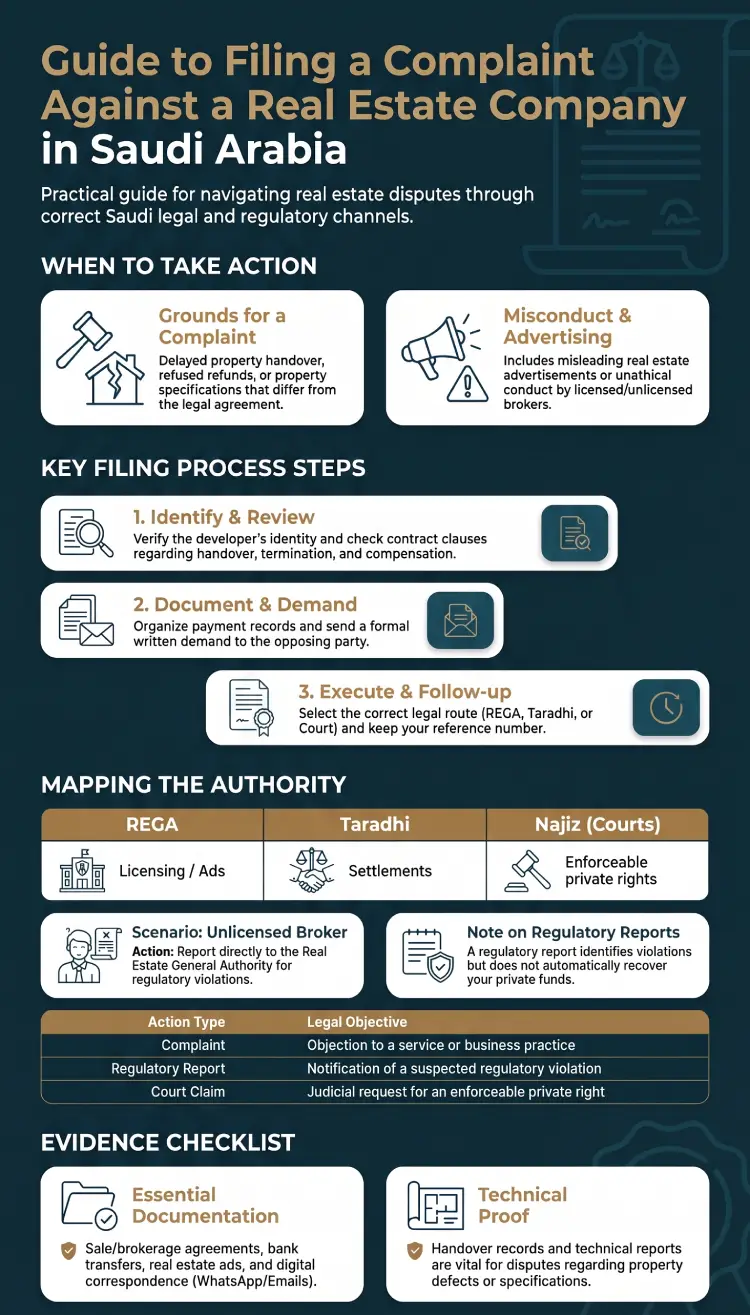
Complaint Against a Real Estate Company: 7 Steps to Start
Do not begin by submitting a generic complaint form. First identify your right and determine which authority can address the specific issue. A regulatory report may be appropriate for a compliance violation, but it does not by itself result in a judgment ordering repayment or contract termination.
If your objective involves a contractual or financial right, you may need a written demand, settlement proceedings, or a court claim.
Follow these seven steps:
- Identify the other party: developer, broker, real estate office, seller, or property management company.
- Review the contract, annexes, delivery terms, cancellation provisions, and compensation clauses.
- Arrange the facts chronologically, including payment dates and correspondence.
- Send a written demand identifying the obligation and a reasonable response period.
- Choose the appropriate route: report, complaint, settlement, or court claim.
- Attach evidence of the contract, payments, breach, and resulting loss.
- Keep the reference number and follow up on responses and additional document requests.
The clearer your requested outcome is, the less likely you are to move between authorities that cannot provide the remedy you need.
Before selecting a route, review the key provisions of your real estate sale agreement, particularly those dealing with handover, termination, compensation, and the legal characterization of payments. These clauses may determine the basis of the complaint and the remedy available.
When Can You File a Complaint Against a Real Estate Company?
A complaint may be appropriate when a company breaches a statutory or contractual obligation affecting your rights, money, or use of the property. Common cases include receiving payment without delivering the property, refusing to refund a reservation amount, developer delay, specification discrepancies, material defects, or misleading advertising.
However, not every disagreement provides sufficient grounds for termination or compensation. The legal position depends on the contract, the seriousness of the breach, and the available evidence.
| Situation | Initial Action | Possible Next Step |
|---|---|---|
| Unlicensed broker or non-compliant advertisement | Report to the Real Estate General Authority | Private claim if financial loss occurred |
| Company received payment but did not deliver | Written demand supported by payment evidence | Settlement or claim for delivery or refund |
| Developer delayed an off-plan project | Verify the licence and project status | Termination or compensation subject to the contract |
| Area or specifications differ | Inspection record and technical report | Repair, value adjustment, or termination |
| Company refuses to return earnest money | Review the nature of the payment and contract terms | Demand or recovery claim |
| Dispute over broker commission | Review the brokerage agreement and licence | Regulatory report or financial claim |
Focus first on the remedy you want. A regulatory authority may address a violation without determining your separate contractual or financial claim.
Which Authority Handles Real Estate Company Complaints?
The appropriate authority depends on the company’s activity and the remedy you are seeking. The Real Estate General Authority may be relevant where the matter concerns brokerage, advertising, licensing, or another regulated real estate activity.
A regulatory report may lead to review and enforcement action, but it does not always replace a claim for delivery, contract termination, or repayment.
If the dispute concerns an off-plan development, verify the project and developer licences, then review the contractual handover date, project status, and payments made. If you seek an enforceable order requiring the company to perform, refund money, or pay compensation, settlement proceedings or a court claim through Najiz may be required.
The Commercial Court does not automatically have jurisdiction merely because the defendant is a company. Jurisdiction depends on the nature of the transaction, the capacity of the parties, and the relief requested.
The Taradhi platform may also be used where the parties can negotiate delivery, repayment, compensation, or termination. If the contract contains an arbitration clause, review it before commencing court proceedings because its effect depends on its wording and how it is invoked procedurally.
What Is the Difference Between a Complaint, Report, and Court Claim?
A complaint generally challenges a service, practice, or action taken by a real estate business and may seek administrative review or corrective action.
A regulatory report informs the competent authority of a suspected violation, such as conducting brokerage activities without a licence or publishing a non-compliant real estate advertisement. Regulatory action may follow without determining repayment of your private financial claim.
A court claim is a formal judicial proceeding in which you request an enforceable judgment, such as delivery of the property, termination of the contract, repayment of amounts paid, or compensation.
A regulatory report and a private claim can sometimes proceed separately when the same conduct involves both a regulatory violation and financial loss.
When the matter moves from an administrative complaint to litigation, understanding real estate claims in Saudi Arabia and their legal basis can help identify the appropriate relief and judicial route.
Documents That Strengthen a Real Estate Complaint
The documents required vary according to the dispute, but a strong file connects each allegation to clear evidence. Do not merely describe what happened; establish the company’s obligation, the amounts you paid, your subsequent demands, and the company’s response.
| Document | Why It Matters |
|---|---|
| Sale or reservation agreement | Establishes obligations, deadlines, and cancellation terms |
| Brokerage agreement | Identifies the broker’s role, commission, and scope of engagement |
| Annexes and specifications | Establish the agreed area, finishes, and facilities |
| Bank transfers and receipts | Confirm payment amount, date, and recipient |
| Real estate advertisement | Records information presented before contracting |
| WhatsApp messages and emails | Document demands, responses, and acknowledgements |
| Handover record | Records property condition and reservations at delivery |
| Technical report | Identifies defects and estimated remedial work |
| Written demand | Shows that the company was formally notified of the issue |
Keep full copies of conversations rather than isolated screenshots. Preserve sender details, dates, attachments, and surrounding context. Digital evidence can be relevant where its attribution, integrity, and connection to the dispute can be established.
Common Grounds for a Complaint Against a Real Estate Company
The correct approach depends on the type of breach and the right you seek to enforce. A complaint against a real estate company may involve delayed handover, refusal to refund money, specification discrepancies, or misconduct by a broker.
Developer Delay or Project Distress
Review the contractual handover date, project completion status, cause of delay, developer licence, and amounts already paid. Temporary delay should be distinguished from a distressed or stalled development because each situation may affect claims for delivery, termination, repayment, or compensation differently.
Refund of Payments or Earnest Money
You cannot determine whether earnest money must be returned without reviewing how the payment is described in the contract and which party caused the transaction to fail.
The amount may constitute earnest money, an advance payment, a reservation fee, or part of the purchase price. Each characterization may affect the legal consequences.
If the company accepted payment but failed to perform, establish the purpose of the payment before deciding whether to seek performance, termination, or repayment.
Specification Differences or Property Defects
Document any difference between the agreed property and the delivered unit, particularly its area, finishes, facilities, and technical defects. Record visible issues in the handover document, take dated photographs, and obtain technical evidence when the cause or repair cost is disputed.
Possible remedies may include repair, reimbursement of repair costs, a value adjustment, or termination where the breach is sufficiently material.
If the defects may be altered or repaired before they can be formally examined, an urgent property condition evidence claim may help preserve technical evidence before the condition changes.
Complaint Against a Real Estate Broker or Office
Verify the broker’s licence, advertisement licence, and brokerage agreement. Potential violations may include operating without a licence, providing inaccurate information, concealing material facts, or claiming an unagreed commission.
Keep a copy of the advertisement, licence number, advertiser identity, publication date, and all correspondence connected with the transaction.
What Can You Claim From the Real Estate Company?
Do not combine conflicting remedies without considering whether they are legally compatible. Delivery may remain the better option where performance is still possible, while repayment or compensation may become more appropriate where performance is no longer practical.
Depending on the contract and facts, potential remedies may include:
- Performance of the contractual obligation or delivery of the property.
- Contract termination and repayment of amounts paid.
- Recovery of earnest money or a reservation payment.
- Repair of defects or reimbursement of remedial costs.
- Compensation for a proven reduction in value.
- Compensation for proven loss resulting from the breach.
Each remedy should be connected to a contractual obligation, specific breach, supporting evidence, and proven loss. Avoid claiming speculative amounts that are unsupported by documents or expert evidence.
Where a company’s delay or property defect results in financial loss or loss of use, it may be necessary to assess a property damage compensation claim and establish the connection between the breach, the proven damage, and the compensation sought.
Mistakes That Can Weaken Your Position
Do not submit a purely financial demand to a regulatory authority and then assume that the money will automatically be recovered. A separate private claim may still be required.
Likewise, do not commence litigation before reviewing any arbitration or dispute-resolution clause in the contract.
Avoid signing a handover record without noting visible defects. Do not delete correspondence, change your account of the events, or rely on vague descriptions without dates and payment details.
Your position may also become harder to prove if you delay action until evidence disappears or the condition of the property changes.
Where the amount in dispute is significant, the project is distressed, or technical defects require expert analysis, consider obtaining legal advice before escalation.
A consultation with a real estate lawyer in Jeddah can help clarify the available remedy, competent authority, and documents required before formal action.
Frequently Asked Questions About a Complaint Against a Real Estate Company
How do I file a complaint against a real estate company in Saudi Arabia?
Review the contract, collect payment evidence, identify the remedy you want, then choose the appropriate regulatory, settlement, or judicial route.
Does the Real Estate General Authority refund money paid to a real estate company?
A regulatory complaint does not automatically result in a refund. You may still need a written demand, settlement, or court claim.
When should I file a court claim against a real estate company?
A court claim may be appropriate when you seek delivery, contract termination, repayment, or compensation and administrative action does not resolve the private right.
Can earnest money paid to a real estate company be recovered?
It depends on how the payment is described, the contract terms, and which party caused the transaction not to proceed.
Can a buyer claim compensation for a developer’s delay?
Compensation may be available depending on the project type, contract, cause of delay, and the proven loss suffered by the buyer.
.
Can WhatsApp messages be used as evidence in a real estate dispute?
They may be used as digital evidence when their attribution, integrity, and connection to the dispute can be established.
How do I complain about a real estate broker?
Verify the broker’s licence, collect the brokerage agreement, advertisement, and correspondence, then submit the appropriate regulatory report.
Which court has jurisdiction over a dispute with a real estate company?
Jurisdiction depends on the nature of the contract, the parties’ legal capacity, and the relief requested, not merely on the company’s name
Complaint Against a Real Estate Company: 7 Steps to Protect Your Rights is not simply a form sent to the first authority you find. The process begins with understanding the contract and ends with a clearly defined remedy. Identify the company’s role, review its obligations, arrange the facts, send a written demand, choose the appropriate route, attach your evidence, and follow the case through the correct channel.
If your objective is to report a regulatory violation, a formal report may be appropriate. If you want delivery, contract termination, repayment, or compensation, you should select the route that can actually determine that private right.
Where a dispute requires contract analysis, identification of the competent authority, and preparation of an evidence-based claim, a law firm in Jeddah can provide structured legal support beginning with an assessment of the file before settlement, litigation, or arbitration is considered.
Official Sources: