
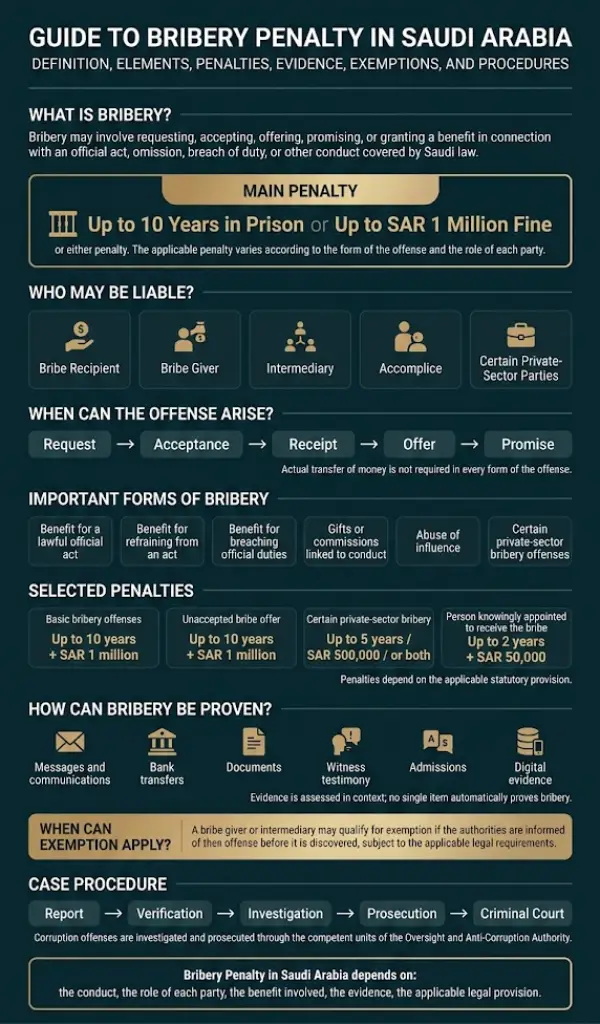
The Bribery Penalty in Saudi Arabia varies according to the form of the offense, the legal capacity of the parties, and the conduct involved. In certain cases, the penalty may reach 10 years’ imprisonment and a fine of SAR 1 million, or either of those penalties. Liability is not limited to the public official who solicits or accepts the benefit; depending on the facts, it may also extend to the bribe giver, intermediary, accomplice, and certain forms of private-sector bribery.
The Saudi Anti-Bribery Law defines the principal forms of bribery, the applicable penalties, and the legal consequences of conviction, while related Saudi laws regulate investigation, prosecution, and trial procedures. For that reason, the amount of money involved or the existence of a gift does not by itself determine whether bribery has occurred. The purpose of the benefit, the status of each party, and the act or omission connected to it must all be examined.
What Is the Bribery Penalty in Saudi Arabia?
The basic form of bribery covers a public official who requests for himself or another person, accepts, or receives a promise or benefit in return for performing an act connected with his official duties, or an act he claims falls within those duties, even where the requested act is lawful in itself.
The Saudi Anti-Bribery Law also addresses abstaining from an official act, breaching official duties, offering a bribe, liability of the bribe giver and intermediary, exemptions, and certain consequences arising from conviction.
The Law provides that a bribe giver, intermediary, or other participant is punished according to the provision governing the offense in which that person participated. It is therefore inaccurate to assume that every participant and every form of bribery automatically carries the same sentence.
| Form of Conduct | Maximum Penalty |
|---|---|
| Basic bribery offenses under Articles 1–3 | 10 years’ imprisonment and SAR 1 million, or either penalty |
| Offering a bribe that is not accepted | 10 years’ imprisonment and SAR 1 million, or either penalty |
| Breach of official duties due to a request, recommendation, or intercession | 3 years’ imprisonment and SAR 100,000, or either penalty |
| Certain cases involving the follow-up of transactions by reason of public office | 2 years’ imprisonment and SAR 50,000, or either penalty |
| Certain private-sector bribery offenses | 5 years’ imprisonment or SAR 500,000, or both |
| A person appointed to receive the bribe while knowing its purpose | 2 years’ imprisonment and SAR 50,000, or either penalty |
A conviction may also produce consequences beyond imprisonment and fines. Depending on the applicable provisions, these may include confiscation of the money or benefit connected with the offense and employment-related consequences for a public official.
Do you have a report, summons, or active investigation involving a bribery case?
The appropriate next step depends on your role in the matter—whether you are a reporting person, suspect, employee, bribe giver, intermediary, or company representative. A confidential initial assessment with BMS Legal’s criminal law team can help identify the current procedural stage and the documents that may affect your position before further action is taken. Contact: +966 54 442 1246.
What Is a Bribery Offense Under Saudi Law?
A bribery offense is not limited to secretly handing cash to a public official. Depending on the applicable provision, the offense may arise through requesting, accepting, or receiving a benefit, while offering or promising a benefit may also be criminalized.
The legal characterization therefore depends on the purpose of the benefit and its connection with the act, decision, or omission sought from the other party.
What Does Bribery Mean Under Saudi Law?
In its conventional form, bribery occurs where an official requests, accepts, or receives a promise or benefit in return for an act connected with official duties, refraining from an act, or breaching official obligations, depending on the applicable provision.
A bribery offense may arise even where the requested official act is lawful in itself. The issue is not necessarily whether processing the transaction is lawful; rather, it is whether a benefit was requested or accepted in exchange for performing an act falling within the official function.
Accordingly, paying an employee an additional amount to accelerate a task that already falls within that employee’s official responsibilities does not become lawful merely because the desired outcome itself is legally permissible.
Must a Bribe Be Money?
No. A bribe does not necessarily have to take the form of cash. A promise or benefit may include a material or non-material advantage, depending on its nature and connection with the requested conduct.
For that reason, describing something as a “gift,” “reward,” or “service” does not automatically exclude the possibility of bribery. What matters is why the benefit was provided, when it was provided, who benefited from it, and how it relates to an official act or decision.
At the same time, not every gift or commission automatically constitutes a bribe. The full circumstances must be assessed before the conduct can be legally characterized.
What Are the Elements of Bribery in Saudi Arabia?
The existence of a financial transfer or benefit between two people is not enough by itself to establish a bribery offense in Saudi Arabia. The conduct, the relationship between the parties, the purpose of the benefit, and the applicable statutory provision must all be identified.
Conduct That May Constitute Bribery
The prohibited conduct varies according to the form of the offense. On the recipient’s side, it may involve requesting, accepting, or receiving a benefit. On the other side, it may involve offering, promising, or granting that benefit.
This also answers a common question: must the bribe actually be delivered? Not in every case. Certain offenses may arise before money or another benefit is physically transferred. A request by an official may have legal consequences, while an offer of bribery that is rejected may constitute a separate offense.
The absence of an actual transfer should therefore not be confused with the absence of criminal liability. Each case depends on the conduct that actually occurred and the provision applicable to it.
Connection Between the Benefit and the Official Act
A central issue in assessing bribery is the relationship between the benefit and the conduct sought in return.
The benefit may be connected to performing an official act, refraining from an act, breaching official duties, or using influence in situations addressed by the Law.
This connection helps distinguish an unrelated financial transaction from a benefit that was offered or requested in return for particular conduct.
Two practical questions therefore become important: Why was the benefit provided? And what was the other party expected to do in return?
Criminal Intent and the Status of the Person
Criminal intent is assessed by examining the person’s knowledge of the nature and purpose of the transaction and whether his or her will was directed toward the prohibited conduct.
The description given to a payment by one of the parties is not decisive. The surrounding circumstances and supporting evidence must also be considered.
The required legal status of the person also varies by offense. Certain provisions apply to public officials or persons treated as public officials, while others cover influence-related conduct or persons working within private entities.
Determining a person’s actual or claimed authority is therefore an important part of assessing the elements of a bribery offense.
Penalties for the Bribe Giver, Recipient, and Intermediary
The legal position of the bribe giver, recipient, and intermediary is not identical. Accordingly, the phrase penalties for the bribe giver, recipient, and intermediary in Saudi Arabia should not be understood as referring to one fixed sentence.
The first step is to identify the specific bribery offense and then determine the role played by each participant.
Penalty for the Bribe Recipient
Under the basic offense in Article 1, the penalty for the bribe recipient may reach 10 years’ imprisonment and a fine of SAR 1 million, or either penalty.
Several provisions cover an official who requests, accepts, or receives a promise or benefit in return for performing an official act, refraining from an act, or breaching official duties, subject to the requirements of each provision.
The official does not necessarily need to physically receive the money before liability can arise. In some circumstances, the request for the benefit or acceptance of the promise is the conduct on which the allegation is based.
Penalty for the Bribe Giver and Intermediary
The bribe giver, intermediary, and other participant are punished according to the penalty prescribed for the offense in which they participated.
Participation may, subject to its statutory requirements, include agreement, incitement, or assistance in committing the offense.
The penalty for a bribery intermediary may therefore differ from one case to another. Merely describing someone as an “intermediary” does not determine the applicable sentence. The person’s actual role, the conduct in which he participated, and the underlying offense must first be established.
The Law also provides a specific rule for a person appointed by the bribe giver or recipient to receive the bribe where that person agrees to do so while knowing its purpose.
What Is the Penalty for Offering a Bribe That Is Rejected?
An official’s refusal to accept a bribe does not necessarily eliminate the liability of the person who made the offer.
Saudi law criminalizes offering a bribe where the offer is not accepted. In this situation, the penalty may reach 10 years’ imprisonment and a fine of SAR 1 million, or either penalty.
It is therefore important to distinguish between an unacted-upon idea or general conversation and an offer or promise that has developed into conduct falling within the statutory provision.
When Can a Gift, Influence, or Private-Sector Benefit Become Bribery?
Bribery cases do not always involve cash being handed to a government employee. The alleged benefit may take the form of a gift, commission, or later reward, or the case may involve influence or an employee working within a private entity.
When Can a Gift or Commission Become a Bribe?
The label placed on a benefit does not determine its legal character.
A gift may be lawful in one context but may fall within the scope of bribery where it is connected with an act, omission, or breach of duty.
The timing of the gift, the reason for providing it, the identity of the beneficiary, and its connection with what the recipient did or was expected to do should therefore be examined.
Saudi law also addresses certain situations involving a benefit given after the official conduct has occurred. A written or prior agreement is therefore not necessarily required before the circumstances warrant legal examination.
How Is Abuse of Influence Connected to Bribery?
The Law addresses the use of real or alleged influence to obtain, or attempt to obtain, a decision, authorization, service, or other benefit from a public authority in return for a promise or benefit, subject to the conditions set out in the applicable provision.
The central issue in such a case is the use of a person’s actual or claimed influence with a public authority in return for a benefit.
Not every person claiming influence must be a public official in every form of the offense. The applicable provision, the person’s status, and what that person promised to obtain must therefore be examined.
What Is the Penalty for Private-Sector Bribery in Saudi Arabia?
Saudi law contains specific bribery provisions covering companies, institutions, associations, and other private entities.
These provisions may apply where a person offers or grants a benefit to an employee in return for performing or refraining from an act in breach of the employee’s duties, or where the employee requests or accepts such a benefit.
For the relevant private-sector offenses, the penalty may reach five years’ imprisonment or a fine of SAR 500,000, or both.
Consequences may also arise for a company or private institution where a director or employee is convicted and the offense is established to have been committed for the entity’s benefit, subject to the statutory requirements governing corporate liability.
How Is Bribery Proven in Saudi Arabia?
Proving bribery in Saudi Arabia does not depend on one fixed type of evidence that applies to every case. A bribery file may be built from a combination of evidence and circumstantial indicators, each of which is assessed in the context of the facts and the procedures through which it was obtained.
What Evidence May Appear in a Bribery Case?
Depending on the circumstances, the file may contain communications between the parties, bank transfers, documents, arrest and investigation records, witness testimony, admissions, or relevant digital data.
The presence of any one of these items does not by itself establish the complete offense.
A bank transfer, for example, may establish that money moved from one account to another, but it does not by itself explain why the transfer occurred. Similarly, a message may establish communication without necessarily proving what that communication meant in the broader context.
The proof of bribery therefore depends on connecting the available evidence to the alleged conduct, the parties involved, their legal status, and the sequence of events.
Where an active case exists, it may also be useful to understand how this evidence fits within the stages of a criminal investigation in Saudi Arabia. An investigation does not itself establish guilt; it is a stage for examining facts and evidence and determining the appropriate legal route.
How Does Criminal Intent Relate to Evidence?
Evidence in a bribery case is not limited to proving that a benefit existed. The purpose of the benefit and its connection to the alleged conduct must also be examined.
There may be a legitimate financial relationship between two people, or a benefit may instead be connected to the alleged prohibited act. The distinction may emerge from documents, communications, timing, the nature of the relationship, and other surrounding facts.
For that reason, relying on a single piece of evidence outside its broader context may lead to an incomplete assessment of the case.
When Can a Bribe Giver or Intermediary Be Exempted?
The Saudi Anti-Bribery Law provides a specific situation in which a bribe giver or intermediary may qualify for exemption. The timing of the report and the stage at which the offense had been discovered are therefore critical.
A bribe giver or intermediary may be exempted from both the principal and consequential penalties if the authorities are informed of the offense before it is discovered.
Early reporting is therefore legally different from admitting or cooperating after the competent authorities have already discovered the conduct.
An exemption should not be assumed merely because a person later provides information after an investigation has started. It is necessary to determine when the offense was discovered, when the report was made, and the reporting person’s role in the incident.
The Law also regulates a reward for a person whose information leads to proof of a bribery offense where that person was not the bribe giver, an accomplice, or an intermediary, subject to the applicable statutory requirements.
What Are the Procedures in a Bribery Case in Saudi Arabia?
A bribery case may begin in different ways. It may arise from a formal report, information received by the competent authority, regulatory work, or investigative findings.
The Law of the Oversight and Anti-Corruption Authority classifies bribery offenses as corruption crimes and gives the Authority powers relating to receiving and verifying reports, investigating corruption offenses, and bringing cases before the competent court.
Who Receives the Report and Investigates a Bribery Offense?
The Oversight and Anti-Corruption Authority receives complaints and reports relating to corruption offenses, verifies them, and takes the appropriate statutory action.
Its Criminal Investigation and Prosecution Unit investigates corruption offenses, brings criminal proceedings, and conducts the prosecution before the competent court.
The filing of a report or the summoning of a person for investigation does not establish liability. Investigation is the stage in which the facts are examined, statements are heard, evidence is assessed, and the proper legal characterization is determined.
If you have been summoned, detained, or are giving a statement, understanding the rights of the accused during investigation in Saudi Arabia can help you deal more carefully with investigation records and statements attributed to you.
Which Court Has Jurisdiction Over Bribery Cases?
Once the investigation is completed and criminal proceedings are brought, the case moves to the competent court for examination of the allegation, evidence, and defenses.
Under the decision approving the Law of the Oversight and Anti-Corruption Authority, the Criminal Court in Riyadh has jurisdiction to hear corruption crimes, including bribery offenses.
Once judgment has been issued, the available objection or appeal procedures may become the central issue in the case. The guide on appeal against criminal judgments in Saudi Arabia explains where an appeal fits within the criminal process and what should be reviewed after a judgment is issued.
What Should You Do if You Are Involved in a Bribery Case?
The appropriate response depends on your status and the stage of the proceedings. A person may be reporting a request for a bribe, responding to an investigation summons, acting as an employee or intermediary, or representing a company whose employee is connected to the incident.
If someone requests a bribe from you, preserve the original messages and documents and record the date of the incident, the nature of the request, the authority involved, and the persons concerned. Avoid altering messages or files connected with what occurred.
If you are summoned for investigation, organize the chronology of events, the amounts or benefits in question, and the relevant communications and documents. You should also determine the capacity in which you have been summoned and the stated reason for the procedure.
Where the matter concerns a company, it may also be necessary to identify the employee’s position and authority, whether the conduct was allegedly carried out for the company’s benefit, and the contracts, approvals, records, and communications connected to the matter.
Where a case has progressed to investigation or formal accusation, understanding the role of a lawyer in criminal cases can help clarify how facts, evidence, and procedures are reviewed before a defense strategy is determined.
What Defenses May Arise in a Bribery Case?
There is no single defense that applies to every bribery case. The relevance of a defense depends on the facts, the statutory provision underlying the allegation, the evidence in the file, and the procedures followed.
Potential issues may include whether an element of the offense has been established, whether a sufficient connection exists between the benefit and the alleged act, whether criminal intent has been proven, whether the conduct can properly be attributed to the accused, or whether a particular item of evidence has sufficient probative value when read in the context of the whole case.
Procedural issues may also arise where an irregularity affects evidence or the rights of the accused during investigation or trial.
The existence of a possible defense does not mean that the outcome is predetermined. A proper assessment begins with the investigation records, statements, documents, evidence, and the statutory provisions applicable to the specific facts.
If you have an active criminal matter, you may contact the BMS Legal criminal law team in Jeddah to review the current procedural stage, the documents that may affect the case, and the available legal options before deciding on the next step.
Frequently Asked Questions About the Bribery Penalty in Saudi Arabia
How Severe Is the Bribery Penalty in Saudi Arabia?
For certain offenses, the penalty may reach 10 years’ imprisonment and a fine of SAR 1 million, or either penalty. The applicable sentence depends on the conduct, the status of the person involved, and the statutory provision governing the offense.
Is Offering a Bribe a Crime if It Is Rejected?
Yes. Saudi law criminalizes offering a bribe even where it is not accepted. In the applicable form of the offense, the penalty may reach 10 years’ imprisonment and a fine of SAR 1 million, or either penalty.
Must the Bribe Actually Be Delivered?
Not in every case. Certain bribery offenses may arise through requesting or accepting a benefit, while the Law also provides a separate penalty for offering a bribe that is rejected.
What Is the Penalty for Private-Sector Bribery?
For the relevant private-sector bribery offenses, the penalty may reach five years’ imprisonment or a fine of SAR 500,000, or both, depending on the conduct and statutory provision applied.
When Can the Bribe Giver or Intermediary Be Exempted?
The Law provides an exemption from the principal and consequential penalties where the bribe giver or intermediary informs the authorities of the offense before it is discovered.
Who Investigates Bribery Cases and Which Court Has Jurisdiction?
The Oversight and Anti-Corruption Authority exercises the relevant investigation and prosecution functions for corruption offenses through its Criminal Investigation and Prosecution Unit, while the Criminal Court in Riyadh has jurisdiction over corruption crimes.
Bribery Penalty in Saudi Arabia: When Can It Reach 10 Years? The penalty can reach this level for a number of offenses identified under Saudi law, but it is not a uniform sentence for every bribery case. The applicable consequences may vary according to the nature of the conduct, the status and role of the person involved, and whether the matter concerns the public or private sector.
In practice, the legal analysis does not depend on what the payment, gift, or benefit was called. What matters is why the benefit was provided, the act or omission sought in return, the status of the parties, the available evidence, and the procedures already taken in the case. An active bribery matter therefore requires assessment of its specific facts and documents before criminal liability or a defense strategy can be determined.