
Searching for Khula Requirements in Saudi Arabia is usually connected to a practical decision rather than a purely theoretical question. A wife may need to know whether her husband’s consent is required, how compensation works, what procedure applies, and whether the process begins with documentation through Najiz or requires court proceedings when a dispute exists.
Before examining these requirements in detail, it is useful to understand the steps for obtaining Khula under Saudi law and the distinction between a Khula completed by mutual agreement and a case involving disagreement over consent or compensation.
Quick Answer: Khula Requirements in Saudi Arabia
Khula in Saudi Arabia is based on a request from the wife, the husband’s consent in a consensual Khula, and the existence of compensation, because Khula does not take effect without compensation. Under Saudi law, Khula is treated as a dissolution of the marriage contract even if it is expressed using the wording of divorce.
Where both spouses agree on Khula and the compensation, the most direct route is generally to document the Khula through Najiz.
If the husband refuses, the parties cannot agree, or a dispute exists over the compensation or relevant facts, the matter may move into a judicial process requiring the case to be legally classified according to its circumstances. Children’s rights, including custody and maintenance, cannot be used as compensation for Khula.
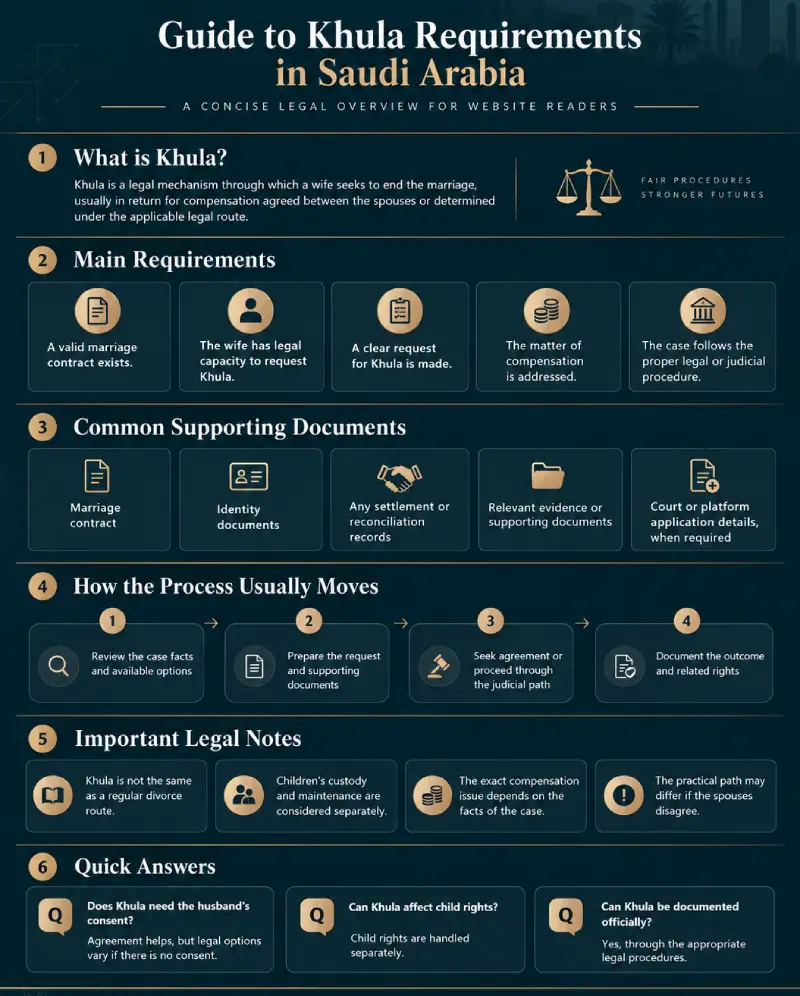
For anyone asking, “What are the requirements for obtaining Khula from a husband?”, the main Khula Requirements in Saudi Arabia can be summarized as follows:
- A valid and existing marriage contract.
- A request made by the wife.
- The existence of compensation.
- The husband’s consent in a consensual Khula.
- Legal capacity of both parties to consent and act.
- Children’s custody, maintenance, and other rights must not form part of the compensation.
What Is Khula and What Are Its Basic Requirements?
Under Saudi law, Khula is not simply a divorce by mutual agreement. It is a form of marital separation made in return for compensation, with a specific legal definition and distinct consequences. Understanding its legal character is therefore important before examining the procedure.
The Saudi Personal Status Law defines Khula as a separation between spouses requested by the wife and accepted by the husband in return for compensation. It also provides that Khula constitutes dissolution of the marriage contract even where it is expressed using the wording of divorce.
This is why Khula differs from divorce in its legal characterization and also differs from judicial dissolution of marriage in terms of its basis and procedural route.
When considering what is sometimes described online as the “new Khula law,” the governing legal reference is the Saudi Personal Status Law together with the documentation procedures and electronic services provided by the Saudi Ministry of Justice.
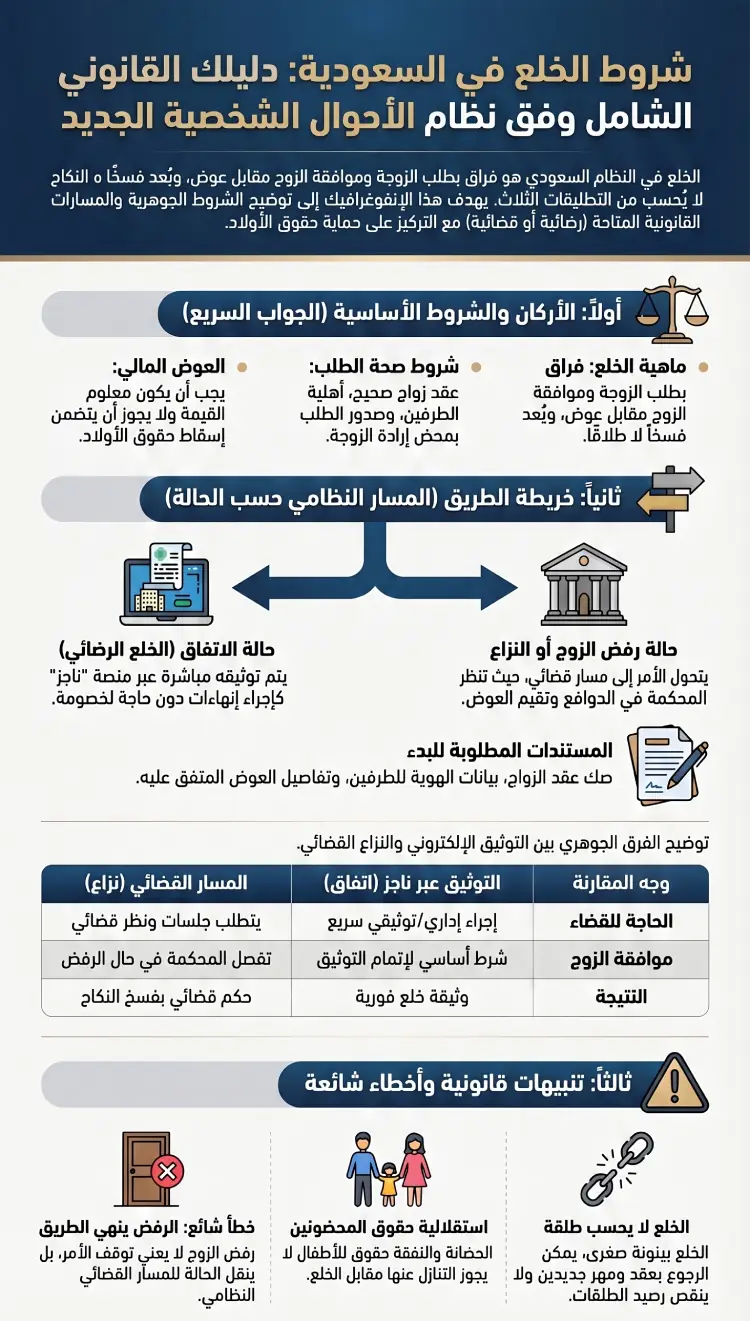
Infographic – Khula Requirements in Saudi Arabia
When Can a Wife Request Khula in Saudi Arabia?
A wife may request Khula when she wishes to end the marital relationship through this legal mechanism in return for compensation. However, making the request alone does not determine which procedural route applies.
The practical question is whether the case qualifies for consensual Khula or whether the facts indicate a dispute requiring a different judicial approach.
The principal requirements can be summarized as follows:
- A valid marriage contract must still be in force when the procedure begins.
- The request must be made by the wife.
- There must be legally valid compensation.
- The husband must consent where the parties are pursuing consensual Khula.
- Both parties must have the required legal capacity.
- Children’s rights must remain separate from any financial compensation agreed for Khula.
Common Khula Cases in Saudi Arabia
Not every Khula case follows the same route. Some cases can be completed through documentation relatively directly, while others involve court proceedings or disagreement over the amount or nature of compensation.
- Full agreement between the spouses: Where both spouses agree to Khula and its compensation, documenting Khula through Najiz is generally the most direct route. The process then focuses mainly on providing the required information, obtaining approval, and issuing the document.
- Husband refuses: If the husband refuses to approve the consensual Khula, the consensual documentation process cannot be completed. This does not necessarily mean that every possible legal route has ended; rather, the case becomes a dispute requiring careful assessment of the facts, documents, and appropriate legal characterization.
- Disagreement over compensation: The spouses may agree in principle that the marriage should end but disagree over the amount of compensation, the way it should be paid, or whether the compensation has been sufficiently identified. In such cases, the financial issue may become the central point of the dispute.
Which Route Is Usually Appropriate?
| Situation | Likely Route | Main Issue |
|---|---|---|
| Full agreement between spouses | Khula documentation through Najiz | Approval and identification of compensation |
| Husband refuses to approve | Judicial dispute | Legal characterization and supporting documents |
| Disagreement over compensation | Direct documentation may not be possible | Amount and evidence of compensation |
| Special circumstances, such as before consummation | More detailed legal assessment | Marriage contract and specific facts |
Does Khula Require the Husband’s Consent?
One of the most frequently asked questions about Khula Requirements in Saudi Arabia is whether the husband must consent and whether he has the right to refuse.
For consensual Khula, the answer is yes. This route is based on a request from the wife, the husband’s consent, and compensation. When both parties agree, documentation is therefore the ordinary procedural route.
If the husband refuses to approve the Khula or the consensual documentation process cannot be completed, the circumstances may require assessment by a Khula lawyer in Jeddah to determine the appropriate judicial route and prepare the claim correctly.
Khula Compensation and Its Legal Limits
Whether Khula can take place without compensation is another common question. Under the legal framework discussed here, Khula does not take effect if it is made without compensation.
Compensation is therefore not a secondary consequence of the agreement. It is a fundamental element of Khula itself, and its absence changes the legal characterization of the separation.
When considering the idea of Khula without compensation, three points are particularly important:
- Compensation is an essential element of Khula.
- The absence of compensation may change the legal characterization of the separation.
- Correctly identifying the applicable legal route from the outset can help prevent procedural difficulties later.
What Can Be Used as Compensation for Khula?
As a general rule, compensation for Khula may consist of money or something that may legally be treated as having financial value. This allows the parties some flexibility in determining the form of compensation, provided that it is clear and identifiable.
However, this general rule is subject to an important limitation. Children’s rights cannot be surrendered or used as compensation for Khula.
When discussing compensation, the following points should therefore be considered:
- The compensation should be known and capable of being identified.
- Children’s rights cannot be waived as Khula compensation.
- Keeping issues involving children separate from the Khula compensation helps ensure that the application is properly structured.
When Can Khula Be Confused with Judicial Dissolution of Marriage?
Confusion between Khula and judicial dissolution of marriage often arises when the issue is not simply whether the wife wants the marriage to end, but rather what the correct legal basis for ending the marriage should be and what consequences follow from that characterization.
Many cases involve questions beyond the desire to separate. For example: What is the reason for requesting separation? Is compensation involved? Do the circumstances indicate a dispute affecting the legal basis of the marital relationship or the possibility of continuing it?
These questions are central to distinguishing Khula from other routes for ending a marriage.
Khula is fundamentally based on separation in return for compensation. Judicial dissolution of marriage, by contrast, may be connected to facts or legal grounds that result in a different legal basis and different consequences.
Choosing a legal characterization before properly understanding the circumstances can therefore lead to an unsuitable procedural route or an incorrectly structured application.
Common areas of overlap include:
- A dispute concerning compensation or whether it is legally payable.
- Facts underlying the request for separation that go beyond a simple wish to end the marriage.
- The need to determine the correct legal effect before filing the application.
Where there is uncertainty between Khula and judicial dissolution, or disagreement over the correct characterization of the case, consulting a personal status lawyer in Jeddah may help determine the appropriate route before proceedings begin.
Najiz Documentation or Court Proceedings?
Understanding how Khula ends requires more than looking at the technical steps on an online platform. The choice between documenting Khula through Najiz and pursuing court proceedings depends first on the nature of the case.
Where both parties clearly agree on Khula and the compensation, electronic documentation is generally the more appropriate route for an agreed and organized case.
The distinction can be summarized as follows:
- Documentation is suited to a clear and complete agreement.
- Court proceedings are more appropriate where a dispute or factual complexity exists.
- Selecting the correct route begins with understanding the case, not merely choosing a platform.
Where the matter is likely to proceed judicially, it may also be useful to review the procedure for filing a Khula case to understand the practical steps involved.
When Is Documentation Through Najiz the Most Suitable Option?
Documentation is usually the most suitable option when the spouses agree both on Khula itself and on the compensation, with no fundamental dispute preventing the procedure from being completed.
In such cases, the Saudi Ministry of Justice provides a Khula documentation service through Najiz as part of its electronic social-status services. The process is therefore closer to documenting an agreement that already exists than resolving a dispute requiring judicial determination.
Documentation is generally more suitable where the following conditions are present:
- The husband agrees to the Khula.
- The spouses have a clear agreement regarding compensation.
- Required information and documents are complete.
- No fundamental dispute requires judicial determination.
What Does the Judicial Route Mean?
The judicial route involves more than simply moving from an electronic platform to a court. It requires the case to be organized legally from the outset.
Where the parties are in dispute, the legal characterization is uncertain, or disagreement exists concerning compensation or facts that affect the application, it becomes necessary to identify the correct legal request, prepare supporting documents, and structure the case appropriately.
In practice, this process commonly depends on:
- Identifying the correct legal request from the beginning.
- Gathering and organizing supporting documents.
- Understanding which facts affect the legal characterization of the case.
- Avoiding the premature filing of an incomplete or incorrectly structured application.
What Documents Are Commonly Required?
Having the necessary documents available is an important practical part of meeting the Khula Requirements in Saudi Arabia. Commonly relevant documents and information include:
- The marriage contract.
- Details of both spouses.
- Details of the agreed compensation.
- Documents related to the relevant facts of the case.
The clearer these elements are from the beginning, the more organized the procedure is likely to be.
Are Witnesses Required, and How Long Does Khula Take?
According to the Saudi Ministry of Justice information cited in the original article, witnesses are not required when submitting a request to document Khula.
This is an important distinction because information circulating online sometimes fails to differentiate between electronic documentation and disputed court proceedings.
As for the expected timeframe, two situations should be distinguished:
- Agreed documentation: The official service provides the relevant procedural information for the documentation process.
- Judicial dispute: There is no single timeframe applicable to every case, because the duration depends on the nature of the dispute, the completeness of the documents, and the procedures required in the individual case.
Common Mistakes That Can Delay Understanding or Procedure
When reviewing Khula Requirements in Saudi Arabia, several legal terms and procedural routes are often confused. Common mistakes include:
- Confusing Khula with divorce.
- Confusing Khula with judicial dissolution of marriage.
- Assuming that the husband’s refusal automatically ends every possible legal route.
- Expecting all Khula cases to follow the same procedure.
- Failing to address compensation or required documents from the beginning.
To reduce the risk of choosing the wrong route, start with two questions:
- What is the correct legal characterization of my case?
- Which route is more appropriate: documentation or a judicial dispute?
When Is a Legal Assessment Useful Before Starting?
A legal assessment becomes particularly relevant where there is:
- Refusal by the husband.
- A dispute concerning compensation.
- Possible overlap between Khula and judicial dissolution of marriage.
- Uncertainty about documents or the next procedural step.
Legal Review
Family Law Content
Saudi Arabia
Legal Review & Content Verification | BMS Legal
This article has been reviewed for legal clarity, topical accuracy, and reader usefulness by the legal content review team at BMS Legal. It is designed to explain the main Khula requirements in Saudi Arabia in a clear and practical way for website readers.
Important note: This content is for general informational purposes only. The appropriate legal route in a Khula case may differ depending on the facts, the available documents, the spouses’ agreement or disagreement, and the applicable judicial procedure.
Frequently Asked Questions About Khula Requirements in Saudi Arabia
What are the main requirements for Khula in Saudi Arabia?
Khula generally requires a valid marriage, legal capacity, a clear request for Khula, and an agreed compensation where applicable.
Does Khula require the husband’s consent?
The husband’s consent is relevant to consensual Khula. If no agreement is reached, the appropriate judicial route depends on the circumstances of the case.
Can Khula be granted without compensation?
Khula usually involves compensation. Whether it can proceed without compensation depends on the legal basis and the specific facts of the case.
Does Khula affect child custody rights?
No. Child custody, maintenance, and other children’s rights are considered separately and should not form part of the Khula compensation.
How is Khula documented in Saudi Arabia?
Where the spouses agree, Khula may be documented through the approved Ministry of Justice procedures, including the relevant services available through Najiz.
Understanding Khula Requirements in Saudi Arabia, including compensation and the effect of the husband’s refusal, is not merely a theoretical exercise. These rules help determine the correct route from the outset.
Where the spouses agree, documenting Khula through Najiz is generally the closest procedural route. Where there is refusal, disagreement over compensation, or facts that may overlap with judicial dissolution of marriage, accurately assessing the case becomes more important than rushing into a particular procedure.
In summary, Khula is based on several clear elements: a request from the wife, compensation, and an accurate distinction between consensual documentation and judicial proceedings. Children’s rights cannot be included as compensation, and understanding these rules from the beginning can reduce unnecessary procedural steps and help preserve the parties’ legal rights.
If the correct route remains unclear after considering the requirements, compensation, and effect of the husband’s refusal, the facts may be presented to a Jeddah law firm to identify the next appropriate step.
Official Sources: