
Article 85 of the Saudi Labor Law determines the percentage of the end-of-service benefit an employee is entitled to when the employment relationship ends due to resignation. The amount of entitlement depends on the length of service completed with the employer.
Resignation does not automatically eliminate an employee’s right to an end-of-service benefit. Instead, Article 85 sets the applicable entitlement percentage based on the employee’s service period. Understanding this provision helps employees evaluate their financial rights before ending their employment relationship.
Article 85 is part of the broader framework governing employment relationships in Saudi Arabia, including employee rights and employer obligations under the Saudi Labor Law rights and obligations framework.
Quick Answer: How Much End-of-Service Benefit Does a Resigning Employee Receive?
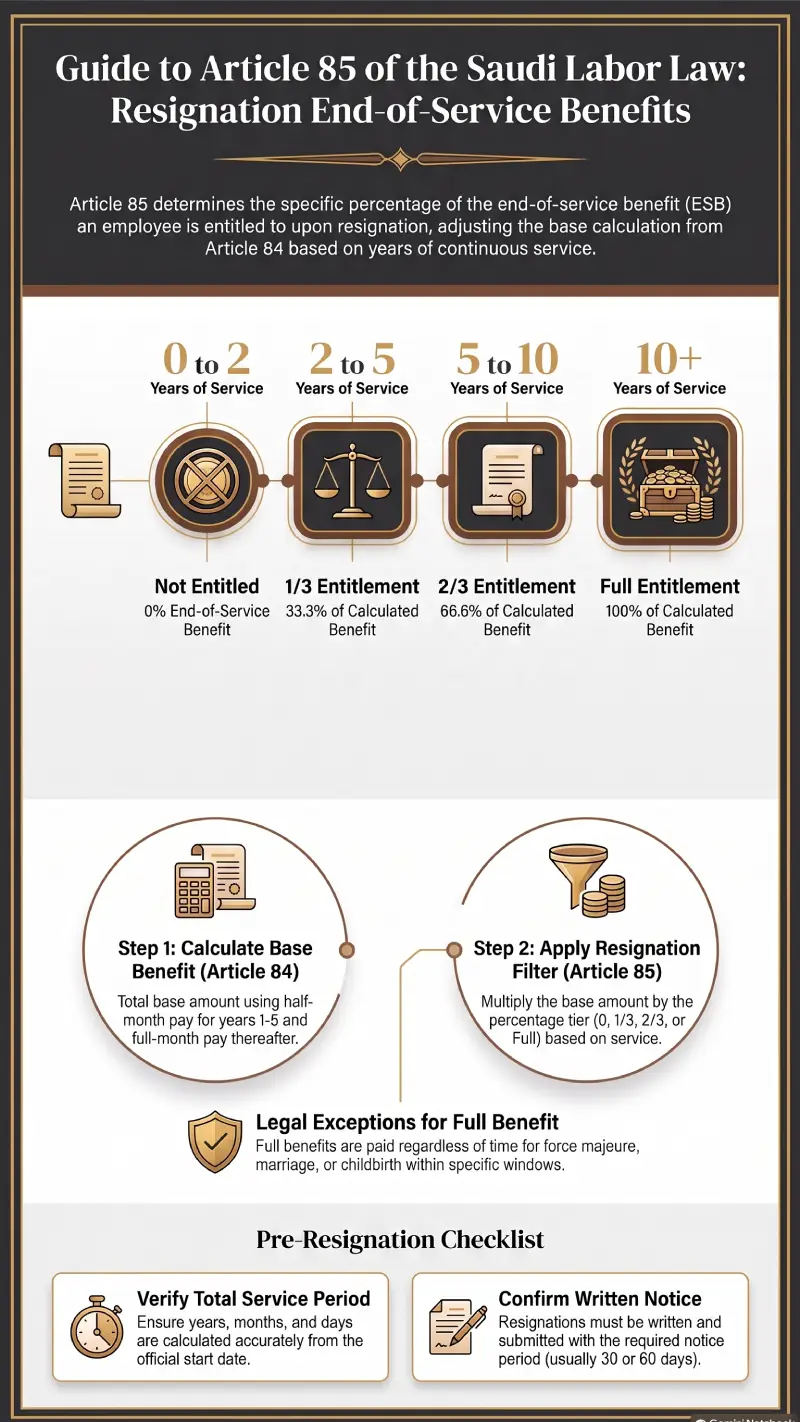
A resigning employee’s end-of-service benefit depends on the total period of service as follows:
| Service Period | Entitlement Percentage |
|---|---|
| Less than two years | No end-of-service benefit applies under resignation rules |
| From two to five years | One-third of the benefit |
| More than five years and less than ten years | Two-thirds of the benefit |
| Ten years or more | Full benefit |
What Is Article 85 of the Saudi Labor Law?
Article 85 of the Saudi Labor Law regulates the percentage of the end-of-service benefit payable upon resignation according to the provisions of the Saudi Labor Law.
The entitlement percentage depends mainly on the employee’s length of service. As the service period increases, the percentage payable to the employee also changes.
Calculating the End of Service Benefit after Resignation does not depend only on submitting a resignation. The employee’s service period, reason for termination, and the basic benefit calculation must all be reviewed.
Unlike the general rules governing end-of-service benefits, Article 85 addresses a specific situation: termination initiated by the employee through resignation.
Therefore, understanding this provision requires understanding its relationship with [Article 84 of the Saudi Labor Law](internal link), which establishes the basis for calculating the end-of-service benefit.
How Much End-of-Service Benefit Does an Employee Receive After Resignation?
The Resignation End of Service Benefit varies depending on the employee’s length of service. Employees who resign after a short period of employment do not receive the same entitlement as those who have completed longer service periods.
When calculating the End of Service Benefit after Resignation, the following rules apply:
- If the service period is less than two years, the employee is not entitled to the benefit under resignation rules.
- If the service period is between two and five years, the employee receives one-third of the calculated benefit.
- If the service period exceeds five years but is less than ten years, the employee receives two-thirds of the benefit.
- If the service period reaches ten years or more, the employee receives the full benefit.
Therefore, the answer to the question “How much does a resigning employee receive from end-of-service benefits?” depends on the actual completed service period.
The calculation is completed through two connected steps:
- Calculating the basic end-of-service benefit according to Article 84 of the Labor Law.
- Applying the entitlement percentage under Article 85 based on the employee’s service period.
The calculation formula is:
Payable Benefit = Basic End-of-Service Benefit × Resignation Entitlement Percentage
Example:
If the basic benefit calculated under Article 84 is SAR 60,000, and the employee is entitled to one-third of the benefit:
60,000 × 1/3 = SAR 20,000
If the employee qualifies for the full benefit:
60,000 × 1 = SAR 60,000
Therefore, calculating the End of Service Benefit after Resignation requires applying both Article 84 and Article 85, not Article 85 alone.
Article 85 is closely connected with Article 84 of the Saudi Labor Law, as Article 84 establishes the basic calculation method for the end-of-service benefit, while Article 85 determines the applicable entitlement percentage when employment ends through resignation.
Legal Review Box | BMS Legal
This guide was prepared to explain the rules of
Article 85 of the Saudi Labor Law
and how resignation affects the end-of-service benefit, including how the entitlement percentage is determined based on the employee’s length of service and its relationship with Article 84 of the Labor Law.
The final benefit amount may vary depending on the details of each case, including the employee’s length of service, the reason for ending the employment relationship, and the wage elements used in the calculation.
BMS Legal for Advocacy and Legal Consultations
License No.: 7053637679
Review Date: September 2026
What Is the Difference Between Article 84 and Article 85?
Understanding Article 85 of the Saudi Labor Law requires understanding the role of Article 84, as each provision serves a different purpose in determining the employee’s end-of-service benefit.
Article 84 establishes the basic calculation method for the end-of-service benefit payable when the employment relationship ends. Article 85, however, determines the percentage payable when the termination occurs because of the employee’s resignation.
| Article | Role in End-of-Service Benefit |
|---|---|
| Article 84 | Establishes the basic calculation of the end-of-service benefit |
| Article 85 | Determines the resignation entitlement percentage |
Accordingly, calculating the End of Service Benefit after Resignation does not depend on Article 85 alone. The process begins by calculating the basic benefit under Article 84, then applying the percentage specified under Article 85 according to the employee’s service period.
This distinction is important because knowing the basic benefit amount does not necessarily mean knowing the final amount payable to a resigning employee.
Employees can review the Official End-of-Service Benefit Provisions to understand the statutory framework governing end-of-service benefits under Saudi regulations.
When Is an Employee Entitled to the Full End-of-Service Benefit Despite Resignation?
As a general rule, an employee who resigns is subject to the entitlement percentages established under Article 85. However, certain situations may require a different legal assessment depending on the reason for termination and the circumstances surrounding the end of employment.
Before treating a case as a normal resignation, it is important to review the actual reason for leaving employment and the documents supporting the termination.
Special cases may include:
- Situations connected with Article 87 of the Labor Law.
- Leaving employment due to circumstances beyond the employee’s control where applicable.
- Cases where the employee leaves because the employer has failed to meet essential legal obligations.
The description of the termination as a “resignation” alone may not determine the final legal outcome. The actual circumstances and supporting documents should be reviewed to identify the applicable rules.
What Should an Employee Do If There Is a Dispute Over the End-of-Service Benefit?
If an employee and employer disagree about the value of the end-of-service benefit or the calculation method, the first step is to review the elements used in calculating the entitlement.
The following factors should be verified:
- The actual service period.
- The start and end dates of employment.
- The reason for termination.
- The wage used for calculation.
- The applicable entitlement percentage under Article 85.
Employment documents can help clarify the employee’s position, including:
- Employment contract.
- Resignation letter or termination documents.
- Salary statements.
- Documents proving the length of service.
If the dispute continues, the employee may follow the legal procedures available for labor claims, beginning with amicable settlement procedures and, if no agreement is reached, proceeding before the Labor Court.
In disputes involving benefit calculations or the classification of the termination reason, consulting a Labor Lawyer in Jeddah may help identify the appropriate legal approach based on the circumstances of each case.
Frequently Asked Questions About Article 85 of the Saudi Labor Law
1. What does Article 85 of the Saudi Labor Law provide?
Article 85 determines the percentage of the end-of-service benefit payable when an employee leaves employment through resignation. The percentage depends on the employee’s length of service.
2. Is a resigning employee entitled to an end-of-service benefit in Saudi Arabia?
Yes. A resigning employee may be entitled to an end-of-service benefit, but the applicable percentage depends on the completed service period under Article 85.
3. How is the end-of-service benefit calculated after resignation?
The benefit is first calculated according to Article 84 of the Labor Law, then the resignation entitlement percentage under Article 85 is applied.
4. How much does an employee receive after resigning after five years of service?
The entitlement depends on the exact service period. Under Article 85, service from two to five years results in entitlement to one-third of the calculated benefit.
5. Is an employee entitled to the full end-of-service benefit after ten years?
Yes. If the employee’s service reaches ten years or more, the employee is generally entitled to the full end-of-service benefit under Article 85.
6. What is the difference between Article 84 and Article 85?
Article 84 establishes the basic calculation of the end-of-service benefit, while Article 85 determines the percentage payable when employment ends due to resignation.
Article 85 of the Saudi Labor Law provides the framework for determining the end-of-service benefit entitlement when an employee resigns. The applicable percentage depends on the employee’s completed service period and the rules governing resignation cases.
Understanding the End-of-Service Benefit After Resignation helps employees evaluate their financial rights before ending the employment relationship. The final entitlement is not determined by resignation alone, but also by factors such as the length of service, the reason for termination, and the calculation method under the Saudi Labor Law.
When there is uncertainty regarding the calculation of the benefit or the classification of the termination, reviewing the employment details and applicable legal provisions can help identify the appropriate course of action.
BMS Legal provides legal reviews for labor-related matters and helps clarify available options under Saudi regulations.