
Elements of bribery under Saudi law determine whether a particular set of facts falls within a bribery offence or requires a different legal classification. The existence of money, a gift, or another benefit is not enough on its own. The legal assessment also examines the status of the parties, the nature of any request, acceptance, or receipt, its connection with an official act, and the intent shown by the surrounding facts and evidence.
The applicable legal classification may differ depending on whether the benefit was connected to performing an official act, refraining from one, breaching official duties, or using actual or purported influence. These distinctions also affect the relevant provision and potential sanction, as explained more broadly in the rules governing bribery penalties in Saudi Arabia according to the conduct and status of the parties.
What Are the Elements of a Bribery Offence under Saudi Law?
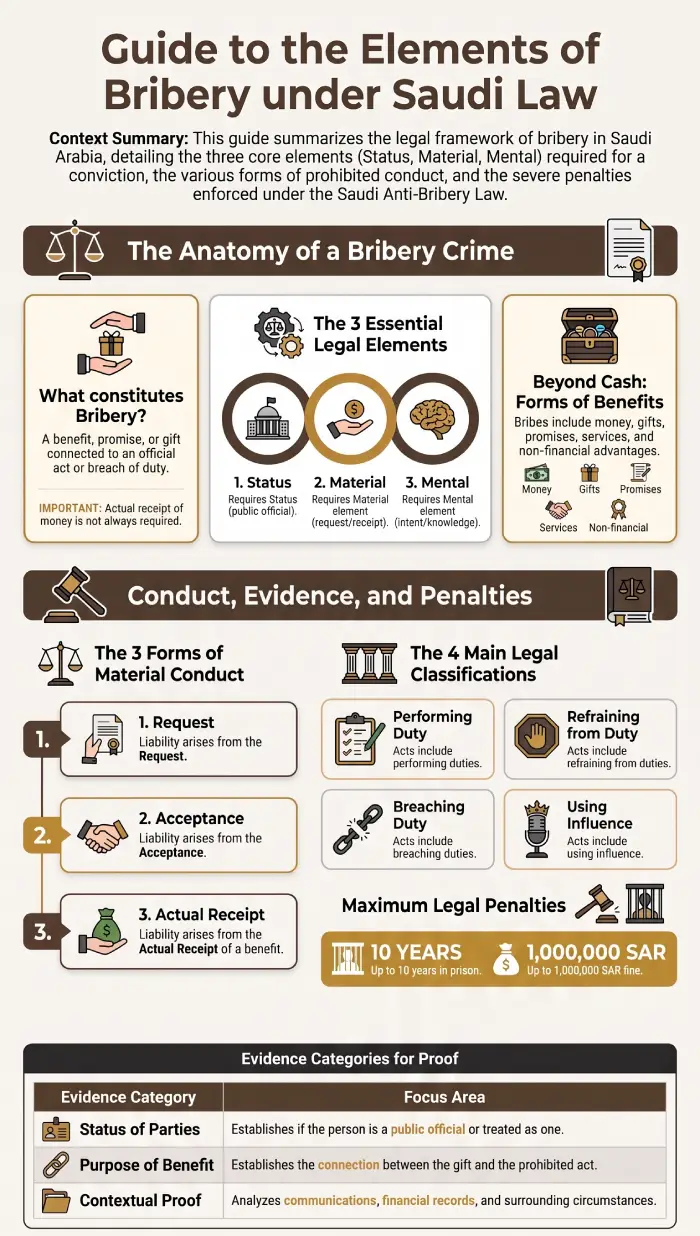
In the core public-sector bribery offences, the legal analysis generally focuses on three connected elements: the required legal status of the person involved, the material conduct linked to the benefit, and the mental element. Establishing only one of these points is not enough where the applicable provision requires the others as well.
Short answer: The three principal elements are the status element, where the law requires a public official or a person treated as one; the material element, involving a request, acceptance, or receipt connected with an official act; and the mental element, which concerns knowledge and intent. Their application depends on the specific offence and facts.
| Element | What is examined? |
|---|---|
| Status element | The person’s legal status and connection with the relevant office or function |
| Material element | The request, acceptance, or receipt and the benefit offered in return |
| Mental element | Knowledge of the nature of the benefit and intention to engage in the conduct |
The Status Element in a Bribery Offence
The status element refers to a legal capacity required by certain bribery provisions before the remaining elements are examined. It is particularly relevant where the offence is tied to a public official or another person whom the Saudi Anti-Bribery Law treats in the same manner.
This does not mean that every bribery-related offence in Saudi Arabia requires the offender to be a public official. The law also regulates other forms of bribery, including certain private-sector conduct and influence-related offences.
Examining the elements of bribery under Saudi law therefore begins with a question that can materially affect the legal classification: does the person have the status required by the provision governing this particular form of conduct?
The Material Element of Bribery
The material element concerns the outward conduct that connects the benefit with the official function or other protected interest. Article 1 of the Saudi Anti-Bribery Law covers forms of conduct including requesting, accepting, or taking a promise or gift in return for performing an act falling within the official’s duties, or which the official claims falls within those duties.
Accordingly, bribery is not limited to the physical receipt of money. A request, acceptance, and receipt are distinct forms of conduct, and identifying which one occurred is important when classifying the case.
The practical significance of the elements of bribery under Saudi law becomes clearer when the facts are reduced to a precise question: was there a request, an acceptance, or the taking of a promise or benefit?
The Mental Element of Bribery
The mental element concerns the person’s knowledge of the nature and purpose of the benefit and the connection between that benefit and the conduct attributed to them.
Intent is assessed from the surrounding facts, statements, documents, communications, and other available evidence. It should not be presumed merely because money changed hands or because the parties had a previous relationship.
The Status Requirement and the Meaning of a Public Official
Determining the person’s legal status is an important part of assessing the elements of bribery under Saudi law. Some provisions depend on the person being a public official or someone treated as one, while other provisions apply to a broader category of persons.
The assessment should therefore focus on the individual’s actual legal position and function, rather than relying only on their job title.
Who Is Treated as a Public Official?
Article 8 extends the relevant status beyond conventional permanent government employees. It covers several categories, including persons working for the state or public legal entities, certain arbitrators and experts, persons assigned specific duties by public authorities, and specified persons working in public utilities, joint-stock companies, banking institutions, and public-benefit associations.
The provision also extends, within the scope specified by the law, to foreign public officials and employees of international institutions and organisations in connection with international business transactions. The wording was affected by the 1443 AH amendments to the Saudi Anti-Bribery Law.
Must the Official Have Formal Authority Over the Act?
Articles 1 and 2 address an act falling within the official’s duties or an act the official claims to fall within those duties. The analysis therefore does not necessarily end simply because the act was outside the person’s formal authority.
This is distinct from the offence involving actual or purported influence. Article 5 was amended so that its scope is no longer framed solely around public officials and may apply to any person who meets the conditions of that provision.
What Conduct Forms the Material Element of Bribery?
The material element identifies what actually happened: did the person request a benefit, accept an offer, or take a promise or benefit? These concepts should not be treated as interchangeable because each describes a different form of conduct.
The benefit must also be examined in connection with what was expected in return.
Requesting a Bribe
A request arises where the official seeks a promise or benefit for themselves or another person in return for conduct covered by the relevant provision.
The offence is not necessarily dependent on the other party later paying or delivering the benefit. A request itself is expressly recognised as one of the forms of prohibited conduct under the core provisions of the Saudi Anti-Bribery Law.
Accepting a Bribe or a Promise
Acceptance differs from a request because the proposal for the benefit originates from the other party and is then accepted by the official.
The acceptance may concern a promise of a future benefit rather than something transferred immediately. For that reason, whether money was physically received is not the only issue when assessing the conduct.
Taking a Gift or Benefit
Taking refers to obtaining the gift or benefit connected with the relevant official conduct. The benefit does not have to consist of cash.
Article 12 of the Saudi Anti-Bribery Law treats any advantage or benefit obtained by the recipient, whether material or non-material, as potentially falling within the concept of a promise or gift.
A non-financial advantage may therefore fall within the scope of the law where the required connection with the prohibited conduct is established. The mere existence of a benefit, however, does not by itself prove bribery without examining why it was given and what it was connected to.
How Is Bribery Legally Classified in Saudi Arabia?
Legal classification determines which provision applies after the conduct, benefit, and status of the parties have been examined. Four important forms illustrate why the elements of bribery under Saudi law cannot be assessed without identifying what the benefit was intended to obtain.
The distinction matters because performing an act, refraining from an act, breaching a duty, and using influence are not treated as identical conduct.
Bribery in Return for Performing an Official Act
Article 1 addresses requesting, accepting, or taking a promise or gift in return for performing an act falling within the official’s duties, or which the official claims falls within those duties.
The fact that the underlying official act is itself lawful does not necessarily prevent bribery from being established if the benefit was provided in return for performing that act in the manner prohibited by law.
Bribery in Return for Refraining from an Official Act
Article 2 addresses a benefit connected with refraining from an act falling within an official’s duties, or which the official claims falls within those duties.
The assessment therefore focuses on the act the person was expected to refrain from performing, its relationship with their function, and the reason for the requested, accepted, or received benefit.
Bribery Involving a Breach of Official Duties
Article 3 concerns requesting, accepting, or taking a benefit in return for breaching official duties. It also addresses a reward for a breach that has already occurred, subject to the conditions of the provision.
The timing of the benefit therefore does not by itself determine the outcome. A benefit given after the relevant conduct may still require examination under the law.
Use of Actual or Purported Influence
Article 5 deals with benefits connected with the use of actual or purported influence to obtain, or attempt to obtain, from a public authority an act, decision, licence, service, advantage, or another result covered by the provision.
Following the amendment to Article 5, the provision is no longer framed as applying only to a public official. That distinction can materially affect the legal classification of a case.
How Is the Mental Element of Bribery Established?
The mental element focuses on whether the person knew the nature and purpose of the benefit and intentionally engaged in the conduct connected with it.
This issue is assessed through the relationship between the benefit and the official act, the sequence of events, communications between the parties, documents, and other circumstances. Two cases that appear similar on the surface may therefore lead to different conclusions depending on what can actually be established about the purpose of the benefit.
Must the Agreed Official Act Actually Be Performed?
Not necessarily. Articles 1 and 2 provide that an intention on the part of the official not to perform the act they promised to perform does not prevent the offence from arising where the remaining requirements are satisfied under the Saudi Anti-Bribery Law.
Accordingly, a later failure to perform the act does not automatically erase the legal effect of an earlier request or acceptance if the prohibited conduct had already occurred.
When May the Mental Element Be Disputed?
A dispute may concern whether the person knew why the benefit was being provided, whether the benefit was genuinely connected with an official act, or whether there was an independent explanation supported by the documents and circumstances.
None of these matters produces an automatic outcome. The court evaluates the evidence and arguments as a whole when determining whether the required mental element has been established.
How Are the Elements of Bribery under Saudi Law Proven?
A bribery case does not necessarily turn on a single bank transfer, message, or recording. The evidential assessment instead considers whether the evidence as a whole establishes the required status, conduct, purpose of the benefit, connection with the relevant function, and mental element.
The sequence of events and context of each item of evidence can therefore be as important as the existence of the document itself.
What Evidence May Be Examined?
Depending on the case, the evidential record may include statements, correspondence, financial transfers, documents, official records, digital evidence, and other materials.
A bank transfer does not by itself prove bribery unless its purpose and connection with the alleged conduct are established. Likewise, a digital message must be examined in its context and attributed to the relevant person.
Once the matter moves into the stage of statements, evidence collection, and formal questioning, preserving and organising relevant records becomes part of dealing with criminal investigation procedures in Saudi Arabia, before any final determination is made on whether the allegation has been proved.
What Happens If One Element Is Not Established?
Failure to prove an element required by the particular provision may affect whether that provision can properly apply. The issue may concern the required legal status, the absence of a proven request or acceptance, the lack of a demonstrated connection between the benefit and the official act, or the mental element.
However, the failure of one particular legal classification does not necessarily mean that no other provision may apply. The Saudi Anti-Bribery Law regulates several forms of conduct with different requirements.
What Are the Penalties Once the Elements of Bribery Are Established?
Once the elements of bribery under Saudi law are established, the applicable penalty is determined by the provision governing the particular conduct rather than by the label “bribery” alone.
Article 1 provides for imprisonment for up to ten years, a fine of up to SAR 1,000,000, or either penalty. Articles 2 and 3 apply the same punishment to the conduct they regulate under the Saudi Anti-Bribery Law.
These limits do not mean that every bribery-related offence carries an identical penalty. The law provides different penalties for certain forms of conduct, while Article 10 regulates the liability of the bribe-giver, intermediary, and participants by reference to the provision governing the offence in which they participated.
The differences become clearer when comparing the various penalties for bribery offences in Saudi Arabia, including additional consequences that may apply where their statutory conditions are satisfied.
Refusal by the public official does not make the offer lawful. Article 9 separately addresses offering or promising a bribe that is not accepted, meaning that an unsuccessful offer may still fall within the scope of the law.
BMS Legal
Legal Review & Professional Verification
This article has been reviewed by the legal team at BMS Legal for consistency with the
Saudi Anti-Bribery Law and to ensure a clear explanation of the
elements of bribery under Saudi law, legal classification, evidence, and applicable penalties.
legal definition, status requirement, material element, mental element, legal classification, evidence, and the general penalty framework.
legal wording, statutory consistency, heading structure, clarity of explanation, and alignment with the relevant Saudi legal provisions.
September 2026
This content is provided for general legal information. The legal assessment may differ depending on the facts, evidence, documents, and procedural stage of each case.
Frequently Asked Questions About the Elements of
What are the elements of a bribery offence under Saudi law?
They generally include the required legal status, the material act of requesting, accepting, or receiving a benefit, and the mental element of knowledge and intent.
Is requesting a bribe enough for an offence to arise?
Yes, in some cases. A request may itself constitute the prohibited conduct if the other statutory requirements are met.
Must the bribe money actually be received?
No. Liability may arise from requesting or accepting a promise or benefit even before any money is received.
Is a gift to a public official always considered a bribe?
No. Its purpose, timing, and connection with an official act must be examined.
What happens if one element of bribery cannot be proved?
The specific bribery charge may fail if a required element is not established, although another legal provision may still apply.
Is a person liable for offering a bribe that the official refuses?
Yes. Saudi law separately criminalizes an unaccepted offer or promise of a bribe.
Elements of Bribery under Saudi Law: 3 Elements, 4 Forms and Penalties provides a practical framework for examining a case from the outset: first the required status, then the material conduct and mental element, followed by the specific form of conduct and the provision governing the potential penalty.
The amount of money involved, the existence of a message, or a financial transfer does not determine the outcome by itself. The legal classification depends on why the benefit was provided, its relationship with an official function, the sequence of events, and what the evidence establishes.
Where a case has already reached the stage of a summons or criminal investigation, an early review of the facts and documents can help identify the provisions and procedural issues that may affect the matter. A criminal defense lawyer in Jeddah at BMS Legal can review the case and explain the next legal step according to its facts and procedural stage.