
Inheritance waiver procedures in Saudi Arabia start with identifying the share being waived, before any declaration is documented. A waiver is not a division of the whole estate and not just a family understanding. It is a legal act by an heir who leaves all or part of his or her share in favour of a specific person.
Before you sign, ask yourself which share you are waiving, in favour of whom, whether there is a payment in return, and whether there is a property, a power of attorney or a dispute among the heirs. The answers decide whether the procedure is sound.
A waiver cannot be separated in practice from establishing the heirs, knowing the shares and understanding the nature of the property involved, so it helps to see the whole picture of inheritance and estates in Saudi Arabia first.
Before you sign a waiver, is the share clear?
Gather the inheritance deed, the property documents, any power of attorney and proof of payment. A BMS Legal lawyer in Jeddah can give them an initial review.
Enquiries are handled confidentially · No specific court outcome can be guaranteed
The Deciding Point Before You Sign
The procedure does not begin with a ready-made form. It begins with knowing the effect of the waiver on your right. If the share is unclear, or the waiver relates to a property or a payment, a short wording can open a dispute later.
The practical rule: do not sign a waiver whose limits you do not know, and do not rely on a general phrase such as “I waived my right” without describing the share or the property. Documentation matters, but it does not always cure coercion, uncertainty or an incomplete power of attorney.
| Situation | Most suitable step |
|---|---|
| Waiver of the whole share | Document a declaration once the share is clear |
| Waiver of an inherited property | Check the deed, the share and the transfer route |
| Waiver against a payment | Prove the payment and how it will be made |
| Dispute among the heirs | Review the documents before signing |
| Waiver through an agent | Check the agent’s powers carefully |
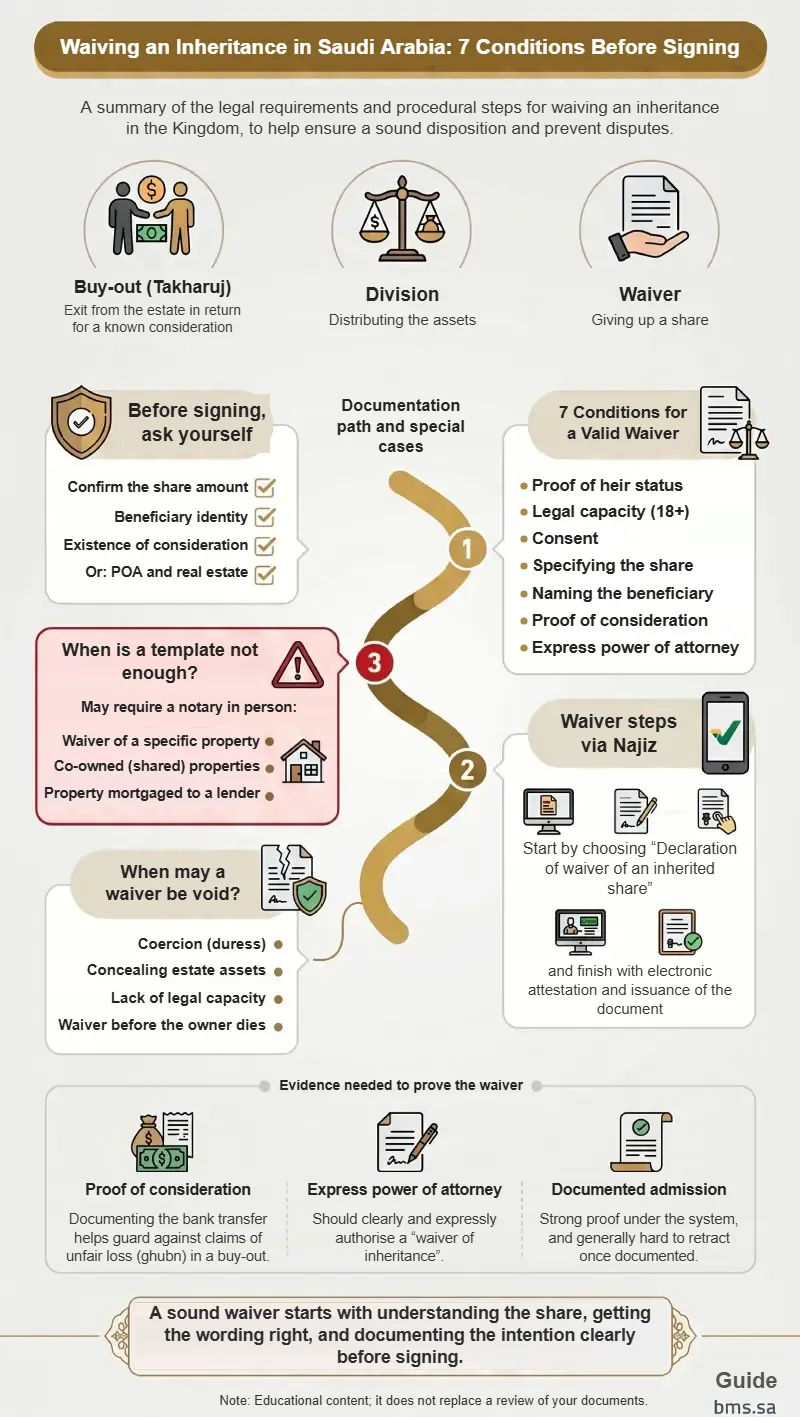
Seven Conditions Before Documenting a Waiver
The conditions of an inheritance waiver revolve around capacity, consent and the clarity of what is being waived. A family wish to waive is not enough if the wording does not show what was left and to whom.
Before documenting the waiver, review these conditions:
- Proof that you are an heir, by an inheritance deed or an equivalent document.
- Full capacity of the person waiving at the time of the declaration.
- Clear consent, without coercion or undue pressure.
- A share or property that is identified well enough.
- A named beneficiary, with no uncertainty over name or status.
- Proof of the payment where the waiver is for money or in kind.
- An express power of attorney where the waiver is made through an agent.
Having the document does not mean the waiver has happened or that the estate has been divided, but it proves who is an heir. The details of obtaining it are in our guide to the Najiz electronic inheritance deed in Saudi Arabia.
What Does Waiving an Inheritance Between Heirs Mean?
An inheritance waiver is an act by an heir who gives up his or her share, or part of it, in favour of another person. It may cover the whole inherited share, a sum of money, or a share in an inherited property.
A waiver is different from dividing the estate. Division distributes the estate’s assets among the heirs, whereas a waiver is an individual act or a specific agreement about one heir’s share. The wording for a division should not be used in place of a waiver, or the reverse.
A waiver also differs from an heir’s withdrawal from the estate in return for compensation. A waiver can be free of charge, while a withdrawal is usually linked to an heir leaving the estate for a payment. If there is a payment, it must be stated expressly so that it does not turn into a new claim later.
A waiver concerns an heir’s dealing with his or her own share. Turning shares into an actual distribution of a house, land or rent belongs to the steps in how to divide inheritance in Saudi Arabia.
Inheritance Waiver Procedures in Saudi Arabia
The procedure follows a practical path: prove capacity as an heir, identify the share, settle the wording, then document. Not every waiver is complicated, but complexity usually appears with a property, a power of attorney or a payment.
The practical steps are:
- Review the inheritance deed to confirm capacity and shares.
- Decide whether the waiver is of the whole share or part of it.
- State the beneficiary and his or her details clearly.
- State whether the waiver is for a payment or free of charge.
- Check the deeds where the subject is a property.
- Check the power of attorney where an agent will sign.
- Document the declaration or the wording and keep a copy.
If the size of the share is not clear, fixing it before signing starts with how to calculate inheritance in Saudi Arabia, so that you do not waive a right you do not understand.
Waiving an Inheritance Share Through Najiz
The Ministry of Justice offers an e-service in Najiz for a declaration waiving an inherited share. It is designed for a beneficiary to declare a waiver of a share that belongs to him or her, according to the data and procedures the platform requires.
The service usually runs through these steps, although the platform screens and names may change:
- Sign in to Najiz (individuals) through the national single sign-on.
- Open the list of all e-services.
- Go to the package of powers of attorney and declarations.
- Choose the service for declaring a waiver of an inherited share.
- Submit a new request and enter the parties’ details.
- Review the details of the declaration before approving.
- Approve the request once the data has been checked.
Using Najiz is not enough on its own in every case. A prior review may be needed where the waiver concerns a property, involves a payment, is made through an agent, or is linked to a dispute among the heirs.
Is your waiver wording complete?
Name the share, the beneficiary and any payment, and check the deed and the power of attorney before you sign. A short wording can leave room for a later dispute.
Enquiries are handled confidentially · No specific court outcome can be guaranteed
Wording for an Heir’s Waiver in Favour of Another Heir
A waiver wording must be specific about the parties, the share, any payment and the limits of its effect. A weak wording does not prevent a dispute; it lets each side read it differently.
| Item | Purpose |
|---|---|
| Details of the waiving heir | Identify the owner of the share |
| Details of the beneficiary | Identify who benefits from the waiver |
| Details of the deceased | Link the waiver to the estate |
| Description of the share | Show whether the waiver is total or partial |
| Payment | Show whether anything is given in return |
| Declaration of consent | Reduce disputes about coercion |
| Limits of the waiver | Prevent an expanding interpretation |
It is better for the wording to state that the waiving heir knows what is being waived, that the decision was made freely, and which share or asset is covered. A ready-made form is not recommended where the waiver concerns a property or involves a payment.
Proving a Waiver When There Is a Dispute
Proof of a waiver does not rest on intention or family talk alone. It needs a document, a declaration or acceptable evidence. Proof matters when the waiver is denied, coercion is alleged, or the payment is disputed.
The main means of proof include:
- A documented declaration waiving the inherited share.
- A written wording signed by the waiving heir.
- Messages showing consent or the terms agreed.
- A bank transfer or receipt proving the payment.
- An express power of attorney where the waiver was made through an agent.
- Property documents where the waiver concerns a deed.
A signed paper is not enough if it is vague. It should show what was waived, whether it was for a payment, and whether it covered the whole share or only a specified part.
With or Without a Payment
A waiver may be free of charge, or it may be for money or in kind. The difference matters in drafting and proof, especially if a dispute appears after documentation.
In a free waiver, focus on consent, capacity and clarity of the share. It is better for the wording to say expressly that the waiver is without compensation and that the waiving heir knows its effect.
In a waiver for a payment, state the value, how it will be paid and the payment date. If the payment is deferred, prove the term and the way it will be settled so that the dispute does not become a separate claim.
Waiving an Inherited Property
Waiving a share in an inherited property needs particular care, because a property involves a deed, a transfer procedure, a tax question and possibly a mortgage. A general wording that omits the property details or the waiving heir’s share is not enough.
Check the following before signing:
- The deed number and the property details.
- Whether the property is divided or held in common.
- The waiving heir’s share in the property.
- The name and status of the beneficiary.
- Whether the waiver is free or for a payment.
- Whether there are encumbrances, a mortgage or a dispute.
- The route for transferring title or updating ownership.
Check how real estate transaction tax applies to a transfer of this kind, since the treatment can depend on the facts. The Zakat, Tax and Customs Authority publishes a guide on that tax, which is available in Arabic. If the property cannot be dealt with because an heir refuses to sell or divide, the file may move from a voluntary waiver to a claim, as in compulsory division of inherited property in Saudi Arabia.
Waiving an Inheritance Through an Agent
A waiver can be made through an agent if the power of attorney is valid, express and suitable for the procedure. A waiver is not a routine administrative step, so a general power of attorney is not always enough.
Before relying on a power of attorney, check the following:
- It was issued by the owner of the share, or by someone with legal authority.
- It states the power to waive or to make a declaration in clear words.
- It includes the power to deal with the property if the waiver concerns a deed or a transfer.
- It mentions receiving the payment where the waiver is for money.
- It is still valid at the time of signing or documenting the declaration.
Where the waiver is made by an agent, the limits of the authorisation become part of the soundness of the declaration, so the powers should match the wording and not remain general or incomplete.
Can a Waiver Be Withdrawn or Challenged?
As a general rule, a documented waiver is not cancelled merely because of regret or a change of mind. Legal stability calls for respecting declarations made freely and in clear wording.
A challenge may be considered where there is a significant reason, such as coercion, deception, forgery, lack of capacity or a fundamental mistake about what was waived. A dispute may also arise where the payment in a waiver for compensation cannot be proved.
The difference between regret and a challenge matters. Regret means changing your mind after signing, whereas a challenge needs a provable reason before the court or the competent body. Whether any reason applies in a given case is a legal question for review of the documents.
If the problem is that an heir refuses to sell or delays the division, the route is different from a waiver, as explained in how to claim inheritance in Saudi Arabia.
When Do You Need an Estates Lawyer Before Waiving?
Not every waiver needs a court or a dispute, but some cases justify a legal review before signing. The aim of the review is to understand the effect of the waiver, not to delay the procedure or inflate the disagreement.
A review is important where:
- There is an inherited property that needs a deed or a transfer.
- There is a large or deferred payment.
- The waiver is made through an agent.
- A minor or a person with limited capacity is involved.
- The size of the share is unclear.
- There was an earlier disagreement among the heirs.
- The waiver favours one heir over the others.
- A challenge after documentation is possible.
Where a property, a payment, an agent or a possible challenge is involved, reviewing the documents with an inheritance and estates lawyer in Jeddah is a practical step to understand the effect of the waiver before it is signed or documented.
Trust and Legal Basis
Trust and Legal Basis
Legal basis
This guide is based on the Ministry of Justice e-service for declaring a waiver of an inherited share and the official texts listed below, and is written for general legal awareness rather than as advice on a specific case. It does not replace a review of the inheritance deed, the property documents, any power of attorney and the payment terms.
Published by: BMS Legal Law and Legal Consultancy Company.
Address: Jeddah, Al-Mishrifah District, Palestine Street, Al-Safeer Tower
Frequently Asked Questions About Inheritance Waiver Procedures
What are the procedures for waiving an inheritance in Saudi Arabia?
They start by proving that you are an heir, then identifying the share being waived, settling the wording and documenting the declaration.
Is a waiver different from dividing the estate?
Yes. A waiver is an heir's act concerning his or her own share, while division distributes the estate's assets among the heirs.
What are the conditions for waiving an inheritance?
The main ones are capacity, consent, a clear share, a named beneficiary and proof of any payment.
Can an heir waive a property?
Yes, but the deed, the share, any encumbrances and the transfer route should be checked before signing.
Can a waiver be made through an agent?
It can, if the power of attorney expressly covers the waiver or declaration and the property dealing where relevant.
Can a waiver be withdrawn after it is documented?
Not merely because of regret. A challenge may be considered if there is a provable reason such as coercion, deception, lack of capacity or a fundamental mistake.
Conclusion
Inheritance waiver procedures in Saudi Arabia are not a formality. A sound waiver needs capacity, consent, a clear share, a named beneficiary, careful wording and suitable proof, and it should not be confused with establishing the heirs, calculating shares or dividing the estate.
If you have a draft waiver or inheritance documents that need an initial check, you can contact our legal team to present the case and identify the right step before the waiver is approved.
To have your waiver wording and estate documents reviewed before signing, contact BMS Legal in Jeddah for a preliminary review.
A property, a payment or an agent involved?
Send us a short description of the waiver and a BMS Legal lawyer in Jeddah will tell you what to check before it is signed or documented.
Enquiries are handled confidentially · No specific court outcome can be guaranteed
Official Legal and Government Sources
- Ministry of Justice: declaration waiving an inherited share e-service (Arabic-language official website)
- Bureau of Experts: Personal Status Law (Arabic-language official website)
- Zakat, Tax and Customs Authority: real estate transaction tax guide (Arabic-language official document)
Disclaimer: This article is for general legal awareness and is not advice on an individual case, and reading it does not create a lawyer–client relationship. The legal assessment varies with the facts, the documents and the rules that apply to each case.