
The penalty for killing in self-defense in Saudi Arabia depends on whether the legal conditions of self-defense are proven, how the incident unfolded, and how strong the evidence is before the court. A person’s statement that they acted in self-defense is not enough on its own to change the legal classification of the case.
This type of incident remains a specific branch of homicide cases in Saudi Arabia. Its main test is whether there was an immediate threat and whether the response stayed within the limits of lawful defense. For that reason, these cases should be handled carefully from the beginning, because the first statements, police report, and medical evidence may affect the entire file.
How Should the Penalty for Killing in Self-Defense Be Understood?
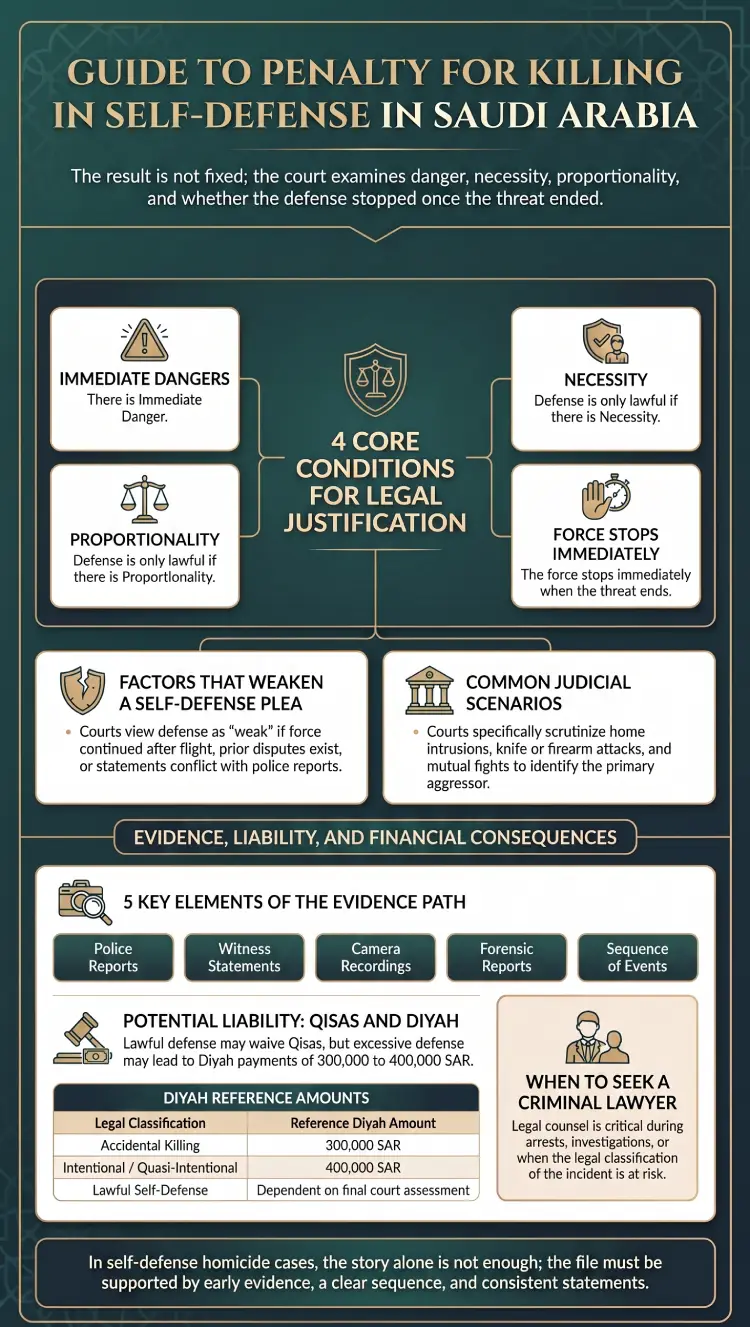
The penalty for killing in self-defense in Saudi Arabia is not fixed in every case. It changes according to whether the conditions of lawful self-defense are met. If the killing occurred to repel an immediate danger that could not be avoided by a lesser means, this may affect criminal liability, qisas, and diyah.
If the response appears to have been revenge, continued after the danger ended, or exceeded what was necessary, the legal classification may change. The court does not rely only on the title of the incident. It examines the evidence, the sequence of events, and the surrounding circumstances.
What Does Killing in Self-Defense Mean in Saudi Arabia?
Killing in self-defense in Saudi Arabia means using force to repel a direct unlawful attack threatening life, honor, or property. This meaning is linked to the concept of lawful defense and the traditional legal idea of repelling an aggressor.
An aggressor is a person who starts an unlawful attack that places another person in an urgent need to protect themselves or others. Still, self-defense is not accepted merely because an attack happened. The response must remain within necessity and proportionality, and it must not turn into personal punishment.
Before assessing the legal effect of killing in self-defense, it is important to distinguish lawful defense from revenge. Both situations may lead to the same physical result, but the court examines intent, timing, the sequence of the attack, and whether the danger still existed when the act occurred.
| Point of Comparison | Lawful Self-Defense | Revenge |
|---|---|---|
| Intent | Repelling an existing danger | Causing harm after the incident |
| Timing | During or immediately before the attack | After the danger has ended |
| Legal effect | May affect liability | May support criminal intent |
| Court assessment | Necessity and proportionality | Intent and sequence of events |
The difference between self-defense and intentional homicide lies mainly in intent and context. For cases where the will is directed toward unlawful aggression, the legal consequences are better understood through the penalty for intentional killing in Saudi Arabia.
Conditions of Lawful Self-Defense in Homicide Cases
Saudi courts do not accept a self-defense argument based only on a dispute or general fear. The facts must show that the danger was real, immediate, and that the response was necessary at that moment. The conditions of self-defense in Saudi Arabia usually revolve around four main elements:
| Condition | Practical Meaning | What the Court Examines |
|---|---|---|
| Immediate danger | An ongoing or imminent attack | How the attack started and unfolded |
| Necessity | No lighter means was available | Whether escape or help was possible |
| Proportionality | A response matching the level of danger | The tool used and severity of the act |
| Stopping the defense | The response ends when danger ends | Whether force continued after the aggressor fell |
Immediate Danger, Necessity, and Proportionality
Immediate danger is the first condition in cases involving killing in self-defense in Saudi Arabia. A past threat or earlier dispute is not enough if there was no direct attack at the time of the incident. Necessity means that the killing was not a rushed option, but a response to danger that could not be repelled by a lighter method.
Proportionality does not require the defensive tool to be identical to the attacker’s tool. It means the response must not exceed the danger. If lethal force is used against a limited threat that could have been repelled by a lesser means, the court may view the defense as excessive.
Lawful defense also ends when the threat ends. If the act continues after the aggressor falls, flees, or stops attacking, the response may become an excess that affects the legal classification of the case.
Does Qisas Fall Away in Killing in Self-Defense Cases?
Proving full lawful self-defense may affect a qisas claim, because the court first examines whether the act was aggression or a response to danger. It is not accurate to assume that qisas will fall away before the facts and evidence are examined.
In killing in self-defense and qisas, the court considers both private and public rights. The private right relates to the claim of the victim’s heirs, while the public right relates to public order and community safety.
The effect of self-defense on qisas and public prosecution depends on the criminal process, from investigation to trial. If self-defense is established under its conditions, the result may differ from an ordinary intentional homicide case. If excess is proven, the court may examine its effect on classification and the appropriate legal consequence.
Is Diyah Payable in Killing in Self-Defense Cases?
Diyah in killing in self-defense cases is not decided simply because the accused describes the incident as lawful defense. If the court finds that the act was necessary and within proportional limits, the result may differ from cases where liability is established. If the response involved excess, or if there is doubt affecting proportionality, diyah may be examined according to the final legal classification.
Diyah becomes especially relevant when the case moves away from full self-defense into another classification, such as accidental killing, quasi-intentional killing, or excessive defense. Published Saudi judicial sources refer to 300,000 SAR for accidental killing of a Muslim man, and 400,000 SAR for intentional and quasi-intentional diyah. These figures should therefore be tied to the legal classification, not merely to the phrase “self-defense.”
The practical distinction is that established lawful defense may affect liability itself, while excess may open the door to diyah or other legal consequences. The key question is not only whether diyah exists, but whether the defense was complete or whether doubt or excess changed the nature of the incident.
How Can You Prove the Killing Was in Self-Defense?
Proving killing in self-defense begins with the first version of events, because it shapes the initial legal understanding of the incident. The accused’s statements should be consistent with the scene, medical report, and witness testimony. The clearer the evidence is in showing the start of the attack, the reason for the response, and the point at which the defense stopped, the stronger the self-defense argument becomes.
The accused’s rights during investigation become especially important when early statements affect how the attack and response are understood. In homicide cases, the first account may later become difficult to correct if it conflicts with physical evidence or official records.
Police Report and Technical Evidence
The police report shows how the incident began, how it was handled, and what the first statements were. Any contradiction between the first account and later evidence may weaken the self-defense argument.
Important evidence may include witness statements, surveillance cameras, recordings, medical reports, injury locations, and previous messages or threats if they are connected to the immediate danger. Cameras alone are not always sufficient, but they can be decisive when they show who started the attack and how the confrontation developed.
Repelling an Aggressor in Saudi Arabia
Repelling an aggressor is linked to the idea of responding to a person who creates an unlawful danger to life, honor, or property. However, this does not mean that killing is allowed in every case of aggression. Defense must be limited to what is needed.
If the danger could have been repelled by shouting, seeking help, escaping, or using a lighter means, the court may not accept lethal force. The self-defense argument becomes stronger when the evidence proves that the attack started from the other party and that the response stopped once the danger ended.
The argument becomes weaker if the danger had already ended, the aggressor was fleeing, or the defender continued acting after the threat disappeared. In these situations, the case may move from lawful defense into excessive defense requiring careful legal assessment.
Common Scenarios in Killing in Self-Defense Cases
The court’s assessment differs according to the place of the incident, the nature of the attack, and the tool used. Entering a home may strengthen the defender’s position if it is linked to a direct threat to life or honor. However, entry alone is not enough if no real or imminent danger appears.
If someone attacks with a knife, this may support the existence of serious danger. Still, the court will examine whether the response was necessary and whether the defender stopped when the danger ended.
Killing during a mutual fight is more complex. When both parties engage in violence, identifying the first aggressor may become difficult, especially if statements conflict or witnesses are absent. The use of a knife or firearm also does not decide the case on its own. The main question remains the size of the danger, why the tool was used, and whether the response stayed within necessity.
Where aggression becomes intertwined between both sides, the legal classification may require closer separation of responsibility in killing during a fight or altercation.
When Does Self-Defense Become a Crime?
Self-defense may become a crime when the response departs from its original purpose: repelling danger. If the act becomes revenge or personal punishment, it may lose its lawful character.
Excessive self-defense may appear when a person pursues the aggressor after they flee, continues striking after they become unable to attack, or uses lethal force against a danger that could have been repelled by a lighter means.
Weak evidence can be as damaging as weak legal conditions. The case is not decided by the accused’s words alone, but by material evidence and the sequence of events. Changing statements, hiding the tool, disturbing the scene, or having a prior dispute may all weaken the self-defense argument.
Role of a Lawyer in a Killing in Self-Defense Case
A lawyer’s role in killing in self-defense cases begins before trial, and often before formal questioning becomes advanced. Early statements, the way the facts are presented, and requests to preserve evidence may affect the direction of the case.
A lawyer may review the police report, medical evidence, camera footage, and witness accounts. The aim is to build a coherent defense connecting the immediate danger, necessity, proportionality, and the stopping point of the response.
Before the court, the role is not limited to general denial. The defense should explain why the act was necessary, why it was not revenge, and how the evidence supports that legal position. If the case is under investigation or before the court, consulting a criminal lawyer in Jeddah may help clarify the available legal options.
Frequently Asked Questions About Killing in Self-Defense in Saudi Arabia
What is the penalty for killing in self-defense in Saudi Arabia?
It depends on whether lawful self-defense is proven. If danger, necessity, and proportionality are established, the outcome may differ from ordinary intentional homicide.
When is killing considered self-defense?
It may be considered self-defense when it repels an immediate danger that cannot be avoided by a lighter means, and the response stops once the danger ends.
Is killing in self-defense punishable?
It may not be treated as ordinary homicide if lawful defense is proven. However, excessive force or weak evidence may change the classification.
Does qisas fall away in killing in self-defense cases?
Lawful self-defense may affect a qisas claim, but the final decision depends on the facts, evidence, and court assessment.
Is diyah payable in killing in self-defense cases?
Diyah may not arise if full lawful defense is proven. It may be examined if there is excess, doubt, or a different legal classification.
What are the conditions of self-defense in homicide cases?
The main conditions are immediate danger, necessity of response, proportionality, and stopping the defense once the threat ends.
How can killing in self-defense be proven?
It may be proven through the police report, witnesses, cameras, medical evidence, and a consistent sequence showing how the attack began.
What does repelling an aggressor mean in Saudi law?
It means responding to an unlawful immediate danger, provided the response does not exceed the limits of necessity.
Is killing during a fight considered self-defense?
It may be, if the first aggressor is proven. The argument becomes weaker when both sides exchanged violence or statements conflict.
Someone attacked me, and I killed him defending myself. What should I do?
Do not change your account or disturb evidence. Preserve witnesses and camera footage, and seek legal advice immediately.
Penalty for Killing in Self-Defense in Saudi Arabia captures the central issue in these cases: was the act protection from an existing danger, or did it cross into excessive force? Between these two descriptions, the reading of qisas, diyah, public right, and every piece of evidence may change.
In sensitive criminal incidents, a logical story is not enough. It must be supported by a clear sequence, witnesses, medical findings, and evidence that does not conflict with the police report. If the case is still at an early stage, early legal review may help identify strengths and weaknesses before first statements become difficult to correct.
When a broader assessment is needed, a law firm in Jeddah can review the facts and evidence confidentially before any further step is taken.
Official Sources: