
Punishment for accidental killing in Saudi Arabia is not determined by one question about blood money or imprisonment. A single detail may change the entire direction of the case: a traffic report, a fault percentage, a professional error, workplace negligence, or an unintended act that resulted in someone’s death. For that reason, you should not look only at the death itself. You need to review the error, causation, responsibility, the heirs’ position, and the role of insurance when it applies.
An accidental killing case may involve blood money, compensation, public rights, private rights, an objection to a traffic report, or a dispute with an insurance company. You need to know what happens after the incident, which documents should be prepared, and when speaking with a lawyer becomes necessary before settlement, waiver, or responding to a blood money claim.
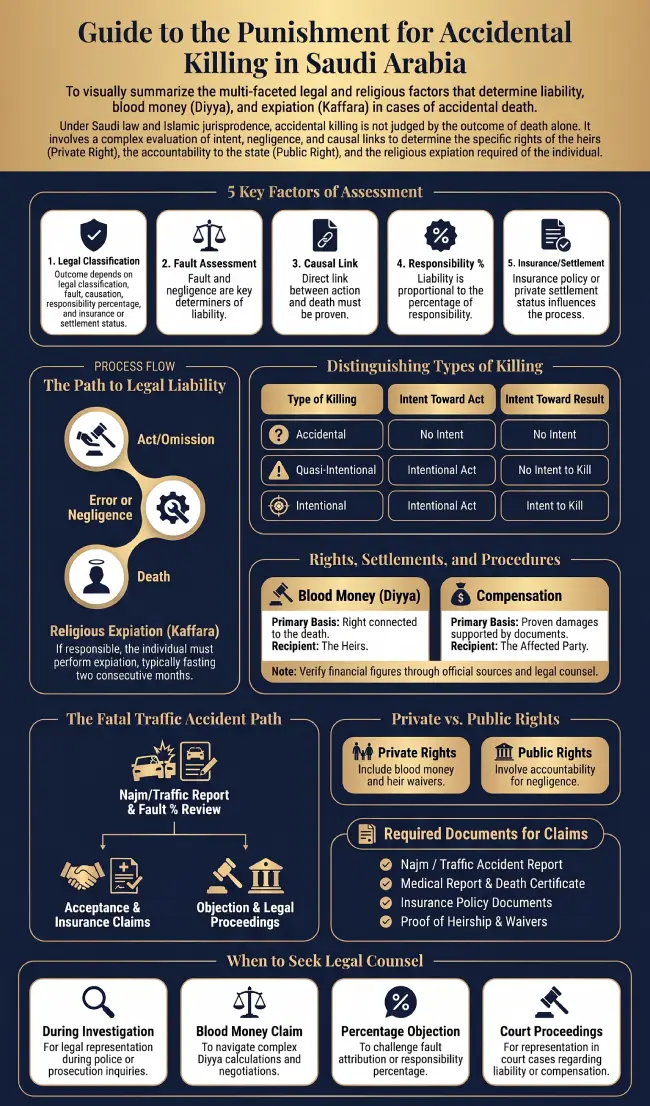
Punishment for Accidental Killing in Saudi Arabia: 5 Points Before Any Step
Before searching for the amount of blood money or whether imprisonment may apply, understand first that punishment for accidental killing in Saudi Arabia is not based on the death result alone. It depends on the error, causation, and the percentage of responsibility.
Accidental killing is not treated as intentional killing when the intent to kill is absent. Still, the case may remain serious because it can involve blood money, compensation, public rights, insurance, and fault percentage. You should deal with the incident through its legal elements, not through a general answer.
The main points to understand before taking any step are:
- Retaliation is not the usual path in accidental killing when there is no intent to kill.
- Blood money is tied to the heirs’ private right and should be assessed according to a current, reliable source.
- Public rights may appear when there is a traffic violation, serious negligence, or significant fault.
- Insurance may apply in vehicle accidents, but only within policy limits and exclusions.
- Objecting to the fault percentage may matter if it is supported by a technical reason or clear document.
If you are dealing with an accidental death or a blood money claim, do not start with settlement or waiver before understanding the effect of each step. BMS Legal can review the report, fault percentage, insurance policy, and heirs’ position with confidentiality and clarity before any action.
When Is a Death Considered Accidental Killing in Saudi Arabia?
Determining accidental killing requires reviewing what happened before the death, not only what happened afterward. A death may follow a traffic accident, professional error, or negligence, but responsibility is not established unless there is a relevant error and a clear causal link between the act and the death.
Accidental killing in Saudi Arabia refers to a death that occurs without intent to kill, but as a result of error, negligence, or breach of a duty of care. The occurrence of death alone is not enough to establish liability. There must be an act or omission, a death result, and a causal link between the error and the death.
The error is established when a person acts in a way that does not meet the required level of caution in the circumstances. This may include careless driving, leaving a dangerous item unsecured, or breaching safety instructions. If the death resulted from an independent cause unrelated to the accused person’s act, liability may weaken or the fault percentage may change.
You also need to distinguish accidental killing from intentional killing and quasi-intentional killing. Legal classification affects the penalty, blood money, and defense strategy.
Difference Between Accidental, Quasi-Intentional, and Intentional Killing
| Comparison Point | Accidental Killing | Quasi-Intentional Killing | Intentional Killing |
|---|---|---|---|
| Intent | No intent to kill | Intent to commit a harmful act, not death | Intent toward the act and result |
| Result | Unintended death | Death resulting from assault | Intended death |
| Effect | Blood money, compensation, and public right depending on the case | Often heavier blood money | Retaliation or blood money upon pardon |
| Defense Focus | Error, causation, and fault percentage | Classification and intent | Intent and evidence |
An incident may initially be described as accidental killing, then the classification may change if evidence reveals intent, assault, or serious misconduct. This is why you should not rely only on the first description of the case.
An incident may initially be described as accidental killing, then the classification may change if evidence reveals intent, assault, or serious misconduct. In that situation, it becomes important to compare the file with the punishment for intentional killing in Saudi Arabia before relying on the first description of the cases.
Penalty, Blood Money, and Compensation
Do not reduce punishment for accidental killing in Saudi Arabia to one question: is there imprisonment, or how much is the blood money? The case may combine heirs’ rights, public rights, compensation, insurance, and an objection to the fault percentage. Separate these paths so you understand the impact of each step.
It is not accurate to confirm or deny imprisonment in every accidental killing case. In some files, the private right and blood money dominate. In others, public rights may arise because of a traffic violation, professional negligence, or serious fault. Retaliation is generally not the usual result where the intent to kill is absent, but the final classification remains tied to the facts and evidence.
Blood Money in Accidental Killing and Who Pays It
Blood money in accidental killing is one of the most searched issues, but its amount should be stated only according to a current official or judicial source. The question of who pays blood money depends on responsibility, fault percentage, insurance, and the final judgment or settlement.
If the claim arises after a traffic accident, review the traffic report or Najm report, the insurance policy, the heirs’ position, and any settlement offers before accepting or rejecting them. Each document may affect liability and the source of payment.
Difference Between Blood Money and Compensation
You should distinguish between blood money and compensation before filing a claim or accepting a settlement. Blood money is linked to the heirs’ right arising from death. Compensation may relate to other damages proven by documents. For that reason, the file may include a blood money claim, a death compensation claim, or a claim against the insurance company, depending on the facts and parties.
Compensation for heirs in accidental killing is not based on general impressions. It requires documents proving the damage, the responsible party, and the link between the error and the result. This is why organizing the file matters before making a claim, objecting, or entering into a settlement.
Accidental Killing in Traffic Accidents and the Role of Insurance
Traffic accidents are among the most common scenarios when people search for the punishment for accidental killing in Saudi Arabia. A fatal traffic accident often involves a traffic report, fault percentage, blood money claim, insurance, and possibly an objection to the result. Do not treat a fatal accident as one isolated report; treat it as a full legal file.
In a fatal accident, it is not enough to know that the accident caused death. Review the fault percentage, the traffic or Najm report, the driver’s conduct, the insurance policy, and whether there was shared fault. The result may differ if the deceased person or another party contributed to the accident.
Effect of Fault Percentage and Insurance in a Fatal Accident
The fault percentage in a fatal accident may affect liability, the claim amount, and the insurance company’s position. If the report is inaccurate, ignores a relevant circumstance, or fails to consider another party’s contribution, objecting to the fault percentage may become important before accepting a settlement or responding to a blood money claim.
Insurance may cover blood money or compensation in vehicle accidents, but this depends on the policy limits, exclusions, and type of incident. The existence of insurance does not mean that the public right has ended, and it does not remove the need to examine liability.
If the insurance company rejects the claim, review the policy, the reason for rejection, and the technical documents before giving up or escalating. Do not sign a settlement or waiver before understanding its effect on blood money, compensation, objections, and heirs’ rights.
Public Right, Private Right, and Waiver
Do not assume that the heirs’ waiver ends every consequence of the case. The private right in accidental killing is the heirs’ right to blood money, compensation, or settlement. The public right relates to the state’s interest in addressing conduct that violates safety or involves significant negligence.
A waiver by the heirs may affect the private right, but it does not always end the public right. This point becomes important in serious traffic accidents, professional negligence, or violations affecting public safety. You should understand the effect of any waiver before signing it and make sure its wording is clear.
A settlement may be appropriate when liability is clear, the heirs agree, the documents are complete, and the insurance company is cooperative. It may be harmful if signed before the final report appears, before the fault percentage is established, or before the public-right position is clear.
Before settlement or waiver, prepare the traffic or Najm report, the official record, the medical report or death certificate, the insurance policy, the heirs’ deed when a claim exists, and any settlement offers or proposed waivers.
Procedures and Proof in Accidental Killing Cases
Accidental killing procedures usually begin with a report or action by the competent authority, followed by collecting reports, hearing statements, and examining the cause of death. The causal link between the act and the result is then reviewed, because it is the basis for proving or denying responsibility.
After the report and supporting documents are collected, the file may move to the Public Prosecution if there is a criminal aspect requiring investigation. From there, the path depends on classification and claims: is the case related only to the public right, or is there also a claim by the heirs for blood money or compensation? Understanding the stages of criminal proceedings before responding or objecting may affect how you deal with the case.
Key Defenses and Required Documents
Proving accidental killing requires four elements: death, error, a link between the error and death, and the percentage of responsibility. If the death resulted from an independent cause, if the deceased person’s conduct contributed to the result, or if the technical report ignored important facts, the direction of the case may change.
In accidental killing cases, it is not enough to say that the death was not intended. You need to review where the error occurred, whether it directly caused the death, and whether the deceased person or another party contributed to the result. The defense may rely on absence of error, broken causation, shared fault, or an external cause that changed the course of events.
You may need the traffic or Najm report, official record, medical report or death certificate, insurance policy, heirs’ deed, and any correspondence, settlement offers, or blood money claims. If you want to object to a report or judgment, make the objection based on a clear reason, such as incorrect classification, insufficient reasoning, or an ignored document.
If the file includes a claim that the act occurred while responding to an immediate danger, do not treat it as a normal accidental killing file. The facts should be reviewed separately against the rules explained in punishment for killing in self-defense in Saudi Arabia.
When Do You Need a Lawyer in an Accidental Killing Case?
You need a lawyer in an accidental killing case when there is an investigation, blood money claim, insurance dispute, or objection to the fault percentage. You may also need legal assistance if the heirs disagree, if a settlement is offered before the file is complete, or if liability is shared between more than one party.
General legal knowledge is not enough in these files. You need to connect the legal rule with the report, causation, fault percentage, and documents. A case may appear simple at first, then change after a technical report, witness statement, objection from the heirs, or insurance company response.
You may also need a criminal lawyer in Jeddah if the file involves investigation, blood money, insurance dispute, or an objection to the fault percentage.
Frequently Asked Questions About Punishment for Accidental Killing
What is the punishment for accidental killing in Saudi Arabia?
The punishment for accidental killing in Saudi Arabia varies according to the error, causation, public right, and the heirs’ claim for blood money or compensation.
When is death considered accidental killing?
It may be considered accidental killing when death occurs without intent to kill, but because of proven error, negligence, or misconduct.
Can accidental killing lead to imprisonment?
Imprisonment may arise when the death is linked to a traffic violation, serious negligence, or significant fault.
Is retaliation applied in accidental killing?
Retaliation is generally not the usual outcome in accidental killing when the intent to kill is absent.
How much is blood money in accidental killing?
The amount of blood money should be verified through a current official or judicial source.
Who pays blood money in accidental killing?
It is paid by the party whose responsibility is established, and insurance may apply in vehicle accidents according to the policy.
Does insurance pay blood money in a fatal accident?
Insurance may pay within coverage limits and exclusions, while liability and the public right still need review.
Can a traffic report be challenged?
An objection may be considered if there is a technical flaw, new document, or relevant omission in the report.
Does the heirs’ waiver end the case?
It may affect the private right, but it does not always end the public right or other legal consequences.
What are the key defenses in accidental killing?
Key defenses include absence of error, broken causation, shared fault, the deceased person’s fault, and external cause.
When the question is Punishment for Accidental Killing in Saudi Arabia: 5 Points, the answer does not begin with a fixed number or quick prediction of the judgment. It begins by reading what lies behind the documents: how the report was written, where the fault percentage was placed, whether causation was proven, and whether settlement or insurance may change the claim.
Do not treat a fatal accident as a one-line file. A traffic report, blood money claim, insurance policy, and possible objection may each lead to different outcomes when reviewed separately. Before accepting a percentage or signing a settlement, you need a legal reading that brings the full picture together.
Before accepting a fault percentage or signing a settlement, you need a legal reading that brings the full picture together. Working with a law firm in Jeddah can help you review the report, insurance position, heirs’ claims, and available objections before taking the next step.
Legal Sources