
The need for a waqf nazir confirmation claim in Saudi Arabia arises when a waqf is established but the capacity of the person who manages it needs formal proof. This often follows the death of the previous nazir, a founder’s condition that names the nazir, or the need for a separate trusteeship deed.
In some cases the waqf deed alone is not enough, because it proves the waqf and its conditions. Proving the nazir concerns who holds the right to manage the waqf and represent it before the competent bodies and the beneficiaries. That capacity is what the statement of claim and its final requests are built on.
From the start, documenting a waqf must be kept apart from proving a nazir. The Ministry of Justice describes documenting a waqf as a service for issuing an official waqf deed, while proof of a nazir for a waqf or a will is among the requests handled through the statement of claim service on the Najiz portal.
Need to prove who manages a waqf?
A lawyer can review the waqf deed and the founder’s condition, and help you prepare the statement of claim before you file through Najiz.
Enquiries are handled confidentially · No specific court outcome can be guaranteed
Summary: Confirming a Waqf Nazir Before You File
A waqf nazir confirmation claim is a statement of claim filed to prove the capacity of the person who administers a waqf and represents it officially. It is used when the waqf exists but the nazir’s capacity needs clear recognition before the competent bodies.
The basis of the claim is the waqf deed, the founder’s condition, and the document that proves why the trusteeship passed. The procedure therefore does not begin with filling in a Najiz form, but with reading the document, identifying the capacity and preparing the requests accurately.
If you hold a waqf deed and need to know the right route, a legal consultation can review the documents before the statement of claim is filed.
Does Your Case Suit a Nazir Confirmation Claim?
This table helps identify the closest route before filing, without confusing the confirmation of a nazir with other procedures.
| Situation | Does a confirmation claim suit it? |
|---|---|
| You hold a waqf deed that names a nazir | Usually yes, if the capacity needs formal proof |
| The previous nazir has died | Yes, if the deed provides a basis for the trusteeship to pass |
| The founder’s condition names the nazir | Yes, if the condition is clear and can be applied |
| There is no clear waqf deed | An earlier route may be needed before the nazir is proved |
| A real estate waqf needs official administration | Yes, if the capacity and documents are clear |
| There is a will that includes a waqf | Review the will first to identify the capacity and the route |
Before choosing the route, notice the type of endowed property, because a family, charitable or real estate waqf can change the documents required and how the request is presented. It helps to understand the types of waqf in Saudi Arabia first. Filing a nazir confirmation claim without identifying the capacity can leave the statement of claim incomplete.
The applicant should first answer: what is the waqf, what is the basis of my capacity, and why do I need the trusteeship confirmed now?
What Is a Waqf Nazir Confirmation Claim?
A waqf nazir confirmation claim is a judicial procedure that aims to prove the capacity of the nazir of an existing waqf. Its purpose is to enable the nazir to administer and represent the waqf on the basis of the waqf deed, the founder’s condition and the supporting documents.
A waqf nazir is the person who handles the affairs of the waqf, such as protecting the asset, following the revenue, carrying out the spending purposes and dealing with the official bodies. The nazir may be a natural person or a legal entity, depending on the waqf deed and the relevant rules.
Confirming a nazir must not be confused with appointing one. Confirmation applies where there is a prior capacity or basis that needs formal recognition. Appointment arises where the waqf has no clear nazir or the founder’s condition cannot be carried out. See our guide to waqf law in Saudi Arabia for the general framework.
The regulation organising trusteeship work notes that a founder may appoint the nazir or name who holds the trusteeship afterwards, consistently with the waqf deed and the competent body.
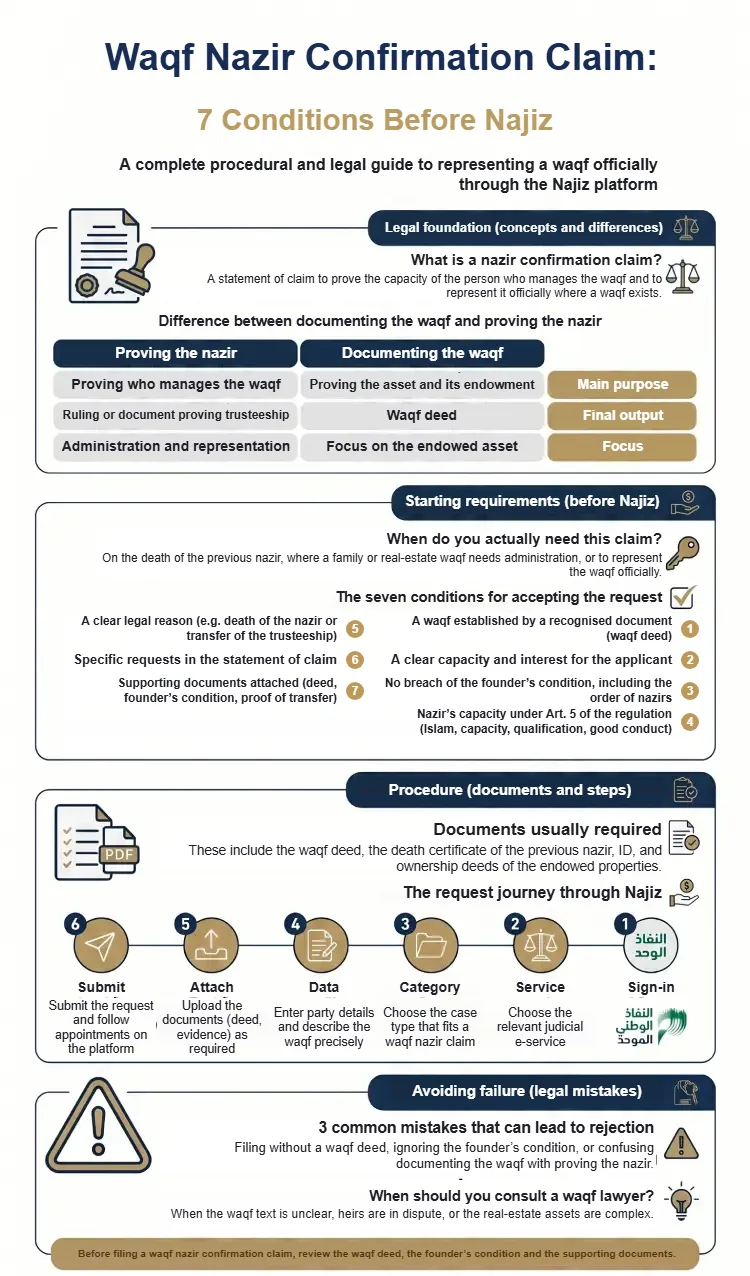
Documenting a Waqf Versus Confirming a Nazir
The essential difference is that documenting a waqf concerns the waqf itself and its conditions, while confirming a nazir concerns who has the power to administer and represent before the competent bodies.
| Point of comparison | Documenting a waqf | Confirming a waqf nazir |
|---|---|---|
| Subject | The waqf asset and its conditions | The nazir’s capacity and authority |
| Purpose | Issuing an official waqf deed | Proving who represents the waqf |
| Key document | Details of the endowed asset | The waqf deed and the founder’s condition |
| Result | A waqf deed | A judgment or document proving the trusteeship |
| Common mistake | Asking for documentation when the waqf is already documented | Asking for proof without stating the capacity |
A waqf deed shows that the waqf exists and states its conditions and spending purposes, but it does not always prove who the current nazir is. The deed may be old, may name a former nazir, or may contain an arrangement that needs interpreting when the trusteeship passes.
A judgment or document that proves the trusteeship matters when representing the waqf before the competent bodies. Its effect shows when managing endowed property, opening accounts or proving capacity to the beneficiaries.
When Do You Need to File a Nazir Confirmation Claim?
You need it when the nazir’s capacity is not enough for official dealings. The reason may be a change of nazir, an unclear founder’s condition, or the absence of a separate trusteeship deed.
The main practical situations are:
- The previous nazir has died and the founder’s condition names the next one.
- The founder’s condition names the nazir by name or description.
- There is no separate trusteeship deed although a waqf deed exists.
- The waqf needs someone to represent it before the competent bodies.
- A family waqf needs a clear arrangement of the trusteeship.
- A real estate waqf needs documented administration and updated documents.
- The beneficiaries need to know who officially holds the power to manage.
In these cases the problem is not proving that the waqf exists, but proving who holds the trusteeship over it. The statement of claim should therefore focus on the capacity, the reason the trusteeship passed, and the specific request to the court.
Conditions for Confirming a Waqf Nazir in Saudi Arabia
The conditions depend on an established waqf, a clear capacity for the applicant, and no breach of the founder’s condition. The clearer the basis of the trusteeship, the more orderly and understandable the statement of claim.
- An established waqf supported by a recognised document: a waqf deed or a document that proves the waqf and its conditions.
- Capacity and interest: being a relative or a beneficiary is not enough; the link to the trusteeship must be shown.
- No breach of the founder’s condition: the condition often fixes the method of administration or the order of nazirs.
- Capacity of the proposed nazir: legal capacity, good conduct, suitable knowledge and qualification for managing a waqf, and nothing that touches trustworthiness. These conditions come from Article 5 of the regulation organising trusteeship work; Saudi nationality is required only where the founder is a foreigner and the waqf is real estate.
- A clear reason for the request: such as the death of the previous nazir, a transfer of the trusteeship, or the need for a separate deed.
- Specific requests: naming the waqf, the deed, the capacity and the documents, not general wording.
- Supporting documents attached: the waqf deed, the founder’s condition, and the document showing why the trusteeship passed to the applicant or proposed nazir.
The regulation organising trusteeship work explains that its aim is to organise the work of nazirs so as to achieve the founder’s purpose, raise professional competence and protect the waqf.
Before Proving the Trusteeship: Do Not Rely on the Deed Alone
1. The basis of capacity. Is the nazir’s name or description in the document? Is there a clear order after the previous nazir’s death?
2. The type of endowed property. A real estate, family or will-related waqf needs a more precise statement of facts and documents.
3. Drafting the request. The right request proves the trusteeship and does not mix it with documentation of the waqf, accountability or removal.
Editorial note: if the reason for the request is the nazir’s death, the key document is not the death certificate alone but its relationship to the founder’s condition and the order in which the trusteeship passes under the deed.
Documents Needed to Confirm a Waqf Nazir
Preparing the documents before filing reduces procedural gaps. No single list suits every case, because the documents depend on the reason for the request and the type of waqf.
Documents usually reviewed:
- The waqf deed or document.
- The previous trusteeship deed, if any.
- The text of the founder’s condition on the trusteeship.
- The death certificate of the previous nazir, where relevant.
- The founder’s death certificate where the trusteeship depends on it.
- National ID or the details of the legal entity.
- A legal power of attorney, if the applicant is an agent.
- Beneficiary details where needed.
- Documents of the real estate or other endowed assets.
- Any document that proves why the trusteeship passed.
Each document should be tied to the reason for the request. Where the request rests on the nazir’s death, the death certificate and the founder’s condition are the important elements. Where it rests on an order stated in the waqf deed, the text must be shown clearly.
| Reason for the request | Most important document to prepare |
|---|---|
| Death of the previous nazir | The death certificate with the waqf deed |
| Trusteeship passing under the founder’s condition | The text of the condition, clearly |
| No separate trusteeship deed | The waqf deed and whatever proves capacity |
| A real estate waqf | The waqf deed and the property details |
| A family waqf | The waqf deed and beneficiary details where needed |
| A will that includes a waqf | The will and the documents of death and capacity |
Steps to File Through Najiz
The claim is filed through the statement of claim service on Najiz, where the request falls within the proper judicial route. The service allows a claim to be filed in one of the courts through electronic steps that begin with sign-in through National Single Sign-On.
- Sign in to the Najiz portal through National Single Sign-On.
- Choose all electronic services.
- Enter the judiciary package.
- Choose the statement of claim service.
- Select a new request.
- Choose the suitable classification from the options available.
- Enter the applicant’s details and those of related parties.
- Describe the waqf and state the number of the deed or document.
- Write the facts and the reason for asking to confirm the nazir.
- Draft the final requests clearly.
- Attach the required documents legibly.
- Submit the request and follow up any gaps or hearing dates.
The facts should be in time order. Begin by showing the waqf exists, then the founder’s condition, then the reason for the request, then the documents that support the applicant’s capacity.
A general template is not advisable where the case involves a family waqf, an endowed property or a condition that needs interpretation. Different documents change how the facts and requests are presented.
Where the file combines a waqf, heirs and beneficiaries, an inheritance and estates lawyer in Jeddah can help identify capacity and arrange the documents before filing.
Trust and Legal Basis
Legal basis
This guide is based on the General Authority for Awqaf trusteeship regulation and the Najiz statement-of-claim service listed below, and is written for general legal awareness rather than as advice on a specific case.
Published by: BMS Legal Law and Legal Consultancy Company.
Address: Jeddah, Al-Mishrifah District, Palestine Street, Al-Safeer Tower
Form of a Waqf Nazir Confirmation Claim
The form should be direct and specific. It is not a long explanation but an ordered request that sets out the waqf, the capacity, the reason for confirmation and the supporting documents.
The basic elements are:
- The name of the competent court.
- The applicant’s name and capacity.
- Details of related parties where needed.
- A description of the waqf and the number of its deed or document.
- The text or summary of the founder’s condition.
- The reason for asking to confirm the nazir.
- The documents supporting the request.
- The final requests in clear wording.
A short outline that can be adapted:
To the Honourable President of the competent court,
I submit a request to confirm my capacity as nazir of the waqf named (…), established under waqf deed number (…) dated (…). The founder provided that the trusteeship shall be held by (…). As the previous nazir has (…), I ask the court to confirm my capacity as nazir of the waqf and to enable me to complete the formal procedures connected with its administration and representation.
I attach the waqf deed, whatever proves why the trusteeship passed, and the documents supporting my capacity and interest in the request.
This outline does not replace adapting the wording to the facts. A case based on the death of the nazir differs from one where the founder’s condition needs interpretation, and from a real estate waqf that needs additional documents.
Special Cases
The wording of a confirmation claim depends on the type of endowed property and the reason the trusteeship passed, so one template should not be used for every request. The most common situations are:
- Death of the previous nazir: the deed is reviewed to see who takes over, with the death certificate and supporting documents.
- Trusteeship tied to descendants: the focus is on the founder’s condition and the order of beneficiaries, because capacity is usually built on the document.
- Several family members entitled: the request must show clearly who holds the capacity, especially if the condition or the order of entitlement is read differently.
- Revenue assigned to a charity: the spending purpose and the method of administration matter, with the extent to which the nazir follows the founder’s wording.
- Real estate within the assets: deeds or asset data are usually attached, because the trusteeship is tied to specific properties and revenue.
- A will that includes a waqf: check the capacity of the executor and the link to the trusteeship, especially where wills, estates and beneficiaries’ rights overlap.
Effect of Beneficiaries’ Objections
A beneficiaries’ objection does not by itself prevent a nazir being confirmed, but it becomes more influential when it relates to the management of revenue and the account statement, or to documents that touch the interest of the endowed property.
An objection matters if it concerns the applicant’s failure to meet the founder’s condition, or the unclear reason for the trusteeship passing. It may also matter if a document contradicts the capacity relied on.
A general objection without a document or clear reason does not weaken the request alone. The statement of claim should therefore present the basis of capacity precisely and tie the request to the waqf deed, the founder’s condition and the documents.
When there is an objection, do not widen the claim to side issues. The focus remains on one question: does the applicant have a recognised basis for confirming the trusteeship over this waqf?
Common Mistakes in Filing a Nazir Confirmation Claim
A claim to confirm a waqf nazir is weakened when filed without specifying the capacity or the documents. The request may be sound, but the way it is presented can leave the statement incomplete or unclear.
- Filing without attaching the waqf deed.
- Not copying the founder’s condition accurately into the statement.
- Not stating why the trusteeship passed to the applicant.
- Relying on family relationship without stating the basis of capacity.
- Attaching many documents without arranging them or explaining their link to the request.
- Using a general form that names neither the waqf nor the requests.
- Confusing proof of the waqf itself with proof of the nazir.
- Leaving out beneficiary details where they are needed.
The practical rule is that the statement of claim must answer three direct questions: what is the waqf, what is the basis of the nazir’s capacity, and why does the request need confirmation now?
When Do You Need a Waqf Lawyer?
You need a lawyer where the matter is more than filling in an electronic form: an unclear founder’s condition, the death of the previous nazir, a family or real estate waqf, or a statement that needs careful ordering.
Legal review is appropriate for: a condition that needs interpretation, no previous trusteeship deed, the death of the previous nazir with no clear successor, several properties or assets, beneficiaries with different positions, drafting a clear statement, and sorting the documents before filing.
Where there are signs of a breach of the founder’s condition or of the waqf’s interest, the discussion may go beyond confirming capacity to examining whether the nazir should remain in post. See personal status lawyer in Jeddah where the dispute is within the family.
Frequently Asked Questions About Confirming a Waqf Nazir
What is a waqf nazir confirmation claim?
It is a claim that aims to prove the capacity of the person who manages a waqf and represents it officially before the competent bodies.
Is a waqf nazir confirmed through Najiz?
Yes. The Ministry of Justice states that proof of a nazir for a waqf or a will is among the requests handled through the statement of claim service on Najiz.
What is the difference between documenting a waqf and confirming a nazir?
Documenting a waqf concerns the waqf asset and its conditions, while confirming a nazir concerns who has the power to administer the waqf and represent it.
Is a waqf deed enough to prove the nazir?
Not always. A waqf deed may prove the waqf and its conditions without proving who the current nazir is, especially if it is old or names a former nazir.
What documents are needed to confirm a waqf nazir?
They usually include the waqf deed, a previous trusteeship deed if any, the death certificate where relevant, identity documents, a power of attorney if an agent files, and whatever proves why the trusteeship passed.
What happens if the nazir of a waqf dies?
The waqf deed and the founder's condition are reviewed to find the next nazir, and then the documents proving the transfer of the trusteeship are prepared.
Conclusion
A waqf nazir confirmation claim in Saudi Arabia begins with reading the waqf deed and the founder’s condition. The statement of claim is then built on the applicant’s capacity, the reason the trusteeship passed, and the documents that support the request.
Knowing the Najiz steps is not enough if the capacity is unclear or the documents are incomplete. Prepare the deed, identify the reason for confirmation, and order the facts before filing.
If your case involves the death of a previous nazir, a family waqf, or a founder’s condition that needs interpretation, you can ask for a review of the documents and the right drafting before the statement of claim is filed, through our contact page.
Need help confirming a waqf nazir? Send us the deed and your documents for an initial review of the route that fits your case.
Need help confirming a waqf nazir?
Speak with a BMS Legal lawyer in Jeddah for an initial review of the waqf deed, your documents and the route that protects your rights.
Enquiries are handled confidentially · No specific court outcome can be guaranteed
Official Legal and Government Sources
- Najiz: statement of claim service (Arabic-language official service page).
- General Authority for Awqaf: systems and regulations (Arabic-language official page).
- Regulation Organising Trusteeship Work, General Authority for Awqaf (Arabic-language official document).
Disclaimer: This article is for general legal awareness and is not advice on an individual case, and reading it does not create a lawyer–client relationship. The legal assessment varies with the facts, the documents and the rules that apply to each case.