Proving property ownership in Saudi Arabia means presenting what establishes your right to a specific property: a title deed, a sale contract, old documents, proof of payment, witnesses, or a court judgment where there is a dispute. The route does not always begin with a lawsuit. The right step may be updating a title deed, amending data, correcting a record, or filing a claim where someone objects.
You may need this where you hold property without a title deed, an old sale contract that was never completed by transfer, an unclear inherited property, conflicting deeds, or a dispute with another party. In those cases scattered papers are not enough: each document must be tied to the reason for ownership and to the description, boundaries and location of the property.
Property without a deed, or an ownership dispute?
A real estate lawyer can review your deed, contract and documents, and help identify the right route before you file.
Enquiries are handled confidentially · No specific court outcome can be guaranteed
Proving Ownership Starts With Choosing the Right Route
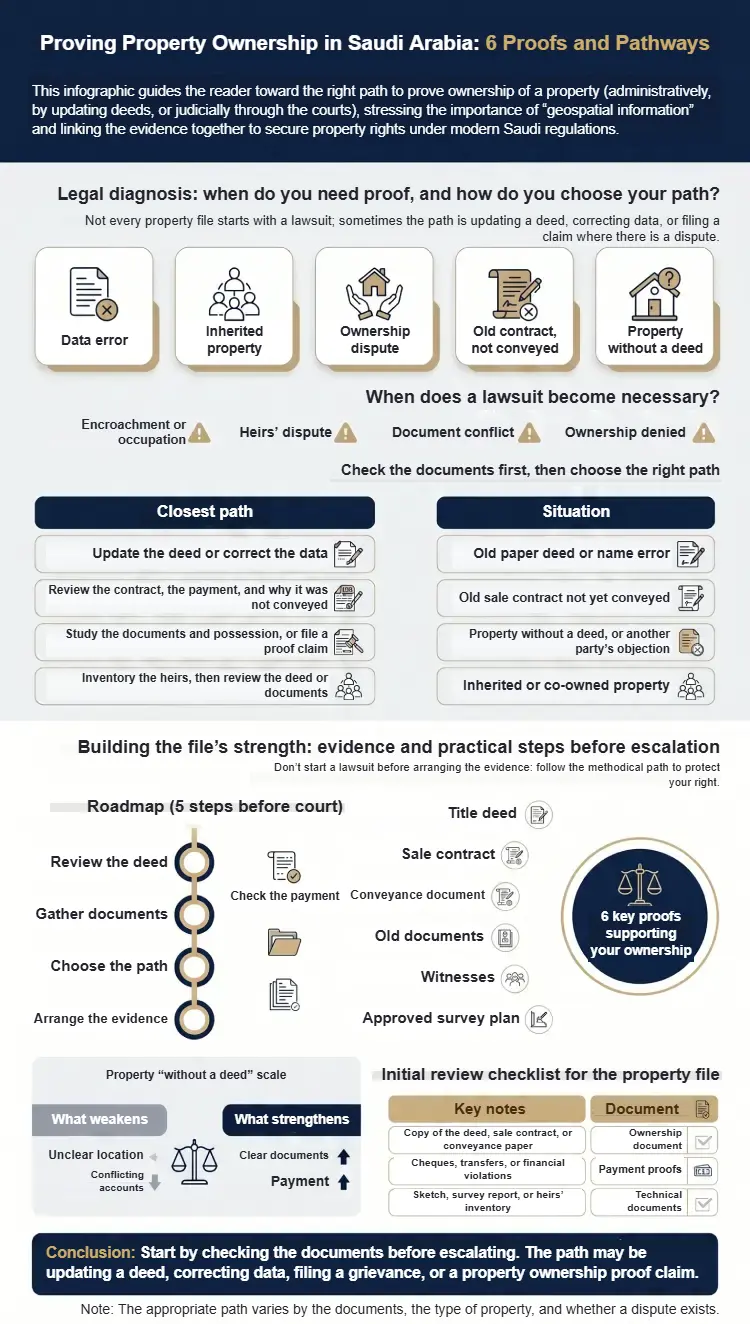
Before filing a claim to prove ownership, ask yourself: do I hold a deed that needs updating, an incomplete contract, or an actual dispute? That question sets the direction of the file, because proving ownership may be a documentation step or a court dispute that needs a statement of claim and organised evidence.
The Ministry of Justice offers a service to update or amend a title deed. Its steps include signing in through National Single Sign-On, choosing the type of request, entering the data, attaching the documents and submitting the request. Some cases therefore begin administratively before a claim is considered.
| Your situation | Closest route |
|---|---|
| You hold an old title deed | Update or amend the deed |
| There is an error in a name or area | Request to correct the data |
| You hold an old sale contract | Review the contract, the payment and why transfer was not completed |
| The property has no deed | Study the documents, possession and location of the property |
| Another party objects to your ownership | A claim to prove ownership, or the claim that suits the dispute |
| The property is inherited or held in common | Heirs’ deed first, then review the deed or documents |
If you are not sure of the route, start by checking the documents, not by drafting a claim. The wrong procedure can prolong a dispute, lead to refusal of the request, or weaken your position when you escalate. If the problem lies in an old deed or unclear data, begin with the steps in our guide to a Saudi property deed inquiry before moving to a claim or a correction.
What Does Proving Property Ownership in Saudi Arabia Mean?
Proving ownership is the arrangement of evidence confirming that you have a right in a specific property with clear details. Proof may come through a deed, a contract, an old document, a court judgment, registration, or indications that support the reason for ownership.
It is not enough to say the property is yours. Ownership must be understandable to the competent body, whether a notary, a registration body, or a court if there is a dispute. Documented ownership usually rests on a deed or clear registration showing the owner, the property and its boundaries. Disputed ownership appears when another party objects, documents conflict, or the data cannot decide the right. That is why verifying a documented property differs from proving a disputed one.
One document may not be enough, especially with an untransferred sale contract, an old deed, inherited property or an unclear area. You then need linked documents that prove the reason for ownership and describe the property precisely.
When Do You Need to Prove Ownership?
You need to prove ownership when it is incomplete or unclear in law. The need usually arises on sale, mortgage, division, inheritance, removing an encroachment, or facing someone who claims a right in the property.
- Property without a deed: having no deed does not prove ownership automatically; the reason for ownership, the documents and the location must be examined.
- Undocumented land: proving ownership of land without a deed needs indications such as an old contract, payment, clear possession or witnesses.
- An old house: proving ownership of a house without a deed means linking it to ownership documents, the previous owner or possession.
- A property dispute: arises when someone claims ownership, takes possession, or produces conflicting documents.
- Inherited property: the route starts by proving the heirs’ capacity, then the link between the property and the deceased.
- An error in the deed: the answer may be a correction or amendment, not a claim to prove ownership.
A common mistake is to start with a claim when the problem is only updating or correcting a deed. Examine the case first, then choose the procedure.
6 Kinds of Evidence That Support Proof of Ownership
Evidence is not equally strong. A title deed differs from a sale contract, a sale contract differs from testimony, and an old document usually needs supporting indications.
| Evidence | Value | Practical note |
|---|---|---|
| Title deed | Strongest where it is sound | Check the name, boundaries and area |
| Sale contract | Shows the reason for ownership | May need proof of payment |
| Purchase agreement | An important indication in older transactions | Does not always replace transfer |
| Old documents | Support the history of ownership | Link them to the current location |
| Witnesses | Explain old events | Better with supporting documents |
| Survey report | Shows location and boundaries | Important where properties overlap or are disputed |
A title deed is the most important document if its data are sound and match the property. If it is old or not updated, the start may be updating or amending the deed before any other step.
Does a sale contract prove ownership? It is important evidence, but not always enough alone if transfer was not completed or a dispute arose. Its strength depends on its validity, the parties, proof of payment, handover, and why the transfer of ownership was never completed.
Do witnesses prove property ownership? They support the file, especially for old events or long possession, but testimony is stronger when backed by documents, receipts, correspondence or a survey report.
Steps Before Filing a Claim
The steps begin with examining the file, not with drafting the claim. The first step is knowing what papers you hold, what is missing, and whether the problem is one of documentation or of litigation.
- Review the core document: check the name, ID, area, boundaries and location.
- Study the sale contract: check the signatures, price, payment, handover and why transfer was not completed.
- Collect supporting material: receipts, correspondence, heirs’ deed, powers of attorney, witnesses and a survey.
- Choose the closest procedure: update, amend, correct, register, grievance or claim.
- Arrange the evidence before escalating: a weak claim often starts with unconnected documents.
If the documents are incomplete or the boundaries or ownership conflict, advice from a real estate lawyer in Jeddah can help arrange the file and choose the right procedure before escalation.
When Does a Claim to Prove Ownership Become Necessary?
A claim to prove ownership becomes necessary when updating, correcting or registering cannot settle the right. That usually happens with denial, conflicting documents, a sale contract whose effect was never completed, or an inherited property in dispute.
The most common situations are:
- Another party claims ownership of the property or objects to your dealing with it.
- An old sale contract was never completed by transfer, and the other side refuses or denies it.
- Deeds or documents conflict over the area, boundaries or date of the transaction.
- Heirs disagree about whether the property belongs to the estate or how it may be used.
- Possession or encroachment prevents you from using the property.
- A need to bring a claim to prove ownership of land, or a claim to acquire a property, depending on the facts.
The suitable claim may be a claim to prove ownership, a claim of entitlement to a property, a claim to stop interference, or a claim to evict the property. It is therefore not enough to pick a claim title from the internet: the request must be tied to the facts and the documents. Our guide to real estate lawsuits in Saudi Arabia explains the main types.
At this stage the statement of claim matters: correct parties, a clear reason for ownership, a defined property, linked evidence and requests that can be understood and enforced.
Proving Ownership of Property Without a Deed
Proving ownership without a deed does not mean ownership is established merely by possession or old documents. Each case needs separate examination of the type of property, its location, the reason for ownership and any legal restrictions that may apply.
What strengthens the file:
- A clear old document tied to the disputed property.
- A sale or purchase contract with understandable parties and details.
- Proof of payment or correspondence confirming the seriousness of the transaction.
- Witnesses who know of the sale or the long possession.
- Boundaries that can be shown by a survey report or sketch.
- No strong objection from another party.
What weakens the file:
- No document supporting the reason for ownership.
- Conflicting accounts or differences in boundaries between documents.
- Possession that rests on a lease, an agency or temporary permission.
- Another claimant who holds a deed or a stronger document.
- Uncertainty about the location of the property or difficulty identifying it.
Does possession prove property ownership? Possession may be an indication, but it does not prove ownership alone in every case. Its duration, nature, origin and whether it was open and settled, rather than casual use, all matter.
Heirs and Common Ownership
Proving ownership for heirs differs from proof between a seller and a buyer. In an estate the route starts by proving the capacity of the heirs, then proving that the property was among the deceased’s assets. Our guide to the Najiz electronic inheritance deed explains how heirs’ capacity is documented.
With common ownership the dispute is not always about the root of ownership. It may concern shares, disposal, division or use, so the nature of the request must be understood before a claim is filed.
Documents that usually matter:
- A heirs’ deed to prove the capacity of those claiming.
- The property deed, if it is in the deceased’s name.
- A sale contract or old document linking the property to the deceased.
- Legal powers of attorney when some heirs are represented.
- Whatever proves the share, the co-ownership or the disputed disposal.
If some heirs refuse to recognise the property, or one disposes of it without the others’ consent, a claim may be needed. The request may be to prove ownership, to divide, to prevent disposal, or to resolve a co-ownership dispute, according to the case. An inheritance and estates lawyer in Jeddah can help identify capacity and arrange the documents.
Updating a Deed and Real Estate Registration: When Are They Enough?
Confusing proof of ownership with updating a deed or with registration often leads to an unsuitable route. Each route addresses a different problem and should not be used as a permanent substitute for another.
| Route | When it suits | When it is not enough |
|---|---|---|
| Updating a deed | An existing deed needs updating | If the root of ownership is disputed |
| Amending a deed | An error in name, area or boundaries | If the amendment affects another party’s right |
| Real estate registration | Registering the property unit in the register | If the ownership dispute came first |
| A claim for ownership | There is no sufficient basis, or a dispute exists | Not to be used to update simple data |
Proving ownership looks at the root of the right, whereas updating a deed deals with an existing deed. Real estate registration concerns organising the property unit’s data within the areas covered by the register. If the problem is data in an existing deed, updating or correcting may be enough. If the root of the right is denied or conflicts, a claim to prove ownership may be the better route.
Trust and Legal Basis
Legal basis
This guide is based on the Ministry of Justice deed update service and the Real Estate Registry services listed below, and is written for general legal awareness rather than as advice on a specific case.
Published by: BMS Legal Law and Legal Consultancy Company.
Address: Jeddah, Al-Mishrifah District, Palestine Street, Al-Safeer Tower
What Documents Should You Send for Review?
Before asking for advice, prepare a clear copy of each document tied to the property. A long explanation is not needed at first: gather the core papers and write a short summary of the problem.
- A copy of the deed, if there is one.
- The sale or purchase contract.
- Proof of payment or transfers.
- A heirs’ deed for inherited property.
- Legal powers of attorney, if someone represents the parties.
- A sketch or survey report where boundaries differ.
- Letters, witnesses or old documents that support the event.
- A short summary: what is the problem, who objects, and what is needed?
This step helps sort the case quickly: does it need an update, an amendment, a correction, a grievance or a claim? It also reduces the chance of starting a route that does not suit the nature of the dispute.
The Role of a Lawyer in Proving Property Ownership
You need a lawyer if the documents are incomplete, a dispute exists, or the property has no deed. The need grows with an old sale contract, heirs, common ownership, conflicting deeds or unclear boundaries.
A lawyer’s role is not to promise a result but to assess the route, prepare the file, and explain the strengths and weaknesses. The suitable step may be an update or correction, a claim, or completing missing documents before any procedure.
Mistakes to avoid:
- Relying on a sale contract alone without checking its legal effect.
- Confusing updating a deed with a claim to prove ownership.
- Filing a claim before preparing the documents that prove ownership.
- Neglecting the boundaries, area and location of the property.
- Treating witnesses or possession as a permanent substitute for documents.
- Submitting an administrative request when the case is clearly a court dispute.
Frequently Asked Questions About Proving Property Ownership
How do I prove property ownership in Saudi Arabia?
Start by proving the reason for ownership through a deed, a contract, documents or a judgment, then choose the suitable route.
Can ownership be proved without a deed?
In some cases, yes, but it depends on the documents, possession, the type of property and its location.
What documents prove property ownership?
They include the deed, the sale contract, old documents, proof of payment, heirs' deed, witnesses and survey reports.
Does a sale contract prove ownership?
A sale contract is important evidence, but it is not always enough if transfer was not completed or a dispute arose.
Does possession prove property ownership?
Possession may be an indication, but it does not prove ownership alone in every case.
What is the difference between proving ownership and updating a deed?
Proving ownership deals with the root of the right, while updating a deed usually deals with the data of an existing deed.
Conclusion
Proving property ownership in Saudi Arabia is not just a title: it is a practical method. Do not start in court. Start by checking the deed, the sale contract, old documents, proof of payment, witnesses and boundaries, because the strength of the file comes from how well the evidence connects, not only from its quantity.
If you hold an old sale contract, a property without a deed, an heirs’ dispute, or conflicting boundaries and areas, do not begin an arbitrary procedure. Prepare the documents and ask for a legal assessment of whether the closest route is updating the deed, amending the data, correcting, a grievance or a claim to prove ownership.
For an initial review, contact a law firm in Jeddah and send the deed, the contract or the available documents, so the case can be examined and directed to the right step without promising a result in advance.
Need help proving property ownership? Send us your documents for an initial review of the route that fits your case.
Need help proving property ownership?
Speak with a BMS Legal lawyer in Jeddah for an initial review of your documents and the route that protects your rights.
Enquiries are handled confidentially · No specific court outcome can be guaranteed
Official Legal and Government Sources
- Ministry of Justice: request to update or amend a title deed (Arabic-language official service page).
- Real Estate Registry: in-kind registration services (Arabic-language official website).
Disclaimer: This article is for general legal awareness and is not advice on an individual case, and reading it does not create a lawyer–client relationship. The legal assessment varies with the facts, the documents and the rules that apply to each case.