
The difference between khula and divorce in Saudi Arabia does not depend only on who asked to end the marriage. It extends to the compensation, the right to return, the number of divorces, the financial rights, and the effect of each route on custody and maintenance. The options can look similar when a dispute begins, but the correct legal characterisation changes the practical outcome of the case.
In Saudi Arabia, a case may be khula if the separation is requested by the wife in return for compensation. It may be divorce if it relates to ending the marriage and its specific consequences. And it may be annulment of the marriage if there is a material ground that needs the court’s review. The most important question is therefore not “What is the fastest procedure?” but “Which route fits the facts and protects the rights, without mixing one procedure with another?”
Before filing any request, separate three things: the reason for the separation, the financial effect, and what follows for the right to return, custody or maintenance. If khula is the closest route for your situation, understanding the steps to obtain khula in Saudi Arabia gives you a clearer picture of the conditions, procedures, rights and timing without confusing them with divorce or annulment.
Unsure whether khula, divorce or annulment fits your case?
A personal status lawyer can review your marriage contract, dowry and documents, and help identify the closest route before you file.
Enquiries are handled confidentially · No specific court outcome can be guaranteed
The Difference Between Khula and Divorce in Brief
The difference between khula and divorce in Saudi Arabia is that khula is generally requested by the wife in return for compensation, while divorce ends the marriage in a different way and may carry financial rights that vary by case. Annulment of the marriage, by contrast, is a court judgment issued where there is a recognised ground such as harm, non-payment of maintenance or a defect, as the court assesses it.
Khula is treated as a dissolution of the marriage contract even if it is worded as divorce. It is a minor irrevocable separation and is not counted among the three divorces. For that reason khula should not be treated as an ordinary divorce, and annulment should not be treated as khula without compensation.
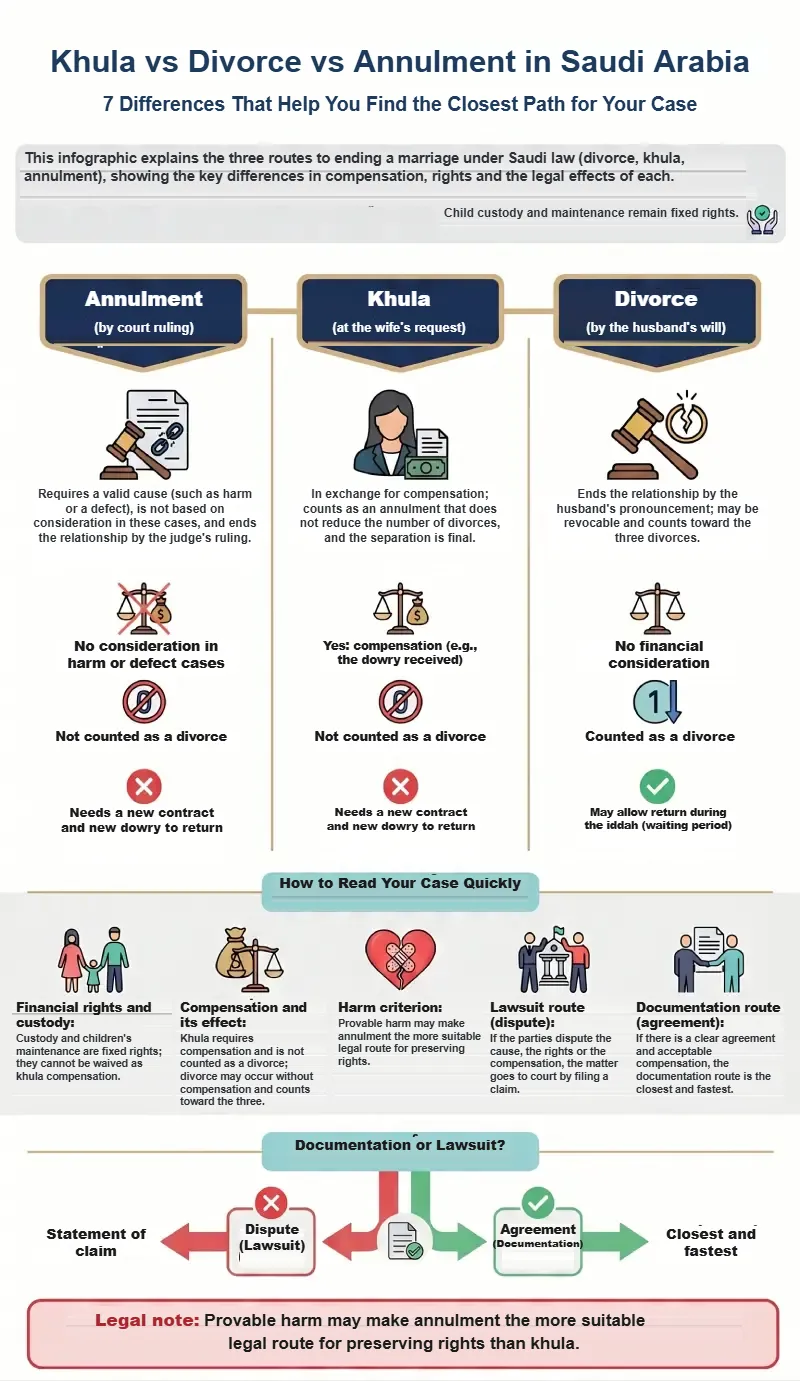
Khula, Divorce and Annulment Compared
Before going into detail, the table below shows the limits of each route. A comparison is not enough on its own to make a decision, but it clarifies the differences that lead to different rights and procedures.
| Point of comparison | Divorce | Khula | Annulment of marriage |
|---|---|---|---|
| Who seeks the end of the marriage | Usually the husband, or through the court in a dispute | Usually the wife, in return for compensation | Either spouse where there is a ground |
| Basis | Ending the marriage by divorce | Separation in return for compensation | Ending the contract for a reason the court examines |
| Compensation | Not normally based on compensation from the wife | A key element of khula | Usually not the basis of the route |
| Number of divorces | May be counted among the divorces | Not counted among the three divorces | Not treated as an ordinary divorce |
| Right to return | Possible in a revocable divorce during the waiting period | Not like a revocable divorce | Needs assessment by the ruling and the case |
| Financial rights | Vary by type of divorce and the facts | Affected by the compensation and the agreement | Affected by the ground and by proof of the facts |
| Children’s rights | Do not lapse because of divorce | Not part of the khula compensation | Considered separately from the reason for separation |
When you are weighing khula, divorce and annulment, the assessment does not start from the fastest procedure. It starts from the reason for the separation, whether there is compensation, the effect on the right to return, the financial rights, and what relates to custody and maintenance. Any mixing of these routes may change your legal position or imply a waiver that was never intended.
Professional note: this content is for general legal awareness. A precise assessment needs a review of the marriage contract, the dowry details, whether there are children, the documents that matter, and the reason for asking to end the marriage.
A Quick Test Before You File
If the reason for separation is that the wife does not wish to continue and accepts compensation, the route may be closer to khula. If the reason is harm, non-payment of maintenance, a material defect, or facts that need proof, annulment may be closer and should be examined legally before the request is filed.
These indicators help you read the case accurately before filing:
- A clear compensation brings the case closer to khula.
- Provable harm may make annulment closer than khula.
- Protecting financial rights needs a different route from simply ending the marriage.
- Custody and child maintenance are not mixed with the khula compensation.
- A documented agreement differs from a claim that needs a court judgment.
Where the indicators point to a dispute rather than a documented agreement, the order and drafting of the request become part of the strength of the file, especially in filing a khula case before the personal status court in Saudi Arabia.
Khula: When Is It the Closest Description?
Khula is closest when the wife wishes to end the marriage in return for compensation, and the file does not turn on harm that needs separate judicial proof. Khula is therefore not about the question “Who is at fault?” so much as the wife’s wish to separate, the existence of compensation, and how clear the agreement or the dispute over it is.
This is where the difference between khula and annulment appears. Khula rests on separation in return for compensation, while annulment rests on a material ground in the contract or in the continuation of the marriage. The case may therefore be closer to annulment if it is built on documented harm, non-payment of maintenance, a material defect, or facts that go beyond a simple wish to separate. Where the compensation, the husband’s refusal or the limits of consent are the point of dispute, it is more accurate to read the case through the khula requirements in Saudi Arabia before treating it as an agreed khula or a dispute that needs a judgment.
Divorce: When Does It Differ From Khula?
Divorce differs from khula in the source of the ending and in its effects. Divorce may be revocable or irrevocable, and different financial claims may arise depending on the type of divorce, whether there are children, the marriage contract and the available documents. Khula is generally tied to compensation and is not counted among the three divorces if it meets its legal description.
The difference between khula and divorce is clearest where there are disputed financial rights. In divorce, a wife may look at the deferred dowry, maintenance during the waiting period, or other rights depending on the case. In khula, the key question may be: how much is the compensation, and does it affect the dowry, the deferred dowry or earlier agreements?
If the facts revolve around harm, abuse, refusal to support, or abandonment, khula should not be chosen merely for speed. Divorce for harm or annulment of the marriage may be closer legally, depending on what can be proved before the court.
Annulment of Marriage: When Is It Closer Than Khula?
Annulment is the ending of the marriage contract by a court judgment where there is a recognised ground that the court examines. It therefore does not rest on a mere agreement on compensation, but on a ground, facts, and documents or indications that support the request.
The difference between khula and annulment appears when the reason for separation is asked about. If the reason is that the wife does not wish to continue and there is compensation, the case may be closer to khula. If the reason is harm, a defect, non-payment of maintenance, or another ground that affects the relationship, annulment may be closer. The difference between a khula claim and an annulment claim also appears in how the request is built. A khula claim generally focuses on the separation and the compensation, while an annulment claim needs to state the ground and the evidence that makes the continuation of the contract a matter for judicial review. The correct description must therefore be chosen before any request is filed. Where the ground is harm, a defect, non-payment of maintenance or another material ground, the conditions of marriage annulment in Saudi Arabia become the most important point to check before filing.
Financial Effects: Dowry, Compensation and Maintenance
The financial effect is the point that causes the most confusion when comparing khula, divorce and annulment. There is no single financial result that suits every case, because the outcome is affected by the reason for the separation, its timing, the marriage contract, whether the marriage was consummated, the compensation, and what is proved before the court.
In khula, the compensation alone is not enough to consider; the dowry, the furniture, custody and the right to return also need a separate reading under the wife’s rights after khula in Saudi Arabia, so that financial rights are not mixed with children’s rights or with the effects of return.
Do not start from the name of the procedure alone, but from its effect on rights:
- The deferred dowry may change the result of the choice.
- A clear compensation brings the case closer to khula, and a dispute over it opens a more detailed route.
- Provable harm may move the case from khula to annulment.
- Maintenance and custody are not always dealt with inside the same file as the separation.
- The facts reveal whether the route is khula with compensation or annulment for a reason.
Custody and Child Maintenance After Khula, Divorce or Annulment
Children’s rights are not treated as part of the financial consideration between the spouses. Child maintenance therefore does not lapse merely because khula took place, and custody does not lapse automatically because of the type of separation. As a rule, matters concerning children are considered according to their best interests and the surrounding facts.
A common confusion is to think that khula means losing custody or that child maintenance falls away. That is not accurate. Khula may affect some of the wife’s own financial rights depending on the compensation, but it does not make the children’s rights an automatic waiver. Where there are children, three files should be separated:
- The separation itself: khula, divorce or annulment.
- The spouses’ financial rights: dowry, compensation, deferred dowry, marital maintenance.
- The children’s rights: custody, maintenance, visitation and housing where appropriate.
For a custody document, see how to get a child custody document in Saudi Arabia.
The Waiting Period and the Right to Return: Why the Correct Description Matters
The possibility of return differs by type of separation. In a revocable divorce, the husband may return during the waiting period under its rules, without a new contract. In khula, the separation is a minor irrevocable one, and the relationship does not resume by mere return as in some forms of divorce.
In annulment, the effect varies with the ground for annulment, the judgment issued and the wife’s position at the time of separation. Before thinking about returning, first identify which procedure ended the marriage: a revocable divorce, khula, or annulment by court judgment.
Mixing these routes can lead to a wrong step after the relationship ends. Return in divorce is not like returning after khula, and the position in annulment differs by the judgment and its grounds.
Documentation or a Court Claim: How Do You Choose the Right Route?
Choosing the electronic service does not start from the name of the request, but from whether the parties agree. If there is a clear agreement on khula or divorce, and the details and compensation are accepted, the route is closer to documentation. If there is a dispute over the compensation, the ground for annulment, or the related rights, the file generally needs a statement of claim to be heard by the court.
In khula in particular, it is not enough that the wish to end the marriage is clear. You must determine whether there is agreement on the compensation, whether the agreement can be ratified, and whether there are separate claims such as custody, maintenance or visitation. Where agreement is not possible, the order and drafting of the request matter more than simply entering Najiz. If your main question is how long the procedure takes or the effect of refusal and objection, you will need a different assessment tied to how long a khula case takes in Saudi Arabia, which depends on the circumstances of the file.
How to Choose the Route Closest to Your Case
Start from the reason, not from the name of the procedure. If the wish to separate is present with a clear compensation, the case may be closer to khula. If the husband has pronounced divorce or wants to document it, the question moves to the effects of divorce and its rights. If the facts rest on harm or another material ground, annulment may be closer.
Do not start from the name of the procedure, but from the facts that change its outcome:
- Agreement between the parties brings the case closer to documentation.
- A clear compensation makes khula more defined.
- Proven harm may make annulment closer.
- Financial rights are not always settled merely by choosing khula or divorce.
- Custody and child maintenance are dealt with as matters separate from the khula compensation.
Where the facts overlap between khula, divorce and annulment, presenting the case to a personal status lawyer in Jeddah helps identify the closest route before a request is filed that could affect the dowry, the right to return or custody. You can also read about the services of a khula lawyer in Jeddah and a divorce lawyer in Jeddah, or use the contact page to ask for an initial review.
Trust and Legal Basis
Legal basis
This guide is based on the Saudi Personal Status Law and the Ministry of Justice and Najiz documentation services listed below, and is written for general legal awareness rather than as advice on a specific case.
Published by: BMS Legal Law and Legal Consultancy Company.
Address: Jeddah, Al-Mishrifah District, Palestine Street, Al-Safeer Tower
Frequently Asked Questions About Khula, Divorce and Annulment in Saudi Arabia
What is the difference between khula and divorce in Saudi Arabia?
Khula is generally requested by the wife in return for compensation and is treated as a dissolution of the marriage contract, even if worded as divorce. It is a minor irrevocable separation and is not counted among the three divorces. Divorce ends the marriage in a different way and may carry financial rights that vary by type of divorce and the facts.
Is khula counted as one of the three divorces?
No. If it meets its legal description, khula is not counted among the three divorces, which is one reason it should not be treated as an ordinary divorce.
When is annulment of the marriage closer than khula?
Annulment is closer where the case rests on a recognised ground, such as provable harm, non-payment of maintenance or a material defect, that the court examines. Khula is closer where the wife wishes to separate in return for compensation and the file does not turn on harm that needs separate judicial proof.
Can the husband return to his wife after khula?
The possibility of return differs by type of separation. In a revocable divorce the husband may return during the waiting period under its rules, without a new contract. In khula the separation is a minor irrevocable one, and the relationship does not resume by mere return as it may in some forms of divorce.
Does khula affect custody and child maintenance?
No. Children's rights are not part of the financial consideration between the spouses, so child maintenance does not lapse merely because khula took place, and custody does not lapse automatically because of the type of separation. Matters concerning children are considered according to their best interests and the surrounding facts.
Should I document the separation or file a court claim?
If the parties clearly agree on khula or divorce and accept the details and compensation, the route is closer to documentation. If there is a dispute over the compensation, the ground for annulment or the related rights, the file generally needs a statement of claim to be heard by the court. A review of the facts before choosing helps avoid an unintended waiver.
Conclusion
There are seven practical differences between khula, divorce and annulment in Saudi Arabia that are not understood from the name alone, but from the reason on which the procedure is built, the financial effect, the right to return, the compensation, custody and the way the request is filed. Khula is generally linked to the wife’s request and the compensation; divorce may open different effects in rights and in return; and annulment needs a ground that the court examines and whose effect on the contract it assesses.
The correct decision therefore starts by reading the facts and documents first, and then choosing the route that fits the case, without mixing a procedure that may preserve a right with another that may imply an unintended waiver.
Before filing a khula, divorce or annulment request, review the marriage contract, the dowry, the compensation, the children’s position and the documents that prove the reason for separation. A personal status lawyer at BMS Legal Law and Legal Consultancy Firm can help you identify the route closest to your case.
Need help choosing between khula, divorce and annulment?
Speak with a BMS Legal personal status lawyer in Jeddah for an initial review of your file and the route that protects your rights.
Enquiries are handled confidentially · No specific court outcome can be guaranteed
Official Legal and Government Sources
- Saudi Personal Status Law, Bureau of Experts at the Council of Ministers: the legal text (Arabic-language official page).
- Ministry of Justice: divorce documentation service (Arabic-language official service page).
- Najiz: khula documentation service (Arabic-language official service page).
Disclaimer: This article is for general legal awareness and is not advice on an individual case, and reading it does not create a lawyer–client relationship. The legal assessment varies with the facts, the documents and the rules that apply to each case.