
Article prepared: 19 November 2026 | Last verified against official sources: 19 November 2026
Article 46 decision Saudi Arabia: what happens after an Enforcement Court Article 46 decision if one was issued against you before the new system took effect? An Article 46 decision showing in your Najiz record does not mean that the attachment on your accounts or your travel ban is still in force, and the new Enforcement Law taking effect on 29 October 2026 does not automatically cancel earlier decisions.
What matters is the status of the enforcement request, the amount still owed, and the decisions and procedures tied to that request. The distinction matters if you paid the debt but still see a restriction on your account, reached a settlement, or found in your file a decision issued before 1447 AH. This guide explains how to check the actual effect of an old Article 46 decision, when the procedures end, and what to do through Najiz, without confusing the earlier decision with Article 46 of the law now in force.
Quick answer: what happens after an Enforcement Court Article 46 decision?
If the decision was issued under the previous Enforcement Law, start by checking the enforcement request in Najiz: is it still open or has it ended? Was the right paid in full? Is there an attachment or travel ban issued under the same request?
Royal Decree M/237 preserves the validity of earlier decisions under the rules in force when they were issued; however, Article 47 of the new Implementing Regulations provides that orders and procedures tied to an enforcement request are lifted as soon as the request ends, without a separate application, while any other requests or orders must still be checked.
Are the effects of the Article 46 decision still in force?
If you have an old decision or an attachment that was not lifted after payment, the BMS Legal team can review the decision date, the status of the request and proof of payment to determine the right path.
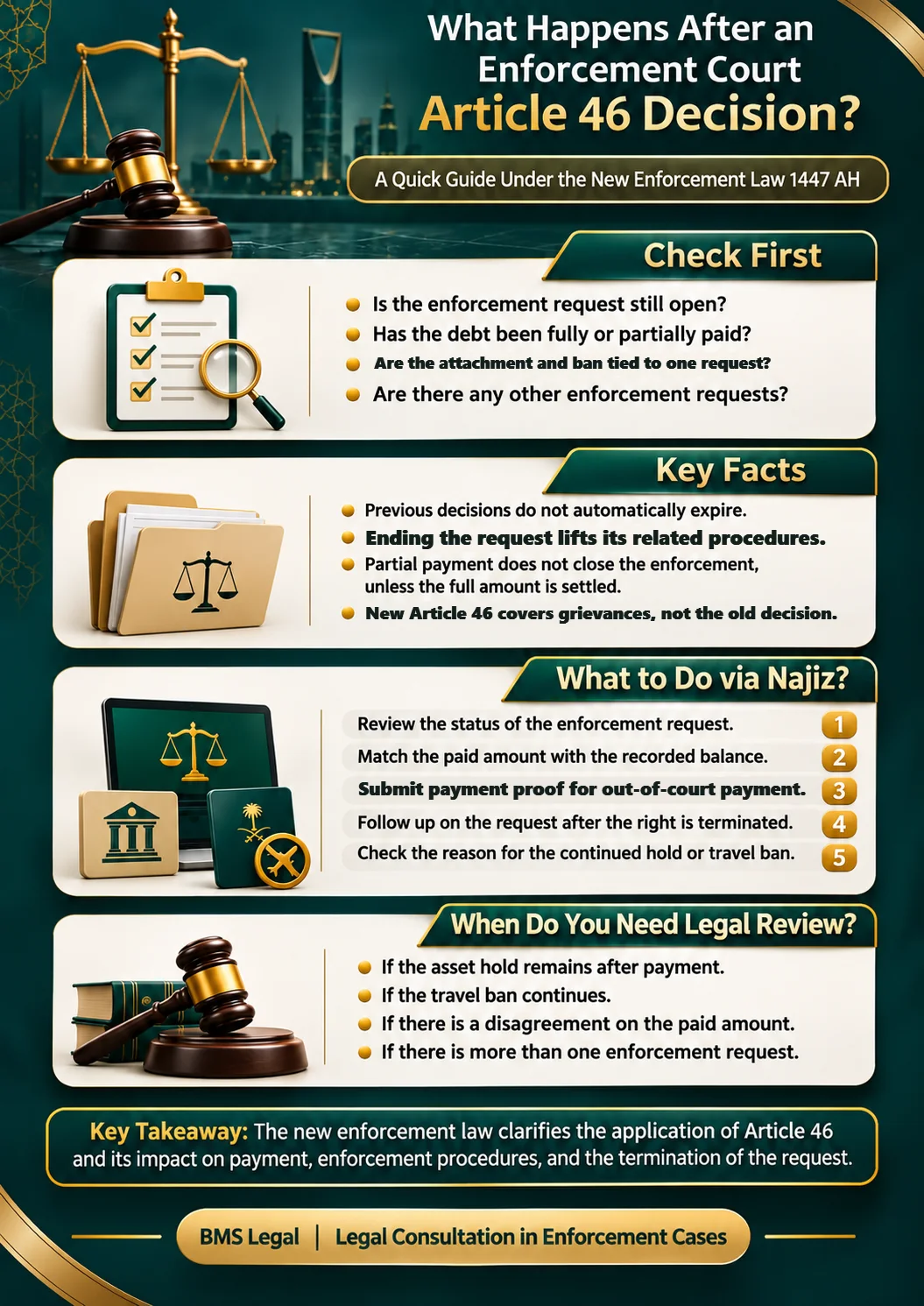
Article 46 Decision Saudi Arabia: What to Do Depending on Your Request Status
When searching for what happens after an Enforcement Court Article 46 decision, start by identifying the current status of the enforcement request, not just the date the old decision was issued. An open request differs from a closed one, and the steps differ for full payment, partial payment, or a continuing attachment and travel ban.
| File status | What to check | First step |
|---|---|---|
| Article 46 decision shows and the request is still open | Remaining amount and the decisions actually in force | Follow the request and determine the effect of each procedure |
| You paid the debt in full outside court | Proof of payment and payment date | Request proof of settlement and follow up on ending the request |
| The request ended but the attachment still shows | Is the attachment tied to the ended request or to another request? | Check why the attachment continues and follow up on lifting the ended request’s effects |
| Travel ban still shows after the request ended | Source of the ban order and the related request | Check whether the order has ended or has an independent basis |
| You paid part of the debt | Remaining balance and amounts previously collected | Document payments and assess the scope of the procedures |
| There is a settlement or payment schedule | Were the terms of the agreement performed? | Determine the agreement’s effect on the request without assuming it ended automatically |
This is an indicative table to help choose a first step; it does not decide the validity of a decision or the extinction of a debt without reviewing the documents.
What was an Enforcement Court Article 46 decision under the previous law?
The Article 46 decision Saudi Arabia debtors still see in Najiz refers to a decision issued under the previous enforcement law. “Article 46 decision” was a common term for the procedures ordered by the enforcement judge under Article 46 of the Enforcement Law issued by Royal Decree M/53 of 1433 AH, where the debtor did not pay or did not disclose assets sufficient to satisfy the debt within the prescribed period after being served with, or publicly notified of, the enforcement order under the rules then in force.
The procedures regulated by that article included a travel ban, disclosure of assets, attachment of and execution against them, and notification of credit information, distinguishing between procedures prescribed once conditions are met and additional measures subject to separate controls. An “Article 46 decision” did not automatically mean that all of these measures were issued or that imprisonment was carried out against every debtor.
What was the difference between the Article 34 and Article 46 decisions under the previous law?
Article 34 of the previous law concerned the enforcement order and its service, whereas Article 46 dealt with later procedures where the debtor failed to pay or disclose within the statutory period. Both numbers may therefore appear in the same request record, but each served a different function.
New requests filed after 29 October 2026 follow the article numbering of the current law: financial compulsory enforcement procedures are regulated by Article 18, and the conditions for a travel ban by Article 19. Details are covered in the guide to the new Enforcement Law in Saudi Arabia and the Najiz notice without repeating it here.
Did the new Enforcement Law cancel the old Article 46 decision?
Whether an Article 46 decision Saudi Arabia enforcement file survives the new law depends on the status of the request and the procedures tied to it. To answer what happens after an Enforcement Court Article 46 decision once the 1447 AH law took effect, distinguish between the validity of the old decision and the continuation of its effects.
Clause two of Royal Decree M/237 provides that earlier judgments, orders and decisions are valid under the rules in force when they were issued. But the continued validity of a decision does not necessarily mean that all its procedures remain after the enforcement request ends or the reason for the procedure disappears.
Do the new rules apply to every old file?
An old file requires review of the decision date, the procedure under way and the type of dispute. The Decree preserved the validity of earlier decisions, excluded from the new law’s application enforcement disputes in which final judgments were issued before it took effect, and temporarily retained some provisions on precautionary attachment and civil insolvency until replacement regulation is issued. It is therefore incorrect to say that every old file was cancelled, or that every earlier procedure automatically falls under all the provisions of the new law without regard to the transitional provisions.
Do the attachment or travel ban continue after an old Article 46 decision?
In an Article 46 decision Saudi Arabia case, an attachment or travel ban is tied to the enforcement request, not to the decision label alone.
Continued attachment on accounts or funds
An attachment may remain in force if the enforcement request is continuing and the reason for the attachment has not ended, or if the funds relate to another enforcement request. The appearance of an Article 46 decision in the record does not alone prove that all accounts are still attached.
Hypothetical example: an Article 46 decision was issued for a debt of SAR 100,000, and payment of SAR 70,000 was then proven. Review whether the payments were recorded in the enforcement file, what remains of the claim, and the scope of the attachment; do not assume that all attachments are lifted because of partial payment, or that enforcement continues on the full debt without deducting what was paid.
Continued travel ban
A travel ban was among the measures covered by the previous law, but whether a particular order continues depends on its source, its date and later decisions concerning it. Under the new law, Article 19 provides that a travel ban order issued under it lapses when the enforcement request ends, and regulates the conditions for issuing and lifting it. The existence of a current travel ban cannot be assumed from the phrase “Article 46 decision” alone. If one enforcement request has ended, other independent orders may exist that call for separate review before travelling.
Does an Article 46 decision include suspension of government services?
The old decision should not be read as an automatic suspension of all government services. The provisions on suspending government services were amended under the previous law, and attachment of funds, travel bans and credit data are different measures, each with its own source and effect. If you face a restriction, identify the entity that issued it and the decision behind it, and do not file a general request to lift “all services” before you know the actual procedure.
When do the effects of an Article 46 decision end after the debt is paid?
After an Article 46 decision Saudi Arabia debtors usually ask when the effects end; that depends on payment and on the end of the request. When asking what happens after an Enforcement Court Article 46 decision once the debt is paid, the first step is to verify that payment is complete and check the status of the enforcement request.
Article 42 of the new Enforcement Law in Saudi Arabia requires the enforcement applicant to end the request after the right is satisfied. Article 46 of the Implementing Regulations clarifies that the request ends as soon as the right is satisfied through enforcement procedures; if the applicant is paid outside those procedures, they must end the request within one working day of the date of payment. Partial payment alone does not end the enforcement request automatically.
Are attachments and orders lifted as soon as the request ends?
Article 47 of the Implementing Regulations of the new Enforcement Law provides for lifting all enforcement procedures and orders tied to the enforcement request as soon as it ends, without a separate application. This effect is tied to the request ending under the law, not merely to the new Enforcement Law taking effect. If an attachment or travel ban still appears after the request ended, check whether the procedure is tied to the ended request, to another enforcement request, or to an independent order.
Does the end of an enforcement request mean the debt is extinguished?
Not always. Article 43 lists several cases in which an enforcement request ends, including satisfaction of the right, proof that there are no assets, impossibility of enforcement, agreement of the parties, and release. It also allows the enforcement request to be resumed in some cases it specifies if there is a justification.
The Regulations clarify that a request ending after all procedures have been taken and the period in Article 43/1/c has passed occurs only one year after the last enforcement procedure, with the other conditions met. A status of “ended” therefore does not mean the debtor paid in full, nor that the creditor lost the right in all cases.
I paid but the attachment remains: what should I do through Najiz?
If an Article 46 decision Saudi Arabia record still shows a restriction after payment, check the status of the request first. Follow these five steps before choosing an electronic request or a court dispute:
- Check the enforcement file: use the Ministry of Justice enforcement request verification service or the services available to your Najiz account, and review the request number, its status, the decisions and the financial movements.
- Identify the decision and its date: confirm whether the Article 46 decision is an old one, what attachment or ban order was actually issued, and whether it has since been cancelled or amended.
- Match your proof of payment: gather transfer receipts, settlements and account statements; distinguish partial from full payment, and payment within enforcement procedures from payment outside them.
- Review why the restriction continues: check that the request itself has ended and that the attachment or ban is tied to it, and consider the possibility of another enforcement request or order.
- Choose the right procedure: if you paid outside court, review the proof of payment service under its conditions; and if the creditor has been paid, review the enforcement request termination service according to the applicant’s capacity and status.
Note on the “request to issue an Article 46 lifting decision”: the Ministry of Justice has an old guidance manual under this name, but do not assume the service name or its steps still apply today. Rely on the service actually offered in Najiz at the time you file, and do not use the historical route just because it appears in an old article.
Practical example: debt paid in 2026 but an attachment issued in 2025 remains
Suppose an Article 46 decision was issued in September 2025, then the debtor paid the full right outside court in November 2026 and the enforcement request ended, but the attachment on one account still shows. The first step is to verify that the attachment is tied to the ended request and that satisfaction is proven.
If it is tied to that request alone, Article 47 of the Regulations provides for lifting the procedures that depend on it. If another request exists on the same funds, its effect must be examined separately. The point of review is therefore why the attachment continues, not challenging the historical decision without justification.
What happens after an Article 46 decision if you are the enforcement applicant?
An Article 46 decision under the previous law does not mean the creditor was paid. The enforcement applicant should therefore determine what has been collected, what remains, the attachments in force and the settlements actually performed. If the applicant has been paid in full outside enforcement procedures, they must end the request within one working day under Article 46 of the Regulations.
If the request ended for a reason that does not extinguish the underlying right, review Article 43 and whether enforcement may be resumed where a new justification arises. An unpaid commercial claim may require review of the instrument and how to collect on it; you can benefit from the debt collection service in Jeddah to assess the suitable documents and procedures.
Is the new Article 46 the same as the old Article 46 decision?
No. The decision commonly called “Article 46” derives from Article 46 of the previous Enforcement Law, whereas Article 46 of the new Enforcement Law regulates grievances against specified enforcement orders and decisions. If the dispute concerns a new procedure that may be challenged by grievance, the route and the deadline are governed by the law and regulations in force, not by the sequence of the old decision.
A separate explanation is in the article Article 46 of the New Enforcement Law: When and How to File a Grievance. An enforcement dispute concerning the validity of the instrument, the conditions for its enforcement or the court’s jurisdiction is governed by Article 45. Under Article 47, a dispute or grievance does not automatically stay enforcement procedures unless a decision is issued by someone with authority to stay them.
FAQ about the old Article 46 decision
Is the old Article 46 decision still valid after the new Enforcement Law?
Yes. Royal Decree M/237 provides that judgments, orders and decisions issued before the law took effect are valid under the rules in force when they were issued. That does not prevent the request from ending, or a related procedure from being lifted later, under the new law.
Does partial payment lift the Article 46 decision and the attachment on accounts?
No. Partial payment alone does not end the enforcement request or lift all attachments. You must prove the amount paid and review the remaining balance, the scope of the attachment and any related requests.
If the enforcement request status shows "ended", has the debt been extinguished?
Not necessarily. A request may end because no assets were found or enforcement proved impossible under the statutory conditions, without the underlying debt being extinguished. Full payment or release has a different effect, so review the reason the request ended.
Does a travel ban end when the enforcement request ends?
Under the new law, Article 19 provides that a travel ban order issued under it ends when the enforcement request ends. For an old order, check its source, its date and later decisions, and make sure no separate request or order exists.
Does the "request to issue an Article 46 lifting decision" service still exist in Najiz?
That name appeared in old Ministry of Justice guidance manuals, and you should not assume the service route or name still applies after the new law took effect. Refer to the services actually shown in your Najiz account and first identify the request status and the procedure in force.
Conclusion
The answer to what happens after an Enforcement Court Article 46 decision starts with distinguishing between the validity of a decision issued under the previous law and the continuation of its effects today. The new Enforcement Law does not automatically void old decisions, but the ending of an enforcement request has important consequences for lifting the attachments and orders tied to it.
So review the request status, the amounts paid, the decisions in force and the possibility of other requests before taking any step. Where decisions overlap or proof of payment differs, a legal review of the documents helps determine the right path without assuming an outcome in advance.
Content reliability and sources
Publisher: BMS Legal Law and Legal Consultancy Company, Jeddah.
Legal basis: the 1433 AH Enforcement Law as a historical reference, Royal Decree M/237, and the 1447 AH Enforcement Law and its Implementing Regulations.
Date of text verification: 19 November 2026.
This information is for general legal awareness and does not replace review of the enforcement decision, its date, the payment documents and the orders issued in each case.