
Article 74 of Saudi Labor Law sets out the main circumstances in which an employment contract may come to an end, including mutual agreement, expiry of a fixed term, resignation, force majeure, permanent closure of the establishment, and termination of the activity in which the employee works. The legal effect does not depend only on the reason stated in the termination decision. The contract type, renewal terms, notice requirements, and outstanding employment entitlements must also be considered.
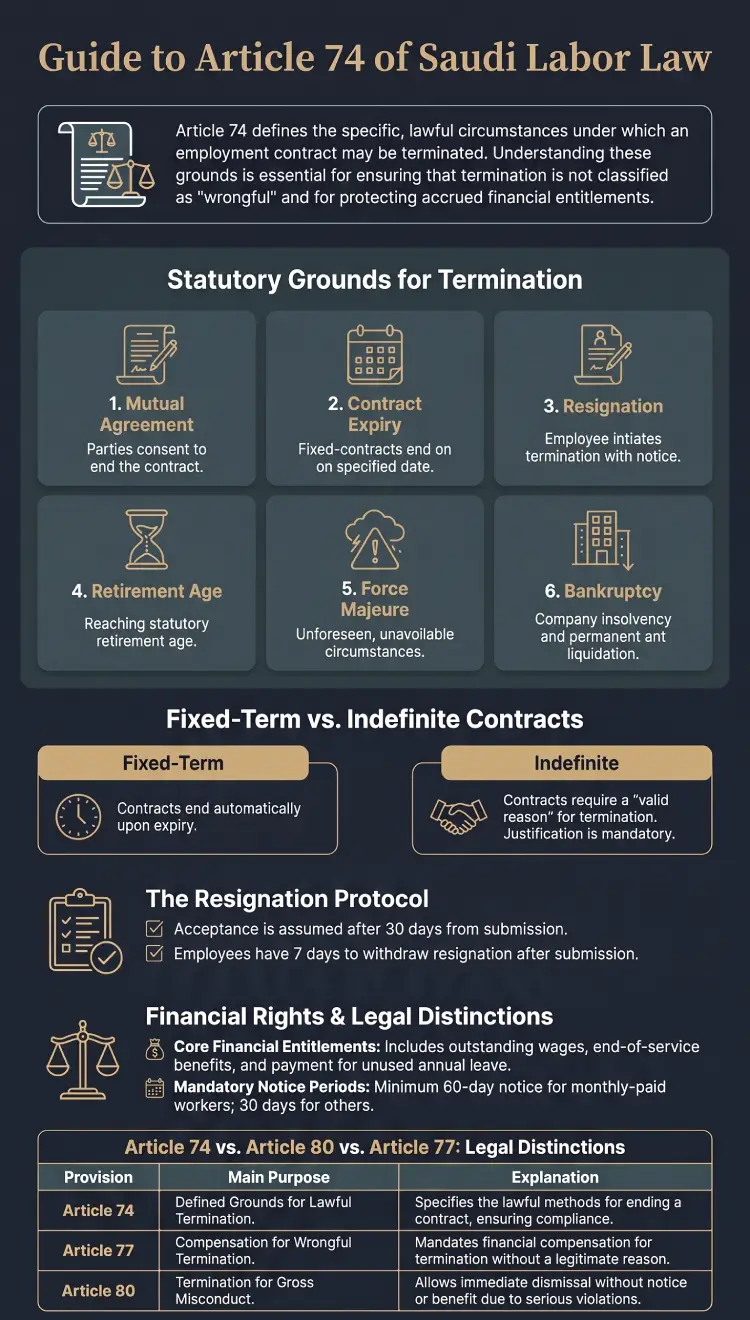
Quick answer: Article 74 covers ten circumstances in which employment may end in Saudi Arabia, including written mutual agreement, expiry of the contract term, termination of an indefinite-term contract, resignation, retirement, force majeure, permanent closure, termination of an activity, certain bankruptcy proceedings, and any other case provided for under another law. Each case has its own requirements and legal consequences.
What Does Article 74 of Saudi Labor Law Provide?
Article 74 addresses specific circumstances in which an employment relationship may end based on the nature of the contract and the reason for termination. It should not be read separately from the wider Saudi Labor Law framework. Fixed-term contracts are affected by the rules on renewal, indefinite-term contracts are connected to Article 75, resignation is further regulated by Article 79 bis, and Article 77 deals with compensation where employment is terminated for an illegitimate reason.
The main cases covered by Article 74 can be summarized as follows:
| How Employment Ends | Key Point to Check |
|---|---|
| Mutual agreement | The employee’s written consent |
| Expiry of the contract term | Whether the contract has been renewed |
| Indefinite-term contract | Compliance with Article 75 |
| Resignation | Application of Article 79 bis |
| Retirement | Applicable rules under the Social Insurance Law |
| Force majeure | Whether the event actually prevents continuation |
| Permanent closure | The closure must be final |
| Termination of an activity | The activity in which the employee works |
| Bankruptcy proceedings | Final decision or judgment from the competent court |
| Another statutory case | A legal provision establishing that ground |
What Are the Main Changes to Article 74?
The current version expressly includes resignation among the grounds for ending employment and also covers a final court decision or judgment terminating an employee’s contract in qualifying bankruptcy proceedings under the official Saudi Labor Law text.
For that reason, an up-to-date explanation of Saudi Labor Law Article 74 should reflect the amended provision rather than relying on commentary published before these changes.
How Does Employment End by Mutual Agreement or Expiry of the Contract?
Employment may end either because both parties agree to terminate the relationship or because a fixed-term contract reaches its expiry date. These are legally distinct situations, and each has different requirements.
Termination by Mutual Agreement
An employee and employer may agree to end the employment contract, provided that the employee’s consent is in writing.
Accordingly, describing a document as a “mutual termination agreement” does not by itself determine its legal effect. Its contents and whether the employee actually agreed to the termination should also be considered.
A mutual termination agreement should also be distinguished from a final settlement or release. The first concerns ending the employment relationship, while the second generally concerns the settlement of financial rights and amounts due.
Expiry of a Fixed-Term Contract
A fixed-term employment contract generally ends when its agreed term expires unless it has been renewed in accordance with the Saudi Labor Law.
Determining when a contract actually ends therefore requires reviewing its original term, renewal clause, previous renewals, and whether the parties continued performing the contract after the stated expiry date.
Article 55 regulates continuation and renewal of employment contracts, including circumstances in which a fixed-term contract may become indefinite in duration under the Saudi Labor Law rules on contract renewal.
Does Non-Renewal of an Employment Contract Fall Under Article 74?
Yes. Expiry of a fixed-term contract is one of the circumstances covered by Article 74, provided that the contract has not already been renewed under the Law.
However, non-renewal of an employment contract in Saudi Arabia should not be assessed from the non-renewal notice alone. A contractual renewal clause or continued performance after the expiry date may affect the legal status of the contract.
Where a dispute concerns non-renewal, the main points to review include:
- The contract start and expiry dates.
- Renewal and non-renewal clauses.
- Previous renewals.
- Whether employment continued after the stated expiry date.
- The date and wording of the non-renewal notice.
Is Non-Renewal Considered Unlawful Dismissal?
A fixed-term contract that reaches its agreed expiry date will generally end because its term has expired. It does not become an unlawful termination merely because one party does not wish to renew it.
The position may be different if the employment is terminated while a valid contract is still in force, if the contract has already been renewed, or if it has become an indefinite-term contract. The applicable legal provision must therefore be identified before determining whether compensation may arise.
How Are Indefinite-Term Employment Contracts Terminated?
Article 74 refers termination of an indefinite-term contract to Article 75 of the Saudi Labor Law. Article 75 requires a legitimate reason and written notice within the applicable statutory period.
Where an employee is paid monthly and initiates the termination, the employer must receive at least 30 days’st 60 written notice. Where the employer initiates termination, the employee must receive at lea days’ written notice. If the employee is not paid monthly, the notice period for the terminating party is at least 30 days.
Where the dispute concerns compensation for termination without a legitimate reason, the compensation rules under Article 77 of Saudi Labor Law help determine the applicable basis according to the type and terms of the employment contract.
How Does Article 74 Apply to Resignation?
Resignation is now expressly listed as a ground for ending employment under Article 74 of Saudi Labor Law, while Article 79 bis governs the resignation request and its legal effect.
A resignation request is deemed accepted if 30 days pass without a response from the employer. The employer may postpone acceptance for up to 60 days where the statutory conditions are met, while the employee may withdraw the request within seven days unless it has already been accepted, as provided by the Saudi Labor Law rules on resignation.
The employee may also withdraw the resignation request within seven days of submission unless the employer has already accepted it before the withdrawal.
Ending employment by resignation does not automatically eliminate the employee’s statutory rights. However, the manner in which employment ends may affect the amount of the end-of-service benefit. Articles 84 to 87 regulate the basic calculation, the effect of resignation, and the relevant exceptions.
When Does Employment End Because of Force Majeure or Closure?
Article 74 distinguishes between force majeure, permanent closure of the establishment, and termination of the activity in which the employee works. These should not be treated as a single ground because each depends on different facts.
Force majeure is expressly recognized as a ground for ending the employment contract. Whether a particular event qualifies must be assessed by considering the nature of the event and its actual effect on the continuation of employment.
For closure of an establishment, the statutory language refers to permanent closure. Closing one branch, office, or location while the establishment continues operating elsewhere is therefore different from permanently closing the establishment itself.
Where a particular activity is terminated, Article 74 refers to the activity in which the employee works, unless the parties have agreed otherwise. The relevant questions include which activity actually ended, the work performed by the employee, and whether the contractual arrangements affect the position.
Article 74 also covers a final decision or judgment from the competent court terminating an employee’s contract in bankruptcy proceedings opened under the Bankruptcy Law.
What Rights Does an Employee Have After Employment Ends Under Article 74?
Employment ending under a ground addressed by Article 74 does not by itself eliminate financial rights that accrued during the employment relationship. Each entitlement should be assessed separately under the provision that governs it.
The main rights that may need to be reviewed include:
| Right | What Determines the Entitlement? |
|---|---|
| Outstanding wages | Amounts due up to the end of employment |
| End-of-service benefit | Length of service, wage, and manner of termination |
| Accrued annual leave | Unused leave entitlement |
| Service certificate | End of employment and employee request |
| Final settlement | Termination date and which party ended the contract |
The end-of-service benefit calculation under Article 84 of Saudi Labor Law depends primarily on the employee’s length of service, final wage, and the way in which the employment relationship ended.
Final employment entitlements must generally be settled within no more than one week after the employment relationship ends. Where the employee is the party who terminates the contract, the settlement period may extend to no more than two weeks.
At the employee’s request, the employer must also provide a service certificate and return any documents previously deposited by the employee.
Disputes may arise over the calculation of the end-of-service benefit, notice compensation, unused leave, or compensation relating to termination. In such cases, a labor lawyer in Jeddah can review the termination reason, employment contract, and disputed entitlements before the appropriate legal route is identified.
What Is the Difference Between Articles 74, 77, and 80?
These provisions are frequently considered together when employment ends, but they perform different legal functions.
Article 74 sets out circumstances in which an employment contract may come to an end. Article 77, by contrast, addresses compensation where a contract is terminated for an illegitimate reason and the contract does not specify compensation for that situation.
Those provisions are also different from termination under Article 80 of Saudi Labor Law, which identifies specific circumstances in which an employer may terminate the employment contract without an end-of-service benefit, notice, or compensation, provided that the statutory requirements are satisfied.
The article number written in a termination decision is therefore not enough to determine the legal outcome. The actual facts must correspond to the requirements of the provision relied upon.
What Documents Matter in an Article 74 Dispute?
Documents can help determine whether the employment relationship ended for the reason stated by the employer or employee, particularly where the dispute concerns renewal, notice, or the legal characterization of the termination.
The review should begin with the employment contract and its amendments, the termination or non-renewal notice, renewal notices, correspondence showing when notice was communicated, wage records, and any document connected to the stated reason for termination, such as a decision relating to closure of an activity.
If the documents or underlying facts do not clearly correspond with the stated ground for termination, the contract, notices, previous renewals, and financial records should be reviewed before a final release is signed or a claim is commenced. A Jeddah law firm such as BMS Legal can review these elements and identify the legal issues that may affect the position.
Frequently Asked Questions About Article 74 of Saudi Labor Law
What is Article 74 of Saudi Labor Law?
Article 74 lists several circumstances in which an employment contract may end, including expiry, resignation, mutual agreement, force majeure, permanent closure, and termination of an activity.
Does Article 74 always mean the termination is lawful?
No. The actual facts must match the statutory ground relied upon, and related requirements under other Labor Law provisions may also apply.
Is an employee entitled to compensation under Article 74?
Article 74 itself does not create a general compensation right. Compensation for termination without a legitimate reason is mainly addressed under Article 77.
Does an employee receive an end-of-service benefit after termination?
It depends on the reason for termination, length of service, and the rules governing end-of-service benefits under the Saudi Labor Law.
What is the difference between Article 74 and Article 80?
Article 74 covers general grounds for ending employment, while Article 80 covers specific cases where an employer may terminate without notice, compensation, or end-of-service benefit if its statutory conditions are met.
Article 74 of Saudi Labor Law: 10 Ways Employment Ends is not simply a list of termination grounds. The correct legal outcome depends on the type and status of the employment contract, whether it has been renewed, compliance with notice requirements, and the financial rights that arise when the employment relationship ends.
Non-renewal, resignation, permanent closure, and other Article 74 circumstances do not necessarily produce the same legal consequences in every case. Likewise, the end of employment does not automatically extinguish an employee’s outstanding statutory entitlements.
Where the termination reason or the amount of outstanding entitlements is disputed, reviewing the employment contract, termination notice, renewal history, and wage records before signing a final settlement can help clarify the employee’s legal position.