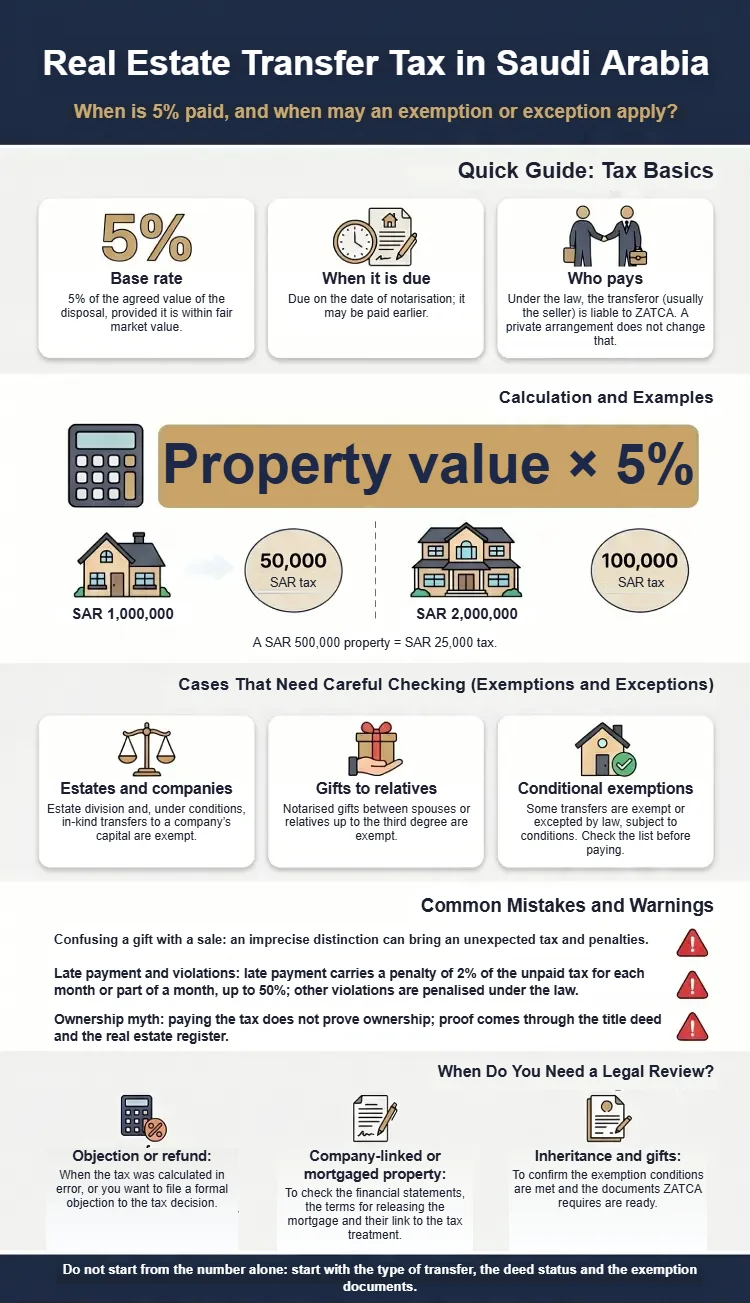
Property transfer tax in Saudi Arabia usually means the real estate transaction tax, a tax at 5% that is charged when a property is sold or its ownership or possession is transferred, where the disposition is subject to it. It falls due on the date of notarisation and may be paid earlier, and exemptions and exceptions need to be checked before you pay.
Knowing the rate is not enough when you sell land, an apartment, a villa or a commercial property. The result depends on the type of disposition, who the parties are, the value of the property and whether an exemption or a government-borne case applies. Look at the whole transaction: is it a sale, a gift, an inheritance, a transfer within a company, or a transfer linked to an earlier contract?
Selling or transferring a property?
Check the type of transfer, the value and any exemption before registering the tax. A BMS Legal lawyer in Jeddah can give your documents an initial review.
Enquiries are handled confidentially · No specific court outcome can be guaranteed
Property Transfer Tax in One Minute: When 5% Applies
If you are preparing to sell or transfer a property, this table summarises what you need to know before calculating or paying the tax. The rules and exemptions can change, so confirm the current position with the Zakat, Tax and Customs Authority (ZATCA).
| Question | Short answer |
|---|---|
| What is the rate? | 5% of the value of the taxable property disposition |
| When is it paid? | Before or during the property transfer or documentation of the contract |
| Who pays? | The transferor, usually the seller. An arrangement between the parties on who bears the cost does not change this towards ZATCA |
| Is every transfer taxable? | No. There are exemptions and exceptions with conditions |
| How is it calculated? | Value of the disposition × 5% |
| What is the tax on SAR 1 million? | SAR 50,000 if the disposition is taxable |
The matter does not end with calculating the tax. The conditions of the deed, the status of the parties and the transfer requirements are tied to the steps for transferring property ownership before a sale or documentation is completed, and a real estate transfer agreement template in Saudi Arabia shows how the undertakings may be organised.
What Is the Property Transfer Tax in Saudi Arabia?
It is the amount you need to watch for before selling or transferring a property, because it can change the final cost of the deal. Its formal name is the real estate transaction tax, and it generally applies when ownership or possession of a property passes from one person to another.
What matters is the substance of the operation, not just its name. It may be a direct sale, a gift that is not excepted, an exchange, or a contract that ends in a transfer of ownership. The type of disposition must be checked before paying, because some cases are taxable while others may benefit from an exemption or exception with conditions.
What Is the Rate of the Tax?
The rate is 5% of the value of the property disposition where the disposition is taxable. It applies to residential and commercial property, land and property units, unless an exemption, an exception or a case borne by the state applies, according to the conditions.
The table below gives quick examples at different values, where the disposition is taxable.
| Property value | Calculation | Tax due |
|---|---|---|
| SAR 500,000 | 500,000 × 5% | SAR 25,000 |
| SAR 1,000,000 | 1,000,000 × 5% | SAR 50,000 |
| SAR 2,000,000 | 2,000,000 × 5% | SAR 100,000 |
| SAR 5,000,000 | 5,000,000 × 5% | SAR 250,000 |
For residential property the base rate stays at 5% where the disposition is taxable, subject to the exemptions listed in the law. For non-Saudis, the question does not start with the tax. First confirm that ownership or the disposition is lawful, then decide whether the real estate transaction tax is due. Any separate rules on non-Saudi acquisitions sit outside the transaction tax law, so confirm them with REGA.
When Is the Tax Due?
The tax falls due when there is a property disposition that transfers ownership, possession or a taxable benefit. It does not depend on the name of the contract alone but on its real effect: a transaction may be called a gift and yet include a payment that makes it close to a sale.
Under the law it falls due on the date of notarisation and may be paid earlier. A notary may not notarise a taxable transaction whose tax is unpaid, and late payment carries a penalty of 2% of the unpaid tax for each month or part of a month, up to 50% of the tax, so it should not be left to the last stage. An error in the value of the property, the deed number, the status of the parties or the type of disposition may delay the transfer or require the application to be corrected.
An error in the deed number or the owner’s capacity can delay the transfer, so the safe route starts with checking ownership of the property before calculating the tax or registering the disposition.
The transfer normally cannot be completed if the disposition is taxable and the tax has not been paid or an exception proved. The most sensitive cases are the transfer of an inherited property, a gift between relatives, a sale between companies, or a property subject to a mortgage or a dispute.
How Is the Tax Calculated?
The calculation starts with a simple equation: value of the property disposition × 5% = tax. The difficulty is not the equation but identifying the right value and the type of disposition, and whether an exemption or a government-borne case applies.
A calculator can give an approximate figure, but it does not settle the legal treatment of the case. If the property is inherited, gifted or moved within a company, the legal description of the disposition matters more than the arithmetic.
The examples below show the calculation, with the final liability still depending on the nature of the disposition and its documents.
| Case | Calculation | Tax if taxable |
|---|---|---|
| Land worth SAR 800,000 | 800,000 × 5% | SAR 40,000 |
| Apartment worth SAR 1,000,000 | 1,000,000 × 5% | SAR 50,000 |
| Villa worth SAR 1,300,000 | 1,300,000 × 5% | SAR 65,000 |
| Commercial property worth SAR 5,000,000 | 5,000,000 × 5% | SAR 250,000 |
The tax is calculated on the value of the disposition, taking into account the fair market value at the time. Writing a value that is not real in order to lower the tax can create tax and contractual risks, and lead to a later claim or adjustment.
Who Pays the Property Transfer Tax?
Under the law the transferor, usually the seller, is liable to pay the tax to ZATCA. The transferee is jointly liable only where ZATCA shows that it caused the non-payment. The parties may agree in the contract who bears the cost, but that agreement does not change the position of the tax authority. What matters is that the contract says clearly who pays, when and in what amount, so the tax does not become a dispute after the deal.
If the contract says nothing, expect the question to arise at the transfer stage, when the payment reference is needed. If the buyer agrees to bear the tax, the price and the payment schedule should say so in plain words.
| Situation | What to write in the contract |
|---|---|
| Seller bears the tax | The seller pays the tax before the transfer and hands over the payment reference |
| Buyer bears the tax | The buyer pays the tax and the price is stated with that in mind |
| Shared between the parties | Each party’s share and the payment date are written down |
Exemptions and Exceptions: What Needs Checking
Not every property transfer is taxed. Some dispositions are exempt or excepted, but the conditions are strict and a missing document can turn an expected exemption into a tax liability. Treat the list below as a set of cases to check, not as a promise that any of them applies to you.
| Case | What to check |
|---|---|
| Transfer under a notarised will | Whether the transfer implements a will that has been notarised |
| Distribution of an estate according to shares | Whether the transfer follows the legal shares exactly, supported by the inheritance deed |
| Gifts between relatives | Whether the gift is notarised and the relationship is within the degree the law allows |
| Transfer without consideration | Whether any payment or benefit changes the description of the transfer |
| Transfer to a company or fund | Whether the conditions for that type of transfer are met |
| Cancellation of a sale | Whether the tax was already paid and whether it can be reclaimed |
| Government or forced dispositions | Whether the disposition is of a type that is treated differently |
For inherited property, the starting point is a valid deed and a clear picture of who inherits what. The article on the Najiz electronic inheritance deed explains how the deed is obtained, and how to divide inheritance explains the division itself.
Gift or Sale: Why the Description Matters
A gift between relatives can fall outside the tax if the controls are met, while a sale is taxed on its value. Problems begin when a transaction is described as a gift but money changes hands, or when the stated value is far below the real value.
A low declared value may look like a saving, but it creates risk. The authority can question the value, the parties can fall out over what was really agreed, and a later buyer or lender may ask why the recorded value does not match the market. If the real arrangement is a sale, describe it as a sale and state the true value.
Steps to Register and Pay the Tax
The process is short, but it needs to be done in the right order. The outline below follows the Arabic official sources used for this guide. The current screens and service names may change, so follow the ZATCA and Ministry of Justice instructions at the time you act.
- Prepare the documents. Gather the deed, the identity details of both parties and the contract or the description of the disposition.
- Register the disposition. Enter the disposition details with the authority so that the tax can be assessed.
- Obtain the payment number. The system gives a reference for the amount due.
- Pay the tax. Payment is made through the channels the authority provides.
- Use the reference at the transfer. Give the payment reference or the proof of exemption when the transfer is completed.
If the details entered are wrong, correct them before paying. Fixing the value, the property or the parties after payment is slower than checking them first.
Refunds and Objections
A refund or objection may be possible in some cases, for example where the tax was paid by mistake, where the sale was cancelled, or where the disposition turned out to be exempt. Each case has its own conditions and time limits, so keep the payment receipt, the contract and the cancellation papers together.
Do not assume that cancelling a contract automatically returns the tax. Ask the authority what proof it requires and apply as soon as the reason arises.
A Contract Clause on the Tax
A clear clause avoids an argument at the last stage. The wording below is a starting point only and should be adapted to the deal.
The Seller shall bear the real estate transaction tax due on this disposition, if any, and shall pay it before the transfer is completed. The Seller shall give the Buyer the payment reference or proof of exemption on or before the date set for the transfer. If the tax is later found to be higher than the amount paid, the party bearing the tax under this clause shall pay the difference.
If the buyer is to bear the tax, replace the first sentence and state whether the price includes it. For a complex deal, have the clause reviewed before signing, and compare it with the terms in the real estate sale agreement template.
Common Mistakes When Paying the Tax
| Mistake | Why it causes trouble |
|---|---|
| Assuming every transfer is exempt | The exemption needs conditions and documents, and the transfer can stop without them |
| Declaring a low value | It creates tax risk and can lead to an adjustment or a dispute later |
| Calling a sale a gift | If money changes hands, the real description of the transfer is a sale |
| Leaving the payer unclear | The seller and buyer argue about the amount at the last minute |
| Entering wrong deed or party details | The payment reference may not match the transfer and must be corrected |
| Cancelling a sale without proof | A refund request is weak without the cancellation papers and the receipt |
Does the Tax Apply to Non-Saudis?
The 5% rate is not limited to Saudi citizens, but for a non-Saudi buyer the first question is different: is the ownership lawful at all? Ownership by non-Saudis is governed by its own law and regulations, and the rules and zones have been updated recently. Do not assume that paying the transaction tax settles the question of eligibility.
The transaction tax law itself sets no separate rate or fee for non-Saudi buyers. Any additional charge under the ownership rules for non-Saudis sits outside that law, so confirm it with the General Authority for Real Estate (REGA) before you budget. The practical guides on types of real estate in Saudi Arabia and real estate lawsuits in Saudi Arabia help to frame what can go wrong when ownership is unclear.
Mortgaged and Disputed Property
If the property is mortgaged, the tax is only one of the costs. The release of the mortgage, the creditor’s consent and the order of payments all affect when the transfer can be completed. See selling a mortgaged property and the mortgage conditions before agreeing on a date. A property that is the subject of a dispute may not be transferable until the dispute is resolved, whatever the tax position.
When Is a Lawyer’s Review Necessary?
A review is worth the cost when the value is high, the transfer is between relatives, the property is inherited or mortgaged, a company is involved, or the buyer is not Saudi. It is also wise when the parties disagree on the value or on who pays.
A lawyer can check the description of the transaction, the exemption claim, the contract clause and the documents before the tax is registered. If you want this done before you sign, speak to a real estate lawyer in Jeddah.
Trust and Legal Basis
Trust and Legal Basis
Legal basis
This guide is based on the real estate transaction tax rules published by the Zakat, Tax and Customs Authority and the related law, as listed in the sources below, and is written for general legal awareness rather than as advice on a specific case. Rates, exemptions and procedures can change, so confirm the current position with the authority before acting.
Published by: BMS Legal Law and Legal Consultancy Company.
Address: Jeddah, Al-Mishrifah District, Palestine Street, Al-Safeer Tower
Frequently Asked Questions About Property Transfer Tax in Saudi Arabia
What is the property transfer tax rate in Saudi Arabia?
The real estate transaction tax is 5% of the value of the taxable property disposition. Confirm the current position with ZATCA before you pay.
Who pays the tax, the seller or the buyer?
In principle the person making the disposition is responsible, but the parties can agree in the contract who bears the cost. Write the agreement down clearly.
When must the tax be paid?
It is paid before or during the property transfer or documentation of the contract. The payment reference or proof of exemption is needed when the transfer is completed.
Is inherited property subject to the tax?
Distribution of an estate according to the legal shares may be treated differently, but the exemption depends on its conditions and the inheritance deed. Check before you assume it applies.
Can I avoid the tax by calling a sale a gift?
No. If money or a benefit changes hands, the real nature of the transfer is a sale. Misdescribing it creates tax and contract risk.
Can the tax be refunded if the sale is cancelled?
A refund may be possible in some cases, such as payment by mistake or cancellation, but each case has conditions and time limits. Keep the receipt and the cancellation papers.
Conclusion
The property transfer tax is simple to calculate and easy to get wrong. The rate is 5% where the disposition is taxable, but the real work is deciding what kind of transfer you have, whether an exemption applies, who pays and what proof you will need at the transfer.
Before you sign, write the payer and the value into the contract, keep your documents together, and check any exemption against the current rules rather than assuming it applies.
To have your sale or transfer documents reviewed before you pay the tax, contact BMS Legal in Jeddah for a preliminary review.
Before you register or pay the tax
Tell us whether the transfer is a sale, a gift or an inheritance, and send the deed and contract. A BMS Legal lawyer in Jeddah will point out the issues to settle before the transfer.
Enquiries are handled confidentially · No specific court outcome can be guaranteed
Official Legal and Government Sources
- Zakat, Tax and Customs Authority: real estate transaction tax (Arabic-language official website)
- Real Estate Transaction Tax Law, Royal Decree No. M/84 (1446H) (Arabic-language official PDF)
- Board of Experts at the Council of Ministers: real estate transaction tax law (Arabic-language official text)
Disclaimer: This article is for general legal awareness and is not advice on an individual case, and reading it does not create a lawyer–client relationship. The legal assessment varies with the facts, the documents and the rules that apply to each case.